DragonCon is upon us! For the first time since 2019, the full Dragon (almost – numbers are slightly limited again this year) is being awakened. And TORn staffers are there to share the fun.
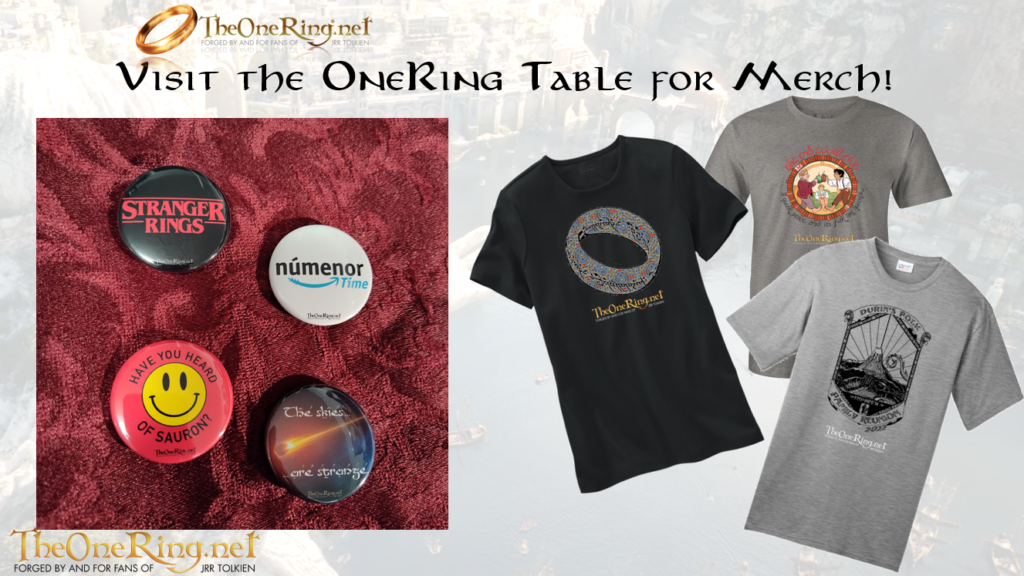
You can find staffers deej and greendragon at TORn’s ‘fan table’ (which we believe will be in our usual spot, in the Hyatt opposite the entrance to the Art Show) throughout the con. We’ll have new button and shirt designs on sale, and all kinds of fun things for fans to look at. You can also sign up at the table for the Evening at Bree costume contest! (Sign up is also available in the High Fantasy Track Room, Marriott L401-403).
Events of interest to Tolkien fans during DragonCon are as follows:
Thursday 1st 7pm TORn’s Rings of Power preview
A last chance to speculate what’s coming in Prime Video’s highly anticipated show, before it becomes available to watch at 9pm ET. Spoiler-free speculation! Marriott room A601-602
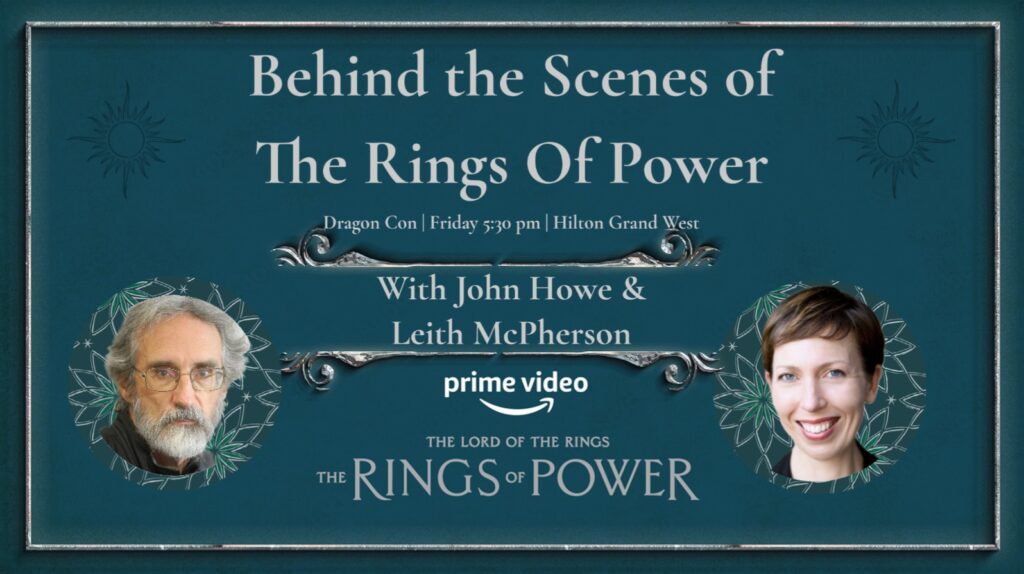
Friday 2nd 5.30pm Behind the Scenes of The Rings of Power
TORn staffer greendragon hosts a panel with very special guests artist John Howe and dialect coach Leith McPherson, talking about their work on The Lord of the Rings: The Rings of Power – and beyond. Hilton Grand West
Friday 2nd 8.30pm An Evening at Bree
TORn is delighted to join the High Fantasy track again to host a long standing DragonCon tradition. Party like a Hobbit! We have three live bands this year, to get toes (hairy and otherwise) tapping – The Brobdingnagian Bards, Beth Patterson, and Landloch’d. We’ll also have the Elf Choir, and of course the costume contest. If you’d like to enter, please sign up in advance of the evening, at the TORn fan table or the High Fantasy track room. Our panel of judges this year will be cosplayer Joshua Duart, together with very special guests John Howe and Leith McPherson.
Saturday 3rd 1pm War of the Rohirrim
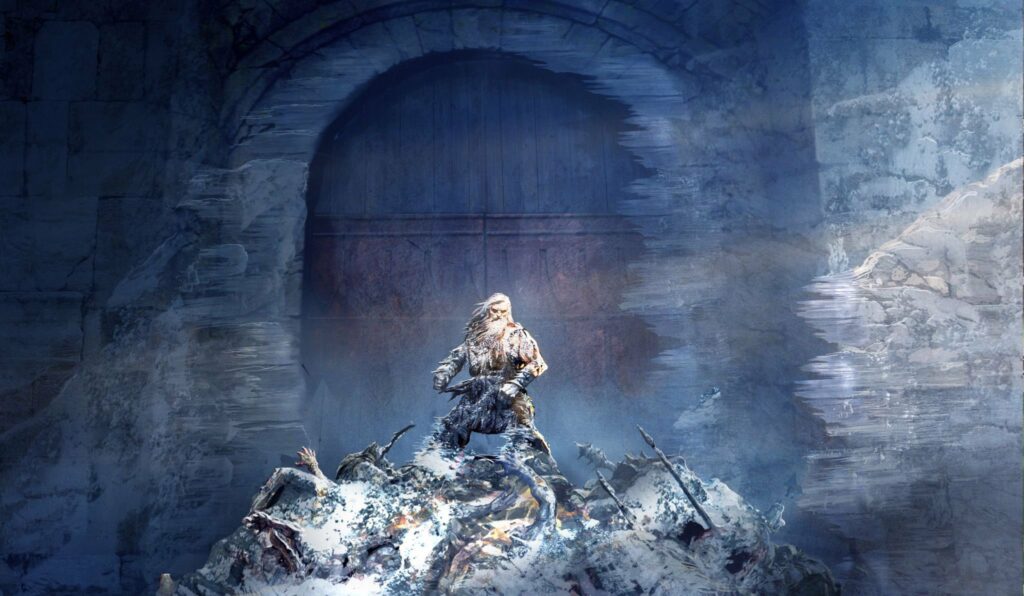
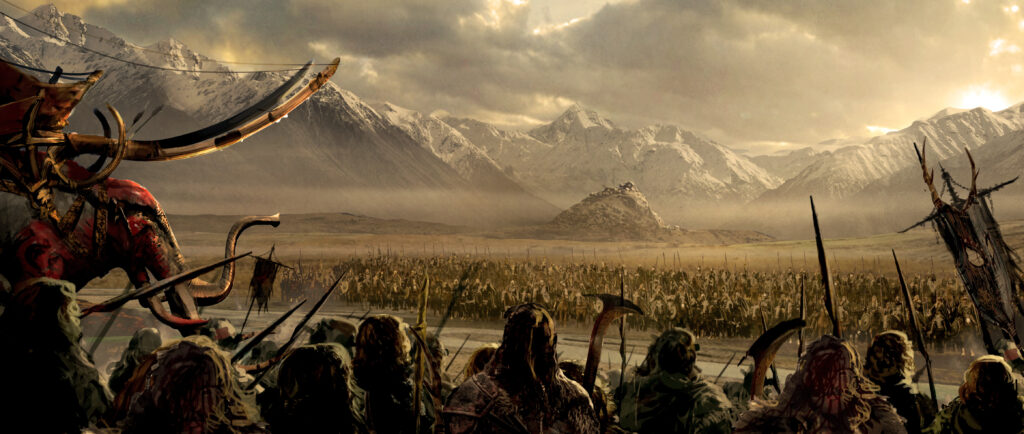
Find out more about this exciting anime film, telling the tale of Helm Hammerhand – coming April 2024. Marriott room L401-403
Monday 5th 10am Rings of Power After Hour
Discuss and reflect on the first two episodes, and what may or may not be to come this season and beyond!
Let the games begin! Please come and say hi if you’re in Atlanta; see you in the belly of the beast!
Here’s a somewhat overlooked piece of news from a little while back! On June 15, voice actor Alex Jordan announced that he had a part in the Warner Bros Animation/New Line Cinema feature The Lord of the Rings: The War of the Rohirrim.
I’m excited to announce that I’ll be voicing the character of Lord Frygt in The Lord of the Rings: The War of the Rohirrim. In theaters April 12, 2024. #WarOfTheRohirrimpic.twitter.com/L8hJJjbgG9
— Alex Jordan (home recording studio) (@AEJORDAN) June 15, 2022
However, it seems that his name was inadvertently omitted from the orginal English voice cast list given to Deadline at the same time. As a result, knowledge of Jordan’s involvement pretty much slipped under the radar.
More interestingly, Jordan has provided the name of the character he will be voicing — an completely original character by the name of Lord Frygt.
Seemingly a strange name, but Scandanavian friends on TORn’s IRC channel tell me that Frygt is a Danish word that means “fear”. One could interpret it as Lord Fear or Lord Fright.
At first I wondered, if the use of Danish could be related to the use of Anglo-Saxon to name the other original character we’ve heard of so far — Helm’s daughter, Héra.
Is it meant to be a Dunlending word? Unfortunately, the only Dunlending word we know of is “forgoil”. It seems to impossible to judge by extrapolating our knowledge of Tolkien. But Dunlending is supposedly related to the language of the Haladin, so it seems more likely it might be Rohirric? I’m no language expert so if anyone knows better, let me know!
A name like Lord Fear seems a little ominous as a name for someone of the Rohirrim. Could it be a Dunlending person instead? That seems a little unlikely since the leaders of the Dunlending faction are the Rohirrim lords (and outlaws), Freca and Wulf.
Instead, perhaps it’s meant to be an appellation give by either the Rohirrim or the Dunlendings to something else. Because I’m reminded of something that Philippa Boyens said when I interviewed her in June just after the casting announcement:
I can give you a little tease and let you know that, although we said this isn’t about The Ring and this isn’t about the Dark Lord … there are the White Mountains and there are creatures [out there]. We know that there were orcs around this area.
She also confirmed that these creatures she’s referring to are definitely not the dead men of Erech.
I think Lord Frygt will emerge as some non-human being feared by either the Dunlendings, or by the Rohirrim. Or both.
The War of the Rohirrim will be released in theatres worldwide on April 12, 2024.
About the author:Staffer Demosthenes has been involved with TheOneRing.net since 2001, serving first as an Associate News Editor, then as Chief News Editor during the making of the Hobbit films. Now he focuses on features and analysis. The opinions in this article are his own and do not necessarily represent those of TheOneRing.net and other staff.
It appears that some, uh, overly enterprising leakers thought they could make a quick buck by posting the full OST of The Lord of the Rings: The Rings of Power to YouTube.
It was quickly caught and deleted. But, in the meantime, we were able discover a little over half of the track titles — and they provide interesting hints of what’s soon to come. Of the 37 tracks on the OST, the title theme is composed by Howard Shore, while the other 36 are by Bear McCreary.
Below are the titles of the first 19:
01. The Lord of the Rings: The Rings of Power Main Title
02. Galadriel
03. Khazad-dûm
04. Nori Brandyfoot
05. The Stranger
06. Númenor
07. Sauron
08. Valinor
09. In the Beginning
10. Elrond Half-elven
11. Durin IV
12. Harfoot Life
13. Bronwyn and Arondir
14. Halbrand
15. The Boat
16. Sundering Seas
17. Nobody Goes Off Trail
18. Elendil and Isildur
19. White Leaves
We can also now add the remaining track titles
20. The Secrets of the Mountain
21. Nolwa Mahtar
22. Nampat
23. A Plea to the Rocks
24. This Wandering Day
25. Scherzo for Violin and Swords
26. Sailing into the Dawn
27. For the Southlands
28. Cavalry
29. Water and Flame
30. In the Mines
31. The Veil of Smoke
32. The Mystics
33. Perilous Whisperings
34. The Broken Line
35. Wise One
36. True Creation Requires Sacrifice
37. Where the Shadows Lie
TORn does not condone piracy. Remember that the official release is around the corner, folks. You’ll very soon be able to stream the music to your heart’s delight via your favourite service, or even pick up a copy on physical media.
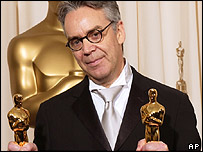
Howard Shore, 3-time Oscar winner for his work on The Lord of the Rings film trilogy, has returned to compose the original main title theme for its blockbuster $465 million series The Lord of the Rings: The Rings of Power. At the same time, Emmy-winner Bear McCreary has composed the full episodic series score.
…
Said McCreary: “As I set out to compose the score for this series, I strove to honor Howard Shore’s musical legacy. When I heard his majestic main title, I was struck by how perfectly his theme and my original score, though crafted separately, fit together so beautifully. I am excited for audiences to join us on this new musical journey to Middle-earth.”
Two new character themes composed by McCreary for Galadriel and Sauron are now available to stream on Amazon Music.
Executive Producer Philippa Boyens is pretty pleased with the casting for The Lord of the Rings: The War of the Rohirrim.
“It’s exciting — we’ve been sitting on it for a little bit,” she says. “[But] it all seemed to come together in an organic way, which is what you want, I think. Suddenly, the right people come to the role.”
Boyens says that bringing in Otto as narrator was not an immediate decision. Rather it was one that gradually emerged.
She explains that Éowyn eventually felt like the natural way into the bloody and grim tale from Rohan’s past.
“Her voice was familiar,” she says. “And then I think it started to come easily for the writers.”
She hopes that it will also help locate the story for film fans who are unfamiliar with deeper cuts from Middle-earth’s history.
Yet that was not the only reason — an oral tradition felt fitting.
“It’s also so fragmentary, what we are dealing with in terms of the source material. It’s little bits of references here and there … so the oral tradition felt kind of right. The oral tradition of her telling the tale, passing the tale on.”
She doesn’t divulge to whom. But one guesses it is likely her grandson, Barahir. Tolkien not only names Barahir in The Lord of the Rings (solving any potential rights-access issues that would arise with her son, Elboron), he is also an in-world scholar and the author of The Tale of Aragorn and Arwen.
Helm Hammerhand: a complex and epic role
Boyens says that both the film’s director Kenji Kamiyama, and Warner Bros SVP and producer Jason DeMarco, were well aware of Brian Cox from his recent voice role in the English dub of Blade Runner: Black Lotus.
“They’re huge fans, of course,” she says.
“Weirdly, years ago — and this is me aging myself — I tried to go and see Brian’s performance as Titus Andronicus.”
She describes how this 1987 run of the Shakespeare tragedy directed by Deborah Warner has attained a legendary status.
“It was just one of those ones which was fresh and shocking,” she says.
“And it [the Andronicus role] wasn’t a role — this is from Brian himself — that many of the other actors were interested in taking on. But he connected to it. I couldn’t get a ticket, but I had a couple of friends saw it who were just blown away. And they talked about the way in which his rage was fuelled by this grief. And the underlying horror that was in the storytelling.
“And that kind of resonated with me when we were thinking about the Helm role. Because it just — it spans a lot of different emotions.”
She says the role — and the film — is about delving into Helm’s choices.
“And the mistakes he made as well. And then his acknowledgement of those mistakes. Was there an acknowledgement of those mistakes?” she asks.
At different points she notes Helm’s hot-temperedness, and how he almost certainly under-estimated the Rohirrim lord, Wulf, who after he is outlawed leads the Dunlending invasion of Rohan.
“[Yet], I saw the tales of him slipping out [of the Hornburg] during the siege and attacking the camp for his people as literally someone trying — even with their bare hands – to protect the people as the king should,” she adds.
“So he was a true manifestation of the king-protector.”
Helm’s heirs and the overthrow of Edoras
The grim reality, though, is that Helm is unable to protect his children.
His eldest son, Haleth, is slain when Edoras is overrun and taken by Wulf’s forces while Helm is forced to take refuge in the Hornburg. We touch only briefly on Helm’s other son but I conclude that his Hama’s fate will remain the same tragedy that it is in Appendix A.
Boyens describes the first as a shocking and powerful moment. Powerful, perhaps, for readers, to finally see things they’ve long envisaged through Tolkien’s descriptions; shocking for film fans to see the unexpected — Edoras besieged and overthrown.
On the other hand, Tolkien leaves the fate of Helm’s daughter unclear. In fact, he never names her even though Freca’s bid for her hand in marriage for his son, Wulf, is a key catalyst for war. Boyens concedes that we simply do not know a lot about her.
“Where we turn to, very deliberately, is to Æthelflæd, the Lady of the Mercians. Alfred the Great’s daughter,” Boyens says, and proceeds to provide a rapid-fire education on an era of British history that I’d barely known of until now.
“She never ruled as a queen per se; she’s known as the Lady of Mercians. But she seems to step in when her people needed her.
“Æthelflæd was also really ingenious, which comes into play in the script. [It] was an idea that Kamiyama had, and they (he and the writers) played with that. I can’t tell you too much about it. But it’s about how you save your life when you have very little to work with?”
It’s a statement that seems to suggest that Helm’s daughter – who they’ve chosen to name Héra – will play some key role after the fall of Edoras to Wulf, and the death of Haleth.
“And I really don’t think that Professor Tolkien would hate this,” Boyens says. “Because I always see him as a bit of a Mercian himself being from the Midlands.”
Héra: so named as a nod to the Anglo-Saxon
Unsurprisingly, the name Héra is chosen for alliterative effect: Helm, Haleth, Hama, Héra. Yet Boyens reveals that wasn’t initially the case.
“Someone suggested another name and I went: “Nope, it’s gotta start with “H”, sorry”,” she says.
“Actually, Fran Walsh named her. I told her we were stuck. It’s actually Héra (I get a quick pronunciation lesson and discover the é functions a little like the “ai” in hair) — that’s why it has the accent. Not so much based on the Greek [goddess] Hera, but a nod to the Anglo-Saxon.
“And I like to think she wasn’t a character that [the writers] tried to create wholesale — pulling things out of thin air. Héra is very much drawing from sources that fit with the storytelling that Tolkien himself is drawing on.”
In case you’re wondering, Boyens confirms that neither Fran Walsh nor Peter Jackson have an official production role. It’s more that, since they’re long-time collaborators and have so much experience within Tolkien’s Middle-earth, they’re sometimes just a natural sounding board for ideas.
“I also want to give a shout out to Gaia Wise who voices Héra. I think you guys are going fall in love with her. She is fantastic, she’s amazing. She just had such innate sense of who the character is and how to play her. She was great.
“She had a very natural sense of fiery-ness, but without it being petulance defiance.”
Mûmakil, mercenaries and money
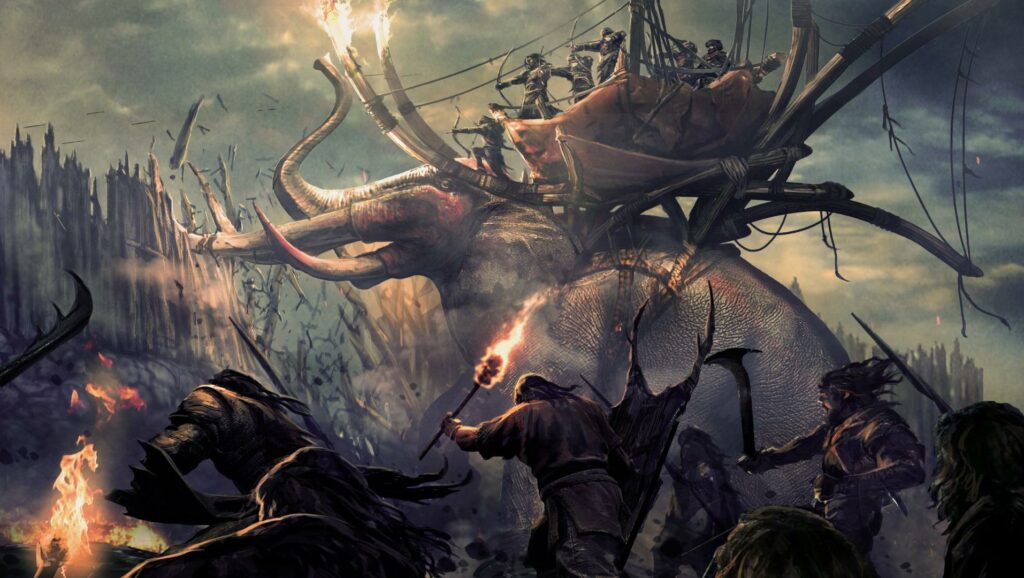
While we’re discussing events at Edoras, conversation inevitably veers toward the Mûmakil that were prominent in the initial concept art released in January.
“In order to understand the use of those [ideas],” Boyens says, “you need to understand the character of Wulf and the position that Wulf is in — and had found himself in. And who he would be turning to.”
At this point she pulls in another fact, mentioning the great wealth of Wulf’s father, Freca.
“His father was not an insignificant Lord of Rohan. He had indeed grown fat and prospered,” she says, referencing Helm’s comment in Appendix A about Freca’s large waistline.
Boyens doesn’t expand any further, but my own guess is that The War of the Rohirrim will establish Wulf as the organising mind behind coordinated assaults on Gondor and Rohan, using resources wealth from his father to secure the assistance of Corsairs and Haradrim.
As Appendix A states:
Four years later (2758) great troubles came to Rohan, and no help could be sent from Gondor, for three fleets of the Corsairs attacked it and there was war on all its coasts. At the same time Rohan was again invaded from the East, and the Dunlendings seeing their chance came over the Isen and down from Isengard.
It was soon known that Wulf was their leader. They were in great force, for they were joined by enemies of Gondor that landed in the mouths of Lefnui and Isen.
A human struggle that becomes increasingly claustrophobic
If this sounds like a very human — and political — struggle, Boyens concurs. I suggest the absence of elves, dwarves and hobbits makes it a very different tale to The Lord of the Rings that most know.
She indicates that this was one of the reasons for choosing Helm’s story.
“It’s not about the Ring, it’s not about the Dark Lord. All of that is very peripheral to the story.”
She says it’s also the attraction of examining honour, revenge and familial ties — on both sides.
For Helm, there’s madness born of grief from the loss of the child. With Wulf, there’s his relationship with his father, and with Héra.
“He is his father’s son, but he has a different character. So he does actually offer [to wed] her and the writers asked: ‘Why?’ What was driving him? Was it just his father demanding that he do this? Was it his ambition? What was at play there?”
Even the historical grievances of the Dunlendings — that the lords of Gondor gave what the Dunlendings felt was their land to the Rohirrim — should come through in the film.
She says that all those things are in the Helm tale.
“When I talked to Kamiyama about it, it resonated with him. So that was the genesis,” she says.
“And there’s a moment in the film, which is incredibly gut-wrenching and powerful where Wulf commits himself to a course of action he cannot turn away from. And once he does that, the story darkens.”
She says it was here that the screenwriters Phoebe Gittins and Arty Papageorgiou really connected with Kamiyama.
“So, yes, it begins with these quite large-scale battles, but it actually becomes more intense and … claustrophobic,” Boyens says.
“And the nature of the film changes almost into a ghost story.
“As the siege takes hold, as the rumours of horror begin to spread. And I can give you a little tease and let you know that, although we said this isn’t about The Ring and this isn’t about the Dark Lord … there are the White Mountains and there are creatures [out there].”
Somewhat to my relief she squashes speculation that she might be referring to the Dead of Erech. Instead, she suggests that orcs inhabited the area — a historically more agreeable inclusion.
“Also, I can just add — and I thought it was, again, really interesting in the way that Kamiyama approached this — this was a long, cold winter that was hurting everyone.”
This suggests that there won’t be space to see Gondor’s own struggles. Gondor may come to the rescue in the end, but it seems the focus will be squarely on a life-and-death struggle within Rohan.
She won’t even confirm or deny the presence of Saruman the White in the film. We’ll just have to wait and see.
About the author: Staffer Demosthenes has been involved with TheOneRing.net since 2001, serving first as an Associate News Editor, then as Chief News Editor during the making of the Hobbit films. Now he focuses on features and analysis.The opinions in this article are his own and do not necessarily represent those of TheOneRing.net and other staff.
If you have a Tolkien/Middle-earth inspired poem you’d like to share, then send it to poetry@theonering.net. One poem per person may be submitted each month. Please make sure to proofread your work before sending it in. TheOneRing.net is not responsible for poems posting with spelling or grammatical errors.
We’re excited to share with you news from the London Philharmonic Orchestra about an upcoming episode of their podcast LPO Offstage featuring Howard Shore.
During the podcast, Howard Shore talks about the recording sessions for the Lord of the Rings films. He is also joined by Principal Percussion, Andrew Barclay and Principal Trumpet, Paul Beniston, who both took part in the recording sessions. They cover a range of topics such as the timeline from Shore’s initial ideas, through drafts to the final version. They discuss the recording process, and Howard making changes overnight. Howard also tells why he decided to work with the LPO for these movies.
The episode is hosted by YolanDa Brown. It will be available for your listening pleasure on July 7th on the London Philharmonic’s website at LPO Offstage.
LPO Offstage is in it’s 4th series and takes you behind-the-scenes of the Orchestra, bringing you closer than ever to the world of classical music. Past episodes have covered things like performance anxiety, the logistics of how a full symphony orchestra goes on tour, and how the music gets from the library to the music stand to name just a few. Tune in to hear from players and special guests to get your access-all-areas pass to the Orchestra.