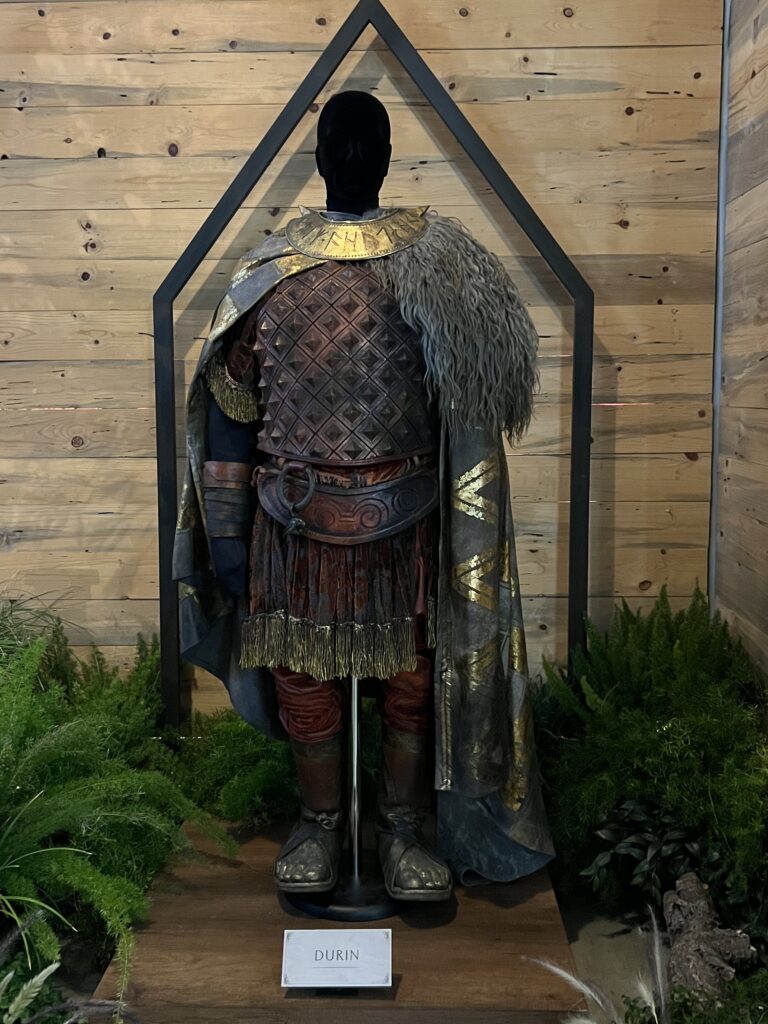
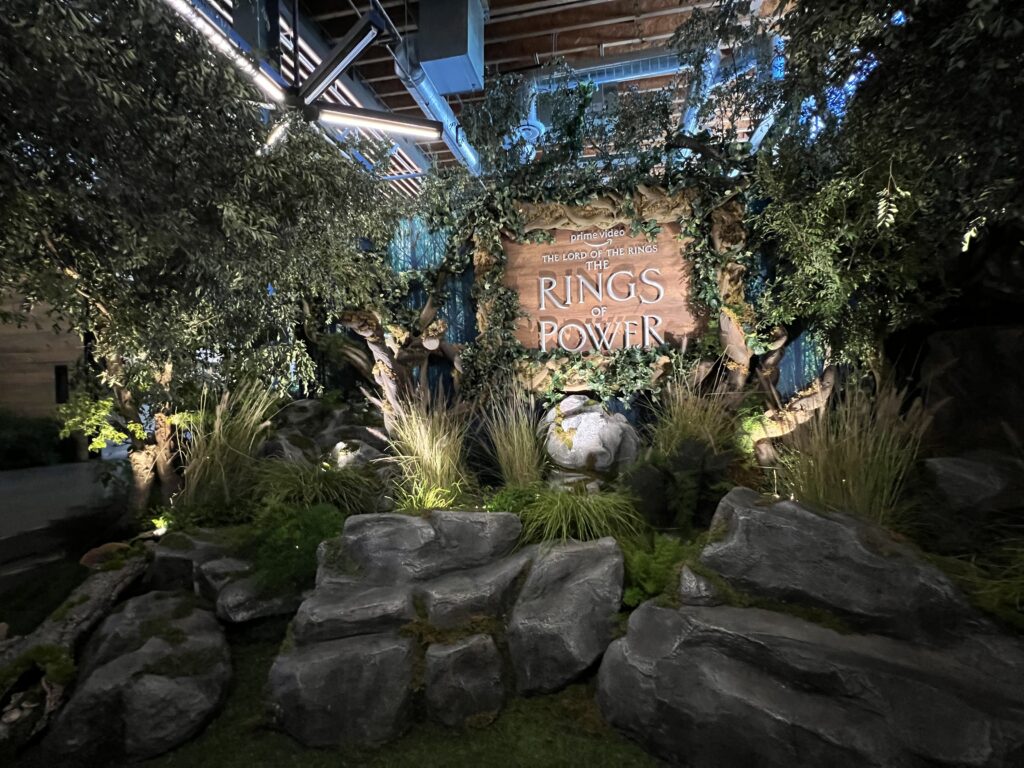
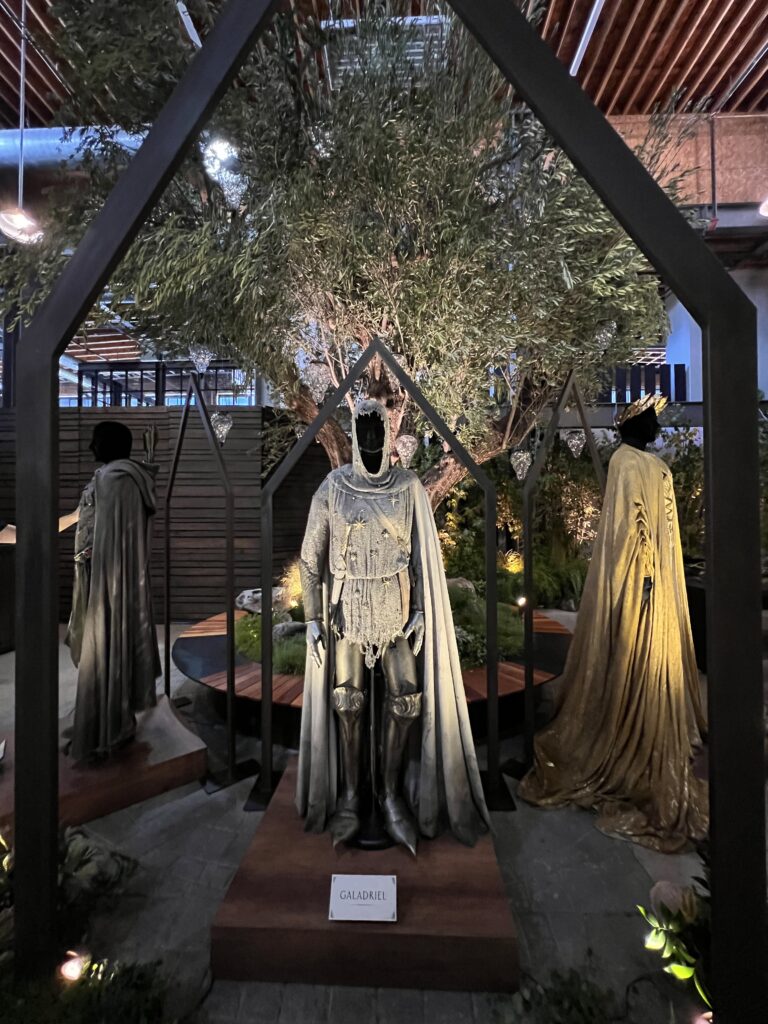
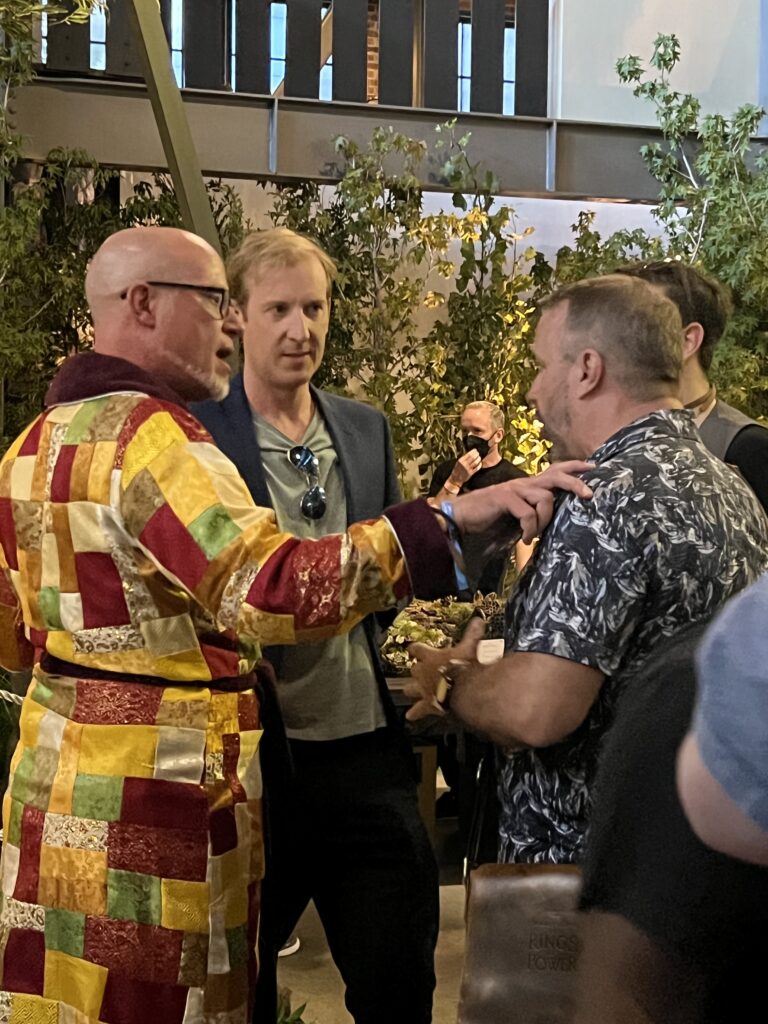
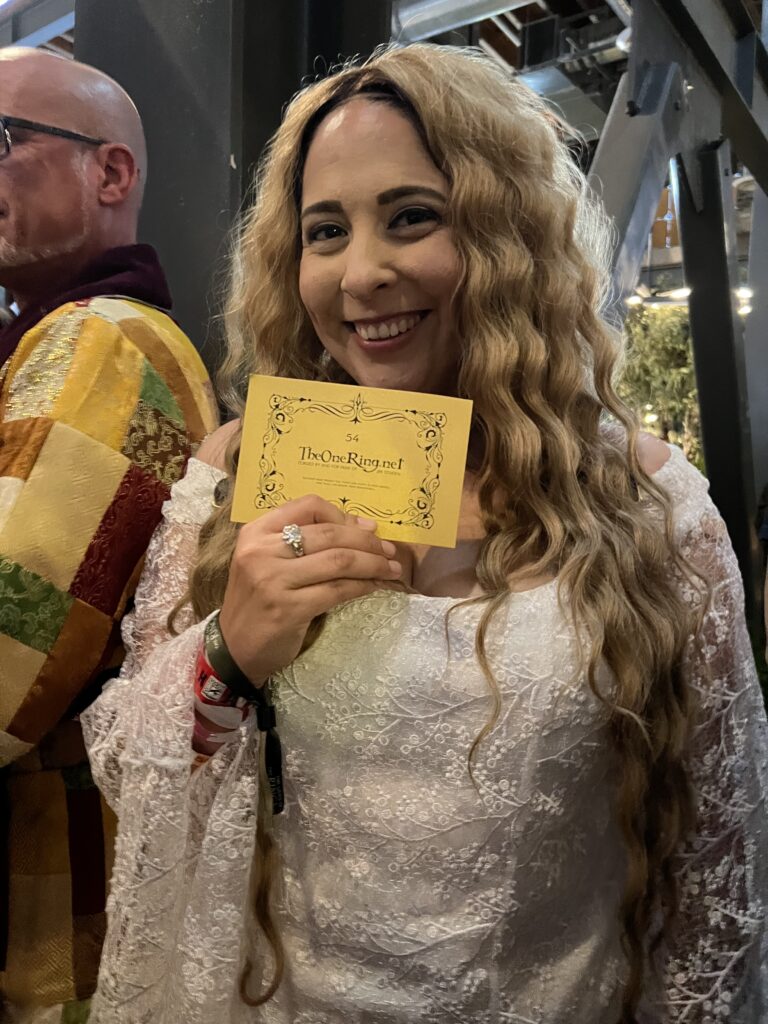
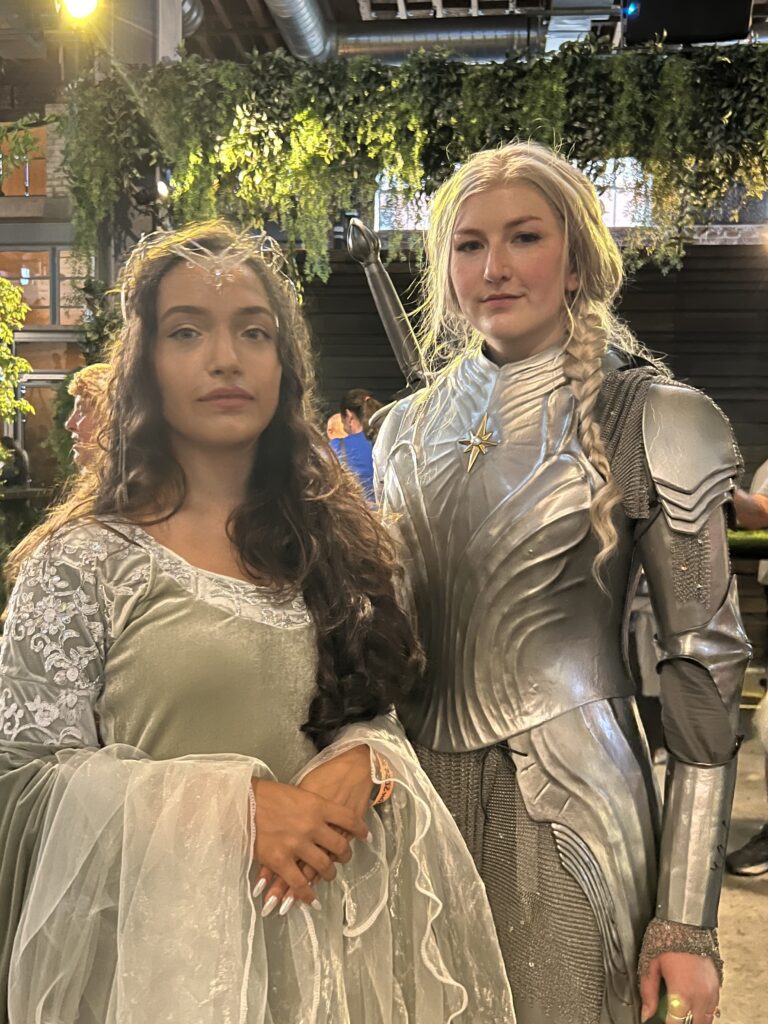
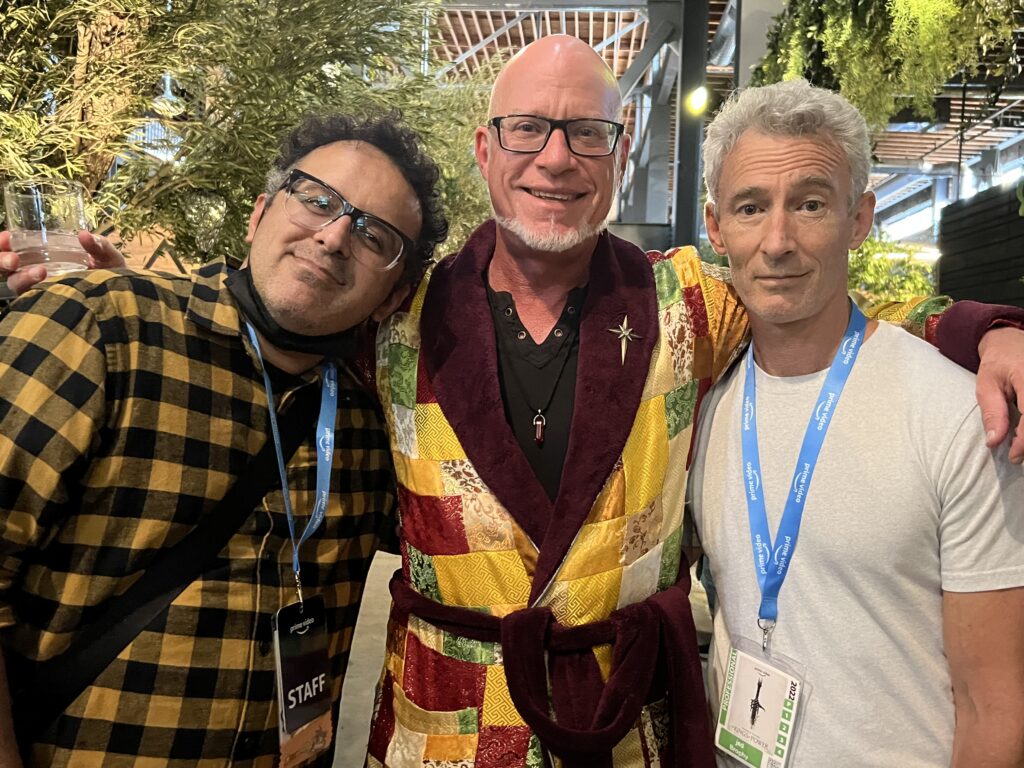
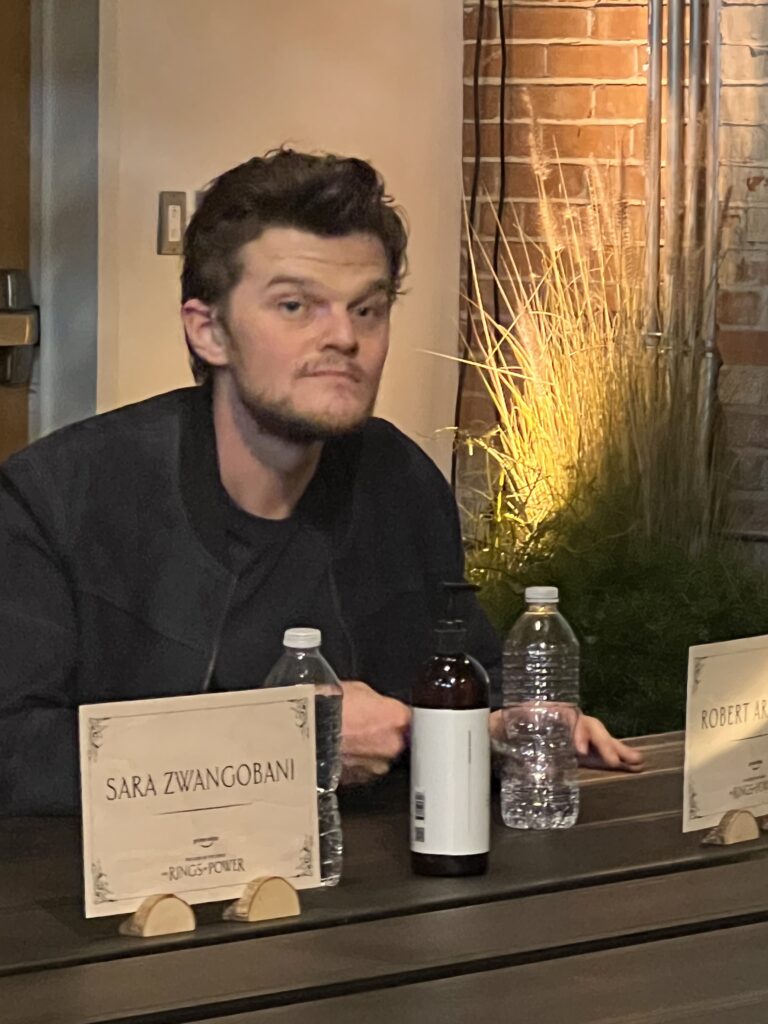
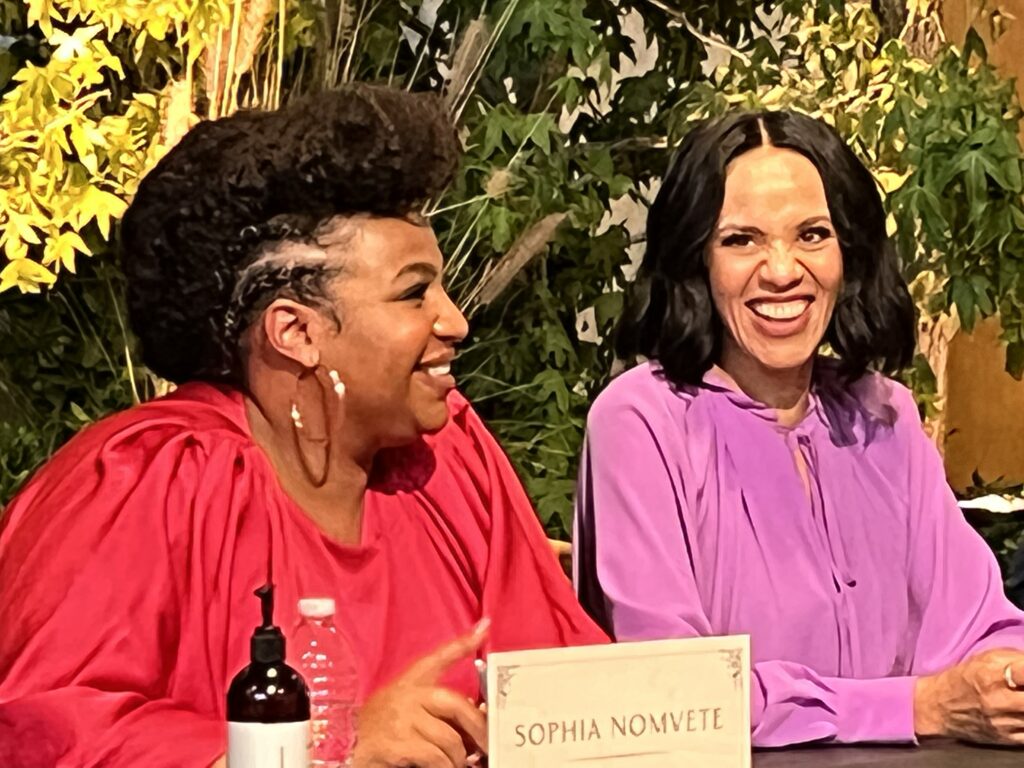
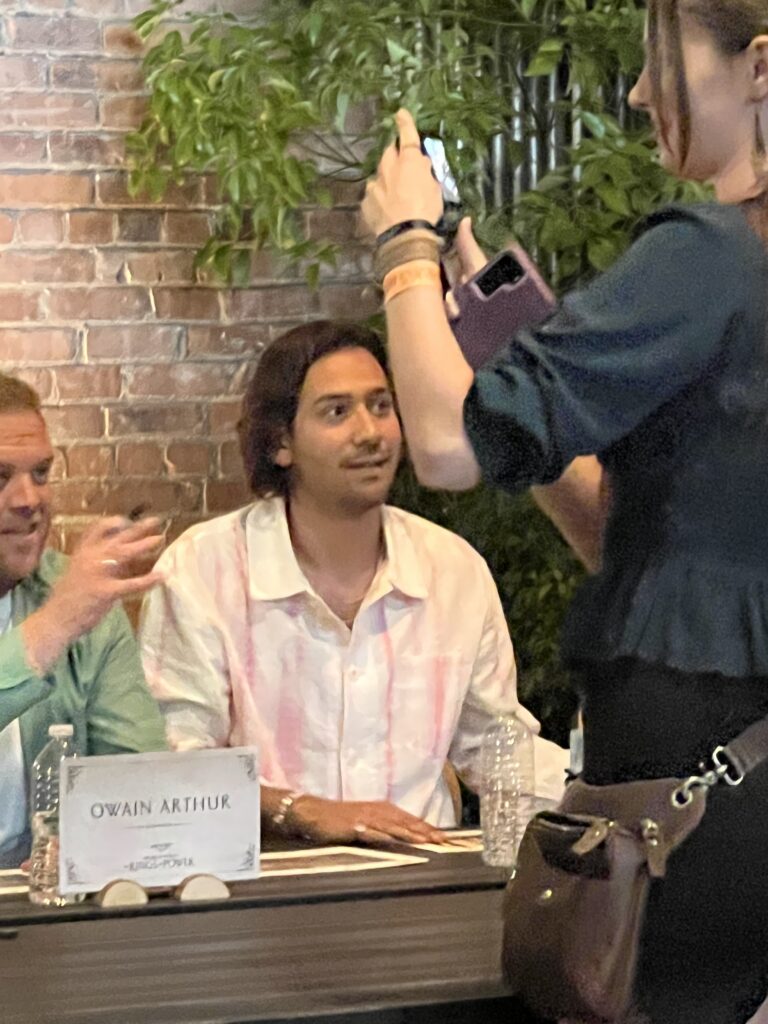
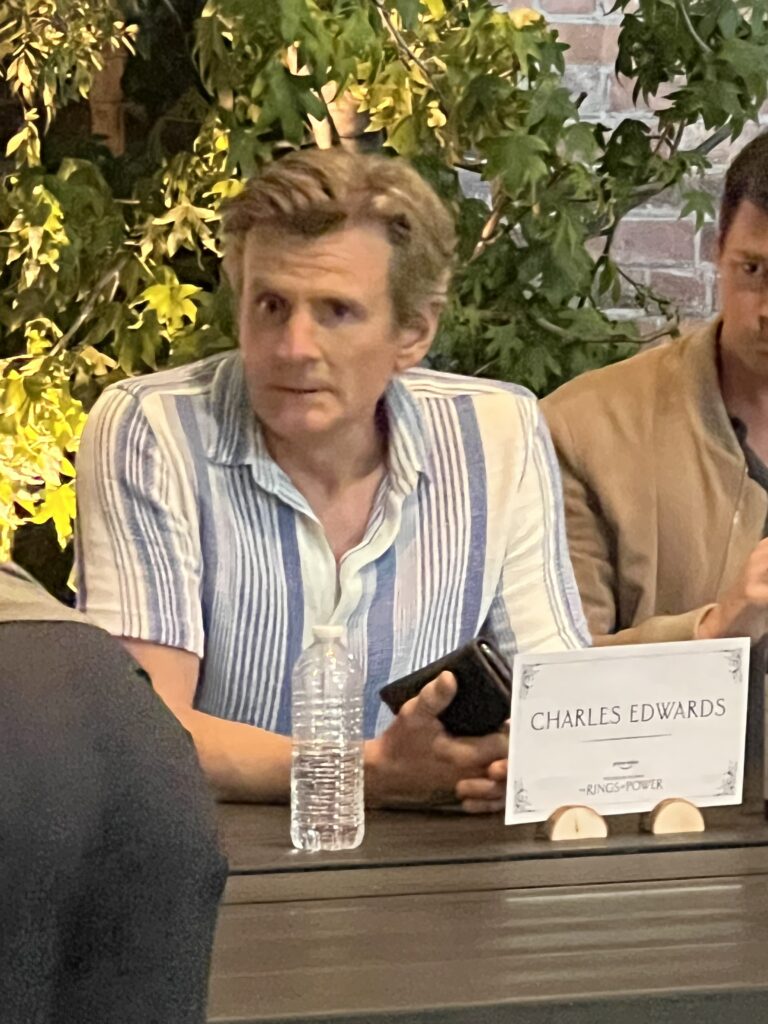
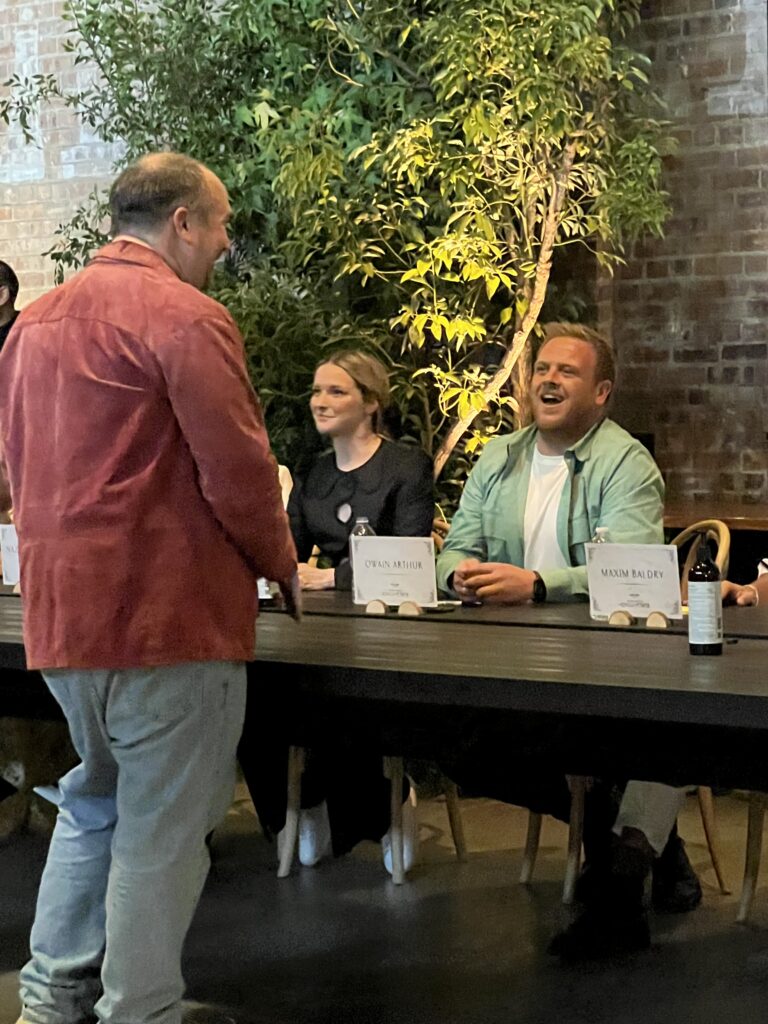
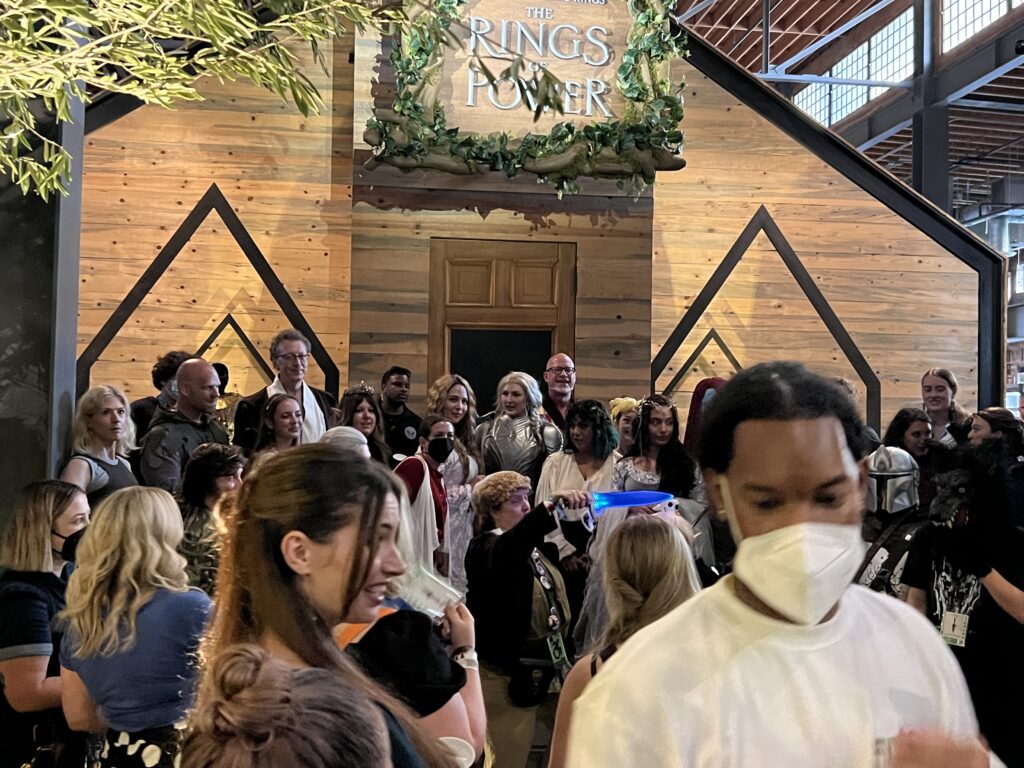
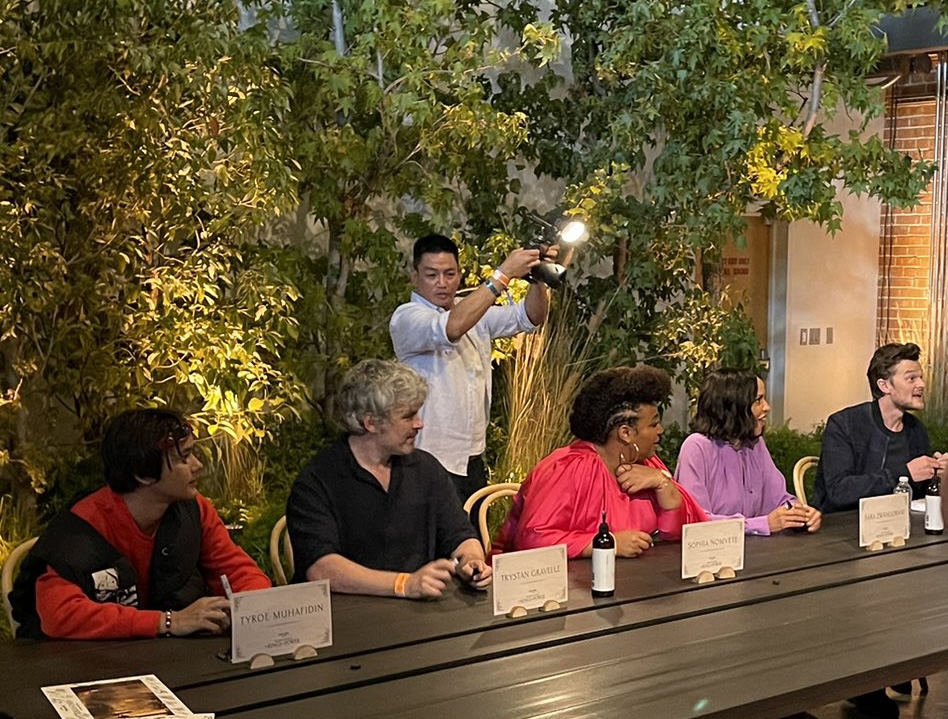
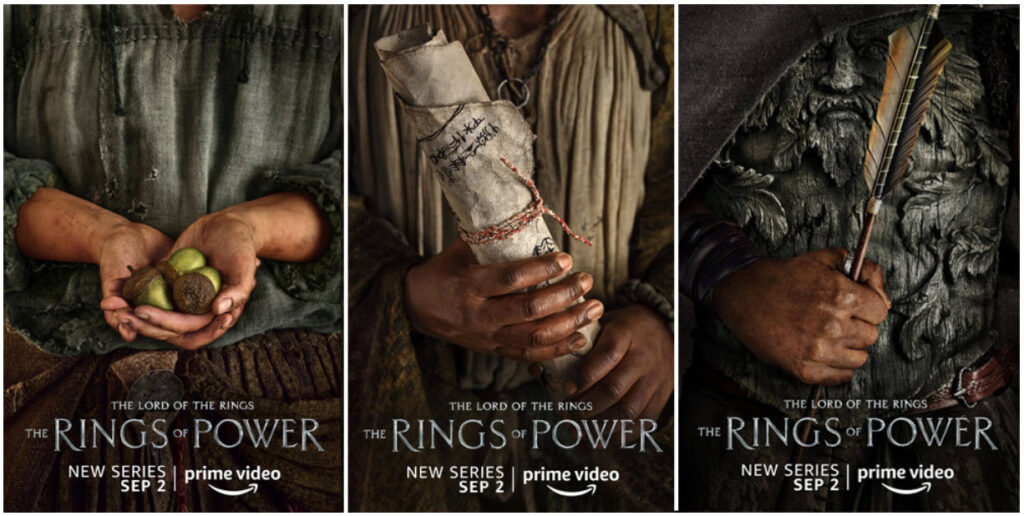
Last night TheOneRing.net and Amazon Prime Video hosted a “Rings of Power” off-site party at San Diego Comic-con.
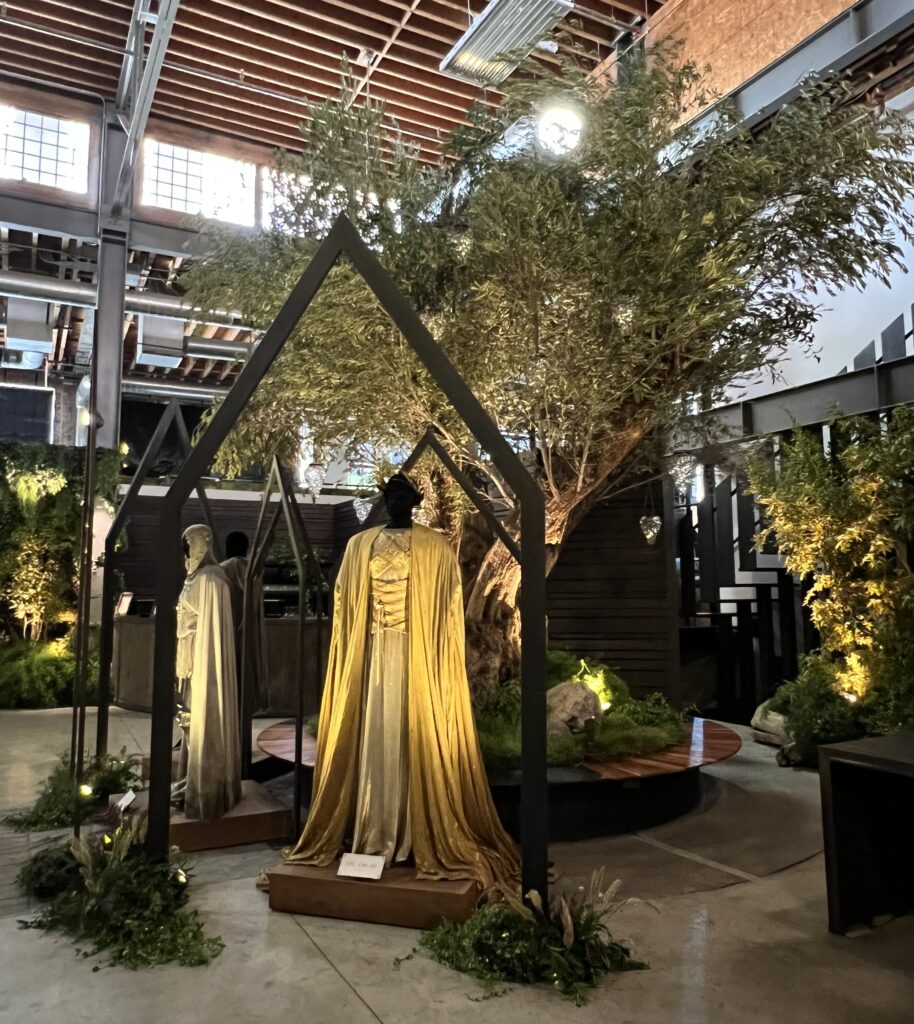
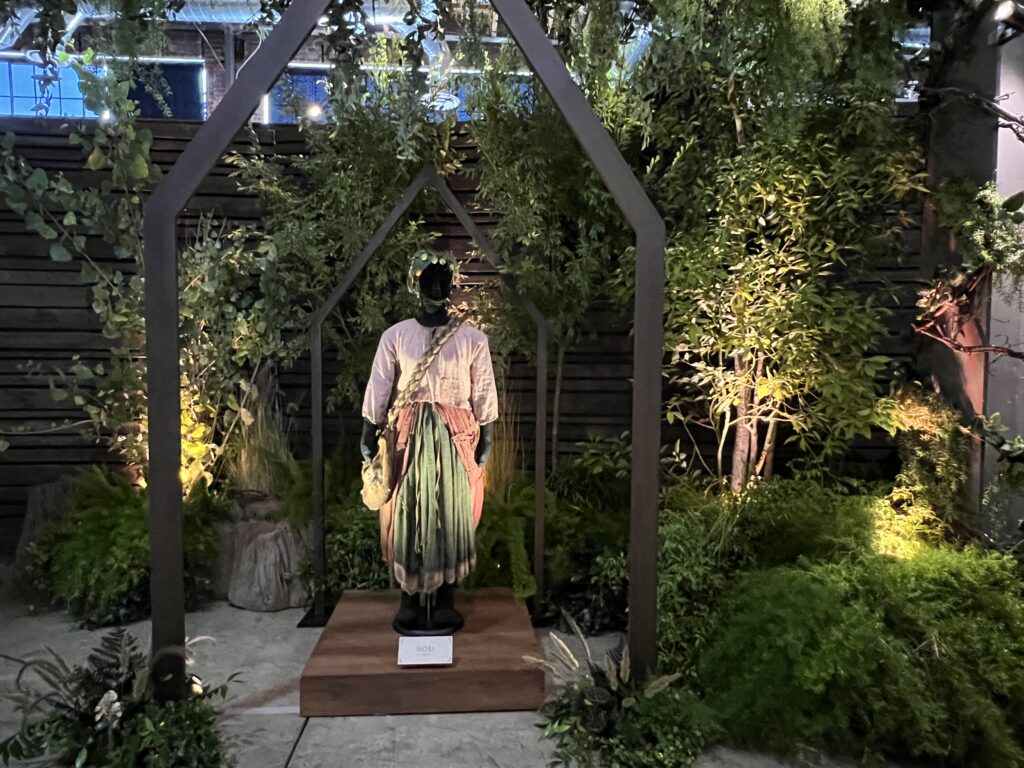
The setting was lovely and looked very Middle-earthy with trees growing inside the venue surrounded by moss, rocks, mushrooms, and even a few birds’ nests filled with eggssess, precious. Showrunner Patrick McKay joined the party, and TORN staffer Cliff “Quickbeam” Broadway talked Tolkien lore with him. Jed Brophy stopped by, too.
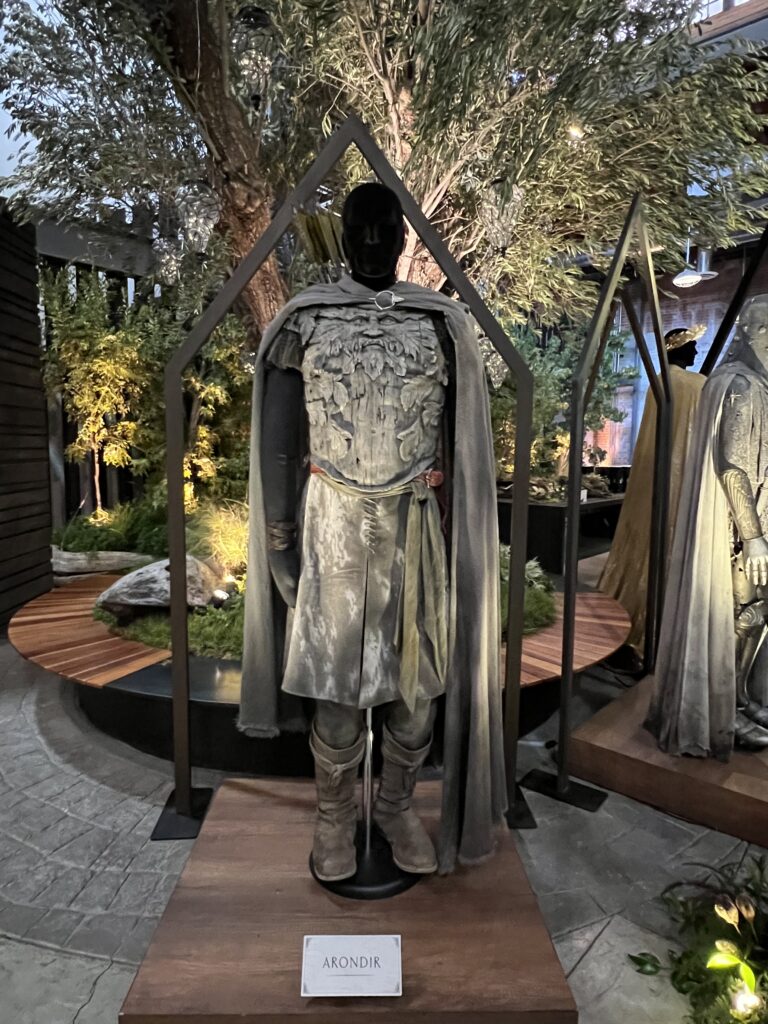
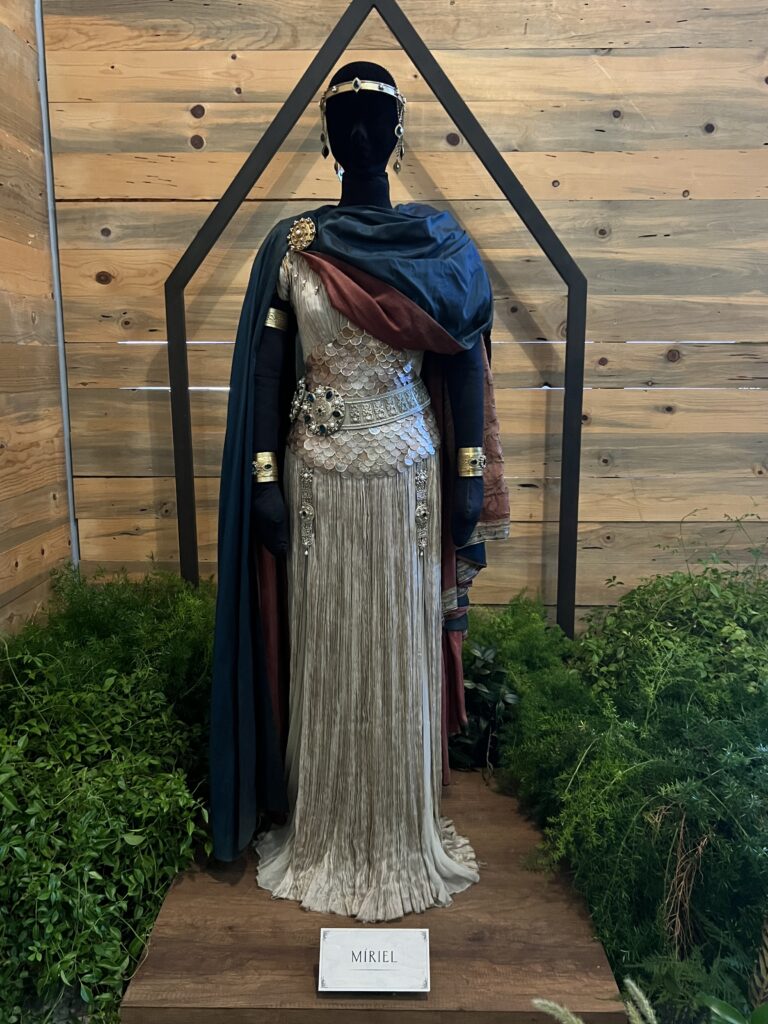
Golden Mallorn leaf tickets were given out at TORn’s Booth 1220 in the convention center for trivia answers. These ticket holders got to meet 20+ Rings of Power actors and have posters signed by them all. Five Middle-earth costume winners also got Mallorn tickets. Actual set-worn costumes were displayed throughout the venue, and immediately after the party, they were bubble wrapped and crated and flown back to the set.
Highlights of the food and drink that flowed throughout the evening were the blackberry sparkling cocktail and the mini poke ice cream cones surrounding a mountain from which smoke poured out.
An expanded trailer that does not disappoint was played in a separate room on loop.
It was a wonderful evening, and hopefully the first of many ”Rings of Power” parties. (Emmys party perhaps?)
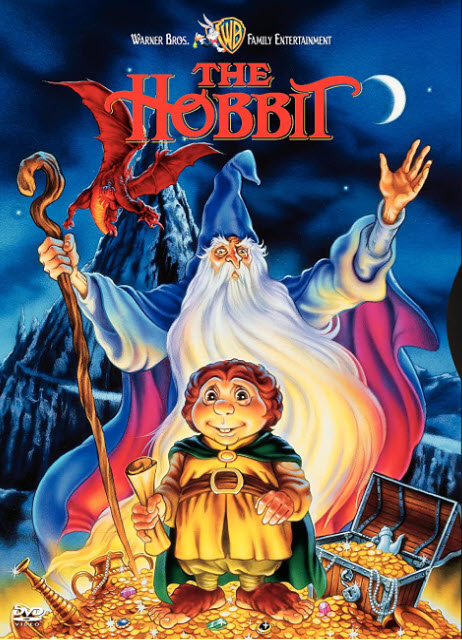
November, 1977: In the United States, the National Broadcasting Company (or NBC – you know, with the Peacock) airs the first ever made-for-television Tolkien story, The Hobbit, by Rankin-Bass. I was just barely ten years old! Cost: $3M US.
Copyright 2001 Warner Brothers Entertainment
September, 2022: Throughout the world, Amazon Prime (you know, with the… thing) is programmed to broadcast the first two episodes of the Rings of Power, the first ever made-for-television live action Tolkien story spun from a literary foundation of The Lord of the Rings Appendices, promising a five season series with a total of 50 hours of showtime. Cost: $8B US.
45 years and $7,977,000,000 later, where are we now? Yeah, I know what you’re thinking, and I mean, besides me getting old.
SUPER EXCITED! And tantalizingly close, compared to 2017, when the show was announced.
Source: Amazon Prime
Quenching our Thirst
Now, after a parching, dehydrated, drought of a post-teaser-trailer-season, the marketing associated with RoP has finally begun to quench the thirst of fans throughout the world. As frustrating as it has been for many, it has been equally impressive: Amazon’s work for inhibiting unauthorized release of media, information, even rumor and urban legend regarding RoP has been impressive. Fans have feverishly picked apart the minutia of every image released in 2022, and one thing is clear: we are here for it!
This marketing strategy is very different than what we have experienced – and frankly, appreciated and been accustomed to – in the past. Many worry the approach has been a failure: 60 days from showtime, and no actual video footage has been shared with the public! Yet, I can’t help but imagine a war room of marketing wizards at work, meeting out exactly what is needed, and when, carefully calibrated to strike just the right measure of hype before the show streams in earnest.
Through the words, experiences, and perspectives of the London 30 who were summoned to England several months ago, the marketing wizards casts their spell. A series of images and articles continue to surface on the webs and in print, shared broadly between traditional media outlets, first web-generation Tolkien fan sites like TORn, and the newest of media formats: Reddit, TickTock, Twitter, YouTube… Influencers abound, and Amazon has them tapped. But will it reach enough consumers to tune in on September 2nd? And what is “enough?” We know more is coming at ComicCon, and eagerly await that and the rest.
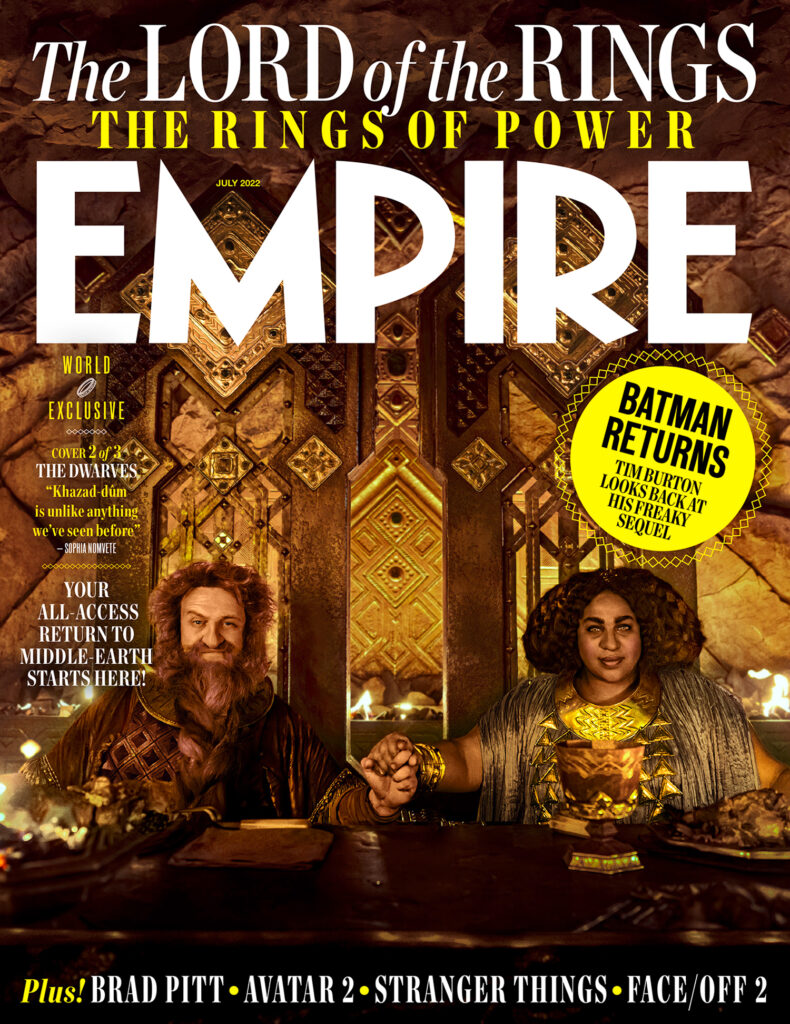
One of three Empire Magazine covers
Author’s note: I’m thrilled to return to news posting here at TORn at the turn of this tide, and looking forward to sharing dispatches from ComicCon this month, and Rings of Power and all manner of Tolkien tidbits with you over the coming years. To stay informed with any breaking news (and plenty of rumors and speculation), and participate in the tantalizing build up to the show in real-time, join me and other TORn staffers Demosthenes, Justin, Kelvarhin and others, and the throng of this generation’s Ringers, in our very own Discord server: https://discord.gg/CTf6sGxR.
See you soon! Tookish bows.
Tookish is one of TORn’s first staff members after the Founding Four, serving as Senior Editor, assistant to Xoanon, lowbrow member of the Greenbooks team, Barliman’s chat moderator, and ComicCon panelist during the Peter Jackson LotR film series era.
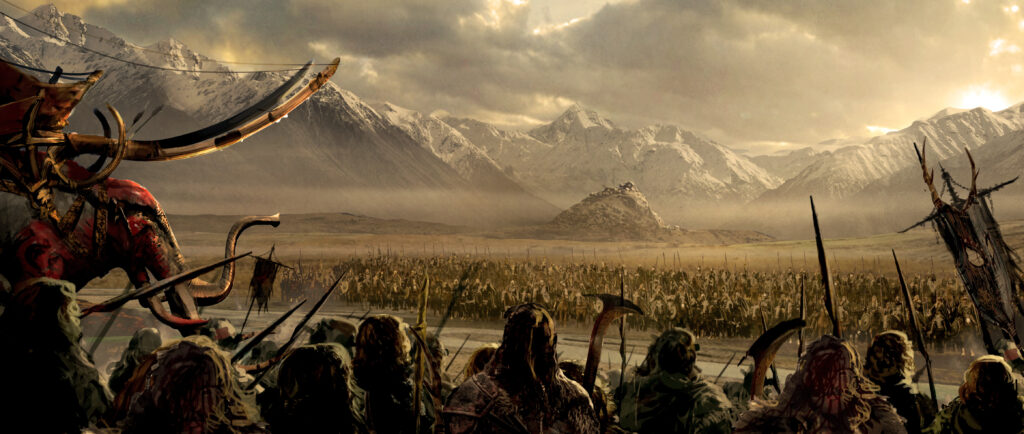
Executive Producer Philippa Boyens is pretty pleased with the casting for The Lord of the Rings: The War of the Rohirrim.
“It’s exciting — we’ve been sitting on it for a little bit,” she says. “[But] it all seemed to come together in an organic way, which is what you want, I think. Suddenly, the right people come to the role.”
Boyens says that bringing in Otto as narrator was not an immediate decision. Rather it was one that gradually emerged.
She explains that Éowyn eventually felt like the natural way into the bloody and grim tale from Rohan’s past.
“Her voice was familiar,” she says. “And then I think it started to come easily for the writers.”
She hopes that it will also help locate the story for film fans who are unfamiliar with deeper cuts from Middle-earth’s history.
Yet that was not the only reason — an oral tradition felt fitting.
“It’s also so fragmentary, what we are dealing with in terms of the source material. It’s little bits of references here and there … so the oral tradition felt kind of right. The oral tradition of her telling the tale, passing the tale on.”
She doesn’t divulge to whom. But one guesses it is likely her grandson, Barahir. Tolkien not only names Barahir in The Lord of the Rings (solving any potential rights-access issues that would arise with her son, Elboron), he is also an in-world scholar and the author of The Tale of Aragorn and Arwen.
Helm Hammerhand: a complex and epic role
Boyens says that both the film’s director Kenji Kamiyama, and Warner Bros SVP and producer Jason DeMarco, were well aware of Brian Cox from his recent voice role in the English dub of Blade Runner: Black Lotus.
“They’re huge fans, of course,” she says.
“Weirdly, years ago — and this is me aging myself — I tried to go and see Brian’s performance as Titus Andronicus.”
She describes how this 1987 run of the Shakespeare tragedy directed by Deborah Warner has attained a legendary status.
“It was just one of those ones which was fresh and shocking,” she says.
“And it [the Andronicus role] wasn’t a role — this is from Brian himself — that many of the other actors were interested in taking on. But he connected to it. I couldn’t get a ticket, but I had a couple of friends saw it who were just blown away. And they talked about the way in which his rage was fuelled by this grief. And the underlying horror that was in the storytelling.
“And that kind of resonated with me when we were thinking about the Helm role. Because it just — it spans a lot of different emotions.”
She says the role — and the film — is about delving into Helm’s choices.
“And the mistakes he made as well. And then his acknowledgement of those mistakes. Was there an acknowledgement of those mistakes?” she asks.
At different points she notes Helm’s hot-temperedness, and how he almost certainly under-estimated the Rohirrim lord, Wulf, who after he is outlawed leads the Dunlending invasion of Rohan.
“[Yet], I saw the tales of him slipping out [of the Hornburg] during the siege and attacking the camp for his people as literally someone trying — even with their bare hands – to protect the people as the king should,” she adds.
“So he was a true manifestation of the king-protector.”
Helm’s heirs and the overthrow of Edoras
The grim reality, though, is that Helm is unable to protect his children.
His eldest son, Haleth, is slain when Edoras is overrun and taken by Wulf’s forces while Helm is forced to take refuge in the Hornburg. We touch only briefly on Helm’s other son but I conclude that his Hama’s fate will remain the same tragedy that it is in Appendix A.
Boyens describes the first as a shocking and powerful moment. Powerful, perhaps, for readers, to finally see things they’ve long envisaged through Tolkien’s descriptions; shocking for film fans to see the unexpected — Edoras besieged and overthrown.
On the other hand, Tolkien leaves the fate of Helm’s daughter unclear. In fact, he never names her even though Freca’s bid for her hand in marriage for his son, Wulf, is a key catalyst for war. Boyens concedes that we simply do not know a lot about her.
“Where we turn to, very deliberately, is to Æthelflæd, the Lady of the Mercians. Alfred the Great’s daughter,” Boyens says, and proceeds to provide a rapid-fire education on an era of British history that I’d barely known of until now.
“She never ruled as a queen per se; she’s known as the Lady of Mercians. But she seems to step in when her people needed her.
“Æthelflæd was also really ingenious, which comes into play in the script. [It] was an idea that Kamiyama had, and they (he and the writers) played with that. I can’t tell you too much about it. But it’s about how you save your life when you have very little to work with?”
It’s a statement that seems to suggest that Helm’s daughter – who they’ve chosen to name Héra – will play some key role after the fall of Edoras to Wulf, and the death of Haleth.
“And I really don’t think that Professor Tolkien would hate this,” Boyens says. “Because I always see him as a bit of a Mercian himself being from the Midlands.”
Héra: so named as a nod to the Anglo-Saxon
Unsurprisingly, the name Héra is chosen for alliterative effect: Helm, Haleth, Hama, Héra. Yet Boyens reveals that wasn’t initially the case.
“Someone suggested another name and I went: “Nope, it’s gotta start with “H”, sorry”,” she says.
“Actually, Fran Walsh named her. I told her we were stuck. It’s actually Héra (I get a quick pronunciation lesson and discover the é functions a little like the “ai” in hair) — that’s why it has the accent. Not so much based on the Greek [goddess] Hera, but a nod to the Anglo-Saxon.
“And I like to think she wasn’t a character that [the writers] tried to create wholesale — pulling things out of thin air. Héra is very much drawing from sources that fit with the storytelling that Tolkien himself is drawing on.”
In case you’re wondering, Boyens confirms that neither Fran Walsh nor Peter Jackson have an official production role. It’s more that, since they’re long-time collaborators and have so much experience within Tolkien’s Middle-earth, they’re sometimes just a natural sounding board for ideas.
“I also want to give a shout out to Gaia Wise who voices Héra. I think you guys are going fall in love with her. She is fantastic, she’s amazing. She just had such innate sense of who the character is and how to play her. She was great.
“She had a very natural sense of fiery-ness, but without it being petulance defiance.”
Mûmakil, mercenaries and money
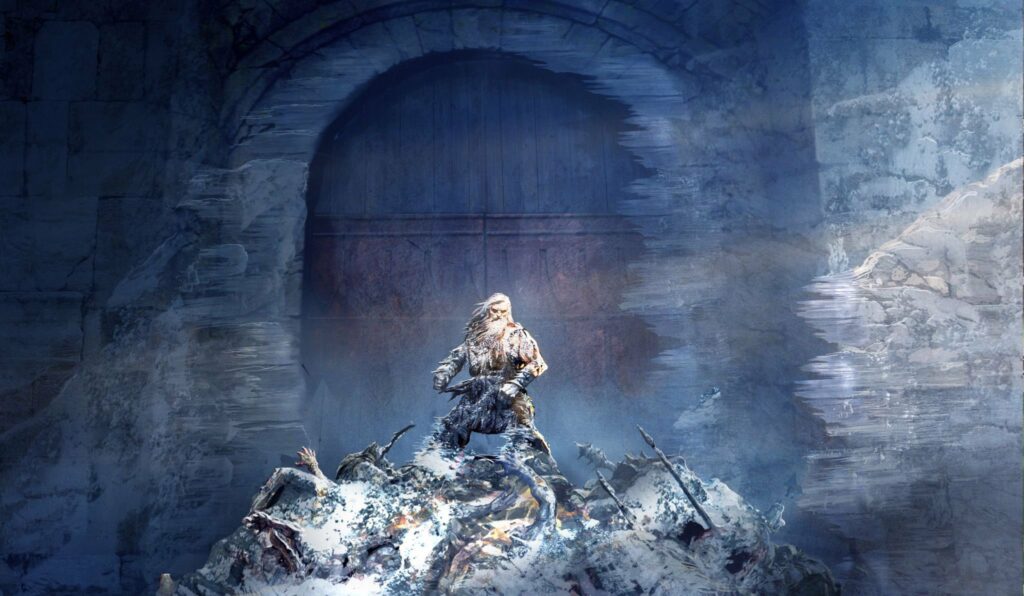
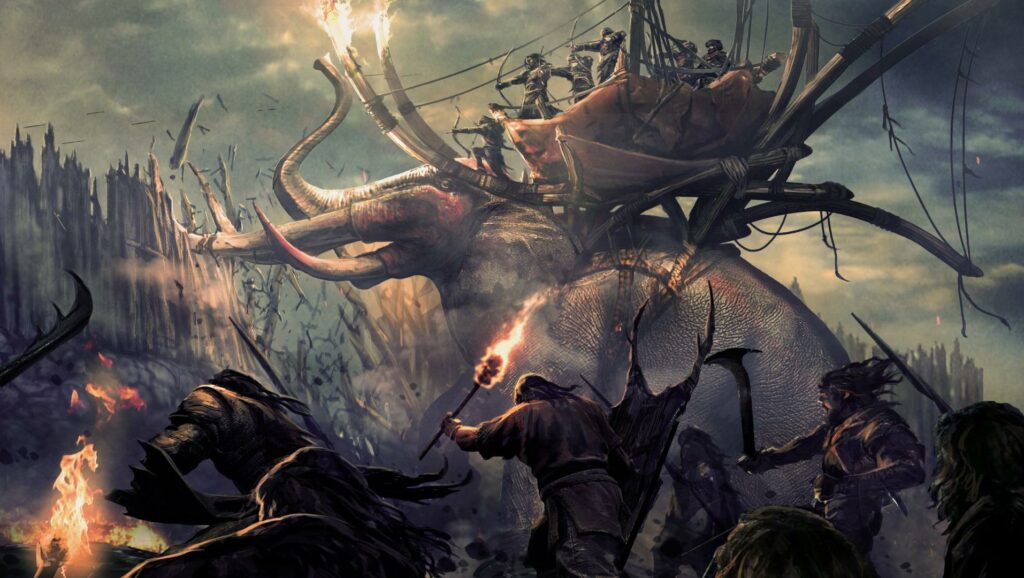
While we’re discussing events at Edoras, conversation inevitably veers toward the Mûmakil that were prominent in the initial concept art released in January.
“In order to understand the use of those [ideas],” Boyens says, “you need to understand the character of Wulf and the position that Wulf is in — and had found himself in. And who he would be turning to.”
At this point she pulls in another fact, mentioning the great wealth of Wulf’s father, Freca.
“His father was not an insignificant Lord of Rohan. He had indeed grown fat and prospered,” she says, referencing Helm’s comment in Appendix A about Freca’s large waistline.
Boyens doesn’t expand any further, but my own guess is that The War of the Rohirrim will establish Wulf as the organising mind behind coordinated assaults on Gondor and Rohan, using resources wealth from his father to secure the assistance of Corsairs and Haradrim.
As Appendix A states:
Four years later (2758) great troubles came to Rohan, and no help could be sent from Gondor, for three fleets of the Corsairs attacked it and there was war on all its coasts. At the same time Rohan was again invaded from the East, and the Dunlendings seeing their chance came over the Isen and down from Isengard.
It was soon known that Wulf was their leader. They were in great force, for they were joined by enemies of Gondor that landed in the mouths of Lefnui and Isen.
A human struggle that becomes increasingly claustrophobic
If this sounds like a very human — and political — struggle, Boyens concurs. I suggest the absence of elves, dwarves and hobbits makes it a very different tale to The Lord of the Rings that most know.
She indicates that this was one of the reasons for choosing Helm’s story.
“It’s not about the Ring, it’s not about the Dark Lord. All of that is very peripheral to the story.”
She says it’s also the attraction of examining honour, revenge and familial ties — on both sides.
For Helm, there’s madness born of grief from the loss of the child. With Wulf, there’s his relationship with his father, and with Héra.
“He is his father’s son, but he has a different character. So he does actually offer [to wed] her and the writers asked: ‘Why?’ What was driving him? Was it just his father demanding that he do this? Was it his ambition? What was at play there?”
Even the historical grievances of the Dunlendings — that the lords of Gondor gave what the Dunlendings felt was their land to the Rohirrim — should come through in the film.
She says that all those things are in the Helm tale.
“When I talked to Kamiyama about it, it resonated with him. So that was the genesis,” she says.
“And there’s a moment in the film, which is incredibly gut-wrenching and powerful where Wulf commits himself to a course of action he cannot turn away from. And once he does that, the story darkens.”
She says it was here that the screenwriters Phoebe Gittins and Arty Papageorgiou really connected with Kamiyama.
“So, yes, it begins with these quite large-scale battles, but it actually becomes more intense and … claustrophobic,” Boyens says.
“And the nature of the film changes almost into a ghost story.
“As the siege takes hold, as the rumours of horror begin to spread. And I can give you a little tease and let you know that, although we said this isn’t about The Ring and this isn’t about the Dark Lord … there are the White Mountains and there are creatures [out there].”
Somewhat to my relief she squashes speculation that she might be referring to the Dead of Erech. Instead, she suggests that orcs inhabited the area — a historically more agreeable inclusion.
“Also, I can just add — and I thought it was, again, really interesting in the way that Kamiyama approached this — this was a long, cold winter that was hurting everyone.”
This suggests that there won’t be space to see Gondor’s own struggles. Gondor may come to the rescue in the end, but it seems the focus will be squarely on a life-and-death struggle within Rohan.
She won’t even confirm or deny the presence of Saruman the White in the film. We’ll just have to wait and see.
About the author: Staffer Demosthenes has been involved with TheOneRing.net since 2001, serving first as an Associate News Editor, then as Chief News Editor during the making of the Hobbit films. Now he focuses on features and analysis.The opinions in this article are his own and do not necessarily represent those of TheOneRing.net and other staff.
If you have a Tolkien/Middle-earth inspired poem you’d like to share, then send it to poetry@theonering.net. One poem per person may be submitted each month. Please make sure to proofread your work before sending it in. TheOneRing.net is not responsible for poems posting with spelling or grammatical errors.
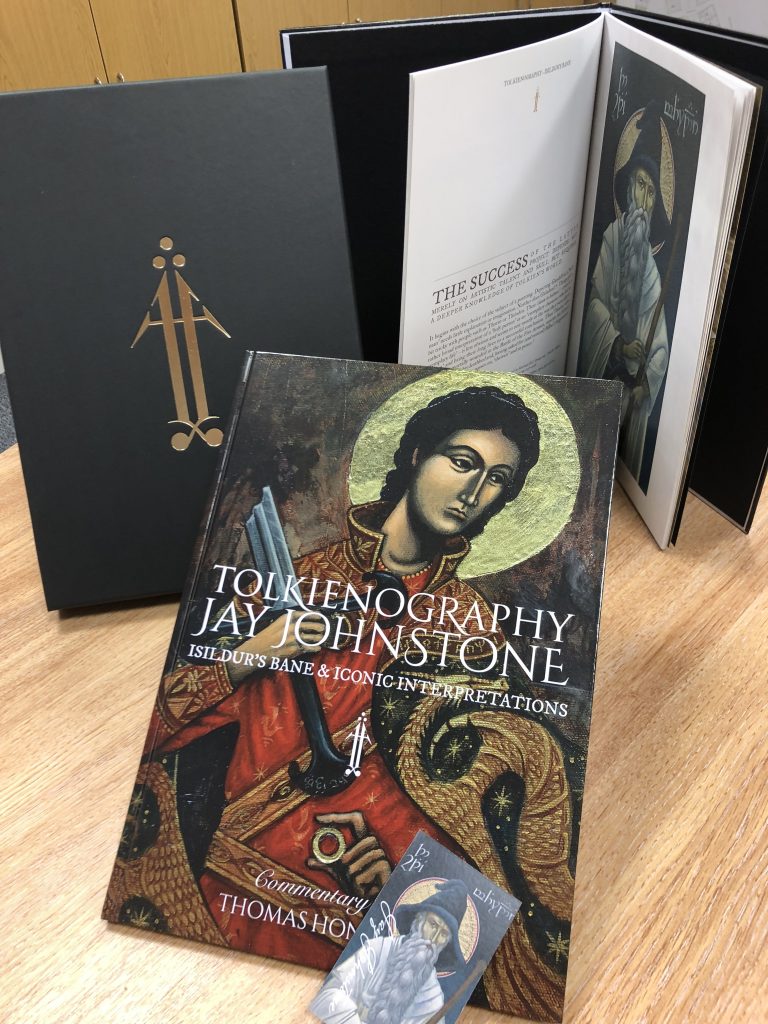
Over on Wraith Land, Thomas Kelley has just published the second part of his extended interview with Tolkien artist Jay Johnstone.
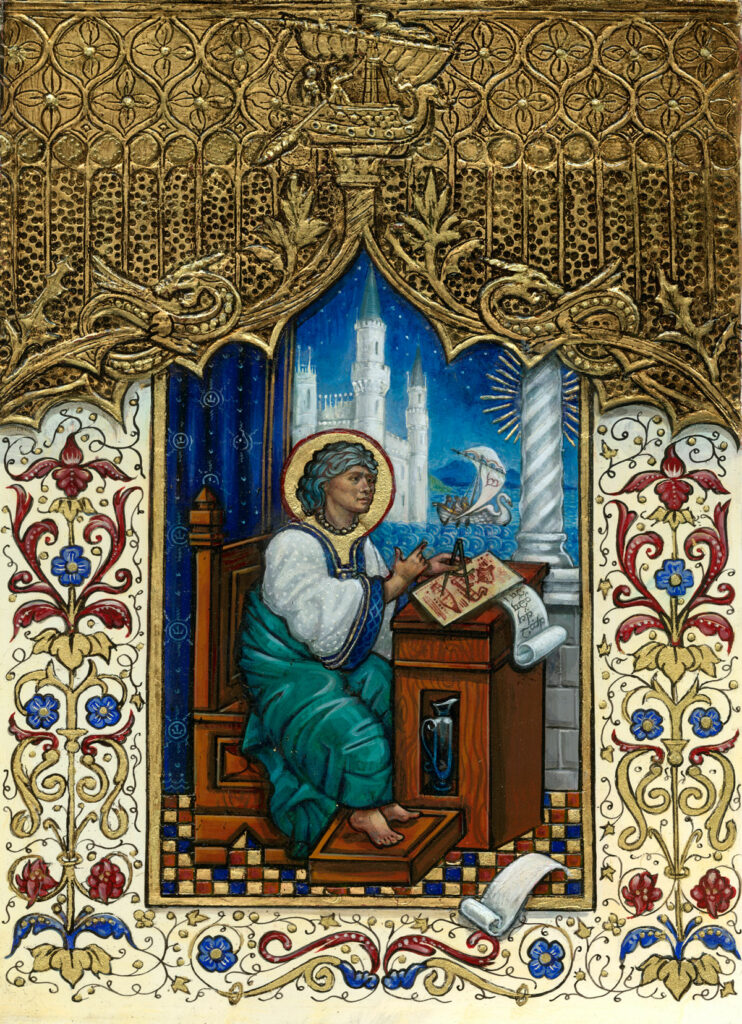
Jay’s artwork employs techniques from religious manuscripts, icon and fresco illustrations from the medieval period, and uses a variety of mediums — oils, watercolors, acrylics, egg tempera with gold powder and leaf. Striking detail and traditional techniques give the impression of artwork that could have been produced in the real Middle-earth.
The first part explored how Johnstone’s own dreams influence his art. In this second part, Kelly explores Johnstone’s medieval illumination approach to Tolkien art in detail.
An excerpt:
When I interviewed Jay last year in April, I asked him about this “text within a text” vision in his Tolkien art, which to me are of the same theme as his “dream within a dream” iconographies. Using his painting “Gandalf in the Library of Minas Tirith” as an example, I pointed out how he meticulously detailed the books and scrolls in that image with Tengwar lettering. You can also see this painstaking attention throughout, as in works like “The Dwarves,” which illuminates Thror’s map in Bag End from The Hobbit.
“You know, I can’t remember what it says but there’s two parchments on his desk and both of them are written on and the lettering is about a millimeter high,” he says of the Gandalf in Minas Tirith work, chuckling a bit under his breath. “It’s absolutely tiny. I literally do it with a magnifying glass and a precision brush, a brush with one hair on it. I do that in quite a lot of paintings.”
It’s another level of getting inside Middle-earth, down to the micro. Such works are a celebration of the writers and sages inside that meta world, and of writing and learning itself. Johnstone’s “Círdan the Shipwright” — with its Tengwar and ship schematics on parchment — and his “Bilbo at the Library at Rivendell” — with history flowing from Bilbo’s pen — give us a new window into time.
If you have a Tolkien/Middle-earth inspired poem you’d like to share, then send it to poetry@theonering.net. One poem per person may be submitted each month. Please make sure to proofread your work before sending it in. TheOneRing.net is not responsible for poems posting with spelling or grammatical errors.
Over on Wraith Land, Thomas Kelley has just published the first part of an extended interview with noted Tolkien artist Jay Johnstone.
Jay’s artwork employs techniques from religious manuscripts, icon and fresco illustrations from the medieval period, and uses a variety of mediums — oils, watercolors, acrylics, egg tempera with gold powder and leaf. Striking detail and traditional techniques give the impression of artwork that could have been produced in the real Middle-earth.
Kelley delves into the goals underpinning Johnstone’s unique approach, and some of the insights into Tolkien’s worksthat Johnstone himself has gained out of it. If the interesection of Tolkien, art, psychology and spirituality is your thing, you’ll find this a very interesting read indeed.
An excerpt:
Johnstone dreams in Tolkien. And through him and his artwork we can perceive anew what it would mean to live in Middle-earth and to create art inside it. While Tolkien himself made “sub-creation” the purview of his own characters, from the creation of the Silmarils by Fëanor to the writing of the Red Book of Westmarch by the hobbits, Johnstone imagines what it would be like to be a painter inside Tolkien’s world, and then paints that world and its history. Reminiscent of the religious medieval icon paintings by Duccio di Buoninsegna and Fra Angelico, Johnstone’s paintings work not just like time portals but dream portals.
If you have a Tolkien/Middle-earth inspired poem you’d like to share, then send it to poetry@theonering.net. One poem per person may be submitted each month. Please make sure to proofread your work before sending it in. TheOneRing.net is not responsible for poems posting with spelling or grammatical errors.
The author of A Song of Ice and Fire (I live in hope that there will be more books!), George R. R. Martin spoke to The Independent during the Santa Fe Literary Festival.
During the chat, he spoke dismissively of the supposed rivalry between The Lord of the Rings: The Rings of Power and House of the Dragon (TLOTR: ROP is out from September 2 on Prime video, while HOTD debuts on August 21 on HBO).
The battle for fantasy supremacy. It’s The Rings of Power versus House of the Dragon — who will win? I don’t know why they always have to do that.
I hope both shows succeed.
Acknowledging his own competitiveness and desire to hopefully “succeed more”, he nonetheless declared that the existence of both was good for fantasy and science fiction and that he wants to see more such shows on television.