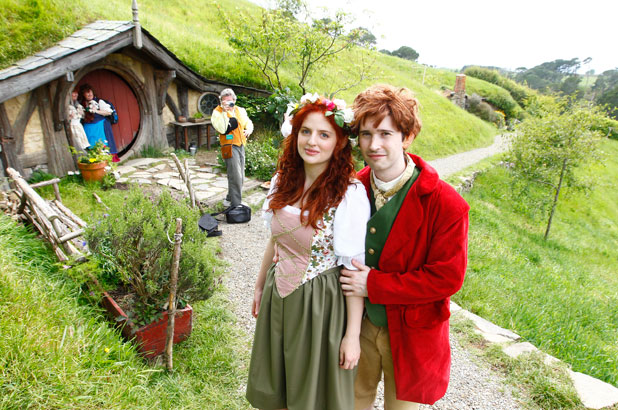
Red Carpet’s Premiere Tour group dressed up for their Hobbiton visit
Red Carpet is steadily adding new locations into its tours in the light of the new Hobbit movie, says director Vic James.
“We’re pretty excited because since the Unexpected Journey came out, we’ve been able to add new sites and new people,” James says. “We visit landowners and check out new locations on a regular basis, as information and invitations come to hand.
“The Premiere Tour last November was the first to visit some of the new places and when the time is right for further landowners to allow visits, we will add them in.”
The north island leg of the tour includes, as before, Hobbiton and the central volcanic plateau that served as Mt Doom. A new feature are some rapids where the dwarves’ more hair-raising barrel-riding scenes were filmed.
The ‘top’ of the South Island is a beautiful addition to the tour, James says. Nelson, with its sunny bay ringed by mountains, is reached by a ferry cruise through the beautiful fjords of Marlborough Sounds. There’s a stop along the way at Pelorus Bridge, scene of Bilbo and the dwarves’ barrel-riding adventures.
Red Carpet’s LOTR tours always include visits to extras, artisans, actors and crew members for the films. Halfdan Hansen, son of the real-life Ringmaker for LOTR, has his studio in Nelson and has created a new version of the Ring, invisibly weighted with some denser metal so that it lies strangely heavy on the palm of the hand.
In Nelson there is also the option to take a two-and-a-half hour helicopter flight to Dimrill Dale and South of Rivendell. The flights have been a huge success with tour guests.
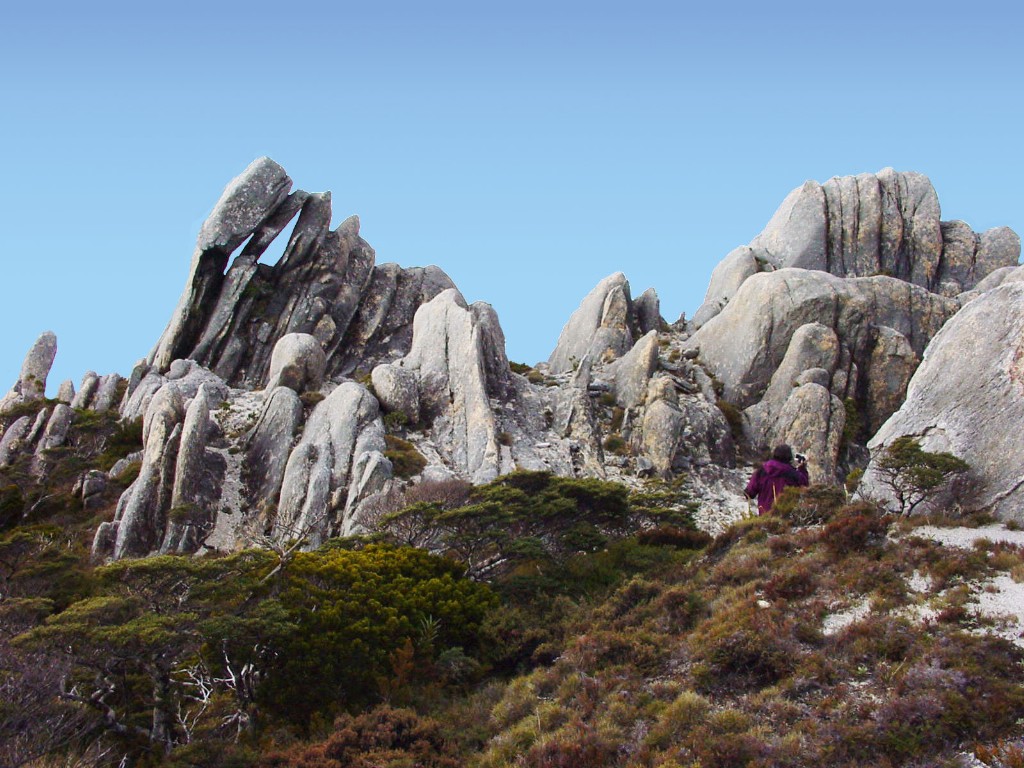
Olympus Rocks – a place to hide from the spies of Saruman
To accommodate the extra locations, tours are now 14 days duration. People can also choose to join the North Island 6 day or the South Island 10 day options. “It’s a long way to come to not see it all,” James says.
In his second of many articles for our worldwide community, Tedoras, long-time audience participant on our TORn TUESDAY webcast brings us a fascinating idea: a lost connection to the Beacons of Gondor perhaps… Read on for a short but very interesting look at how an ancient Biblical account may have inspired Tolkien! Take it away, Tedoras….
————————————————————————————-
The (Biblical) Beacons of Gondor
By Tedoras — special to TheOneRing.net
This past April 28th happened to be the Jewish holiday of Lag B’Omer (the 33rd day of the Counting of the Sheaves, to be more precise). Now, you are probably wondering how this little-known holiday relates to The Lord of the Rings(and, if you’re like me, you’d like to know what a “sheaf” is, too). It turns out a sheaf is a bundle for cereal plants—fortunately for us all, though, my story has nothing to do with Biblical agriculture. Rather, it begins with The Return of the King.
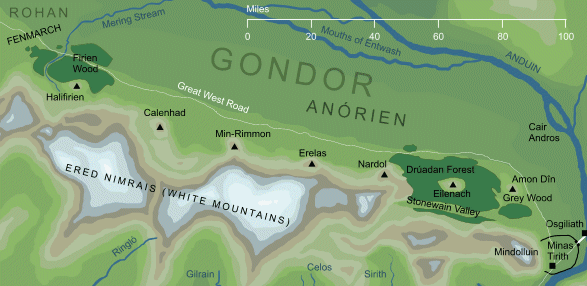
If you are like me, you love those amazing fly-by shots from The Lord of the Ringsfilms. One of the most epic sequences of such shots is the lighting of the beacons in ROTK(refresh your memory here). Whether your first encounter with these mountaintop fires was in literature or film, you probably thought it was an ingenious mode of communication. Certainly, they are by far the best means for sending urgent messages across long distances (and I hope the Gondorian who urged their construction was handsomely rewarded). In order to see the connection between these beacons and the aforementioned holiday, it is important to know the story of Lag B’Omer.
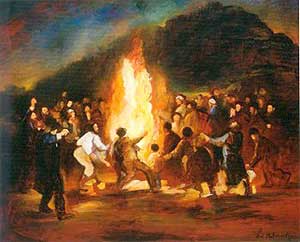
In short, Lag B’Omer commemorates a revolt in the year 131 CE. The Israelites, under the leadership of Bar Kochba, rose up against the Romans, who ruled the land at that time. Years before the Romans came, the Israelites had built a series of m’durot, or bonfires, upon the surrounding mountains. So, when the revolt began, (you guessed it) Bar Kochba ordered a beacon lit. A soldier took a torch to the top of a mountain, lit one the beacons, and thus sent word around the land that war had begun.
Certainly, the use of the beacons of Gondor to call for Rohan’s aid is reminiscent of this episode. Yet, was Tolkien inspired by this Biblical tale in his creation of the beacons? On the one hand, we know Tolkien was well-versed in the Bible; his contemporaneous English education saw to that. Furthermore, Tolkien was a lifelong scholar—thus, if not in school, it is likely he would have encountered this story on his own. Assuming Tolkien was acquainted with this tale, the unanswerable question here, of course, is whether or not he consciously recognized the Bible as their source.
However, on the other hand, a case can certainly be made that Tolkien knew not of the story of Bar Kochba’s revolt. For a realm the size of Gondor, it would make sense to have a system for mass-communication in the event of any important occurrence. And, while these beacons also housed fresh horses on stand-by for couriers, it is clear that signal fires would be a much faster means. The independent invention of the beacons is not only possible in terms of the technology available to Gondor at the time, but it is also becoming of the prudence and wisdom of the Gondorian kings of Old.
This is one of many familiar situations to us Tolkien fans: is there a “right” answer here? Personally, I do not think it really matters; I intended only to present a surprising and uncanny resemblance upon which I happened to stumble. But, of course, such a topic is up for interpretation—so I will let you decide for yourself.
The Weta World Tour continues in June with Supernova. Starting June 22nd-23rd in Sydney and June 29th-30 in Perth, fans will get a chance to come together to celebrate what they love about the pop culture. The team from Weta will also be making the trip to both places bringing their magical work creating Middle-earth with them. While at their booth make sure you grab one of their Weta Treasure cards, which is good for discounts or prizes via the Weta website. That’s not all! If you happen to be going to either of these locations you will get to meet cast members of both The Hobbitand The Lord of the Rings. So make sure to get your ticket to the show before it sells out!
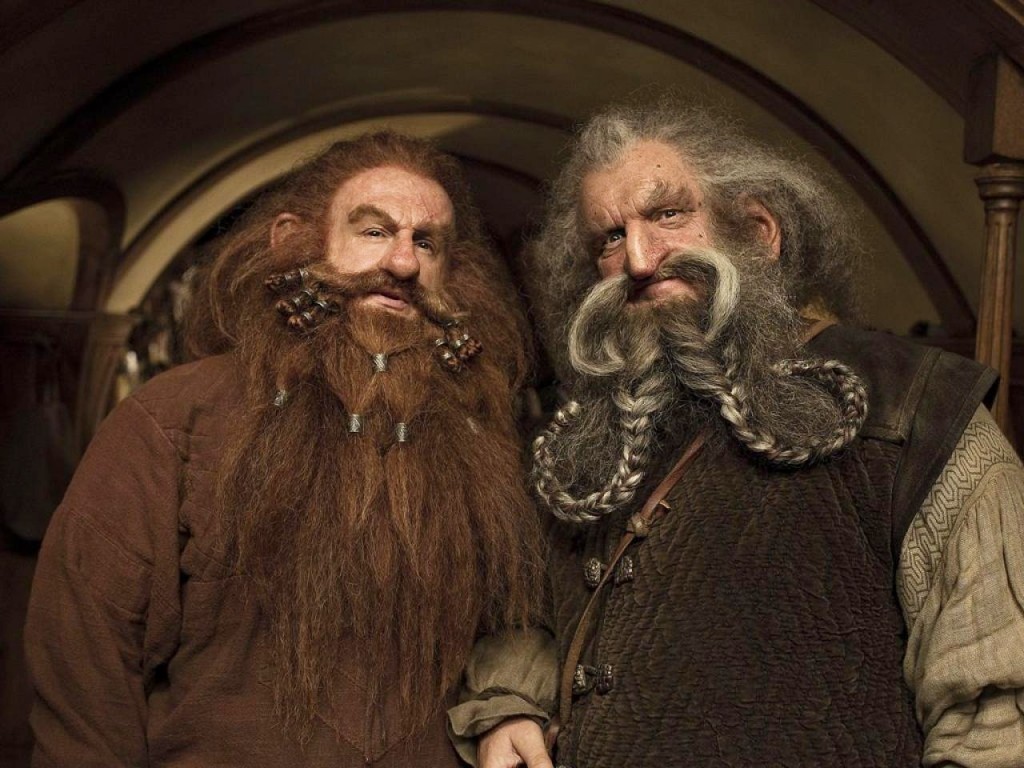
Welcome to our weekly live webcast — known as TORn TUESDAY — a unique show format where you can come into the chat and participate live. We are now on the 4th part of our ongoing series of discussions on the History of the Dwarves who undertake the Quest of Erebor. Today we switch gears to discuss OIN and GLOIN (father of our Fellowship member Gimli) and learn about the great fate tying up these characters in the House of Durin’s Line! Bring your questions and join us LIVE for what will be a very illuminating discussion of dark Dwarven secrets! We have *JUST* confirmed that our actors playing these roles have been whisked away to the studios in Wellington, where Peter Jackson has commenced new shoots for The Hobbit: The Desolation of Smaug!
Join us for TORn TUESDAY every week at 5:00PM Pacific: brought to you by host Clifford “Quickbeam” Broadway and producer Justin “I Haven’t Read The Books Yet” Sewell — as we discuss the unique characteristics of each Dwarf. We shall learn how they fit into the larger history of Tolkien’s legends — and what Peter Jackson & WETA did to help us distinguish these rough and tumble travelers from each other (using more than just colored hoods). Our innovative live show includes worldwide fans who join us on the Live Event page with a built-in IRC chat (affectionately known as Barliman’s Chat room). Be part of the fun and mischief every week as we broadcast *live* from Meltdown Comics in the heart of Hollywood, U.S.A.!
NEXT WEEK: Bifur, Bofur….. and Bombur, for real this time!
——————————————————————-
Follow Cliff ‘Quickbeam’ Broadway on Twitter: @quickbeam2000
Back in September 1999, these were the questions on the minds of fans…
Q:What role did Glorfindel play after the incident at the Fords of Bruinen? I don’t remember any further mention of him and it seems strange that such a noble Elven Lord would not be involved at all in the War of the Ring.
– Quinton Carr
A: He wasn’t. But if you think about it, many “noble Elven lords” did not do anything *active* in the War after the Fellowship left Rivendell or Lorien. Elrond, Celeborn, noble Elven ladies like Galadriel, Arwen . . . their roles were peripheral. Not to mention the fact that I’m sure both Elrond and Celeborn had a goodly number of strong, well-armed Elves at their disposal, who didn’t go with the Fellowship *or* down to the battles in Gondor. But the answer is actually pretty simple, and Elrond gives it to us in “Fellowship:” “The number must be few, since your hope is in speed and secrecy. Had I a host of Elves in armour of the Elder Days, it would avail little, save to arouse the power of Mordor.” So that explains why none of them went with the Fellowship. Why did none of these mighty Elves save Elrohir and Elladan ride down to Gondor once it was clear that there would be battle? My answer has a couple of parts. Firstly, Elrohir and Elladan, according to the Tale of Years, were born after the wars at the end of the Second Age when Sauron was thrown down, and were not a party to them as their father was. They’d never gotten their “chance,” so to speak. As for the rest of them, they had all gone to war against Sauron at the end of the Second Age. They felt their time had passed, and moreover that the hour of the Secondborn was striking. They knew that the power of their Rings would fade if Frodo was successful, and that Men would rise and Elves would dwindle. They must have felt it was right for the men, i.e. the armies of Gondor and Rohan, to earn for themselves the privilege of ushering in the Fourth Age.
It’s been over 12 years since some of these common Tolkien related questions have been answered, so what better time then to repost some of them for the newbies. Contained in this post are some newbie classics….Why do the Eagles always show up at the last minute? Why did Sauron not just come forth to war? Why do the Black Riders seem to be so weak? Read on…
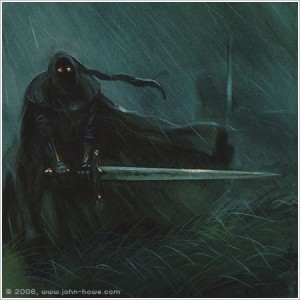
Q:Greetings masters of lore. My question deals with the Nazgul. I know of Khamul, but I have not found the names of the other Nazgul. If they had names, what were they as well as who were they prior to their transformation? Furthermore, is there any story about their creation and why Sauron decided to choose them specifically?
-Reginold
A:Khamul seems to be the only named Ringwraith. What we know of him is given in the section “The Hunt for the Ring” in Unfinished Tales (1980). He was second to the Chief, and his name is given as Khamul the Shadow of the East. Some more about the Nazgul, or the Ulairi, can be found in some of the volumes of the History of Middle-earth, particularly in the section “The Story of Frodo and Sam in Mordor” in Sauron Defeated (1992), and in the work on the Appendices to The Lord of the Rings as printed in The Peoples of Middle-earth (1996). But, unfortunately, the histories of the men who became the Nazgul seems nowhere to be specifically illuminated. Continue reading “Questions and Answers – Eagles, Sauron and Ringwraiths – Oh My!”




 Q:
Q: