Longtime Wētā Workshop designer Daniel Falconer presented a treasure trove of thoughts, images, and lore to a gathering of MegaCon Tolkien fans in Orlando this past weekend.
Falconer’s presentation was entitled, “WETA: Delving too Deep? A Tolkien Nerd’s Stories Designing for the Lord of the Rings films,” – but let me tell you, fellow nerds, Falconer delved the PERFECT amount.
The panel was the first time that Wētā Workshop had ever attended MegaCon Orlando, and provided a rare chance for fans of the Lord of the Rings books and movies alike to look at details from the artwork that touched upon all of the history embedded in the appendices of Return of the King.
The design work of these movies has always been some of the most fascinating parts of the production, not just because fans were provided a glimpse behind the scenes via the DVD Extras, but also because it has always been clear that the artists were bent on creating close to the same historic resonances that Tolkien infused into his works.
Falconer asked that we not share photos of any of his slides and I will abide with his request, but I’ll attempt to describe some of the fantastic details as best I can.
The Nine
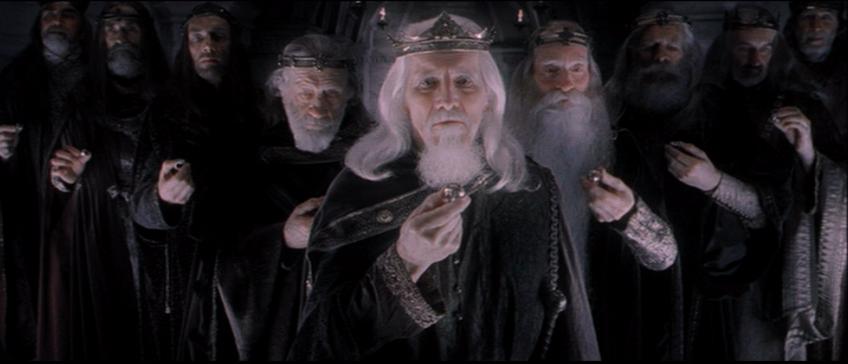
For example, one of the opening slides that Falconer showed was an extremely important but not often dwelt upon detail: What did the Nine Rings for Mortal Men actually look like?
The Nine actually had two different designs, Falconer said. For the living kings, the rings had a red stone encircled by a spiked crown, and the likeness of each king engraved onto the side of their ring. But the rings changed when they became wraiths, with the design becoming both harsher and simpler. The kings’ engraved likenesses turned from faces to skulls. “But this change is never seen because the wraiths are too bright to show the detail of their rings,” Falconer concluded.
Details like this just kill me. Get ready for some more…
Sting
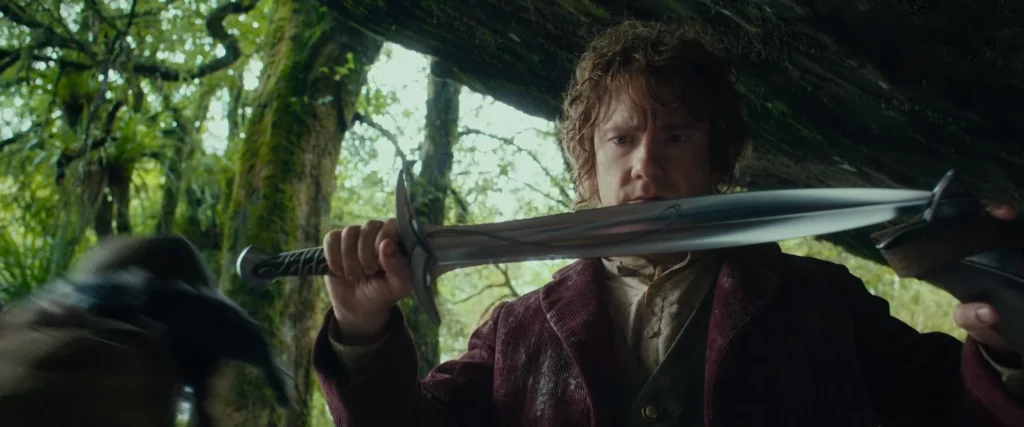
Falconer said that he was just thrilled when his design for Sting made it onto the screen. The inscription on the blade was done by David Salo, who wrote out the Elvish for “Sting is my name, and I am the spiders’ bane.”
Of course, this caused a bit of a continuity concern for The Hobbit, Falconer said, because Sting would not have the inscription on it BEFORE Bilbo named it Sting. So the design for Sting does not have the inscription when Bilbo finds it. Falconer’s head canon is that Bilbo had the inscription added to the blade during his stay in Rivendell, before Frodo joins him.
Glamdring
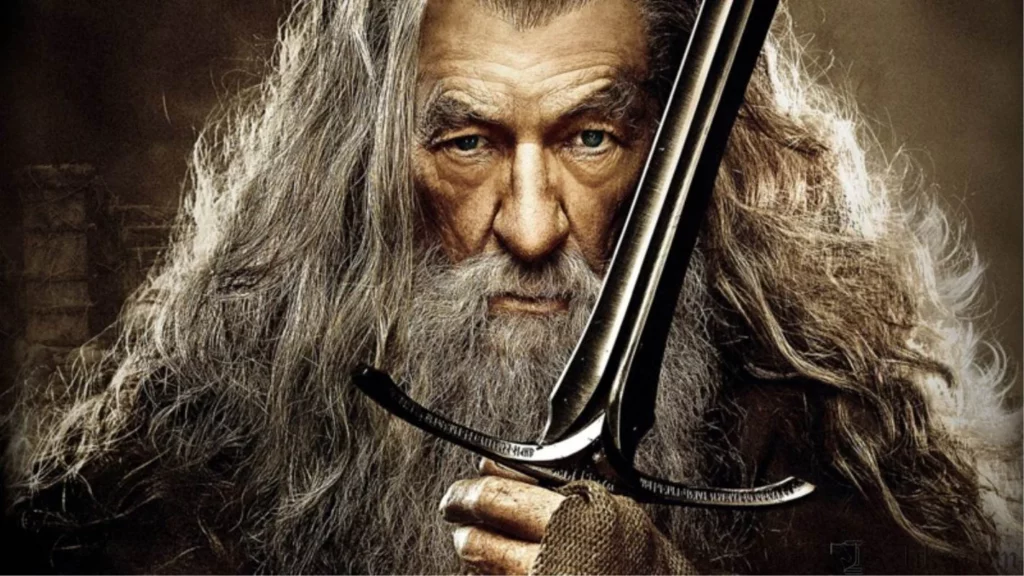
Glamdring also caused a few continuity issues, Falconer said, because Gandalf loses his sword and staff at Isengard, but of course he has to have his famous sword for the rest of the films. So the sword that Gandalf carries to Orthanc is a different sword, with a design based on a longsword that John Howe brought with him to New Zealand, with the idea that Gandalf had left Glamdring in the care of Elrond during his trip to visit Saruman.
“It was interesting seeing John talk his way through customs with that longsword,” Falconer said.
Gandalf’s Staffs
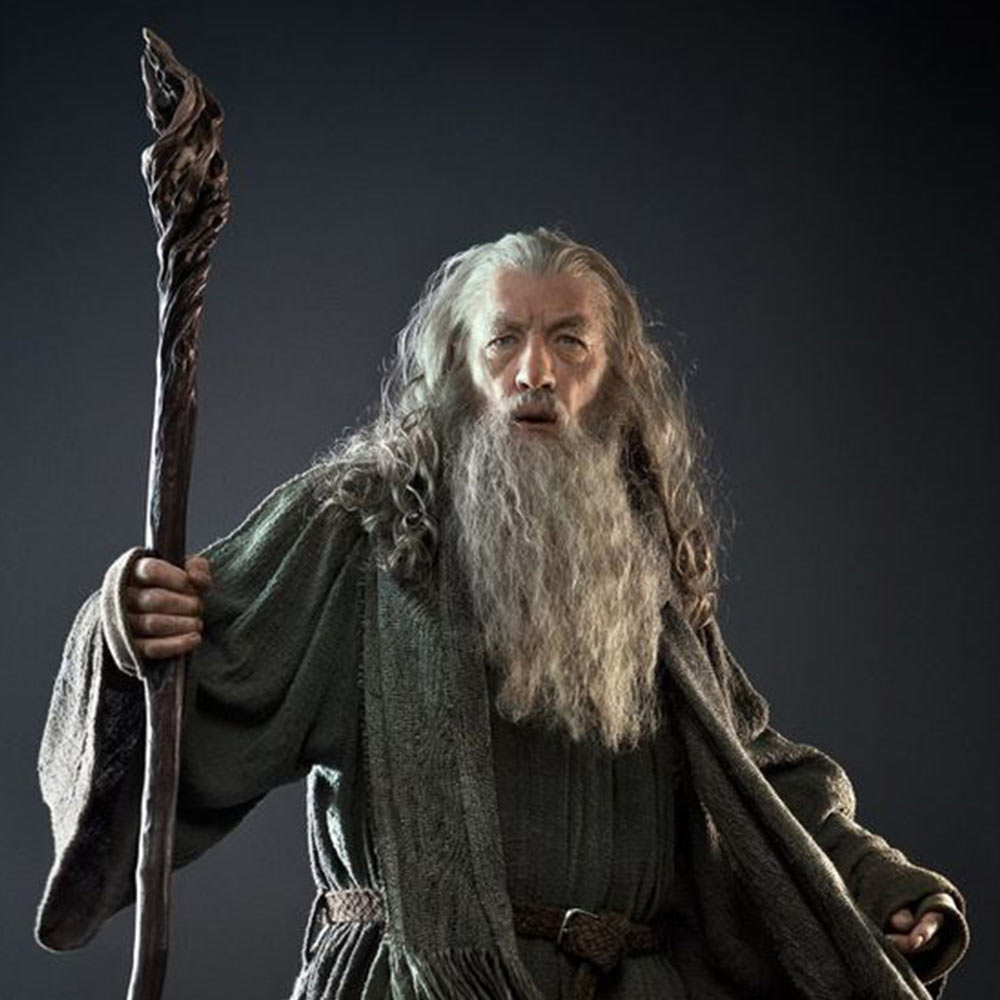
It never occurred to me that Gandalf’s staff changes so often during The Hobbit and Lord of the Rings. Of course it changes when he becomes Gandalf the White, but Falconer revealed just how many times Gandalf has to replace his staff: six!
First is the staff that Gandalf uses to inscribe his initials onto the door of Bilbo’s house. He loses it at some point in The Hobbit movies, and Radagast provides Gandalf with his own staff before the Battle of Five Armies. The staff from Battle of Five Armies gets a few rough pointy bits knocked off before Fellowship of the Ring, and that is what Gandalf uses until he visits Saruman in Orthanc.
He loses that staff in Orthanc along with his unnamed “first sword,” and another staff is made in Rivendell before they set out on their quest.
Finally, Gandalf becomes The White and has a staff that is designed around the shape of flame – because he bears Narya, the ring of fire. But he loses this when he confronts the Witch King, and has to make himself one more staff before the end of Return of the King.
Other Wizard Staffs
Falconer showed us the design for the two blue wizards that were initially going to be in the prologue of Fellowship of the Ring, before they were cut. The designs were much more astrological and Eastern looking than the staffs of Gandalf, Radagast, or Saruman.
(Wētā, if you’re reading this, a 25th anniversary “Concept Art of The Fellowship of the Ring” book should definitely contain all of these unused bits of concept art. Please!)
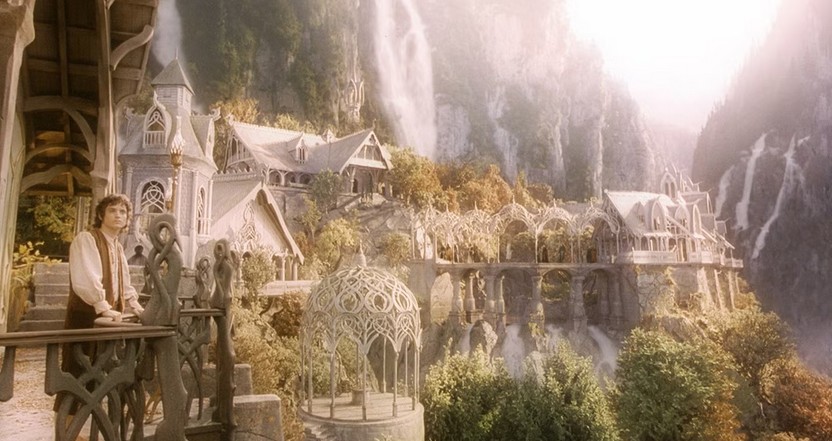
A Look Around Rivendell
Falconer then took us through all of the wonderful historic frescos and objects that Elrond (“A pack rat,” Falconer said) kept around Rivendell.
Sauron’s Missing Ring
Falconer mentioned that Alan Lee painted the mural of Isildur battling Sauron at The Last Alliance for Fellowship of the Ring, but when the mural was brought back for The Hobbit, someone noticed that Sauron did not actually have the One Ring on his finger – Alan Lee painted it in just in time for filming it in The Hobbit, but if you look closely at this mural in Fellowship, it’s still missing.
(As an aside, Falconer said that Rivendell in general had a kind of “Elven magic,” very little set continuity, but somehow it all worked.)
Celebrimbor
Celebrimbor the ring-forger is presented in a that shows him forging one of the Three Rings. But another of the murals in Rivendell resembles the ruins of Celebrimbor’s great Second Age city, Ost-in-Edhel in Eregion, which the Fellowship walks through before encountering the Crebain.
“I asked Alan Lee whether the painting was of Ost-in-Edhel, and he said, ‘Could be,’ so I never really had it verified,” Falconer said.
Gil-galad
Elrond also carefully kept and displayed the shield of Gil-galad after his death at the Last Alliance. Gil-galad’s crest, as drawn by Tolkien, shows a number of four-pointed white stars on a field of blue; the artists took inspiration from this and created livery and a shield that mirrored the crest.
“Elrond also has Gil-galad’s crown on display, but he must not have been thinking too hard about it, because it’s upside down,” Falconer said, showing a picture of Mark Ferguson’s Gil-galad wearing the crown in the other direction.
Aeglos, “Snow-tip” in Sindarin Elvish, the spear of Gil-galad, was designed by Falconer’s colleague at WĒTĀ whose name I was unable to catch (“Incidentally the best man at my wedding,” Falconer said). The inscription on the blade is:
Gil-galad wields a well-made spear
The Orc will fear my point of ice
When he sees me, in fear of death
He will know my name:
Aeglos
Aragorn’s hunting knife is made to echo the design of Aeglos, and has a portion of this inscription on it too.
Arwen (and Idril’s) sword, Hadhafang
Also on display in Rivendell is the sword that was originally designed for Arwen. Here is where my own inner Tolkien geek felt a wash of joy: the sword was designed to be an heirloom from Gondolin, specifically from the princess of that realm, Idril.
Here’s the history: Turgon son of Fingolfin was king of Beleriand’s hidden city of Gondolin. His daughter was Idril Celebrindal. She is better known in Lord of the Rings as Elrond’s grandmother, however. She married the human Tuor and had one son, Ëarendil, who eventually bore the Silmaril on his airship Vingilot; but before that, Ëarendil married Elwing of Doriath and became the dad of Elrond and Elros.
And somehow, Elrond preserved his grandmother’s sword through the third Kinslaying at Sirion, his kidnapping by the sons of Fëanor, the War of Wrath, the drowning of his entire birth country of Beleriand, and finally through a long journey East toward Middle-earth, where he eventually uses it in several battles including the Last Alliance — before he gives it to his daughter.
The inscription on the sword reads, “This blade is called Hadhafang, a noble defense against the enemy throng for a noble lady.” If this inscription was put there by Idril, she had more foresight than just building a secret tunnel out of Gondolin, because “noble lady” translates directly to the word “AR-WEN.”
Amazing, learning this detail alone justified my entire con experience!
Two figures on a boat
Given that this Rivendell mural displayed TWO figures on a boat instead of ONE figure and a BIRD on a boat, I can assume that this is Idril and Tuor aboard the boat Eärramë, off to vanish into the West. I did not get to verify this with Falconer, however.
The Scepter of Annúminas
Why does Aragorn wear a wingéd helm during his coronation instead of a crown? It’s because there isn’t a crown.
Elrond keeps the actual indicator of Aragorn’s kingship, the Scepter of Annúminas, at Rivendell because he’s the keeper of all the important Dunedaín artifacts until there’s a king of unified Gondor and Arnor again. He brings it to Aragorn upon the midsummer wedding of Aragorn and Arwen.
Elrond’s Telescope
This detail slew me. “Elrond has a telescope because his father is a star,” Falconer said. The telescope was a gorgeous and graceful fall of art nouveau lines, decorated with a small paean to Varda, or Elbereth, the Valar who created the stars.
Gimliand the Caves of Aglarond
Falconer showed us concept art of the Caves of Aglarond beneath Helm’s Deep. He said that one of the original endings to Return of the King showed Gimli’s life post-quest, as the lord of Aglarond. The art department created a jeweler’s glass for him to use while at work on the gems of these caves.
“But we had plenty of endings already,” Falconer said.
Falconer also showed us details of the Book of Mazarbul from the Mines of Moria, based on Tolkien’s own drawing of the cover. Incidentally, Tolkien wanted his own illustration of it to be in Fellowship of the Ring, but it proved to be too costly for Unwin & Allen to publish.
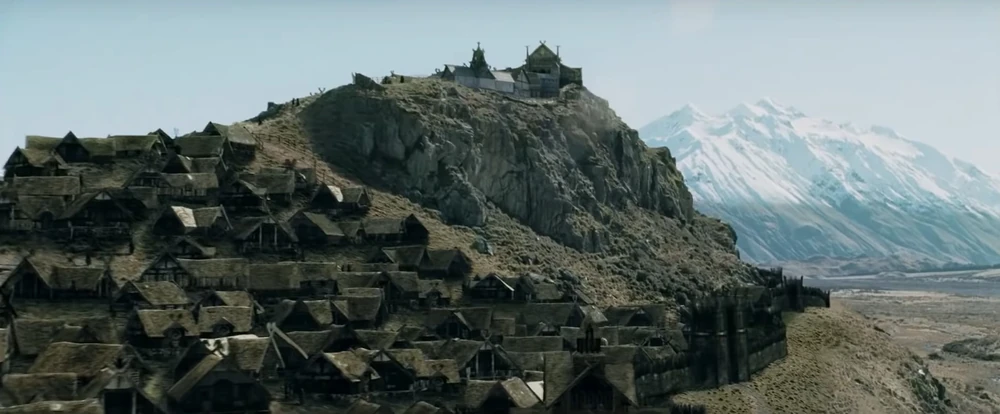
Edoras
Falconer showed close-ups of the hangings from around Meduseld. The hangings are scenes from the history of the Horse-lords. (If you are at all interested, this history is nicely summarized in Unfinished Tales Part II: Chapter 3.)
I noticed Scatha the Worm fighting Fram, and Eorl the Young pledging his friendship to Cirion the Steward of Gondor, among other moments.
Knights of Dol Amroth
We got to see some of the original concept art for the Knights of Dol Amroth. These were not used in the movies, but the banner (a swan and a ship, argent, on a blue field) shows up at the Battle of Pelennor Field.
“These were some of the first pen-and-ink drawings we did in the days before Photoshop, and we’d all played Dungeons and Dragons, so the designs were straight out of the rulebook from the 80s,” Falconer said.
“Elves are Art Nouveau, Dwarves are Art Deco”
You’ve probably seen the meme around the internet that proclaims that the way to tell the difference between the Art Nouveau and Art Deco styles are via their Tolkien race.
I asked Falconer if he was aware that Wētā actually set the agenda for this meme.
“I have seen that meme, but for a little while, Elves were going to be Art Deco with lots of angles and points. And even before that, we took inspiration from Moorish design,” Falconer said.
“So when did the trend toward Art Nouveau begin for the Elves?”
“Probably when Alan Lee designed those columns.”
So there you have it.
Please return
There was a lot more to Falconer’s panel — about the continuity of Gollum, different types of Ents, and the shape of the Fell Beasts — but I think I’d better just leave us all wanting to see it again.
We’ll get to see everyone from Wētā over here again soon, right?!
Back in the middle of March we began our annual tournament of Middle-earth March Madness: with this year’s theme being The Art of Middle-earth. Three weeks and thousands of votes later, the Grand Champion 2025 has been decided.
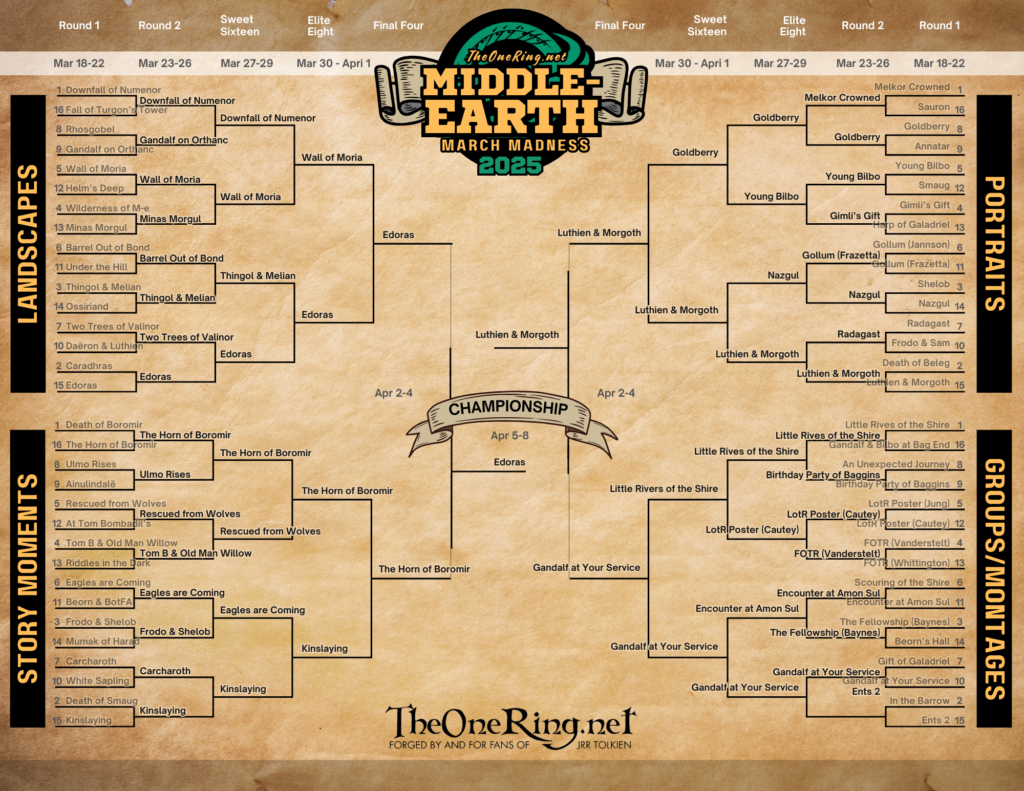
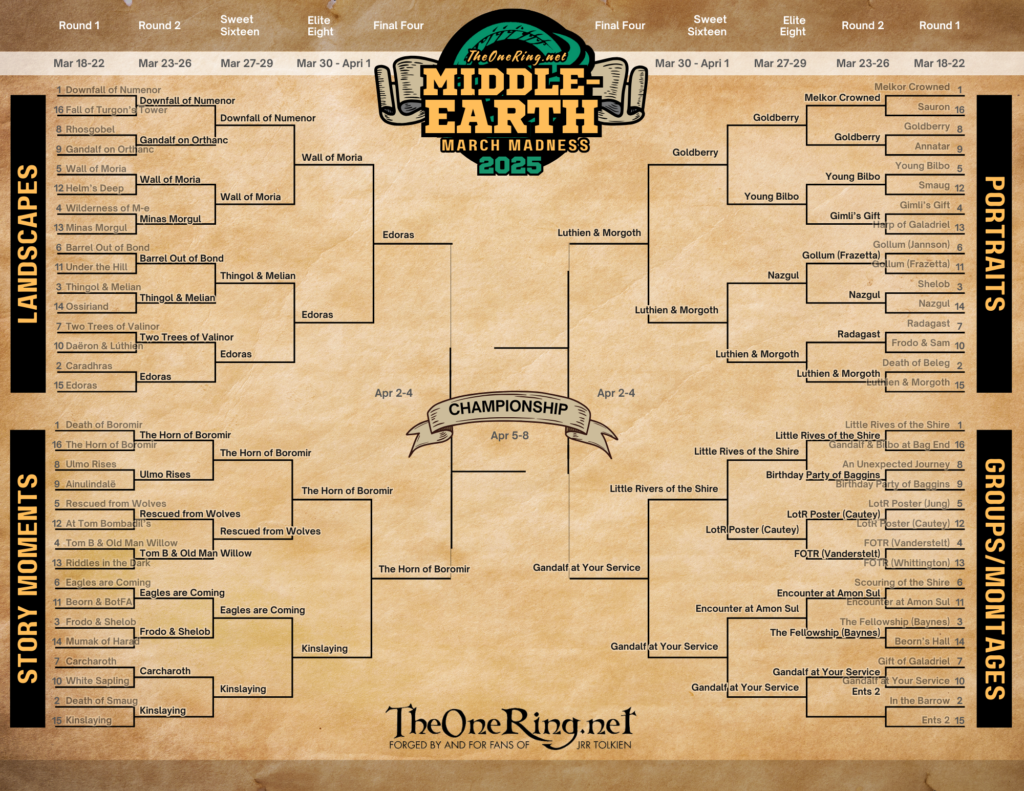
Here’s how the bracket looked this year:
Down to the last battle
The Final
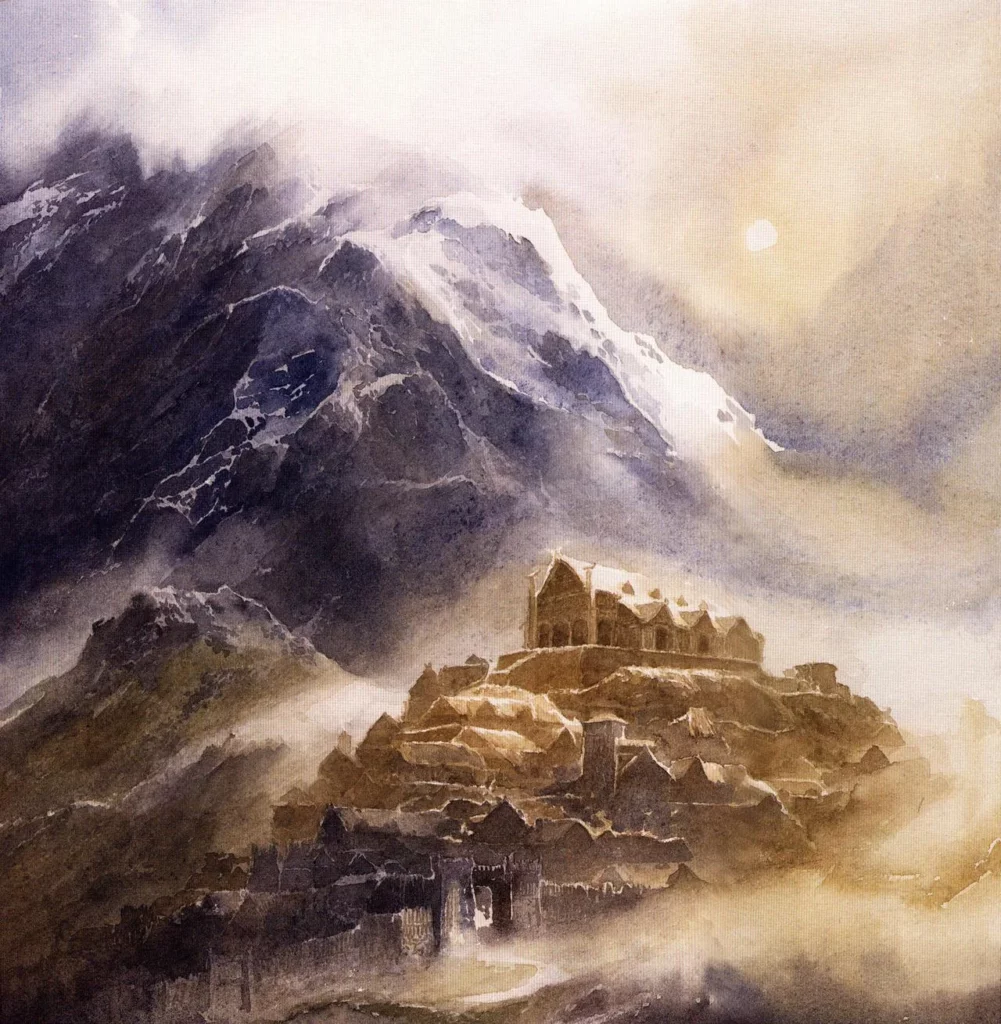
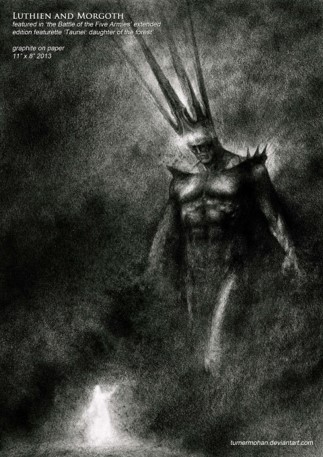
Alan Lee’s Edoras faced Turner Mohan‘s Lúthien and Morgoth; a very familiar scene from a well-known artist, and a First Age scene from a lesser-known artist. Both are stunning works, filled with shadows and light; but starkly contrasting. One is a landscape with no figures; the other shows two figures with no discernible landscape.
EdorasLúthien and Morgoth
Their journeys to the final battle were also very different. The closest fight Edoras had to face was against Donato Giancola’s Walls of Moria, which claimed 45% of the vote. In the rest of the matchups, Alan Lee’s piece won by margins in the 70s and 80s percentage-wise. Mohan’s piece, on the other hand, only ever won by numbers in the 50s; in the second round, only ONE vote separated Lúthien and Morgoth from its competitor, Angelo Montanini‘s Radagast the Magician. A beautiful piece and a very worthy competitor, nonetheless Lúthien and Morgoth had to fight harder to make it to the final.
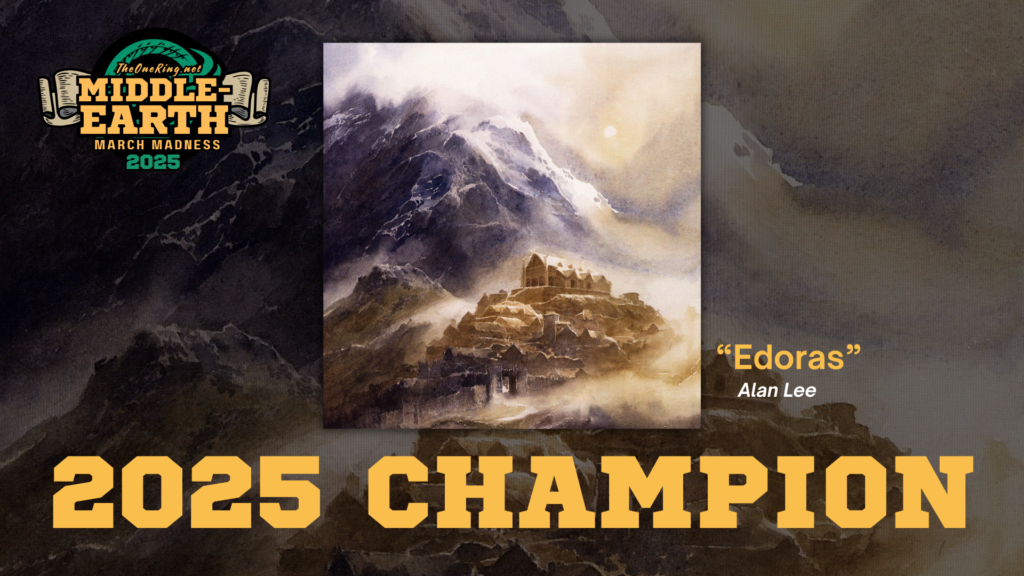
So it is perhaps not a surprise that this year’s Grand Champion of Middle-earth March Madness is:
Staffer Madeye Gamgee shares his thoughts on the winner:
It has been a steady, even overwhelming Ride of the Rohirrim finally bringing the gritty endurance of the Lúthien/Morgoth faceoff to the end of its exciting underdog run! The most serious competition that Edoras faced during the tournament came against Donato Giancola’s The Walls of Moria, a 55/45 matchup; even while Mohan’s Lúthien and Morgoth escaped from two of its matchups with a combined total of six votes. This has been by far the most competitive contest across the entire field that I can remember over many years of Middle-earth March Madness — a testament to the wide appeal and high quality of every artist featured. Here’s hoping that prints of some of their works have found new homes! I know they have in mine! Did you find a new piece to hang on your wall?
Special thanks to artists Jerry VanderStelt, Ted Nasmith and Donato Giancola, who took the time to chat with us on livestreams, and to tell us about their work and their love of Tolkien. (You can see those conversations on our YouTube channel.) And of course thanks to all of YOU, who joined the fun and voted! See you for more Middle-earth March Madness next year!
We come to it at last: the great battle of our age – or at least of Middle-earth March Madness 2025: The Art of Middle-earth. Round Six is here – the final showdown, between the last two remaining works of art. But which piece will be crowned Grand Champion? There can be only one! Voting is open now!
Down to the last battle
Let’s take a look at how the Semi-finals played out:
The Horn of Boromir vs Edoras
Both of these paintings have proved very popular throughout the contest, winning fairly convincingly at each round. The love fans have for Peter Jackson’s movies perhaps inclines them to vote for art which reminds us of those films; and in addition, there is no denying that these are both extraordinary works. In this Final Four round, however, Matthew Stewart’s Boromir could not bring much opposition to the Golden Hall; Alan Lee’s masterpiece is through to the final, with almost three quarters of the vote.
Edoras by Alan Lee
Lúthien and Morgoth vs Gandalf at Your Service
In stark contrast to the other Semi-final, this was indeed a battle for the ages! Every time we checked on the latest tally, the lead had changed. Sometimes Turner Mohan led by 1%, and sometimes David Wenzel claimed back the thinnest margin. Clearly these two very different pieces have captured the imagination of voters! Finally, as the polls closed at midnight last night, the piece edging over the line – by a margin of just five votes! – was Mohan’s dark image. (This wasn’t the first narrow escape for this finalist, having survived an earlier round by a single vote. Is it the power of Morgoth or of Lúthien which keeps just managing to secure victory?)
Lúthien and Morgoth by Turner Mohan
And so – the Championship Round of Middle-earth March Madness 2025 is between Alan Lee’s Edoras and Turner Mohan’s Lúthien and Morgoth. Which will you choose? Voting is now open!
How does it work, you ask? Simple! Click on the button below. This will take you to the voting site, where you can view the entire bracket – including looking back at all 64 individual works in all their glory (and details of the artist), should you wish! Place your votes for Round Six: Championship!
Staffer Madeye Gamgee shares his thoughts on the Championship Round:
We have our Grand Championship matchup! We have ethereal Edoras, gleaming through its foggy backlit haze with glowing promise despite a menacing and dark mountainous backdrop. This piece has the pedigree of one of the most renowned and active Tolkien artists of our time, the incomparable Alan Lee. It is both haunting and familiar, firmly set in The Lord of the Rings lore when we first see the Golden Hall in The Two Towers.
And we have lesser known Turner Mohan, a fantasy illustrator from NYC who has largely worked in pencil and pen, and is beginning to work more and more in watercolors. He also dabbles in crafting medieval armor, which might explain Morgoth’s particularly imposing form in this piece. His Lúthien and Morgoth is rooted in Tolkien’s great First Age love story from The Silmarillion, the tale of Beren and Lúthien: their hopelessly herculean quest to wrest a Silmaril from Morgoth’s crown as the bride price demanded by the elf princess’s father. Just as Lúthien overcame impossible odds through her art of song, might the strength of Mohan’s muse prove similarly compelling to our voters?
Let the Madness come to an end and our 2025 winner be crowned, whether in golden light or a dark iron crown. It’s up to the fans to decide!
You have until 6pm ET on Tuesday April 8th to vote in Round Six; that evening on TORn Tuesday we’ll look back over the whole Middle-earth March Madness contest, and reveal the winner. It’s your last chance to make your vote counts – rally the troops! Vote now!
Two weeks after Middle-earth March Madness 2025: The Art of Middle-earth began, we have reached Round Five – the Final Four. Each regional bracket has a winner; now the Semi-final will decide which two masterpieces go through to face off in the Grand Final. Voting is open now!
Final Four – how the bracket looks
Let’s take a look at each bracket winner:
Landscapes
Donato Giancola’s Walls of Moria went toe to toe with Alan Lee’s Edoras. These are two incredible paintings of landmark locations in Middle-earth – how to choose between them? In the end, the Golden Hall was the one which drew the most votes: Edoras is through with three-fifths of the vote.
Edoras by Alan Lee
Story Moments
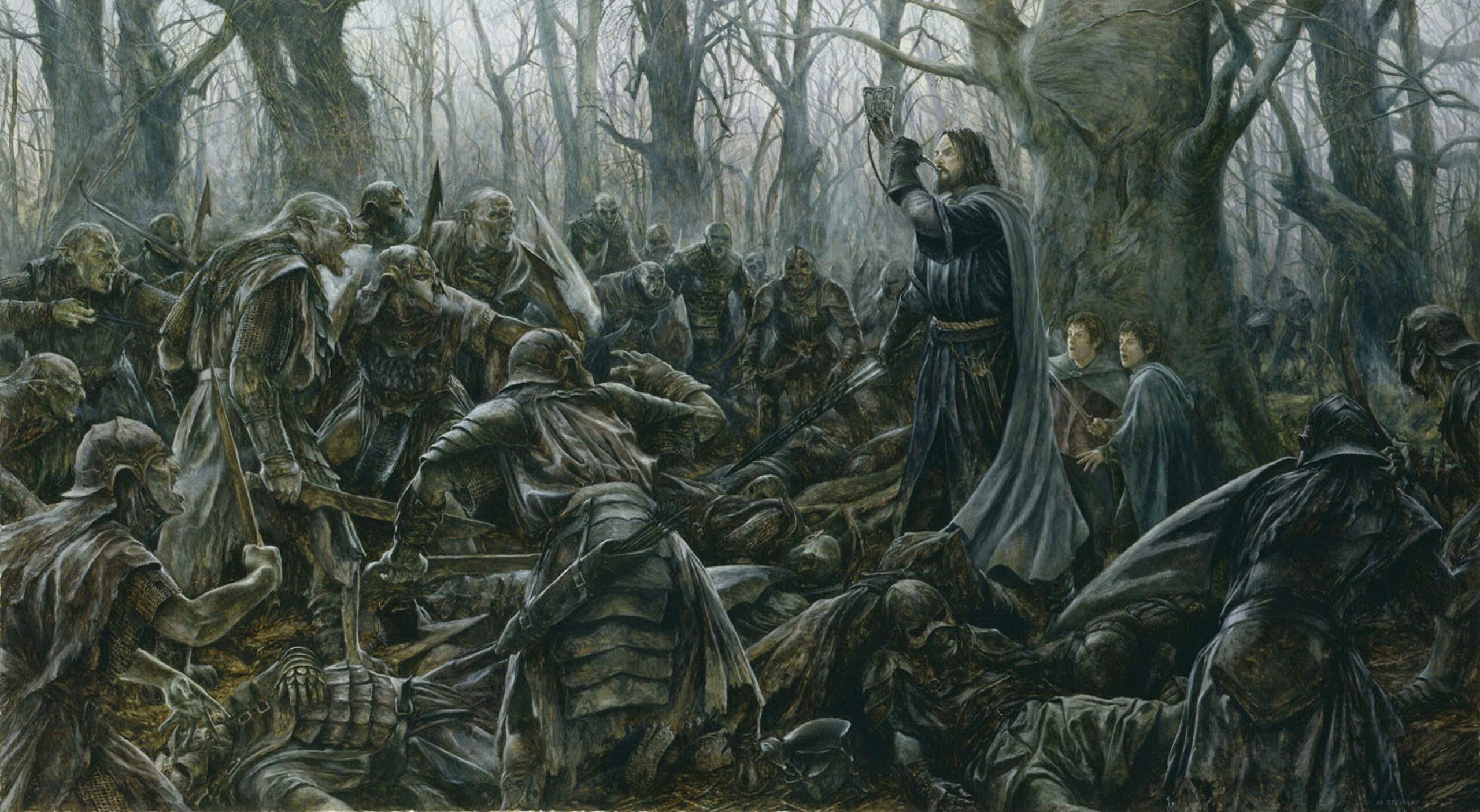
This was another close battle, as Matthew Stewart’s The Horn of Boromir took on Ted Nasmith’s The Kinslaying at Alqualondë. That’s a familiar scene from The Lord of the Rings (and with strong echoes of Peter Jackson’s movie) vs a First Age scene – perhaps a less familiar tale to many? Or a dark, gritty battle scene vs a beautiful, starlit, ethereal, but on close inspection equally (or even more) gruesome depiction of slaughter. How did you vote? Ultimately, The Horn of Boromir claimed 54% of the vote; so two familiar sights (and sites!) for movie lovers will meet in the first Semi-final pairing: The Horn of Boromir vs Edoras.
The Horn of Boromir by Matthew Stewart
Portraits
Two VERY different artworks met in the final of this bracket: Anna Lee’s serene and blissful Goldberry vs Turner Mohan’s striking, dark Lúthien and Morgoth. I know which one I’d rather have on my wall! BUT there is something mesmerising and extraordinary about Mohan’s smokey black work, with a tiny, luminous Lúthien boldy facing a giant foe. It won the heart of fans, but not by much; the final vote tally was 56% to Mohan.
Lúthien and Morgoth by Turner Mohan
Groups/Montages
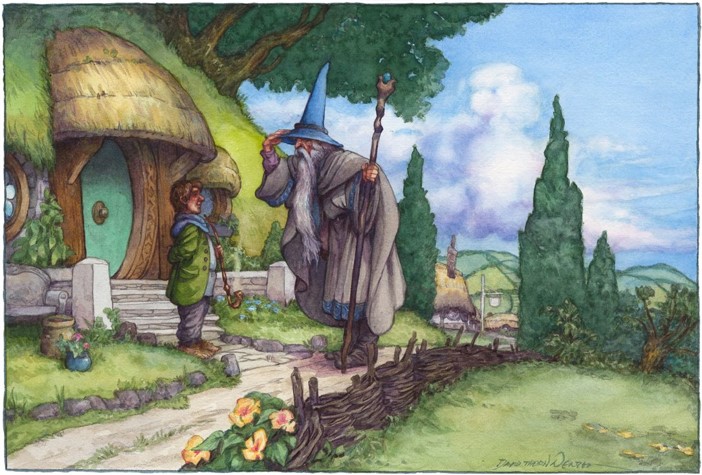
Once again, the closest battle was in this region, where two idyllic Shire scenes fought it out. David Wenzel’s Gandalf at Your Service features two very well-known characters – Gandalf and Bilbo; whereas in Soni Alcorn-Hender’s Little Rivers of the Shire we don’t know who the two Hobbits are. Perhaps they are Halflings we know and love; or perhaps they are peripheral characters: children who once cheered Gandalf’s fireworks, or regulars at The Green Dragon. Either way, it’s a beautiful scene which draws the viewer in. I think we’d all like to visit either of these illustrations; and it was clearly hard for voters to make a choice. The victory in the end went to David Wenzel, 52% to 48%; making our second Semi-final pairing Lúthien and Morgoth vs Gandalf at Your Service.
Gandalf at Your Service by David Wenzel
Only two of these magnificent pieces can go through to the final; how will you make your choices? Vote now!
How does it work, you ask? Simple! Click on the button below. This will take you to the voting site, where you can view the entire bracket, and also view individual works in all their glory (and details of the artist). Place your votes for Round Five: Final Four!
Staffer Madeye Gamgee shares his thoughts on the Final Four:
So, in the Final Four, we have an all Lord of the Rings semifinal, putting an epic and glowing Edoras against a gritty and highly detailed last stand from Boromir. The second match features the sharp contrast between the bright, Hobbity Shire scene featuring Bilbo being wooed toward adventure by Gandalf, versus the dark depths of Angband and Lúthien’s desperate confrontation with mighty Morgoth.
The Final Four is a study in the dark versus light contrasts that so vividly embody the breadth and depths of Tolkien’s subcreation. Think Bilbo and Gollum and their riddle game, Éowyn versus the Witch-king, Denethor’s pyre in the inner sanctum of the White City, or the beauty and horror of Alqualondë that Ted Nasmith so beautifully captured. It is fitting that these artistic tensions are so fully present with our four finalists.
You have until the end of the day Friday April 4th to vote in Round Five; on Saturday 5th we’ll start the Championship Round! So place those votes!
And then there were eight… Middle-earth March Madness 2025: The Art of Middle-earth Round Four voting is open now! And we have a GIVEAWAY for you to enter! And if that were not enough, we have livestreams today and Tuesday with very special guests! Read on to find out more…
How the art works lined up in the Sweet Sixteen
The battles are getting closer; in Round Three, most victories were by a margin of less than 60%. The biggest conqueror was Matthew Stewart’s The Horn of Boromir, which took over 70% of the votes to defeat Michael Hague’s Rescued from Wolves. It seems people have a soft spot for art which echoes Peter Jackson’s movies.
The Horn of Boromir, by Matthew Stewart
In the Groups/Montages region, there was one match up which went right down to the wire. In the end, David Wenzel’s Gandalf at Your Service (from his The Hobbit graphic novel) beat Eric Velhagen’s Encounter at Amon Sûl. The charms of the Shire overcame the dynamic but violent battle with Ringwraiths – but by a margin of only 4% of the votes.
Gandalf at Your Service, by David Wenzel
So now we are down to the final pairing in each of our four regions. This Elite Eight features some big names in the world of Tolkien art; and some with which you may not be so familiar. Which will go all the way, to become the Grand Champion of 2025? If you can predict that, you might be one of our lucky winners!
Thanks to our good friends at Warner Bros. we have copies of The Lord of the Rings: The War of the Rohirrim to giveaway. (What better way to celebrate the Art of Middle-earth than with this epic anime film?) During the Elite Eight round, you can enter to be in with a chance of winning, by guessing which of the remaining masterpieces you think will be the ultimate victor. Simply complete this form with your prediction; once Middle-earth March Madness is over, we’ll pick winners at random from those who successfully predicted the Grand Champion. (Sorry, this giveaway is only open to residents of the USA or Canada.)
Then make sure to give your chosen winner the best chance, by VOTING!
How does it work, you ask? Simple! Click on the button below. This will take you to the voting site, where you can view the entire bracket, and also view individual works in all their glory (and details of the artist). Place your votes for Round Four: Elite Eight!
Staffer Madeye Gamgee shares his thoughts on the pieces in the Elite (or ‘Elegant’ or ‘Engaging’) Eight:
In Landscapes, iconic Lord of the Rings scenes by incredible and well-know masters of their craft, Donato Giancola and Alan Lee. These two have emerged from possibly the strongest region, stacked with well-known artists and strong lesser know ones
In Story Moments, a focus on tragedy and death, curiously, whether it’s Boromir’s last tragic stand and redemption, or one of the darkest days (literally) in the story of the Silmarils, a mixture of beauty and Elven genocide.
-In Portraits, it’s light against dark in a battle of divine strength, with the fair (and powerful) River Daughter facing the specter of Morgoth, perhaps drawing inspiration from Luthien’s triumph in a similar artistic match
In Groups, perhaps a surprising and much more peaceful pairing, and all Shire-centric, with David Wenzel’s familiar meeting between Gandalf and Bilbo up against, well, who are those hobbits fishing by the little Shire river? It seems like a wonderful spot to look for a more peaceful adventure!
You have until the end of the day Tuesday April 1st to vote in Round Four; on Wednesday 2nd the Final Four will begin! But first – please join us TODAY, Sunday 30th, for a very special livestream. 3pm PST/6pm EST Ted Nasmith will join us, to discuss his incredible The Kinslaying of Alqualondë, which features in the ‘Story Moments’ bracket. Then join us again on Tuesday 1st April, when artist Donato Giancola will be with us during TORn Tuesday to discuss his masterpiece The Walls of Moria. We hope you’ll be there to hear from both these fantastic artists, as you make decisions on the Elite Eight round. And don’t forget to VOTE!
And just like that, we’re on to Round Three of Middle-earth March Madness 2025: The Art of Middle-earth. From 64 works of art which started in the four brackets, now we’re down to the Sweet Sixteen; and in this round, you only have three days to vote. Round Three voting is open now!
Round Two for the most part had pretty clear winners in the match ups. The one VERY close battle was between Angelo Montanini’s Radagast the Magician and Turner Mohan’s Lúthien and Morgoth. These two very different works were in a stalemate for most of the round. A brief flurry of votes in the final hour saw them continue to swap places for the lead, until finally, when voting closed, Mohan’s extraordinary work come out the victor – but by just ONE VOTE!
Lúthien and Morgoth by Turner Mohan
One perhaps surprising departure in Round Two was John Howe! His Barrels out of Bond was narrowly defeated by Kip Rasmussen’s Thingol and Melian, which claimed 56% of the vote. Both are gorgeous pieces; it just shows how difficult it is to choose when all these artists are so talented, and their visions are so different. It now looks like Alan Lee and Donato Giancola may meet in the Elite Eight, to decide the overall winner in the ‘Landscapes’ bracket; but first, they have to make it through this next round!
Thingol and Melian, by Kip Rasmussen
Some thoughts from staffer Madeye Gamgee on the contest so far:
In the Sweet 16, as far as book “Conferences” go, we have representation from:
The Silmarillion — 4
The Hobbit — 3
The Lord of the Rings – 9
We had some very familiar artists get knocked out of the tournament this round, including John Howe, Justin Gerard, Jerry VanderStelt, and Colleen Doran. Surviving are newer artists like Anna Lee, Edvige Faini, Soni Alcorn-Fender, and Eric Velhagen. Art from titans Donato Giancola and Alan Lee may be heading to a face-off in the Landscape finals. Can Ted Nasmith’s work prevail over less well-known but formidable competing artwork? Will the comfort of David Wenzel’s classic Hobbit graphic novel be enough to overcome what may be the most diverse group of competing artwork in the Groups/Montages region? It’s not getting any easier!
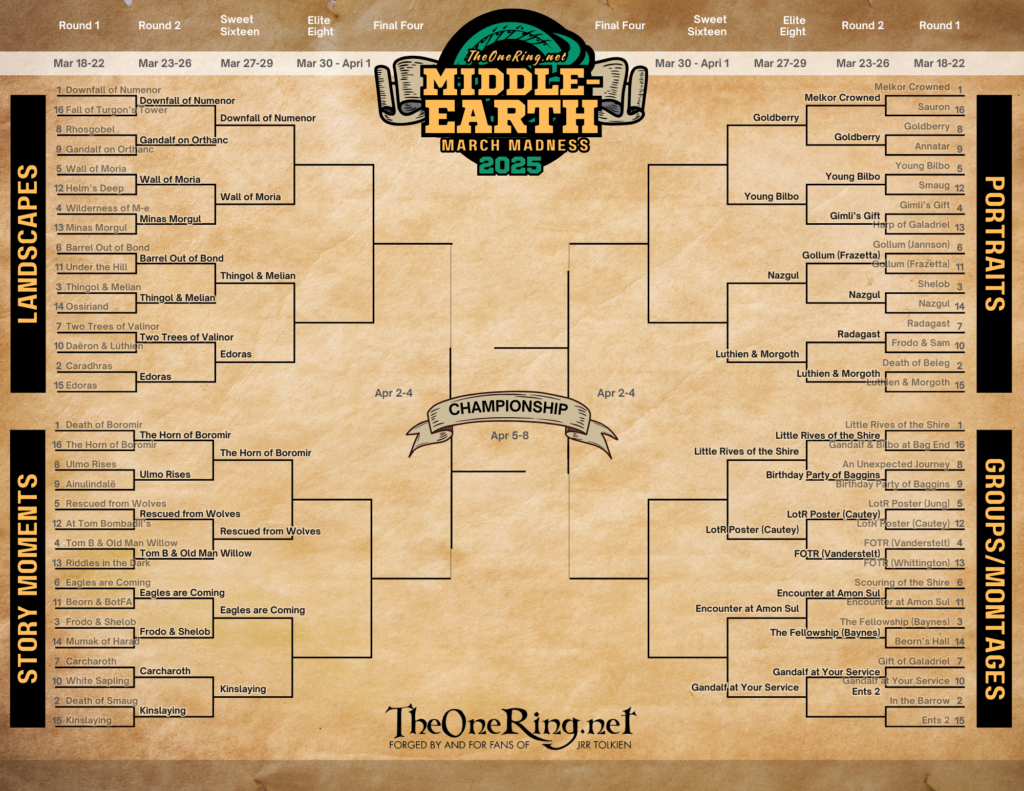
Take a look at the fours brackets as they now stand; which masterpiece do you think is en route to becoming to champion for 2025? As always, we encourage you to take some time enjoying the art, and perhaps follows some links to check out other works by the artists, before you place your next votes. (You can also always access the earlier rounds at the voting link; so all these incredible pieces are still there for your viewing pleasure!)
Decisions are getting harder, as the field narrows. How you make your choice is up to you!
How does it work, you ask? Simple! Click on the button below. This will take you to the voting site, where you can view the entire bracket, and also view individual works in all their glory (and details of the artist). Place your votes for Round Three: Sweet Sixteen!
You have until the end of the day Saturday March 29th to vote in Round Two; on Sunday 30th we’ll open voting for Round Four! That Sunday, we’ll also have a very special livestream at 3pm PST, when none other than Ted Nasmith will join us, to discuss his ‘The Kinslaying of Alqualonde’, which features in the ‘Story Moments’ bracket – and he may even share some preliminary sketches with us! We hope you’ll join us for that, as you make decisions on the Elite Eight round; but first, go and examine the Sweet Sixteen! Vote well!