In his third article for our worldwide community, Tedoras, long-time audience participant on our TORn TUESDAY webcast, shares unique insights on the strange demarcation found in The Hobbit but not mentioned in LOTR: the “Edge of the Wild.” Wondering as we often do what exactly Professor Tolkien meant by this invisible line that other characters refer to in the story, Tedoras has a fresh take on cartography influenced by imagination. Take it away, Tedoras….
————————————————————————————-
Beyond the “Edge of the Wild”
By Tedoras — special to TheOneRing.net
One of the most interesting aspects of the Map of Wilderland included in The Hobbit is that very odd, rather portentous demarcation denoting the “Edge of the Wild.” Perhaps many of us, as kids, did not really note the significance of this line: it remained, to us, an added piece of mystery and awe. Certainly, the line retains those qualities today. However, now that I am older, the real meaning of this line is clearer (and, yes, although the Professor may not have wanted us to search for any “meaning” in this line—but to take at its “face value,” rather—there is yet merit in analyzing it. It was drawn for a reason on the map, mind you). Well, perhaps it is not “meaning” for which we look in this line, but rather its purpose to us, the readers, as we follow Bilbo into the Wild.
My interest in the Edge of the Wild peaked when I discovered a fantastic article by Patrick Brückner. In “Until the Dragon Comes,” Brückner focuses on the “real” and “fantastic,” and the reader’s perception of each, in Tolkien’s works; he notes that the mythopoeic role of dragons adds a “world-view that refers to an epic historic quality far beyond and different from the fairy tale elements of [Tolkien’s] texts” (Brückner 101). In the vernacular, Brückner merely posits that the concept of a dragon inherently adds realism to the text because of the historic properties we prescribe to dragons. I am not going to go on much more about archetypal dragons and their roles in mythopoeic fantasy; rather, I would like to focus on how Brückner applies this principle to uncover the true nature of the “Edge of the Wild” line.
Brückner notes, wisely, that it was Tolkien himself who, by virtue of adding this demarcation to the map, declared the point of transition from the “real” to the “fantastic” in The Hobbit. While it may seem a daunting task to argue against the Professor’s ostensible intent, Brückner provides a good case against this line being the actual point of transition. There are two reasons why this line does not mark a shift: first, because Rivendell (i.e., “the boundary of the perilous realm”) is clearly to the right of the line and, second, because the incident with the trolls occurs to the line’s left (109). Brückner’s thesis is, therefore, that we can assign the right side of the Edge of the Wild to the realistic sphere, and that we can do so because of the role of a dragon, Smaug (118). As a dragon, Brückner says, Smaug adds a “relevant epic-historical context that grounds The Hobbit“—the concept of the dragon inherently makes The Hobbit “a text that refers to older texts and traditions… that possess historical significance” (117). Thus, because Smaug exists to the right of the Edge of the Wild—and because his existence as a dragon carries with it the realistic sphere—this demarcation cannot be a point of transition from “real” to “fantastic.”
While I agree with Brückner’s conclusion, I cannot say it is only the dragon that adds realism to the story. Just as Smaug brings with him the “epic-historical” notions of dragons which ground him in the “real” sphere (think of dragons throughout Western literature, from Beowulf on), so too do the other “mythological” creatures in the text. Because of our now long exposure to Orcs, Elves, Wargs, and other rather fantastical inhabitants of Middle-earth, we attribute to them, too, the very same historical context as Brückner says we do to Smaug. One of the reasons we attribute such realism to the dragon is, as Brückner notes, that it references other texts. Well, with the wealth of literature written by Tolkien himself or about his works, the same references are possible with Orcs or any other creature. To fans of Tolkien’s works, Orcs and Dwarves are as “real” as Smaug; we simply use Tolkien’s legendarium as the historiographic source. Thus, to a fan to whom the question of Smaug’s existence is not an issue, neither is the assumption that the other ostensibly “fantastic” creatures to the right of the Edge of the Wild are actually real. It is, in my opinion, the collective picture painted by the inclusion of all these now familiar “fantastic” aspects (to which we ourselves assign historic—albeit not explicitly “real” historic—weight), that result in our placing the right side of the line in the sphere of realism.
The most common sense case can be made for a demarcation placed East of Rivendell. The Misty Mountains mark the Western border of Rhovanion (Wilderland), so in that sense, such a line would really be the Edge of the Wild. However, that is of course not the case. So why, then, is the line placed where it is? The best scenario would be to ask the Professor himself (certainly this is one of those rather puzzling Middle-earth conundrums). Yet, I think I can fathom a guess, or at least one hypothesis. If you look at the Map of Wilderland, you’ll note that to the left of the demarcation, at the top, is written “Western Lands”, with an arrow naturally pointing West. If we hold Tolkien’s views on direction as canonical, then it makes sense for the East to be characterized as the “wild”, and altogether less fair than the West. Looking at a map of Eriador, such a conclusion seems plausible for, certainly, Wilderland lies far to the East.
Though simple, such a hypothesis is sound; anyone familiar with Middle-earth knows that to the East lies danger. And the aforementioned simplicity is also key. When deciding to draw this now infamous line, Tolkien would probably not have been debating the convoluted significance of such an action—rather, he would have been thinking of geography, as any cartographer is wont to do. Unfortunately, we may never know.
(All references to the text from: Brückner, Patrick. ” ‘…Until the Dragon Comes’: Tolkien’s Dragon-Motif as a Poetological Concept.” Tolkien’s Shorter Works: Essays of the Jena Conference 2007 (2008): 101-35. Walking Tree Publishers. Print.)
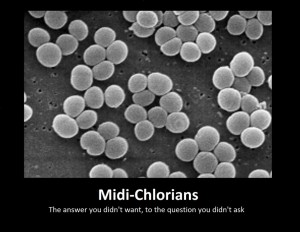
…The boy nodded his understanding. “Can I ask you something?” The Jedi Master nodded. “What are midi-chlorians?” Wind whipped at Qui-Gon’s long hair, blowing strands of it across his strong face. “Midi-chlorians are microscopic life-forms that reside within the cells of all living things and communicate with the Force.”…
…”Use the Force, Luke.”…
…Raistlin lifted his thin, frail hand and allowed the spell component he had taken from his pouch to fall slowly from between his fingers onto the deck of the boat. Sand, Tanis realized. “Ast tasarak sinuralan krynawi,” Raistlin murmured, and then moved his right hand slowly in an arc parallel to the shore….
…”The One Power,” Moiraine was saying, “comes from the True Source, the driving force of Creation, the force the Creator made to turn the Wheel of Time.”…
Bibbidi, bobbidi, boo.
There seem to be almost as many ways of representing magic as there are fantasy writers. Role-players know the whole system with mages, spell components, spellbooks, the language of magic, etc. Jordan fans can tell you the ins and outs of the One Power, complete with a discourse on the varying characteristics of saidar and saidin, and the innumerable levels of strength among Aes Sedai. And Star Wars geeks (a word I use with love, considering that I myself am a dyed-in-the-wool geek!) were stunned when Lucas started explaining the universe-balancing Force with microscopic middlemen, instead of with the innate power of Luke Skywalker and Darth Vader. What ties them in common is that they each have a system, a framework with rules and laws almost more complicated than those of physics. Mages lose their spells after one casting, and must rest and recommit the words to memory before casting again. Aes Sedai spend years in training, because abuse of the One Power can too easily lead to death… and evidently you’ve got to be well-stocked on single-celled symbionts (is that even a word? My spellchecker sure doesn’t like it) to even make a dent in the Force. Fantasy writers delight in coming up with their own, hopefully brand-new systems, to give their books that added twist, that spark that no other sword-swinging Elf-hopping kender-singing dragon-flying books have. But what about Tolkien? Where is the system? What are the rules which govern the making of Rings of Power, which delineate the powers and limits of Istari, of Maiar, of Valar? He never talks about a framework or physical laws; we only see the results of the power’s use. Where does the power come from?
If you have a Tolkien/Middle-earth inspired poem you’d like to share, then send it to poetry@theonering.net. One poem per person may be submitted each month. Please make sure to proofread your work before sending it in. TheOneRing.net is not responsible for poems posting with spelling or grammatical errors.
As we all know, J R R Tolkien was, from an early age, fascinated by myth and heroic legend, reading all he could of the romances and epics of many nations. In a letter to Milton Waldman, which appears in the Preface to the second edition of The Silmarillion, he wrote that he was ‘grieved by the poverty of my own beloved country: it had no stories of its own … Of course there was and is all the Arthurian world, but powerful as it is, it is imperfectly naturalized, associated with the soil of Britain but not with the English; and does not replace what I felt to be missing…’
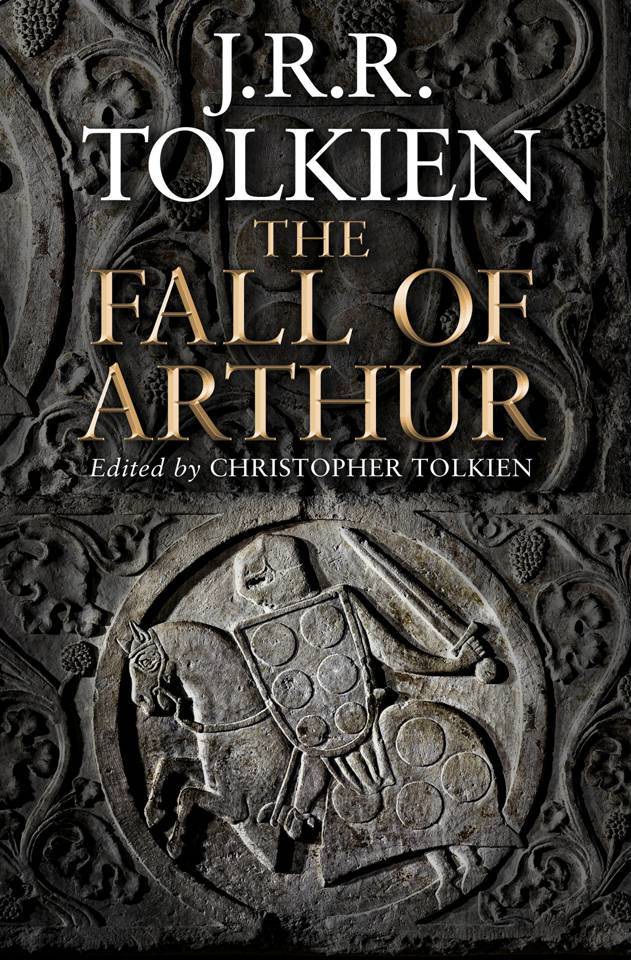
The Professor, then, had little time for the legends of King Arthur; but he did make one foray into those tales, and we are about to be able to read for ourselves the results of those labours! Tomorrow, publishers Houghton Mifflin Harcourt release Tolkien’s narrative poem The Fall of Arthur, edited as ever by his son Christopher. HMH’s press release tells us:
‘The Fall of Arthur, the only venture by J.R.R. Tolkien into the legends of Arthur, king of Britain, may well be regarded as his finest and most skillful achievement in the use of Old English alliterative meter, in which he brought to his transforming perceptions of the old narratives a pervasive sense of the grave and fateful nature of all that is told: of Arthur’s expedition overseas into distant heathen lands, of Guinevere’s flight from Camelot, of the great sea battle on Arthur’s return to Britain, in the portrait of the traitor Mordred, in the tormented doubts of Lancelot in his French castle.’
Alas, Tolkien never finished his poem; but amongst his manuscripts were sketches and drafts, which included ‘significant tantalizing notes. In these notes can be discerned clear if mysterious associations of the Arthurian conclusion with The Silmarillion, and the bitter ending of the love of Lancelot and Guinevere, which was never written.’
It’s a day of celebration for Tolkien fans whenever we have a chance to read more of the Professor’s work, and gain further insight into the explorations which lead to his great myth of Middle-earth. You can read Houghton Mifflin Harcourt’s full information about the book here; and you can order your copy from Amazon by clicking here. The Fall of Arthur will also be available as an e-book. Happy reading!
In his second of many articles for our worldwide community, Tedoras, long-time audience participant on our TORn TUESDAY webcast brings us a fascinating idea: a lost connection to the Beacons of Gondor perhaps… Read on for a short but very interesting look at how an ancient Biblical account may have inspired Tolkien! Take it away, Tedoras….
————————————————————————————-
The (Biblical) Beacons of Gondor
By Tedoras — special to TheOneRing.net
This past April 28th happened to be the Jewish holiday of Lag B’Omer (the 33rd day of the Counting of the Sheaves, to be more precise). Now, you are probably wondering how this little-known holiday relates to The Lord of the Rings(and, if you’re like me, you’d like to know what a “sheaf” is, too). It turns out a sheaf is a bundle for cereal plants—fortunately for us all, though, my story has nothing to do with Biblical agriculture. Rather, it begins with The Return of the King.
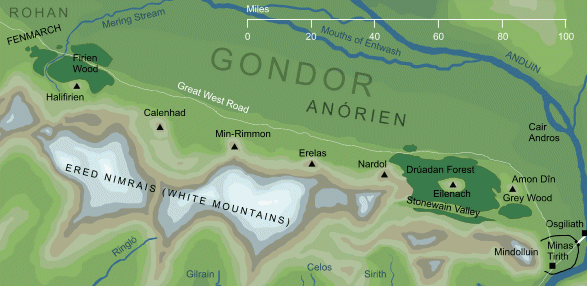
If you are like me, you love those amazing fly-by shots from The Lord of the Ringsfilms. One of the most epic sequences of such shots is the lighting of the beacons in ROTK(refresh your memory here). Whether your first encounter with these mountaintop fires was in literature or film, you probably thought it was an ingenious mode of communication. Certainly, they are by far the best means for sending urgent messages across long distances (and I hope the Gondorian who urged their construction was handsomely rewarded). In order to see the connection between these beacons and the aforementioned holiday, it is important to know the story of Lag B’Omer.
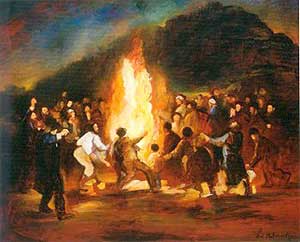
In short, Lag B’Omer commemorates a revolt in the year 131 CE. The Israelites, under the leadership of Bar Kochba, rose up against the Romans, who ruled the land at that time. Years before the Romans came, the Israelites had built a series of m’durot, or bonfires, upon the surrounding mountains. So, when the revolt began, (you guessed it) Bar Kochba ordered a beacon lit. A soldier took a torch to the top of a mountain, lit one the beacons, and thus sent word around the land that war had begun.
Certainly, the use of the beacons of Gondor to call for Rohan’s aid is reminiscent of this episode. Yet, was Tolkien inspired by this Biblical tale in his creation of the beacons? On the one hand, we know Tolkien was well-versed in the Bible; his contemporaneous English education saw to that. Furthermore, Tolkien was a lifelong scholar—thus, if not in school, it is likely he would have encountered this story on his own. Assuming Tolkien was acquainted with this tale, the unanswerable question here, of course, is whether or not he consciously recognized the Bible as their source.
However, on the other hand, a case can certainly be made that Tolkien knew not of the story of Bar Kochba’s revolt. For a realm the size of Gondor, it would make sense to have a system for mass-communication in the event of any important occurrence. And, while these beacons also housed fresh horses on stand-by for couriers, it is clear that signal fires would be a much faster means. The independent invention of the beacons is not only possible in terms of the technology available to Gondor at the time, but it is also becoming of the prudence and wisdom of the Gondorian kings of Old.
This is one of many familiar situations to us Tolkien fans: is there a “right” answer here? Personally, I do not think it really matters; I intended only to present a surprising and uncanny resemblance upon which I happened to stumble. But, of course, such a topic is up for interpretation—so I will let you decide for yourself.
Back in September 1999, these were the questions on the minds of fans…
Q:What role did Glorfindel play after the incident at the Fords of Bruinen? I don’t remember any further mention of him and it seems strange that such a noble Elven Lord would not be involved at all in the War of the Ring.
– Quinton Carr
A: He wasn’t. But if you think about it, many “noble Elven lords” did not do anything *active* in the War after the Fellowship left Rivendell or Lorien. Elrond, Celeborn, noble Elven ladies like Galadriel, Arwen . . . their roles were peripheral. Not to mention the fact that I’m sure both Elrond and Celeborn had a goodly number of strong, well-armed Elves at their disposal, who didn’t go with the Fellowship *or* down to the battles in Gondor. But the answer is actually pretty simple, and Elrond gives it to us in “Fellowship:” “The number must be few, since your hope is in speed and secrecy. Had I a host of Elves in armour of the Elder Days, it would avail little, save to arouse the power of Mordor.” So that explains why none of them went with the Fellowship. Why did none of these mighty Elves save Elrohir and Elladan ride down to Gondor once it was clear that there would be battle? My answer has a couple of parts. Firstly, Elrohir and Elladan, according to the Tale of Years, were born after the wars at the end of the Second Age when Sauron was thrown down, and were not a party to them as their father was. They’d never gotten their “chance,” so to speak. As for the rest of them, they had all gone to war against Sauron at the end of the Second Age. They felt their time had passed, and moreover that the hour of the Secondborn was striking. They knew that the power of their Rings would fade if Frodo was successful, and that Men would rise and Elves would dwindle. They must have felt it was right for the men, i.e. the armies of Gondor and Rohan, to earn for themselves the privilege of ushering in the Fourth Age.
It’s been over 12 years since some of these common Tolkien related questions have been answered, so what better time then to repost some of them for the newbies. Contained in this post are some newbie classics….Why do the Eagles always show up at the last minute? Why did Sauron not just come forth to war? Why do the Black Riders seem to be so weak? Read on…
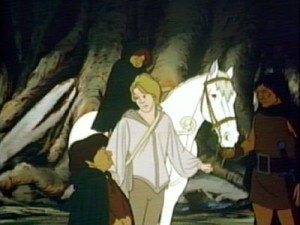
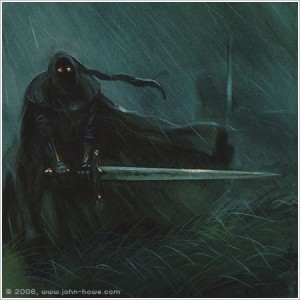
Q:Greetings masters of lore. My question deals with the Nazgul. I know of Khamul, but I have not found the names of the other Nazgul. If they had names, what were they as well as who were they prior to their transformation? Furthermore, is there any story about their creation and why Sauron decided to choose them specifically?
-Reginold
A:Khamul seems to be the only named Ringwraith. What we know of him is given in the section “The Hunt for the Ring” in Unfinished Tales (1980). He was second to the Chief, and his name is given as Khamul the Shadow of the East. Some more about the Nazgul, or the Ulairi, can be found in some of the volumes of the History of Middle-earth, particularly in the section “The Story of Frodo and Sam in Mordor” in Sauron Defeated (1992), and in the work on the Appendices to The Lord of the Rings as printed in The Peoples of Middle-earth (1996). But, unfortunately, the histories of the men who became the Nazgul seems nowhere to be specifically illuminated. Continue reading “Questions and Answers – Eagles, Sauron and Ringwraiths – Oh My!”


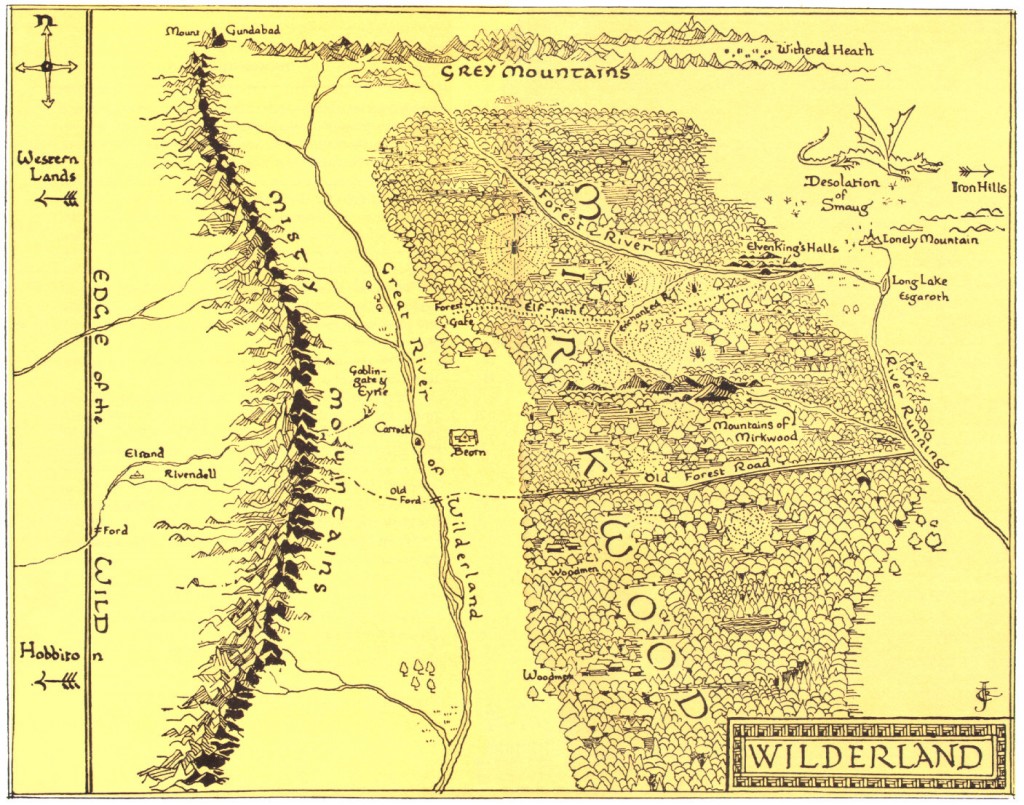 One of the most interesting aspects of the Map of Wilderland included in The Hobbit is that very odd, rather portentous demarcation denoting the “Edge of the Wild.” Perhaps many of us, as kids, did not really note the significance of this line: it remained, to us, an added piece of mystery and awe. Certainly, the line retains those qualities today. However, now that I am older, the real meaning of this line is clearer (and, yes, although the Professor may not have wanted us to search for any “meaning” in this line—but to take at its “face value,” rather—there is yet merit in analyzing it. It was drawn for a reason on the map, mind you). Well, perhaps it is not “meaning” for which we look in this line, but rather its purpose to us, the readers, as we follow Bilbo into the Wild.
 While I agree with Brückner’s conclusion, I cannot say it is only the dragon that adds realism to the story. Just as Smaug brings with him the “epic-historical” notions of dragons which ground him in the “real” sphere (think of dragons throughout Western literature, from Beowulf on), so too do the other “mythological” creatures in the text. Because of our now long exposure to Orcs, Elves, Wargs, and other rather fantastical inhabitants of Middle-earth, we attribute to them, too, the very same historical context as Brückner says we do to Smaug. One of the reasons we attribute such realism to the dragon is, as Brückner notes, that it references other texts. Well, with the wealth of literature written by Tolkien himself or about his works, the same references are possible with Orcs or any other creature. To fans of Tolkien’s works, Orcs and Dwarves are as “real” as Smaug; we simply use Tolkien’s legendarium as the historiographic source. Thus, to a fan to whom the question of Smaug’s existence is not an issue, neither is the assumption that the other ostensibly “fantastic” creatures to the right of the Edge of the Wild are actually real. It is, in my opinion, the collective picture painted by the inclusion of all these now familiar “fantastic” aspects (to which we ourselves assign historic—albeit not explicitly “real” historic—weight), that result in our placing the right side of the line in the sphere of realism.
 Though simple, such a hypothesis is sound; anyone familiar with Middle-earth knows that to the East lies danger. And the aforementioned simplicity is also key. When deciding to draw this now infamous line, Tolkien would probably not have been debating the convoluted significance of such an action—rather, he would have been thinking of geography, as any cartographer is wont to do. Unfortunately, we may never know.
 Q:
Q: