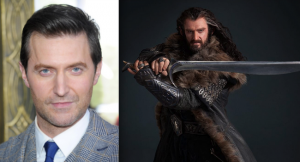
 Welcome to our weekly live webcast — TORn TUESDAY — concluding our popular two month long specials on the History of the Dwarves who undertake the Quest of Erebor. Today we wrap up with the big bang theory of Dwarven tragedy and honor: it’s all about THORIN OAKENSHIELD (played with great swagger by our very own Richard Armitage). Bring your questions and join us LIVE for a fascinating chat about how this major character brought the story of THE HOBBIT to where it is in the Tolkien universe.
Join us for TORn TUESDAY every week at 5:00PM Pacific: brought to you by host Clifford “Quickbeam” Broadway and producer Justin “I Love Ham” Sewell — as we learn how this magnificent Dwarf suffered and struggled to change his family’s future — and what Peter Jackson & WETA did to help us distinguish his rough and tumble companions from each other (using more than just colored hoods). Our innovative live show includes worldwide fans who join us on the Live Event page with a built-in IRC chat (affectionately known as Barliman’s Chat room). Be part of the fun and mischief every week as we broadcast *live* from Meltdown Comics in the heart of Hollywood, U.S.A.!
——————————————————————-
Follow Cliff ‘Quickbeam’ Broadway on Twitter: @quickbeam2000
Posted in:
Share:

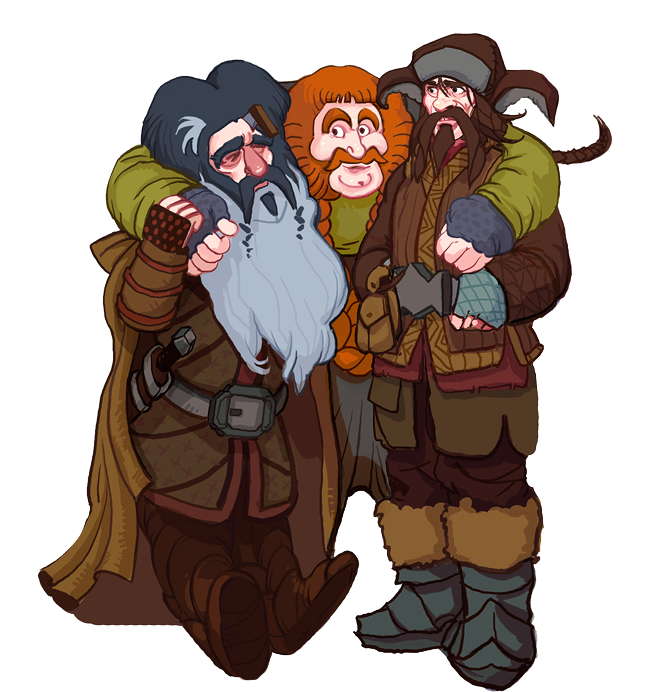 Welcome to our weekly live webcast — TORn TUESDAY — now on the 5th part of our ongoing series of discussions on the History of the Dwarves who undertake the Quest of Erebor. Today we talk about BIFUR, BOFUR and the immensely overweight and endearing BOMBUR (Go #TeamBombur on Twitter!). Bring your questions and join us LIVE for a fascinating chat about how these characters are all intertwined. Continue reading “BIFUR, BOFUR & BOMBUR Dwarven History Part 5 on TORn TUESDAY *Live* Webcast!!”
If you have a Tolkien/Middle-earth inspired poem you’d like to share, then send it to poetry@theonering.net. One poem per person may be submitted each month. Please make sure to proofread your work before sending it in. TheOneRing.net is not responsible for poems posting with spelling or grammatical errors.
Posted in:
Share:
In his third article for our worldwide community, Tedoras, long-time audience participant on our TORn TUESDAY webcast, shares unique insights on the strange demarcation found in The Hobbit but not mentioned in LOTR: the “Edge of the Wild.” Wondering as we often do what exactly Professor Tolkien meant by this invisible line that other characters refer to in the story, Tedoras has a fresh take on cartography influenced by imagination. Take it away, Tedoras….
————————————————————————————-
Beyond the “Edge of the Wild”
By Tedoras — special to TheOneRing.net
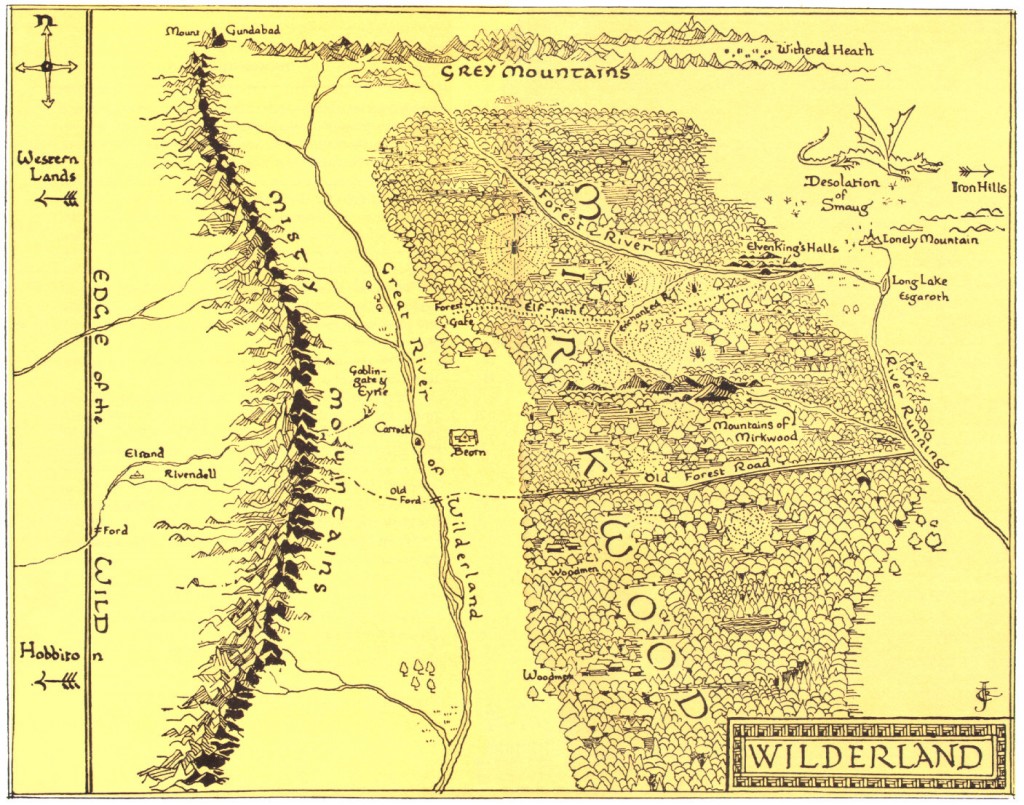 One of the most interesting aspects of the Map of Wilderland included in The Hobbit is that very odd, rather portentous demarcation denoting the “Edge of the Wild.” Perhaps many of us, as kids, did not really note the significance of this line: it remained, to us, an added piece of mystery and awe. Certainly, the line retains those qualities today. However, now that I am older, the real meaning of this line is clearer (and, yes, although the Professor may not have wanted us to search for any “meaning” in this line—but to take at its “face value,” rather—there is yet merit in analyzing it. It was drawn for a reason on the map, mind you). Well, perhaps it is not “meaning” for which we look in this line, but rather its purpose to us, the readers, as we follow Bilbo into the Wild.
My interest in the Edge of the Wild peaked when I discovered a fantastic article by Patrick Brückner. In “Until the Dragon Comes,” Brückner focuses on the “real” and “fantastic,” and the reader’s perception of each, in Tolkien’s works; he notes that the mythopoeic role of dragons adds a “world-view that refers to an epic historic quality far beyond and different from the fairy tale elements of [Tolkien’s] texts” (Brückner 101). In the vernacular, Brückner merely posits that the concept of a dragon inherently adds realism to the text because of the historic properties we prescribe to dragons. I am not going to go on much more about archetypal dragons and their roles in mythopoeic fantasy; rather, I would like to focus on how Brückner applies this principle to uncover the true nature of the “Edge of the Wild” line.
Brückner notes, wisely, that it was Tolkien himself who, by virtue of adding this demarcation to the map, declared the point of transition from the “real” to the “fantastic” in The Hobbit. While it may seem a daunting task to argue against the Professor’s ostensible intent, Brückner provides a good case against this line being the actual point of transition. There are two reasons why this line does not mark a shift: first, because Rivendell (i.e., “the boundary of the perilous realm”) is clearly to the right of the line and, second, because the incident with the trolls occurs to the line’s left (109). Brückner’s thesis is, therefore, that we can assign the right side of the Edge of the Wild to the realistic sphere, and that we can do so because of the role of a dragon, Smaug (118). As a dragon, Brückner says, Smaug adds a “relevant epic-historical context that grounds The Hobbit“—the concept of the dragon inherently makes The Hobbit “a text that refers to older texts and traditions… that possess historical significance” (117). Thus, because Smaug exists to the right of the Edge of the Wild—and because his existence as a dragon carries with it the realistic sphere—this demarcation cannot be a point of transition from “real” to “fantastic.”
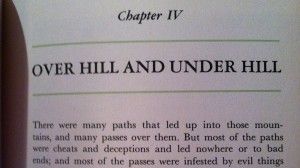 While I agree with Brückner’s conclusion, I cannot say it is only the dragon that adds realism to the story. Just as Smaug brings with him the “epic-historical” notions of dragons which ground him in the “real” sphere (think of dragons throughout Western literature, from Beowulf on), so too do the other “mythological” creatures in the text. Because of our now long exposure to Orcs, Elves, Wargs, and other rather fantastical inhabitants of Middle-earth, we attribute to them, too, the very same historical context as Brückner says we do to Smaug. One of the reasons we attribute such realism to the dragon is, as Brückner notes, that it references other texts. Well, with the wealth of literature written by Tolkien himself or about his works, the same references are possible with Orcs or any other creature. To fans of Tolkien’s works, Orcs and Dwarves are as “real” as Smaug; we simply use Tolkien’s legendarium as the historiographic source. Thus, to a fan to whom the question of Smaug’s existence is not an issue, neither is the assumption that the other ostensibly “fantastic” creatures to the right of the Edge of the Wild are actually real. It is, in my opinion, the collective picture painted by the inclusion of all these now familiar “fantastic” aspects (to which we ourselves assign historic—albeit not explicitly “real” historic—weight), that result in our placing the right side of the line in the sphere of realism.
The most common sense case can be made for a demarcation placed East of Rivendell. The Misty Mountains mark the Western border of Rhovanion (Wilderland), so in that sense, such a line would really be the Edge of the Wild. However, that is of course not the case. So why, then, is the line placed where it is? The best scenario would be to ask the Professor himself (certainly this is one of those rather puzzling Middle-earth conundrums). Yet, I think I can fathom a guess, or at least one hypothesis. If you look at the Map of Wilderland, you’ll note that to the left of the demarcation, at the top, is written “Western Lands”, with an arrow naturally pointing West. If we hold Tolkien’s views on direction as canonical, then it makes sense for the East to be characterized as the “wild”, and altogether less fair than the West. Looking at a map of Eriador, such a conclusion seems plausible for, certainly, Wilderland lies far to the East.
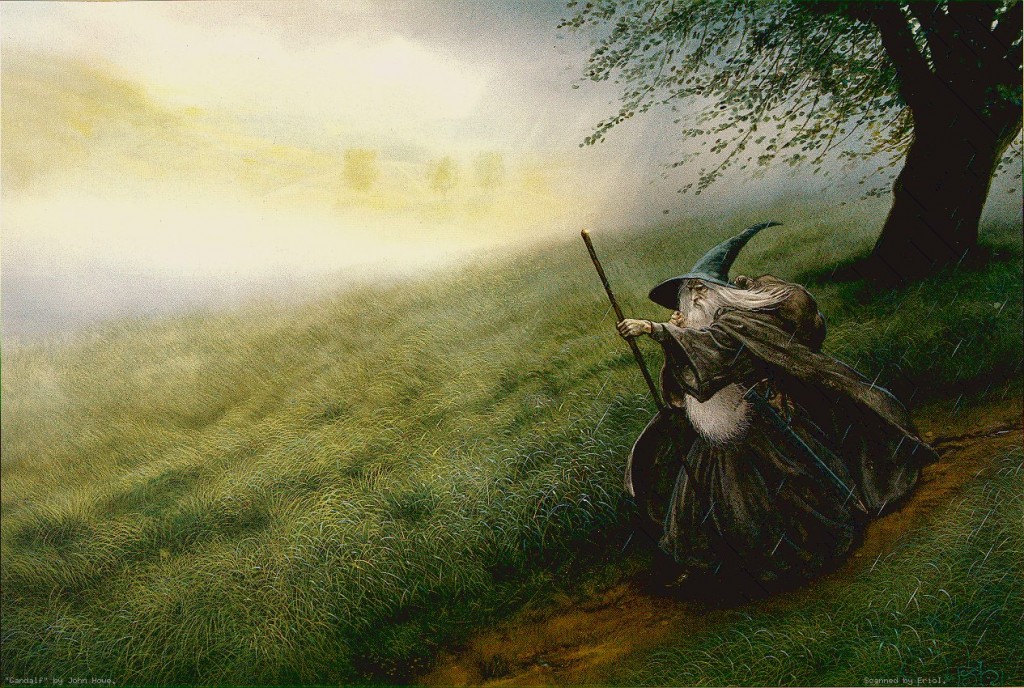 Though simple, such a hypothesis is sound; anyone familiar with Middle-earth knows that to the East lies danger. And the aforementioned simplicity is also key. When deciding to draw this now infamous line, Tolkien would probably not have been debating the convoluted significance of such an action—rather, he would have been thinking of geography, as any cartographer is wont to do. Unfortunately, we may never know.
(All references to the text from: Brückner, Patrick. ” ‘…Until the Dragon Comes’: Tolkien’s Dragon-Motif as a Poetological Concept.” Tolkien’s Shorter Works: Essays of the Jena Conference 2007 (2008): 101-35. Walking Tree Publishers. Print.)
Posted in:
Share:
 As we all know, J R R Tolkien was, from an early age, fascinated by myth and heroic legend, reading all he could of the romances and epics of many nations. In a letter to Milton Waldman, which appears in the Preface to the second edition of The Silmarillion, he wrote that he was ‘grieved by the poverty of my own beloved country: it had no stories of its own … Of course there was and is all the Arthurian world, but powerful as it is, it is imperfectly naturalized, associated with the soil of Britain but not with the English; and does not replace what I felt to be missing…’
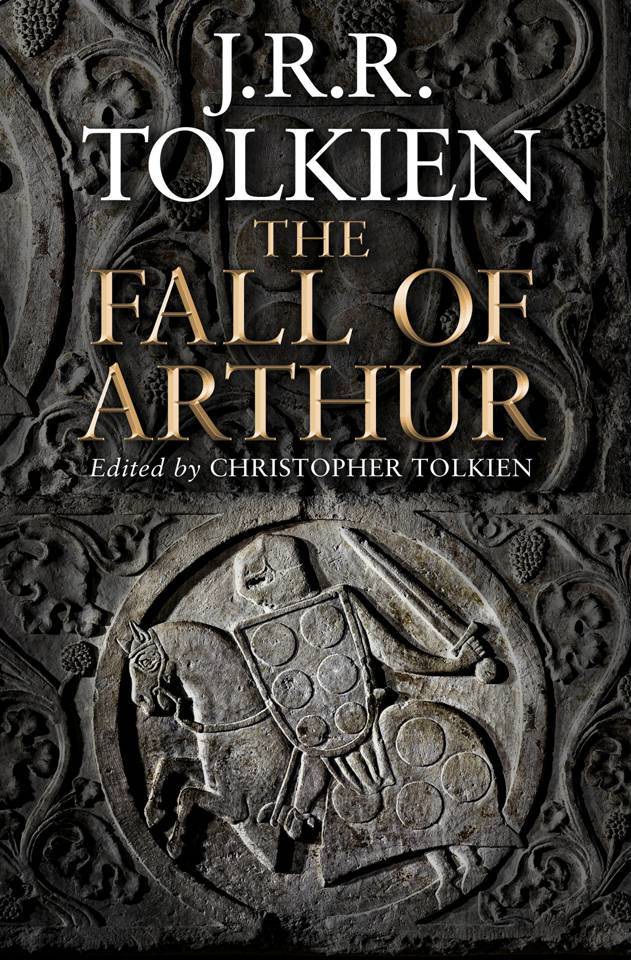
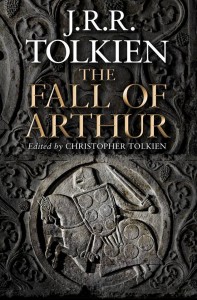
The Professor, then, had little time for the legends of King Arthur; but he did make one foray into those tales, and we are about to be able to read for ourselves the results of those labours! Tomorrow, publishers Houghton Mifflin Harcourt release Tolkien’s narrative poem The Fall of Arthur, edited as ever by his son Christopher. HMH’s press release tells us:
‘The Fall of Arthur, the only venture by J.R.R. Tolkien into the legends of Arthur, king of Britain, may well be regarded as his finest and most skillful achievement in the use of Old English alliterative meter, in which he brought to his transforming perceptions of the old narratives a pervasive sense of the grave and fateful nature of all that is told: of Arthur’s expedition overseas into distant heathen lands, of Guinevere’s flight from Camelot, of the great sea battle on Arthur’s return to Britain, in the portrait of the traitor Mordred, in the tormented doubts of Lancelot in his French castle.’
Alas, Tolkien never finished his poem; but amongst his manuscripts were sketches and drafts, which included ‘significant tantalizing notes. In these notes can be discerned clear if mysterious associations of the Arthurian conclusion with The Silmarillion, and the bitter ending of the love of Lancelot and Guinevere, which was never written.’
It’s a day of celebration for Tolkien fans whenever we have a chance to read more of the Professor’s work, and gain further insight into the explorations which lead to his great myth of Middle-earth. You can read Houghton Mifflin Harcourt’s full information about the book here; and you can order your copy from Amazon by clicking here. The Fall of Arthur will also be available as an e-book. Happy reading!
[Order The Fall of Arthur from Amazon]
Posted in:
Share:
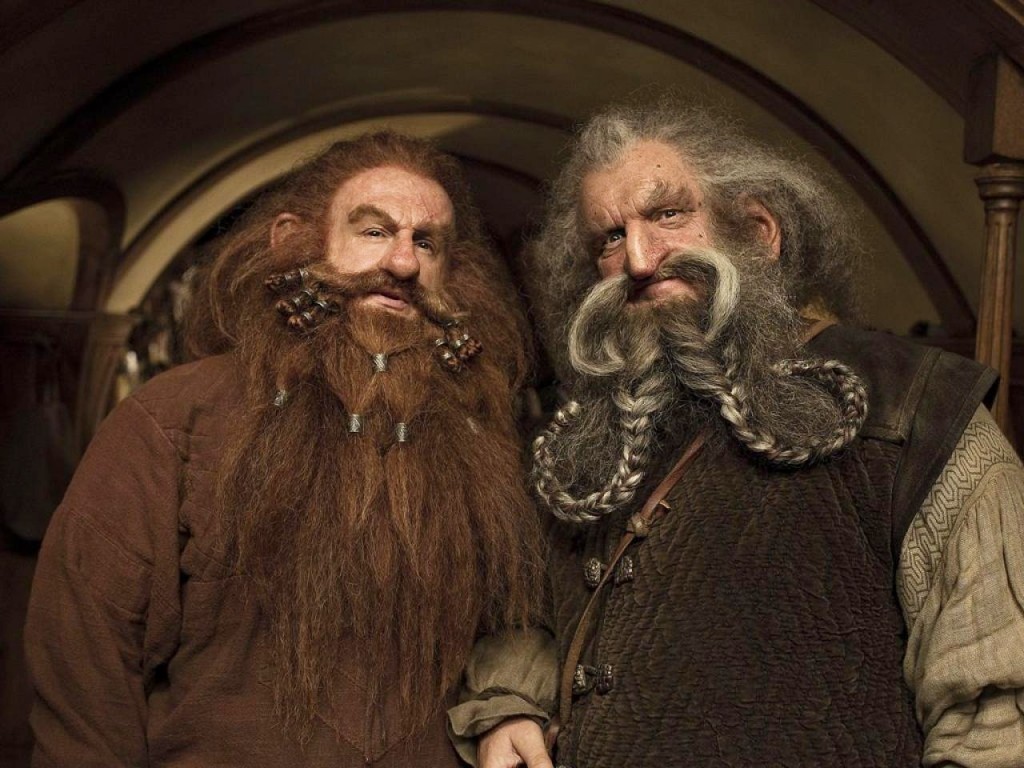 Welcome to our weekly live webcast — known as TORn TUESDAY — a unique show format where you can come into the chat and participate live. We are now on the 4th part of our ongoing series of discussions on the History of the Dwarves who undertake the Quest of Erebor. Today we switch gears to discuss OIN and GLOIN (father of our Fellowship member Gimli) and learn about the great fate tying up these characters in the House of Durin’s Line! Bring your questions and join us LIVE for what will be a very illuminating discussion of dark Dwarven secrets! We have *JUST* confirmed that our actors playing these roles have been whisked away to the studios in Wellington, where Peter Jackson has commenced new shoots for The Hobbit: The Desolation of Smaug!
Join us for TORn TUESDAY every week at 5:00PM Pacific: brought to you by host Clifford “Quickbeam” Broadway and producer Justin “I Haven’t Read The Books Yet” Sewell — as we discuss the unique characteristics of each Dwarf. We shall learn how they fit into the larger history of Tolkien’s legends — and what Peter Jackson & WETA did to help us distinguish these rough and tumble travelers from each other (using more than just colored hoods). Our innovative live show includes worldwide fans who join us on the Live Event page with a built-in IRC chat (affectionately known as Barliman’s Chat room). Be part of the fun and mischief every week as we broadcast *live* from Meltdown Comics in the heart of Hollywood, U.S.A.!
NEXT WEEK: Bifur, Bofur….. and Bombur, for real this time!
——————————————————————-
Follow Cliff ‘Quickbeam’ Broadway on Twitter: @quickbeam2000
Posted in:
Share:
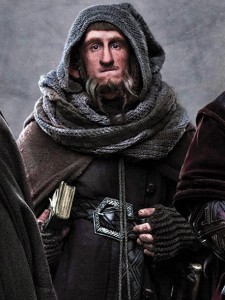 Welcome everyone to our wonderful live show — affectionately known as TORn TUESDAY — a unique webcast where you can come into the chat and participate live with our *very special* guest ADAM BROWN, who plays Ori the Dwarf in Thorin’s Company in the new Hobbit films! Yes, you read that right, “Have they got any chips?!”
We are thrilled to have our first actor from the traveling Company on our show! Adam Brown has arrived in Los Angeles to bring some Hobbity goodness to the 3rd part in our ongoing series of discussions on the history of the Dwarves who undertake the Quest of Erebor. Bring your questions and join us LIVE for what will surely be a show of surprises!
Join us for TORn TUESDAY every week at 5:00PM Pacific: brought to you by host Clifford “Quickbeam” Broadway and producer Justin “I Haven’t Read The Books Yet” Sewell — as we discuss the unique characteristics of each Dwarf. We shall learn how they fit into the larger history of Tolkien’s legends — and what Peter Jackson & WETA did to help us distinguish these rough and tumble travelers from each other (using more than just colored hoods). Our innovative live show includes worldwide fans who join us on the Live Event page with a built-in IRC chat (affectionately known as Barliman’s Chat room). Be part of the fun and mischief every week as we broadcast *live* from Meltdown Comics in the heart of Hollywood, U.S.A.!
NEXT WEEK: Bifur, Bofur….. and Bombur!
——————————————————————-
Follow Cliff ‘Quickbeam’ Broadway on Twitter: @quickbeam2000
Posted in:
Share: