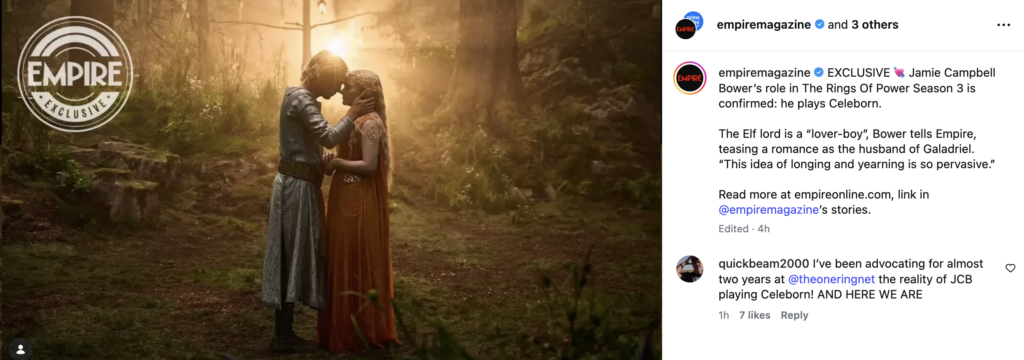
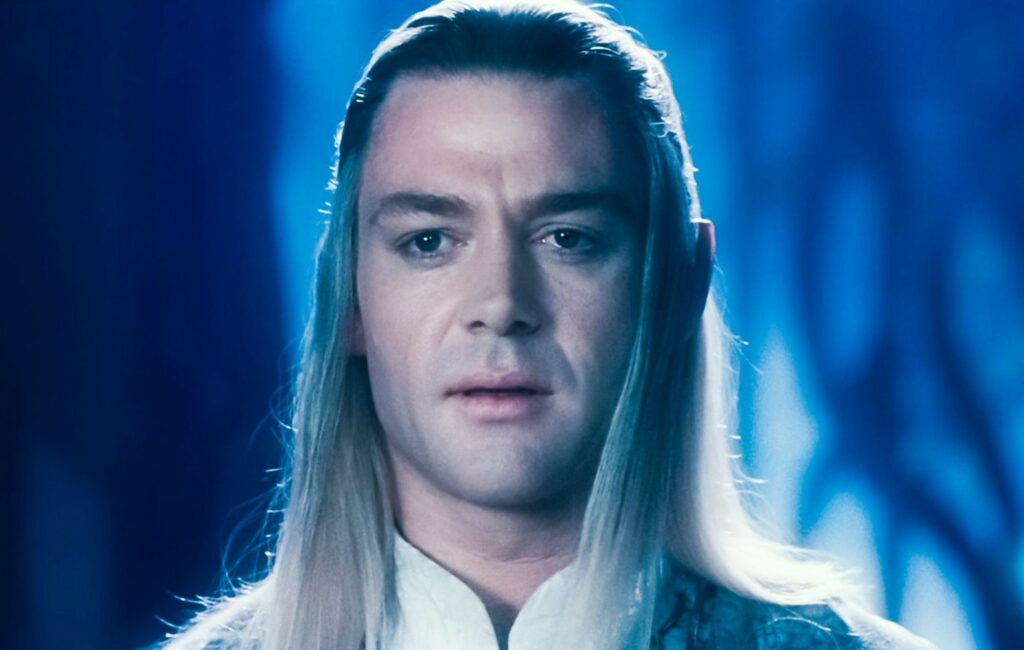
Jamie Campbell Bower has been confirmed as the Elf Celeborn in Season 3 of The Lord of the Rings: The Rings of Power.
The announcement made in an exclusive by Empire Magazine validates much fan speculation. With Bower’s ethereal quality and his ability to portray both vulnerability and strength, his casting for this role seems perfect.
Empire Magazine’s Instagram post about Celeborn Casting (note TORN staffer Quickbeam’s comment)
Bower’s performance as Vecna in Stranger Things was nuanced and terrifying, yet he earlier portrayed a character that was both lover and fighter in the role of Jace Herondale in the film The Mortal Instrument: City of Bones. Hopefully, Bower will have the opportunity to explore all of his acting strengths in Season 3 of The Rings of Power, in his relationship with Galadriel and as a leader in the War of the Elves and Sauron.
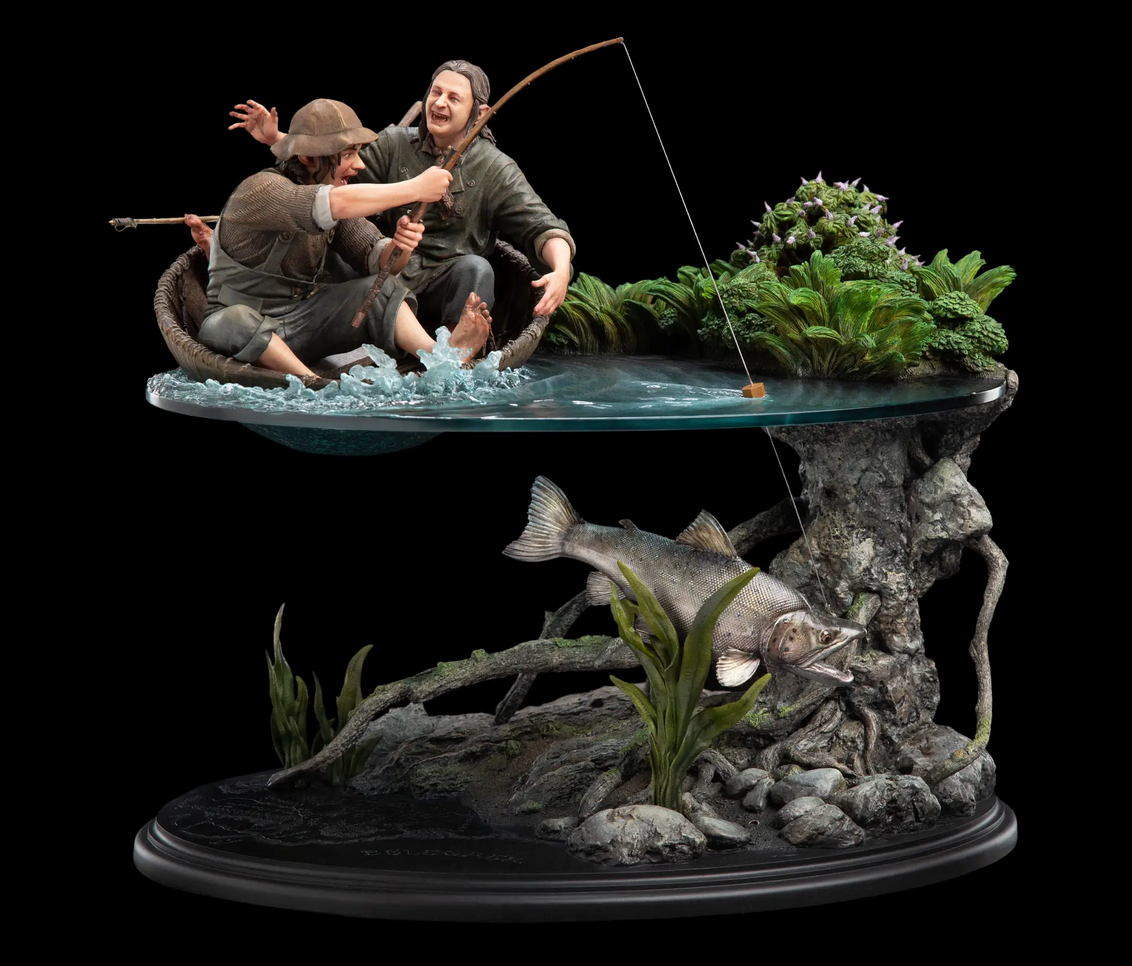
Weta Workshop is kicking off the Summer in spectacular fashion with three brand-new Middle-earth collectibles that are sure to excite The Lord of the Rings fans and collectors alike.
Leading the charge is the long-awaited 1:6 Scale Gimli – Hunter of the Plains statue, which joins the Classic Series lineup, and finally completes the legendary Three Hunters display alongside Aragorn and Legolas. Capturing the fierce determination and indomitable spirit of the son of Glóin during the chase across Rohan, this beautifully crafted statue is a must-have for collectors who have been waiting to unite the iconic trio. Gimli is available for pre-order now for $399 and is expected to ship in Q1 of next year.
After much fan conjecture, Amazon MGM Studios confirms the release date of Season 3.
In a press release from the Amazon Upfronts in NYC, Prime Video has announced the release date of season 3 of The Lord of the Rings: The Rings of Power. While previous seasons launched around Labor Day September 1, the new third season will be debuting November 11, 2026 globally streaming on Prime Video.
Here’s the full press release
NEW YORK, New York – May 11, 2026 – Today during Amazon’s annual Upfront presentation, Prime Video confirmed that the eagerly awaited third season of epic fantasy series The Lord of the Rings: The Rings of Power, will premiere on November 11, 2026. The globally successful and award-winning series, which has attracted over 185 million viewers worldwide, continues to be one of Amazon’s strongest drivers for new Prime membership sign-ups.
“From the very beginning, this series has embodied the scale, ambition, and cinematic storytelling that define Prime Video’s biggest global series,” said Peter Friedlander, Head of Global Television, Amazon MGM Studios. “The extraordinary response from millions of fans around the world has made it clear that this journey through Middle-earth continues to resonate, and that momentum has only grown heading into Season Three.”
The Lord of the Rings: The Rings of Power is one of the highest performing and most-viewed titles ever on Prime Video, with a broad, highly engaged, global fan base. Critics have praised the series for its epic scope and production values, and Seasons One and Two are Certified Fresh on Rotten Tomatoes. Through their respective 91 day post premiere launch windows and ranked by viewers, Season One remains the biggest TV series premiere in the history of Prime Video, and Season Two is among the Top 5 most-watched returning seasons ever. Season Two debuted as the #1 Original Series on Nielsen’s Streaming Top 10 Chart and remained in the top 4 throughout its entire run.
The Rings of Power brings to screens for the very first time the heroic legends of the fabled Second Age of Middle-earth’s history. This epic drama is set thousands of years before the events of J.R.R. Tolkien’s The Hobbit and The Lord of the Rings books, and takes viewers back to an era in which great powers were forged, kingdoms rose to glory and fell to ruin, unlikely heroes were tested, hope hung by the finest of threads, and the greatest villain that ever flowed from Tolkien’s pen threatened to cover all the world in darkness. The series follows an ensemble cast of characters, both familiar and new, as they confront the long-feared re-emergence of evil to Middle-earth. From the darkest depths of the Misty Mountains to the majestic forests of the elf capital of Lindon, to the breathtaking island kingdom of Númenor, to the farthest reaches of the map, these kingdoms and characters will carve out legacies that live on long after they are gone.
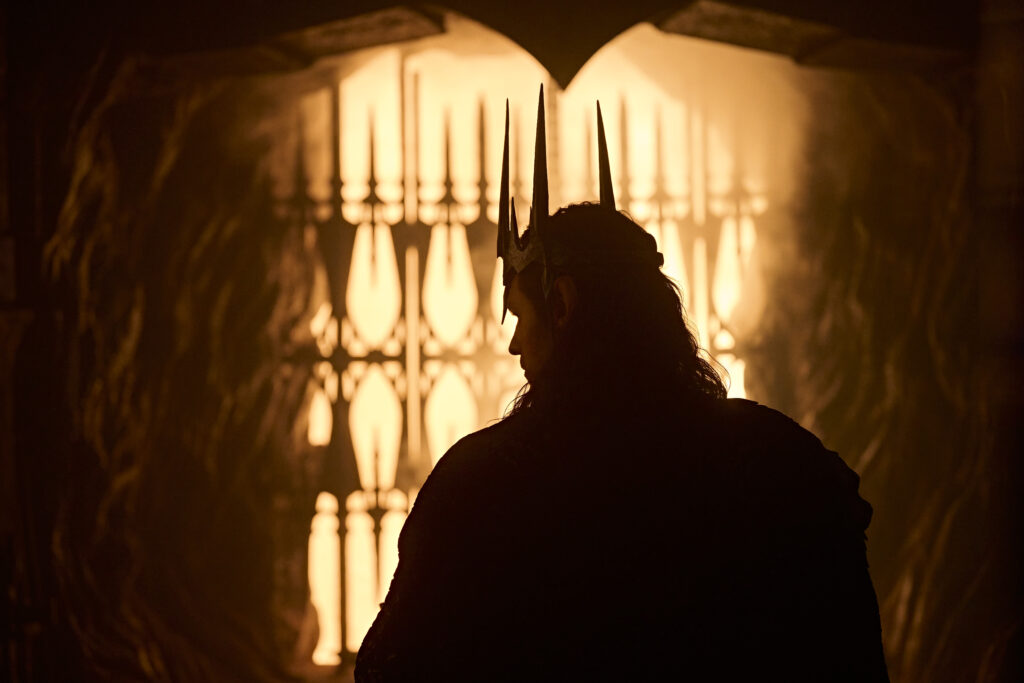
Jumping forward several years from the events of Season Two, Season Three takes place at the height of the War of the Elves and Sauron, as the Dark Lord seeks to craft the One Ring that will give him the edge he needs to win the war, bind all peoples to his will – and at last rule all Middle-earth.
Season Three of The Lord of the Rings: The Rings of Power is produced by showrunners and executive producers J.D. Payne & Patrick McKay. They are joined by executive producers Lindsey Weber, Justin Doble, Kate Hazell, and executive producer-director Charlotte Brandstrom. Matthew Penry-Davey is producer and Ally O’Leary, Tim Keene, and Andrew Lee are co-producers. The series is produced by Amazon MGM Studios.
All episodes of the first two seasons of the series are available to stream exclusively on Prime Video in more than 240 countries and territories in multiple languages.
About Prime Video Prime Video is a first-stop entertainment destination offering customers a vast collection of premium programming in one app available across thousands of devices. On Prime Video, customers can customize their viewing experience and find their favorite movies, series, and live events – including Amazon MGM Studios-produced series and movies Fallout, Heads of State, Reacher, Red One, Road House, The Accountant 2, Beast Games, The Boys, The Lord of the Rings: The Rings of Power, andThe Summer I Turned Pretty; licensed fan favorites; Prime member exclusive access to coverage of live sports including Thursday Night Football, NBA, WNBA, NASCAR, NWSL, and The Masters Tournament, and acclaimed sports documentaries including Bye Bye Barry, Kelce, and Earnhardt. Prime Video is one of many benefits of Prime, which bundles savings, convenience, and entertainment into a single membership. Prime members in the U.S. can share a broad range of benefits, including Prime Video, with Amazon Family. All customers, regardless of whether they have a Prime membership or not can access programming via Prime Video subscriptions such as MGM+, Apple TV, HBO Max, Peacock Premium Plus, FOX One, and Crunchyroll, as well as more than 900 free ad-supported (FAST) Channels, rent or buy titles, and enjoy even more content for free with ads. Customers can also go behind the scenes of their favorite movies and series with exclusive X-Ray access, and watch and shop their favorite titles with the fan-fueled shopping experience Shop the Show in the U.S. For more info visit www.amazon.com/primevideo.
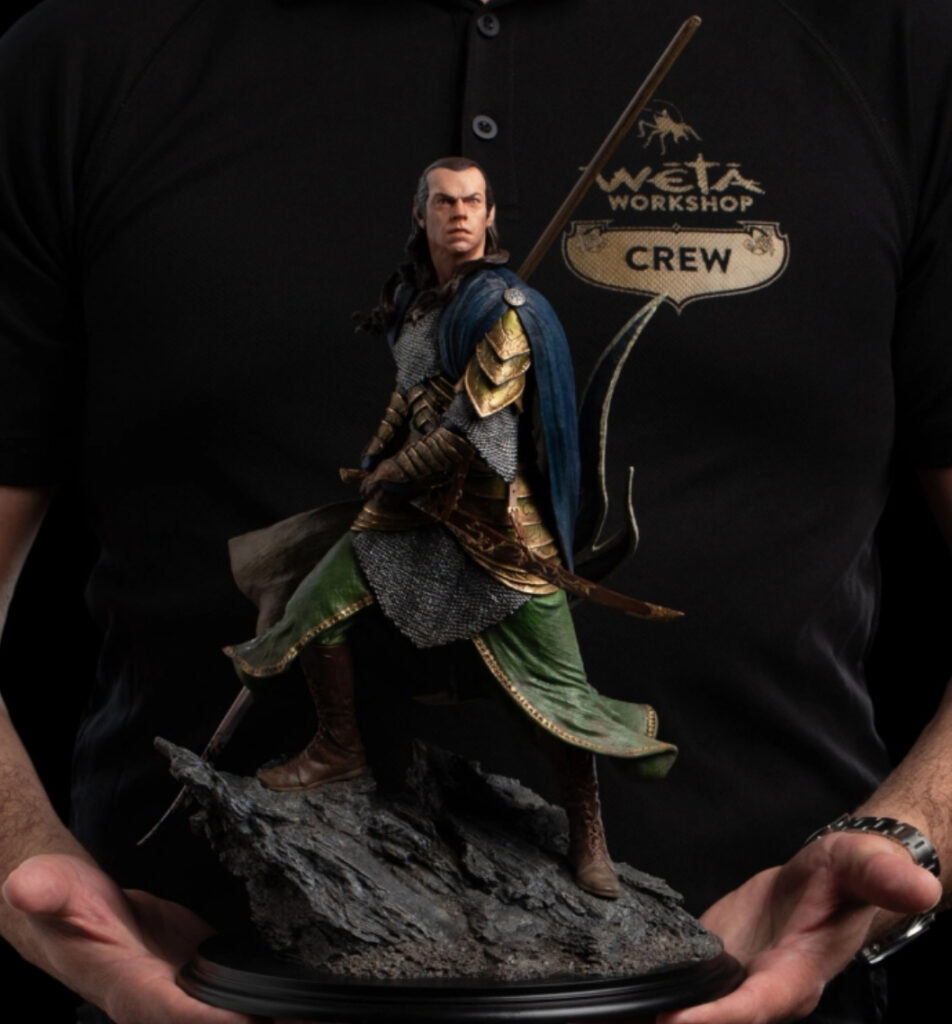
Our friends at Weta Workshop have unveiled their latest amazing statue fans can pre-order for their collections. If you’re like me and love The Battle of the Last Alliance sequence from The Lord of the Rings: The Fellowship of the Ring then you’re going to want to add this to your collection.
Elrond as we see him during the battle is now available for pre-order in 1:6 scale. He joins Elendil, Sauron, and Gil-Galad to create an amazing 4 statue setup of this sequence. Elrond comes in with a price tag of $699 USD, 1350 piece edition size, and will be shipping towards the end of this year. If you’re a fan of The Hobbit Trilogy then you have a chance to add the re-opened open edition of the Smaug Bust or the limited version of Smaug the Golden with an edition size of 900. The open edition of Smaug is $499 USD while the limited edition is coming in at $599 USD, with both due to ship in quarter 2 of this year.
If prop replicas are your thing, and I know many a collector who that is their focus, then these awesome pieces by the folks at United Cutlery just might be what you’re looking for.
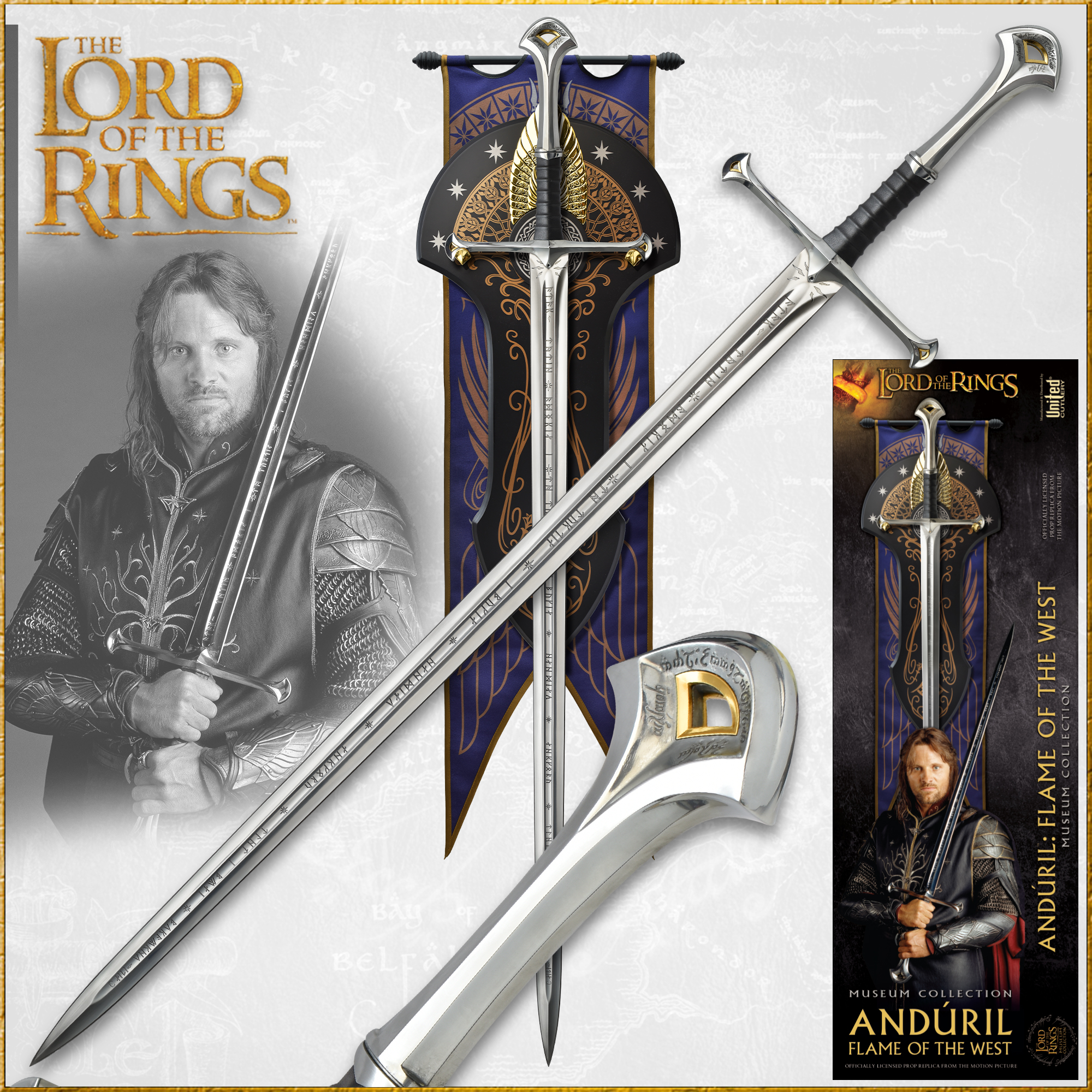
One of my favourite replica weapons I’ve owned was the original Anduril. Now almost 25 years later if you missed out on that version you can snag this beautiful Museum Collection version. This version of Anduril comes with a beautiful plaque, Gondorian banner, and a certificate of authenticity. This awesome piece by UC is in-stock and ready to ship! You can snag it for $599.
If you’re looking to add to your Legolas collection, you can now add his Lothlorien bow. This is very much one of those pieces I think needs to be in a Legolas themed collection and will really pop once it’s in yours. The Lothlorien bow of Legolas is also in-stock and can be snagged for $469.
Now, if bad guys are your thing. Especially a certain dark lord who may have a thing for one rings then this next piece is for you. This is another museum collection piece so you’re getting all the similar goodies you would get with the Andruil sword only themed for Sauron himself. Sauron’s helm is in-stock as well and ready to ship for $499. Fun note this helm is leather lined so you just might be able to wear it.
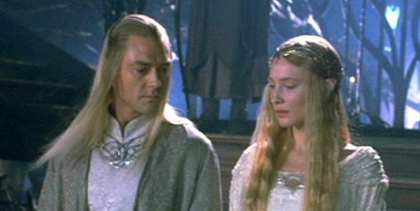
No doubt about it, shoehorning Celeborn (the Wise) into The Rings of Power storyline is one of the trickiest problems that the show must navigate. Importantly, for it to matter, I feel the show has to do it soon — this coming season, even.
But as my TORn Discord colleague, Webcrawler, points out, this is a self-inflicted challenge — the showrunners did this to themselves. They consciously chose to absent Celeborn from the story (a story where, by some of Tolkien’s drafts, he plays more than a minor part in events). Thus, I would assert (I would hope) that they must have some clever idea or resolution in mind.
Once you grasp this rather important fact, it also prompts the question: “Why did they choose to do this?”.
Hold that thought, we’ll return to it later. First, I’d like to posit four different scenarios for finally bringing Celeborn into the story.
Of course, keep in mind this is my own theory-crafting, not set rumours.
THEORY ONE: Re-embodiment in Valinor
This is the most straightforward solution I can think of right now. Per Laws and Customs Among the Eldar (sometimes abbreviated to LACE) in HOME Volume X, it is possible for elves to re-embody post-death after a time spent in the Halls of Mandos.
Tolkien Gateway has an excellent and succinct summarisation of the process Tolkien outlined in LACE:
A houseless fëa that chose or was permitted to return to life was typically only able to be reembodied through childbirth. The reborn fëa would experience childhood again, but would only remember its previous life upon achieving mastery of its body. Through the joy of this second childhood, the griefs of the fëa’s previous life could be redressed.
The most well-known instance is that of Glorfindel, re-embodied after his death in the Fall of Gondolin and subsequently sent back to Middle-earth by the Valar to assist with the Second and Third Age struggle against Sauron. (Aside: arguably, if the show had been going to introduce Glorfindel, then S2 and the destruction of Eregion would have been the ideal time since as Tolkien outlines in HOME XII: Last Writings, assisting survivors out of the destruction and pairing up with Elrond and Gil-galad against Sauron’s war in Eriador is his big Second Age moment.)
What if the show were to, instead, apply this re-embodiment to Celeborn?
What if Celeborn had, in fact, perished on the field of … the Nirnaeth, I guess, that we saw in the S1 prologue, and his spirit was summoned to the Halls of Mandos.
It would provide a thoroughly logical explanation for exactly what Celeborn has been doing for the last 1,000 years and more: he’s been stuck in the Halls of Mandos, and then, quite literally, growing up all over again – and for an elf to grow to adulthood is around 100 years, minimum — in Valinor.
It would fit with Galadriel’s words to Theo in S1: “When he went to [the war], I chided him. His armour didn’t fit properly. I called him a silver clam. I never saw him again after that.”
Now, at the right time, he might return to Middle-earth either of his own volition, or at the behest of the Valar. That’s right, kindasorta stealing Glorfindel’s role.
This is a complete invention at odds with, well, every variation of the Galadriel and Celeborn story. But given the many unresolved contradictions within Celeborn’s (and Galadriel’s) textual history, it’s probably better for The Rings of Power to strive for its own internal consistency.
Re-embodied Celeborn might actually offer the cleanest resolution.
A re-embodied Celeborn could also be an interesting boost to his character — LACE states that “the Re-born (they say) are stronger, having greater mastery of their bodies and being more patient of griefs.” Galadriel, in LOTR, tells the members of the Fellowship that “…the Lord of the Galadhrim is accounted the wisest of the Elves of Middle-earth, and a giver of gifts beyond the power of kings.”
Re-embodiment could help make him less anodyne than the “Cele-boring” we see in PJ’s rendition.
THEORY TWO: Imprisoned by Thranduil
This idea is, I think, kinda cracked, but it’s inspired by recently re-reading The Hobbit. What if Thranduil* had imprisoned Celeborn at the turn of the Second Age, and simply not informed anyone?
Just riffing off what occurs with Thorin in Mirkwood:
“Very well!” said the [elven]-king. “Take him away and keep him safe, until he feels inclined to tell the truth, even if he waits a hundred years [emphasis mine].'”
Then the elves put thongs on him, and shut him in one of the inmost caves with strong wooden doors, and left him.
Flies and Spiders, The Hobbit
But what could even prompt Thranduil to imprison Celeborn — a fellow Sindar — for more than 1,000 years, and not tell anyone? Simple trespassing seems an enormous stretch.
One explanation that comes to mind from The Silmarillion is Thingol’s choice to not join Maedhros and Fingon’s assault on Angband that becomes the Nirnaeth Arnoediad, and his reluctant assent for Mablung and Beleg to join Fingon’s force.
This feels a bit of a reach, but, what if Celeborn (a kinsman of Thingol according to the Silmarillion tale) had also gone to the battle, but without Thingol’s permission? Galadriel does state in The Rings of Power that she “chided him”, and that his armour did not fit. This sounds tender, but could also hint at some underlying “sneaking away” subterfuge — if the writers chose to interpret it like that.
Further, what if, much, much later, he somehow, ended up in Thranduil’s realm. Might Thranduil (also a Sindar elf of the former realm of Doriath) imprison him, exactly like with Thorin, as a long-delayed punishment for such an disobedience.
Like I said, it does feel a crack theory. Holding a continuing (well-documented) grudge against dwarves for perceived ancient wrongs is one thing; holding one against one of your own folk over someone else’s ban on consorting with the Noldor seems quite another. More, you have to set against that the technicality that Thranduil and Oropher spent much of the early Second Age in Lindon and did not migrate to Greenwood, east of the Misty Mountains until at least SA750.
* I’ve written Thranduil here since I feel for the sake of story simplification, we’ll never see his father Oropher in The Rings of Power. Simple as that.
THEORY THREE: Lost in the woods
Consider, first, the situation of Thingol and Melian, lost in each other’s eyes in the deep woods of Nan Elmoth for a vast stretch of time.
Alternatively, consider how Old Man Willow trapped Pippin and Merry by the Withywindle, or how Nimrodel goes missing for a long time after being separated from Amroth on the long journey from then-Lorinand to Edhellond in Gondor’s south.
Or consider how Morwen goes conveniently missing between Glaurung’s assault on Nargothrond, and the end of the Narn i Hîn Húrintale where she meets Húrinat Cabed-en-Aras.
I think it’s fair to conclude from these handful of examples that folks get lost or trapped (in the woods) in Middle-earth now and then.
I want to pair this observation with Celeborn’s curious warning to the members of the Fellowship against Fangorn.
‘Yet [the Fellowship] should not go too far up that stream, nor risk becoming entangled in the Forest of Fangorn. That is a strange land, and is now little known. But Boromir and Aragorn doubtless do not need this warning.’
Farewell to Lórien, The Lord of the Rings
Aragorn also says in LOTR in an exchange with Legolas:
‘Yes, it is old,’ said Aragorn, ‘as old as the forest by the Barrow-downs, and it is far greater. Elrond says that the two are akin, the last strongholds of the mighty woods of the Elder Days, in which the Firstborn roamed while Men still slept. Yet Fangorn holds some secret of its own. [emphasis mine]’
The Riders of Rohan, The Lord of the Rings
What if Celeborn’s long disappearance involved Fangorn? Might he have been trapped there somehow — long-captured by some angry Huorn in an episode resembling what happened to Pippin and Merry in the Old Forest? Even if something like that occurred though, there’s the challenge of elegantly explaining how Celeborn got all the way from Beleriand to Fangorn (or even to the Old Forest if you used that area).
Perhaps the best option here is actually the old lost-my-memory-and-ran-away trick (similar to Nienor’s experience) as the consequence of some significant battlefield trauma. Perhaps even as the result of a confrontation with Glaurung. I’m pretty sure the showrunners did at one point say at an event or convention that they wanted a dragon, and there’s been discussion of the possiblity since.
Bringing him all the way to Fangorn (a place that, despite the “strangeness” Celeborn describes, does not seem hostile towards elves) might be a little hard to convincingly sustain, but it is usefully close to Lorien — a location we will hopefully be introduced to in Season 3.
I’m worried that amnesia is a little too much like what happened with Gandalf. I’m not sure I like that. Convenient amnesia is one of the Celeborn theories that Cliff and Justin considered on TORn Tuesday a while back as well. If you want to listen in, the discussion starts around 25 minutes into the VOD.
THEORY FOUR: Shamed thrall of Morgoth
Alternatively, Morgoth might have imprisoned Celeborn. Angband contained many elven thralls during the First Age. We could see a scenario where Celeborn was captured in the aftermath of the battle Galadriel refers to in The Rings of Power and forced to labour for the Enemy until the War of Wrath and Morgoth’s overthrow.
Many of the Noldor and the Sindar they took captive and led to Angband, and made them thralls, forcing them to use their skill and their knowledge in the service of Morgoth.
Of the Ruin of Beleriand and the Fall of Fingolfin, The Silmarillion
Alone that’s insufficient to explain Celeborn’s thousand-year absence. But consider also the experience of the vast majority of escaped elven thralls…
…ever the Noldor feared most the treachery of those of their own kin, who had been thralls in Angband; for Morgoth used some of these for his evil purposes, and feigning to give them liberty sent them abroad, but their wills were chained to his, and they strayed only to come back to him again. Therefore if any of his captives escaped in truth, and returned to their own people, they had little welcome, and wandered alone outlawed and desperate[emphasis mine].
Of the Ruin of Beleriand and the Fall of Fingolfin, The Silmarillion
Yes, there are exceptions such as the ease with which Gwindor son of Guilin slots back into the hierarchy of Nargothrond. Yet Húrin Thalion is shunned by his folk — and Turgon — after his release from Angband. Even once he realises he is no longer Morgoth’s thrall, “he wanders out of all knowledge” and supposedly throws himself into the sea.
Similarly, even if the source of the angst is different, Maglor commits himself to a perpetual exile of regret, wandering the shores of Middle-earth after he and Maedhros take the remaining Silmarils from Eönwë by force in the wake of the War of Wrath.
What if, in The Rings of Power, after the overthrow of Angband, Celeborn was one of the “multitude of slaves” who came forth from its deep prisons, “looked upon a world that was changed” and, whether through shame or PTSD, turned away to become a solitary recluse who avoids all society.
One might protest that this overlaps Adar’s background. But Adar’s corruption is a bit different. He has become an Uruk. In this instance the thrall concept is not a rerun; it’s exploring a different phenomenon entirely.
Where would Celeborn be, though? Well, there’s an awful lot of Middle-earth coastline that hermit!Celeborn could share with Maglor. A lot of dense, unexplored forest, too, especially around Eryn Vorn given that during the Second Age much of southern Eriador was still heavily forested.
…in the earlier days, at the time of the first explorations of the Númenóreans… Minhiriath and Enedwaith were occupied by vast and almost continuous forests, except in the central region of the Great Fens.
The History of Galadriel & Celeborn, Unfinished Tales of Númenor & Middle-earth
There’s something appealing, to me at least, about the thought of the Telerin/Sindar Celeborn hiding out (maybe even with a handful of Ents or some of the Drúedain) somewhere around Drúwaith Iaur, or even the Belfalas coast and spending S3 raging against the rapacious logging efforts of Kemen and friends. It’d be a nice nod to the temporary Third Age sojourn of Galadriel and Celeborn in that area that Tolkien described in his initial iteration of their story.
Where is less important than why
The reality is that it doesn’t really matter where Celeborn actually is in this scenario — the showrunners will manufacture a way and a reason for Galadriel to find him.
What is more important, I think, is why Celeborn exists — the role he’ll play in the drama.
Of course, Celeborn is a box that The Rings of Power needs to tick if only for continuity. Mechanically, to not have Celeborn co-ruling Lorien with Galadriel so that together through ages of the world they can fight “the long defeat” would be, well, outrageous.
And that need to ultimately match both the book text and PJ’s LOTR is why I’ve always thought it was a bit mad to insist “Celeborn is dead”, and should stay that way.
Who dis?
But the showrunners have always stated that The Rings of Power is about the characters becoming the individuals we know at the end of the Third Age.
Right now, Galadriel’s personality flips between “Artanis” and “Nerwen”: she’s very capable of being the lady of the court — the noble woman of her father-name — but undeniably The Rings of Power has leaned heavily into the “man-maiden” warrior nature of her mother-name.
Still in Season 2 she regularly wears her hair in some sort of crown. It’s surely a nod to “Galadriel” — the epessë (a nickname or honorific) given to her by none other than Celeborn. What better way for Galadriel to rediscover her true self (and stop being torn every which way) than by finding the lover who gave her that name in the first place?
This does not have to be boring.
In the first instance there’s the fact that, in-show, Galadriel seems to have blithely assumed that Celeborn perished in the Nirnaeth yet spent 1,000 years obsessively criss-crossing Middle-earth trying to hunt down Sauron.
Depending on Celeborn’s recent history, the obverse could apply, too — especially if he’s hidden himself away. The text of LACE mentions that elven couples “do not necessarily dwell or house together at all times” despite remaining wedded forever, so the passage of time should not be an insurmountable barrier to the pair reconnecting. Still, they must decide if (and why) it’s worth resurrecting their relationship in such circumstances.
What if Celeborn is mentally, or physically, scarred from his experiences? Consider Gwindor’s return to Nargothrond:
At first his own people did not know Gwindor, who went out young and strong, and returned now seeming as one of the aged among mortal Men, because of his torments and his labours…
Of Túrin Turambar, The Silmarillion
It feels reductive to say this a “she can fix him” situation, but there’s a precedent with what happened with Nenya and Adar in the final episode of S2. It could help bring a blighted Celeborn back to himself. More prosaically, Galadriel also (inadvertently) uses Nenya to heal a fellow elf in S2 E4.
In “fixing” Celeborn (props to Webcrawler for pointing this out), Galadriel can also heal herself. It’s a chance to recognise a healthy partnership and true love — as opposed to the poisonous, controlling version that Sauron/Halbrand keeps trying to offer. One with things like not using each other for personal gain, and not flipping out when you get corrected. Simple stuff!
It’s still going to be a long journey for Galadriel to reach that point where she has the strength to reject the One Ring when Frodo finally offers it. But, for The Rings of Power, accepting Celeborn should be the start.
About the author:Staffer Demosthenes has been involved with TheOneRing.net since 2001, serving first as an Associate News Editor, then as Chief News Editor during the making of the Hobbit films. Now he focuses on features and analysis. The opinions in this article are his own and do not necessarily represent those of TheOneRing.net and other staff.
If you have a Tolkien/Middle-earth inspired poem you’d like to share, then send it to poetry@theonering.net. One poem per person may be submitted each month. Please make sure to proofread your work before sending it in. TheOneRing.net is not responsible for poems posting with spelling or grammatical errors.