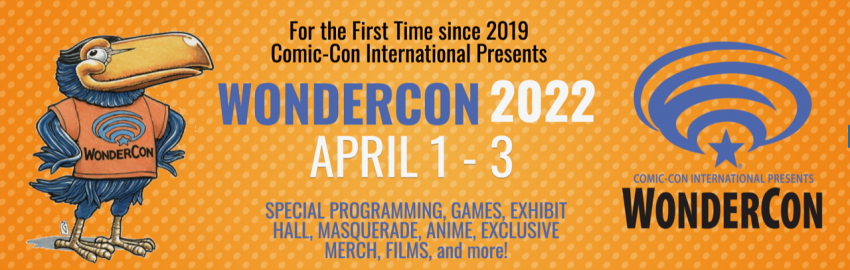
TheOneRing.net will be at WonderCon this year, and we will be hosting two panels over the course of the weekend, April 1-3 in the Anaheim Convention Center. If you plan to attend the convention, please read through the WonderCon COVID protocols.
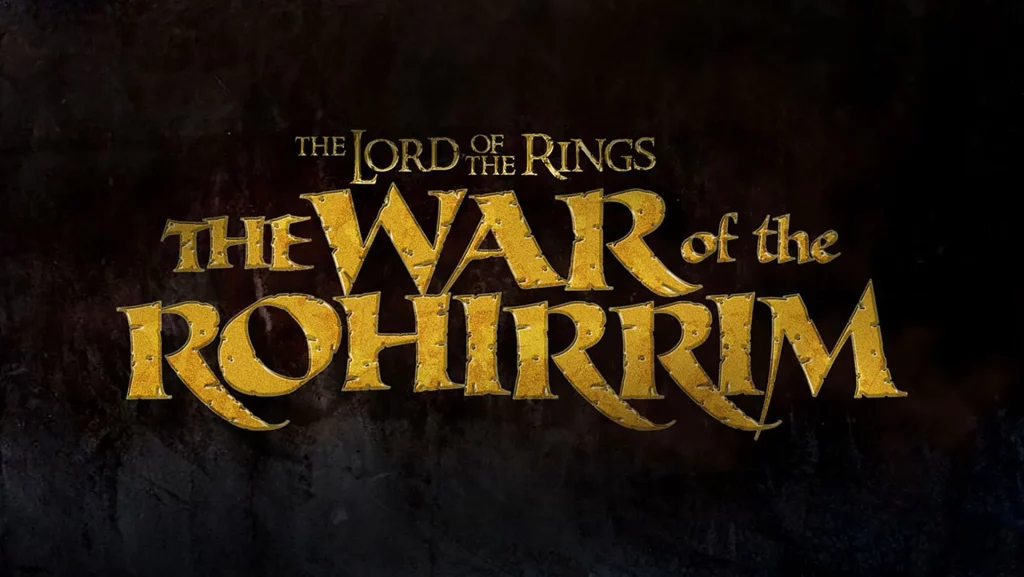
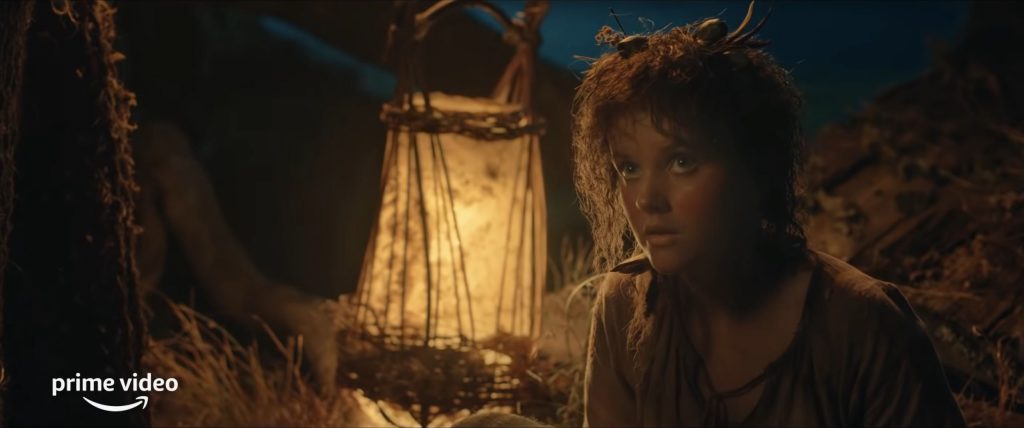
Our first panel, Middle-earth! Coming to your TV this Fall will be at 4:30 pm on Friday, April 1 (no joke) in room North 200A. This will be our big overview panel, with all the news, rumors, and anecdotes about Amazon’s Lord of the Rings: The Rings of Power, as well as the WB’s upcoming animated War of the Rohirrim. There will be an update on any and all Middle-earth news, activities, and events coming up this year. And we can wait to see if anyone has had enough time to create a costume from the recent Amazon Teaser Trailer.
Our Second panel, I am no Man: The Women of Middle-earth will be a deep dive into Tolkien’s legendarium to discuss all the unique and wonderful women that Tolkien created. For those who have just read The Hobbit, Middle-earth feels like an ‘all males club’, but in The Lord of the Rings and some of the books of deeper lore, there are queens and warriors and creators, all women, who had a hand in shaping the Middle-earth we all know and love. The presentation is still being crafted, if there is a specific woman of Middle-earth you wish to see discussed, send an email to Garfeimao@TheOnering.net. Include the character name and a brief note about what makes her so special for you, we will include as many as we can fit into our allotted panel time.
‘We come to it at last – the great battle of our time.’ Or – in this case – the great battle of the Ages! On Tuesday 22nd March we’ll kick off this year’s Middle-earth March Madness; and the theme is A Battle of the Ages.
Each of the four brackets this year represents an Age in Tolkien’s Middle-earth. This is the perfect opportunity to brush up on your history, as we get ready for Amazon’s Rings of Power – and the events of the Second Age – in September.
Over the coming weeks, we’ll have some posts to explore these brackets in more depth. What happened in the time of the Two Trees? Who conquered Glaurung in the First Age? And just when were those rings forged in the Second Age? Get ready to explore some History of Middle-earth together, as we vote to decide fandom’s favourite event from thousands of years.
How does it work, you ask? Simple! Staffers at TORn already voted to narrow down the many, many happenings to their top 64, and instead of seeding this year, the events appear in chronological order in each bracket. For each round, we will have a poll, where you vote for your choice in each match-up. Is Gandalf falling to the Balrog more significant than the Last March of the Ents? Are you more interested in when Beren first sees Luthien, or when they recover a Silmaril together? Which is more terrible – the destruction of the Two Trees, or the Elven Kinslaying? You decide!
Join us on Tuesday to kick off the Middle-earth March Madness tournament for 2022. 64 events will start out – but only one will be crowned Champion!
In the early 1990s, Russian director Roman Mitrofanov began working on an animated version of The Hobbit. The effort ultimately fizzled in the dissolution of the Soviet Union, but six minutes of footage survives and can be watched on Youtube to this day.
The footage functions more or less as a prologue that shows not much more than the destruction of Erebor and Dale by Smaug, and was clearly intended to be just the beginning of a complete adaptation.
It’s also full of delightful details such as the bells and the toy-market that Thorin Oakenshield describes to Bilbo during the Unexpected Party.
They built the merry town of Dale there in those days. Kings used to send for our smiths, and reward even the least skilful most richly. Fathers would beg us to take their sons as apprentices, and pay us handsomely, especially in food-supplies, which we never bothered to grow or find for ourselves. […] and the toy-market of Dale was the wonder of the North.
The Hobbit
Treasures under the Mountain, an incomplete Russian adaption of J.R.R. Tolkien’s The Hobbit from 1991.
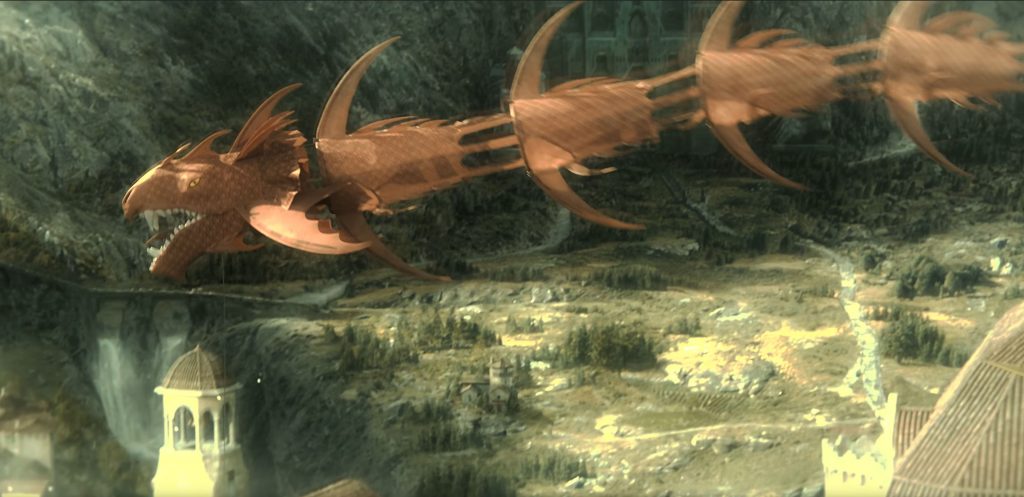
The bucolic imagery of Dale also includes a brief view (at approximately 2 mins 12 secs) of several people flying kites over the town square. If one squints just right (the quality is only 360p), one might construe one as having the shape of a dragon even.
Peter Jackson’s rendition of Dale shares many of the same details. Of course, this should not be surprising — they pull from the same source. But an inspection of the text of The Hobbit reveals no mention the people of Dale having kites or gliders. There’s nothing similar in The Lord of the Rings, either, not even when Frodo reminisces with Glóin in Rivendell.
This prompts the question: might Jackson — or one of his crew — have seen the Russian animation, liked the concept, and been inspired to use the kites in a similar fashion as a beautiful and poignant foreshadowing device?
There’s a particular letter in The Letters of J.R.R. Tolkien where Tolkien writes about his experience of dealing with a proposal from Forrest J. Ackerman to make an animated film of The Lord of the Rings.
Within that letter, there’s one revealing sentence.
Stanley U. &: I have agreed on our policy : Art or Cash. Either very profitable terms indeed ; or absolute author’s veto on objectionable[my emphasis] features or alterations.
Letter #202, The Letters of J.R.R. Tolkien.
The deal never happened, though Tolkien did subsequently sell film rights in 1969 to United Artists under the looming pressure of inheritance taxes.
These days, I suspect there’s no such pressure. More, the “Middle-earth universe” is seen as a proven starter for the world’s media companies. I think that has given Tolkien Estate leverage: the power to demand not just Cash, but Art as well.
In the context of the recent Vanity Fair feature, this explains not just the starting price for the Tolkien Estate’s rights auction a “gobsmacking” $200 million, but the documented demand for input into the direction of the series. In an early, seemingly unauthorised, interview, Tom Shippey described this “input” as a “veto power”.
It also says something about the power of Middle-earth that even with that eye-watering starting price and the attachment of certain pre-conditions, Netflix, HBO and Amazon all put their hand up and bid.
Still, even if Tolkien Estate was willing to put its foot down to get that capital-A Art, it was always going to take an equally ambitious (and well-resourced) studio to come through with the goods.
Despite Vanity Fair’s assurances (it’s pretty stunning that they’ve seen the first three episodes already), it’s too early for us ordinary punters to declare The Rings of Power a sure bet — in either the commercial sense, or the Art sense.
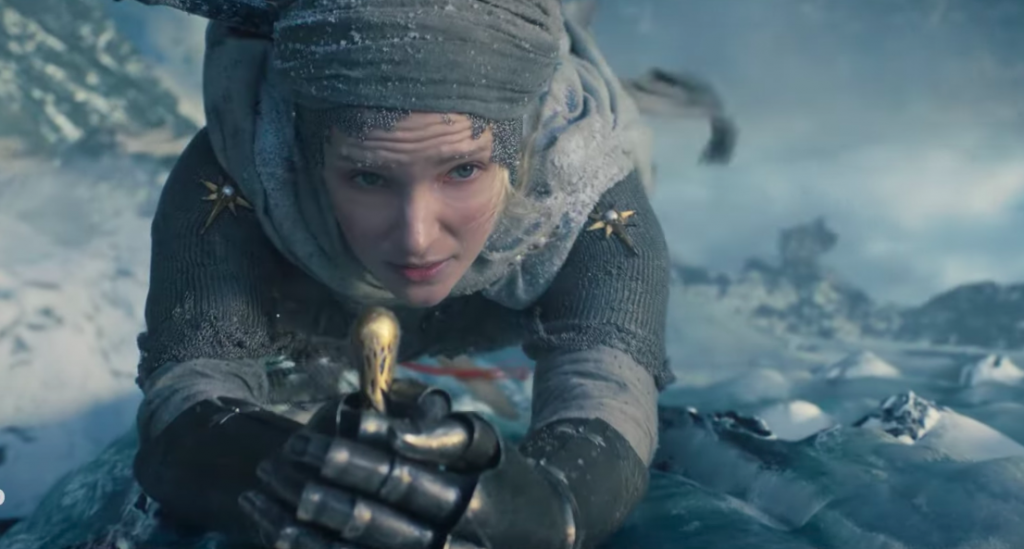
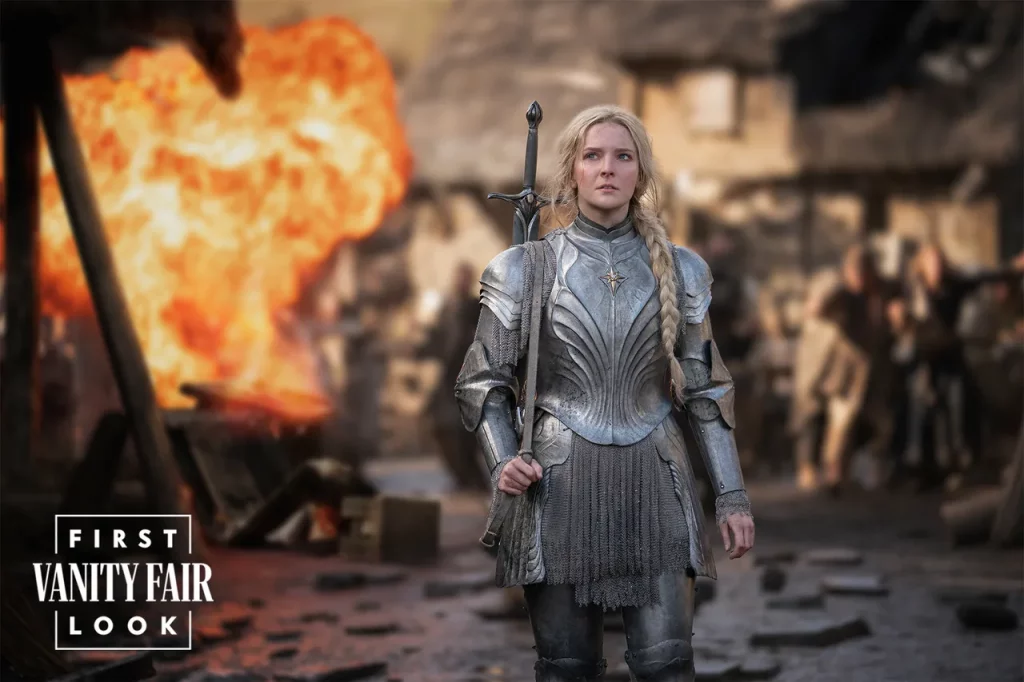
However, Vanity Fair’s first look under the bonnet shows there’s no lack of promise: the images are intriguing and suggestive, sets and costumes look suitably spectacular, and the production staff are making the right sort of noises about respecting the integrity of the source material.
But a show with the resources of The Rings of Power should (by default) have stunning production values and a real, lived-in feel. That’s just a given.
And it’s politic for showrunners to make the right noises (I would, too). The question is, can we identify instances of real substance to back those noises? Has the objectionable — as Tolkien might have seen it — been excised?
An Atlantis-like Númenor, the full glory of Khazad-dûm —- that vast dwarven metropolis carved out of the bones of the Misty Mountains, the puissance of the elven smith Celebrimbor, whose skills with metals and magic are crucial to the forging of the rings are all lore-friendly inclusions.
They’re also easy wins.
In a way, so too is the centrality of Galadriel.
Galadriel is a key player in the Second Age (fighting the long defeat, as she expresses in The Lord of the Rings). After the publication of that book, Tolkien increasingly came to view her as one of the most remarkable elves to play a role in Middle-earth’s history, and his later essays and notes paint her as an increasingly exceptional individual. She’s also incredibly peripatetic throughout the Second Age — wandering from Lindon, into Eriador and eventually south to Eregion, under the Misty Mountains to Lórien, back across to Imladris (Rivendell) and finally the south coasts of what would later become Gondor.
During all that, she’s a key participant in events. She joins Gil-galad to reject the approaches of Annatar, alternately collaborating and at loggerheads with Celebrimbor (and later advising him to hide Nenya, Vilya and Narya), before strengthening then-Lórinand (later Lórien). Unfinished Tales states that she views the dwarves of Khazad-dûm “with the eye of a commander”.
That bespeaks a driven individual — and this is something that the teasers from Vanity Fair support. I want to see lots of ambition from Galadriel — someone with just as much inner-belief and determination to make things happen as Fëanor, but with (even at the start of the Second Age) a touch more wisdom. I think you should too.
As showrunner McKay Patrick tells Vanity Fair: “This young hot-headed Galadriel… how did she ever become that elder stateswoman [who we meet in Lórien in The Lord of the Rings]?” The awareness of that difference is present; if the show is able to intelligently show this change, it will have taken a large step toward something that accords with J.R.R. Tolkien’s own musings.
Reassuring also is the gradual emergence of the Second Age threat — one that’s recognised by some, but not by others. After all, up until the forging of the One, Sauron (as Annatar) uses the velvet glove, not the iron fist. Very late writings recently published in The Nature of Middle-earth even suggest that his minions mocked him behind his back for this.
Again, direct statements from the McKay seem to back this: “We didn’t want to do a villain-centric thing. We wanted it [the first season] to be about introducing these worlds and the peoples who dwell in them and the major heroes and characters.”
And what is potentially one of the most contentious decisions — to include Hobbits as “Harfoots” — accords somewhat with both Gandalf’s description of Gollum’s folk (yes, I know those are, more correctly, Stoors): “a clever-handed and quiet-footed little people.”
And a note in the prologue chapter of The Lord of the Rings, “Concerning Hobbits” details that “even in ancient days [Hobbits] were, as a rule, shy of ‘the Big Folk’, as they call us, and now they avoid us with dismay and are becoming hard to find … [and] they possessed from the first the art of disappearing swiftly and silently, when large folk whom they do not wish to meet come blundering by…”
Is this one decision Tolkien Estate has weighed in on? Regardless, much will hinge on the execution of the concept.
Set against the above is the compression of the timeline that the showrunners discuss. First, kudos to the production staff for being clear on this. In fact, it recalls Peter Jackson’s bald statements that his films would include no Scouring of the Shire — a very real cause of fan angst at the time. (I still think that writing decision undersold some of the character development of the four key hobbits, but, weighing in at 201 minutes, PJ’s The Return of the King is already very long.)
I get the fact that it’s probably really difficult for any television series to traverse a 2,500-year history in a way that is not choppy and disjointed, and remains compelling viewing. Being able to see characters such as, say, Isildur and Ar-Pharazôn across a span of 5 seasons allows a great deal more screentime (and thus development and insight) than would be possible in a couple of seasons. A strictly linear structure would introduce them only at near the very conclusion of the entire series.
Still, I would have liked (as many speculated before the Vanity Fair article came out) to have seen Amazon be really daring and attempt to run two split, simultaneous timelines — one leading up to the forging of the One (and Sauron’s defeat by the elves and Númenor’s fleet), and another focused on Akallabêth and, perhaps, the War of the Last Alliance (also culminating in Sauron’s defeat, this time by the elves and the Dúnedain of Arnor and Gondor).
Doubtless, it would be demanding on the audience. But if it worked, it would have been amazing.
It’s worth noting, though, that J.R.R. Tolkien in his appraisal of the Morton Grady Zimmerrnan’s 1958 script made specific reference to his displeasure with time contraction of events.
There he states that:
I fail to see why the time-scheme should be deliberately contracted. It is already rather packed in the original, the main action occurring between Sept. 22 and March 25 of the following year. The many impossibilities and absurdities which further hurrying produces might, I suppose, be unobserved by an uncritical viewer; but I do not see why they should be unnecessarily introduced.
Letter #210, The Letters of J.R.R. Tolkien
Does that make this particular contraction objectionable?
In Letter #210, Tolkien points out that he doesn’t want to see “his work treated as it would seem carelessly in general, in places recklessly, and with no evident signs of any appreciation of what it is all about.” He does not want the tone lowered “towards that of a more childish fairy-tale.” Lastly, he does not wish for deliberate alteration of the story, in fact and significance, without any practical or artistic object [my emphasis].”
At least, those are my key takeaways.
Now, one observes that if the time scheme of The Lord of the Rings is packed, the precis account of the Second Age in The Tale of Years is most certainly not.
Tolkien also notes in Letter #210 that he closely observed the passing of seasons in The Lord of the Rings. He suggests that such pictorial representations could be used to non-explicitly indicate the passage of time. Similar effects might be employed for The Rings of Power series. Maybe not the thousands we are familiar with from “The Tale of Years”, but certainly dozens — or even the 100 to 200 that might encompass the lifespan of a Dúnedain of Númenor, or a dwarf of Durin’s line.
How much time is being contracted? Vanity Fair is not precise: the writers say that events are compressed “into a single point in time.” That might mean a span of a generation.
Here is where it would have been fascinating to be a fly on the wall in the discussions between Amazon Studios and Tolkien Estate.
Finally, keep in mind J.R.R. Tolkien’s letter to Milton Waldman outlining his artistic vision:
I would draw some of the great tales in fullness, and leave many only placed in the scheme, and sketched. The cycles should be linked to a majestic whole, and yet leave scope for other minds and hands, wielding paint and music and drama. Absurd.
Letter #131. The Letters of J.R.R. Tolkien
Absurd. Yet, here we are.
With this in mind, I think there are promising signs that Tolkien Estate (and indeed, Amazon Studios) is seeking Art, not just Cash. Early shoots with the promise of beautiful spring, you might say.
But there’s still an awfully long way to go.
As Galadriel says in The Lord of the Rings: “hope remains while all the Company is true.” We’ll see in September how true this particular company has been.
About the author: Staffer Demosthenes has been involved with TheOneRing.net since 2001, serving first as an Associate News Editor, then as Chief News Editor during the making of the Hobbit films. Now he focuses on features and analysis.The opinions in this article are his own and do not necessarily represent those of TheOnering.net and other staff.
If you have a Tolkien/Middle-earth inspired poem you’d like to share, then send it to poetry@theonering.net. One poem per person may be submitted each month. Please make sure to proofread your work before sending it in. TheOneRing.net is not responsible for poems posting with spelling or grammatical errors.
Variety reports that Warner Bros. and the Saul Zaentz Co. are currently in private mediation to settle differences over license rights to film adaptations of key J.R.R. Tolkien’s works The Lord of the Rings and The Hobbit.
According to Variety’s sources, the argument stems from disagreement about whether the studio has met ongoing obligations needed to maintain the long-term license that it has held since the late 1990s.
In a statement to Variety, a Warner Bros. spokeswoman said:
New Line Cinema has maintained the theatrical film rights, both live-action and animated, for over two decades now. We are currently in production on our anime film ‘The Lord of the Rings: The War of the Rohirrim’ and look forward to bringing audiences back to Middle-earth.
Warner Bros. earlier this week announced a release date for that film, and showed off the first samples of concept art.
As Variety points out, license deals such as this “often involve producers conducting a certain level of development and production activity by pre-determined dates, among other clauses.”
However, it is the Saul Zaetnz Co. (through its subsidiary, Middle-earth Enterprises) that holds the rights to exploit The Lord of the Rings and The Hobbit “in movies, video games, merchandising, live events and theme parks.”
Variety adds that this includes limited matching rights should the Tolkien Estate make movies or other content based on two Tolkien books published after his death: The Silmarillion, and The Unfinished Tales of Númenor and Middle-earth.
The Saul Zaentz Co. also recently announced that it will auction all its Tolkien IP rights. Universal and Warner Bros. are both reported to be interested.
Writer Joanna Robinson sure has been busy. Over on The Ringer (not actually a Tolkien site, believe it or not), she writes cogently on the commonalities and differences between the “Harfoots” we’ll see in Amazon’s The Rings of Power series, and the Hobbits we know rather better from The Lords of the Rings and The Hobbit.
She muses on how hobbits function as a crucial mediating influence into Tolkien’s milieu — and how that probably serves double for wider audiences outside core Tolkien fandom, a wider audience whose emotional attachment is mostly via Peter Jackson’s films.
And she explores the applicability of Hobbits to the WWI and WWII experiences of J.R.R. and Christopher Tolkien, and of the British folk in general.
Hobbits can be seen as the proxies for Tolkien’s children, but as with all things with the author, there’s also something much darker at play here. Tolkien abhorred any attempts to turn his Middle Earth books into simple allegories for the two world wars he lived and wrote through. Still it’s very hard not to see his hobbits as the “everyman” analogues for the pastoral Brits who were drawn into the horrors of the First World War and then the even greater terrors of WWII, as Tolkien and his sons were, respectively. In that way, Bilbo of The Hobbit—who is press-ganged into leaving his cozy hobbit hole by a wizard and a pack of dwarves—reminds us of the young J.R.R. Tolkien, who was so reluctant to go off to war at the tender age of 22 he used an academic deferral to delay enlisting.
In a 1941 letter to his son Michael, Tolkien recalled: “In those days chaps joined up, or were scorned publicly. It was a nasty cleft to be in for a young man with too much imagination and little physical courage.” A few years later Tolkien did, reluctantly, go to war. He wrote: “Junior officers were being killed off, a dozen a minute. Parting from my wife then … it was like a death.”
DON’T FORGET! Joanna Robinson will be joining TORn Tuesday tomorrow from 5pm PT, 8pm ET to discuss her Rings of Power experience with Staffers Quickbeam and Justin. Join us then, and be sure to bring your own burning questions!