At the outset of the Second Age all of the peoples of Middle-earth had to start over, after their kingdoms and homes were lost in the destruction of Beleriand. Entire rivers, coastlines and regions were gone forever. Moreover, most of the great leaders of Elves and Men perished or left Middle-earth during the First Age. Fingolfin, Fingon, Beren, Lúthien, Húrin and Eärendil were all gone. The ‘baddies’ also lost many of their greats, including Morgoth, Gothmog, and most of the Balrogs and dragons.
Those filling the void of leaders and heroes in the Second Age included Elrond and his brother Elros, Celebrimbor the Elven smith, Gil-Galad, now High King of the Noldor, and Númenorean faithful, Elendil. On the side of evil, any remaining Balrogs and dragons had gone into hiding, so that particular void was primarily filled by Sauron and his legions of orcs and corrupted men. Sauron’s forging of the One Ring in the Second Age and his powers of persuasion also managed to blur the lines of good and evil that were so easily delineated during the First Age. The One Ring’s power over lesser rings to turn once good and noble men to evil, and Sauron’s powers of persuasion, corrupted Elves, men and Kings of men.
Suffice it to say that the events of the Second Age are no less dramatic and compelling than those of the First Age. So, with that let’s delve into 16 of the most important events of the Second Age of Middle-earth, shall we?
Elros & the Edain reach Númenor (SA 32): Given the choice of the halfelven by the Valar, Elros chose to be counted among the race of Men. As such, he led the Edain (Men) to the island of Elenna, a gift of the Valar for the help the Edain provided to defeat Morgoth in the First Age. The Valar wanted to provide a special place for the Edain separate from Middle-earth and closer to Valinor, though the Edain were strictly prohibited from going far enough west that they lose sight of Elenna. The name of the realm Elros founded, which became synonymous with the name of the island, was Númenor. As king, Elros took the Quenya name of Tar-Minuyatur setting a tradition for all the kings of Númenor to follow.
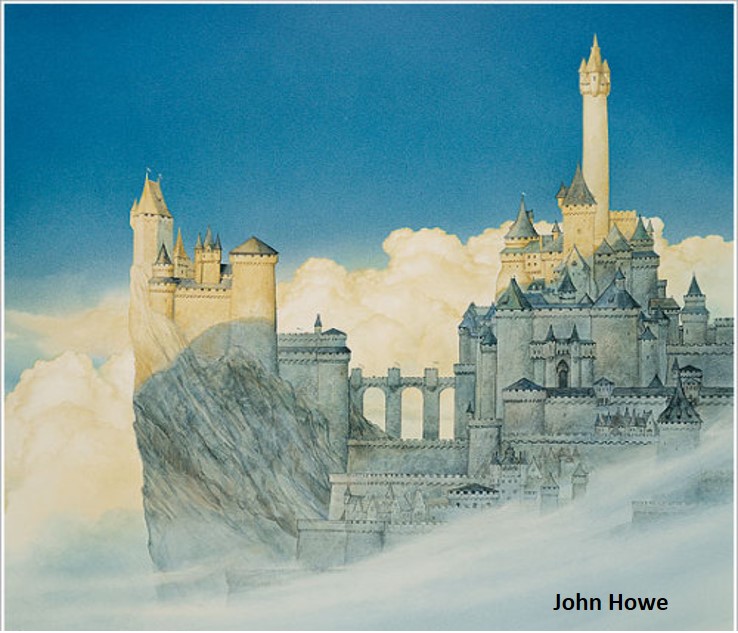
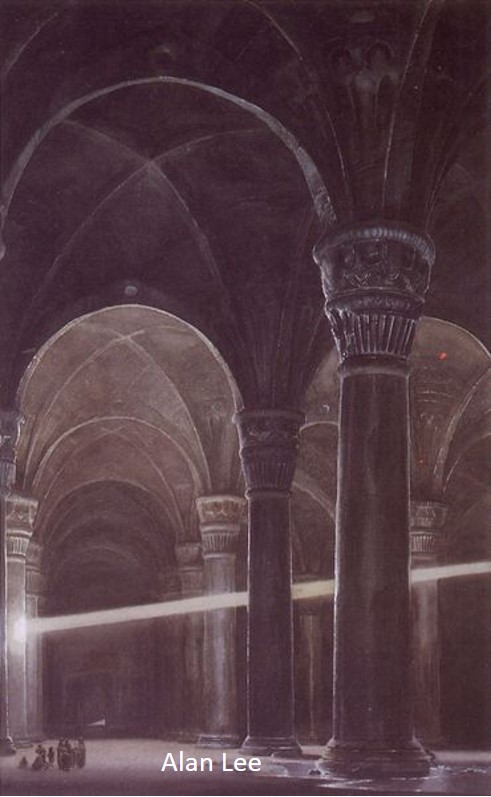
Migration of dwarves to Moria & Khazad-dûm (c. SA 40): Moria’s origins began prior to the First Age when Durin awoke. Looking into the lake of Kheled-zâram, he saw a crown of stars reflected in its waters and took it as a sign to stay. In the caves above the lake, Durin and his folk delved from the east side of the Misty Mountains eventually reaching the west side, and Moria became one of the greatest strongholds of the Dwarves. Unique among its natural resources was the rare metal Mithril. After the destruction of Beleriand at the end of the First Age, many Dwarves migrated to Moria, making it possible to mine more Mithril, and making the caverns even greater and more beautiful.
Moria
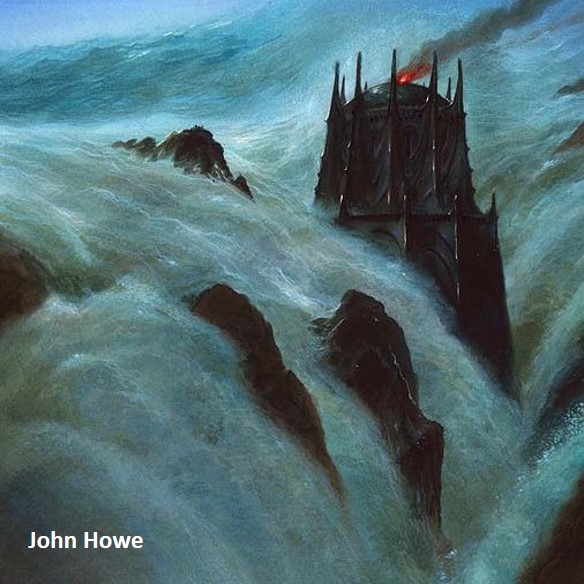
Sauron builds Barad-dûr in Mordor (c. SA 1000): Sauron, originally a Maia of Valinor, was among the servants of Morgoth who escaped the wrath of the Valar and the destruction of Beleriand. Thinking that the Valar had once again forgotten Middle-earth, he began ensnaring Men and orcs alike to his service. Alarmed by the growing power of the Númenorean visitors to Middle-earth, he decided to hedge his bets and construct his own fortress. To that end, he constructed the fortress of Barad-dûr near Mount Doom in the land of Mordor. To complete it, Sauron eventually used the power of the One Ring, making it impregnable as long as the One Ring existed.
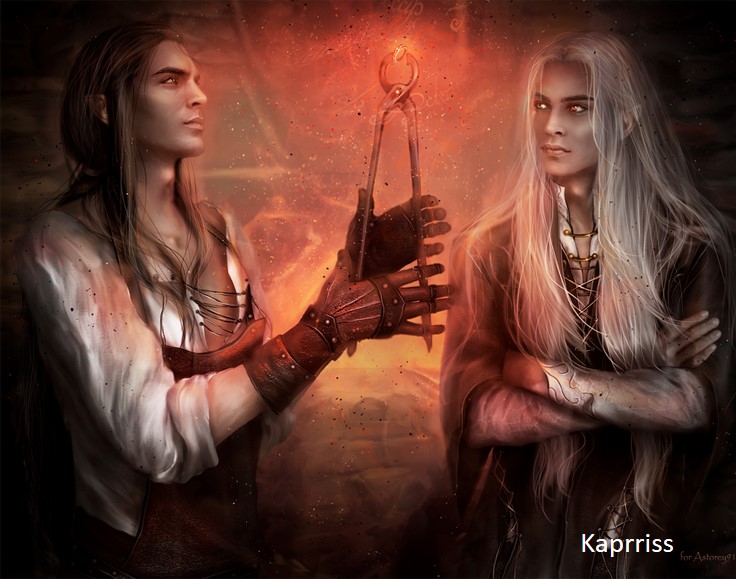
Celebrimbor crafts the Rings of Power (c. SA 1500): Celebrimbor, a grandson of Fëanor, founded the realm of Eregion on the west side of the Misty Mountains around SA 750. Its proximity to Moria was no accident, as the Elves were drawn by the availability of Mithril, and they traded freely with the Dwarves of Moria. Around SA 1200, Sauron began visiting Eregion in fair form under the name of Annatar, ‘Lord of Gifts.’ Imparting some of his knowledge of magic, he assisted Celebrimbor’s smiths in creating a number of rings of power.
The Three Elven Rings are completed (c. SA 1590): After Sauron/Annatar left, Celebrimbor created the three great Elven rings of power: Vilya and Narya (made of gold), and Nenya (made of Mithril). As they were forged without the knowledge of Sauron, they weren’t subject to his will.
Sauron forges the One Ring (c. SA 1600): During his time with the Elven smiths and Celebrimbor, Sauron took as much knowledge as he gave regarding the forging of rings of power. Having left Eregion, he returned to Mordor and forged the One Ring in the fires of Mount Doom, putting a large amount of his own power into the Ring. Celebrimbor immediately realized he had been betrayed, and a war between Sauron and the Elves ensued, leaving Eregion destroyed. Celebrimbor was captured by Sauron. Under torture and before he died, he revealed the location of all the rings of power except the three Elven rings. Sauron eventually used the power of the One Ring to dominate and control the owners of all the lesser Rings of Power, save the Three which were hidden from him.
Elrond builds the refuge of Imladris/Rivendell (SA 1697): After the fall of Eregion, Elrond founded the refuge of Rivendell, or Imladris, near the western slopes of the Misty Mountains. Rivendell became a shelter for the Elves fleeing the destruction of Eregion by Sauron’s forces, and would also become a safe haven for many a traveler throughout both the Second and Third Ages. Elrond had received the Elven Ring, Vilya, from Gil-Galad, and it was partially through its power that he was able to protect Rivendell throughout the Second and Third Ages. At the end of the Second Age, Rivendell served as a gathering point for the forces of the Last Alliance of Elves and Men, prior to crossing the Misty Mountains to eventually confront Sauron.
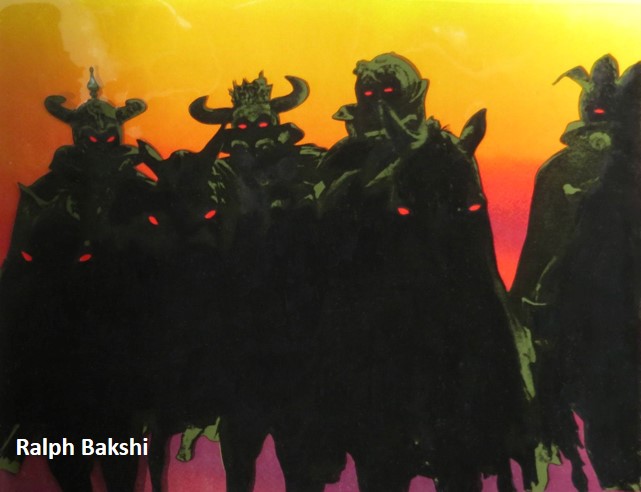
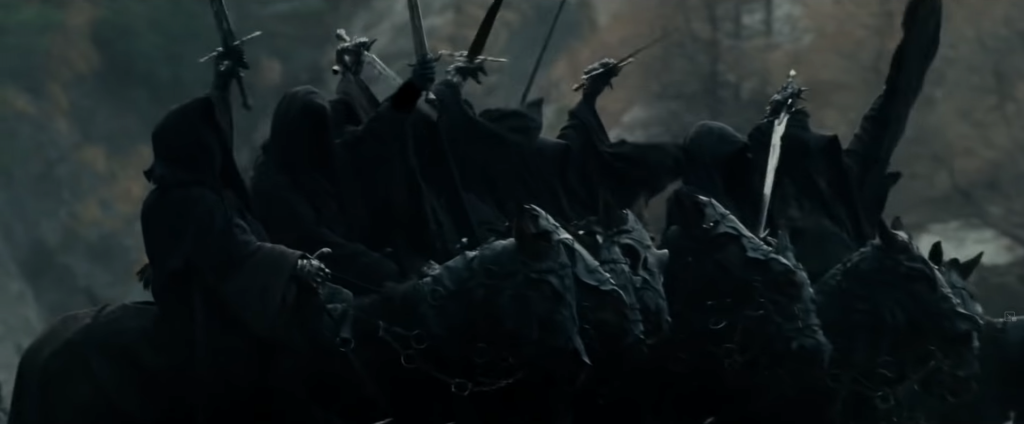
The Ringwraiths arise (SA 2251): After sacking Eregion, Sauron gave nine rings of power to mortal men. As with many of the rings of power, the life of the ringbearers was prolonged and they enjoyed great power while it lasted, but being mortal men they eventually turned into shadows of their former selves, or wraiths. The recipients of the nine rings are referred to in Tolkien’s writings as nine kings of men. However, only one of the Ringwraiths was ever named. Khamûl was a king of the Easterlings during the Second Age, and one of the wraiths to enter the Shire in search of the bearer of the One Ring in the Third Age. The Witch-king was the greatest of the Nine, but Tolkien never revealed his origins or his name. Nevertheless, the Ringwraiths, or Nazgul, were Sauron’s most terrible servants, and turned the tide of many future battles to Sauron’s benefit.
Ringwraiths
Sauron is “defeated” & brought to Númenor (SA 3262): After destroying Eregion, Sauron and his forces continued westward with the goal of dominating all of Middle-earth. At the request of the Elves, the Númenoreans came to their aid, eventually driving Sauron and his forces back. When Sauron realized he was losing, he allowed himself to be taken as a prisoner to Númenor by King Ar-Pharazôn. Using his considerable powers of persuasion, he converted many Númenoreans to the worship of darkness, and convinced Ar-Pharazôn that the Valar were selfish to retain immortality only for themselves. At Sauron’s urging, Ar-Pharazôn eventually decided to openly attack Valinor, convinced that in doing so he would become immortal.
Ar-Pharazôn builds the Great Armada & assails Valinor (SA 3319): Ar-Pharazôn the Golden was the twenty-fifth and last King of Númenor. In a bid to wrest the gift of immortality from the Valar, Ar-Pharazôn gathered a mighty armada with which to sail to Valinor and assail the Valar. The fleet eventually sailed far enough that they could no longer see Númenor on the horizon, which was strictly forbidden. When the fleet passed the island of Tol Eressëa and anchored near the coast of Valinor, the Valar called upon Eru for aid. Eru then changed the shape of the world, making it round so that Men could never again sail to Valinor.
Destruction of Númenor (SA 3319): In the turmoil caused by Eru changing the shape of the world, Ar-Pharazôn’s fleet was pulled into the chasm that opened between the Blessed Realm and mortal lands, and Númenor sank beneath the Sea. All of its inhabitants were killed. However, Elendil, his sons Isildur and Anárion, and others who had not been swayed by Sauron, realized that Ar-Pharazôn’s assault on Valinor could be disastrous. Just before the island was destroyed, they set sail for Middle-earth in nine ships. Reaching Middle-earth, they founded the kingdoms of Arnor in the north and Gondor in the south. Sauron’s body was destroyed, but he was still in possession of the One Ring – and his spirit also escaped to Middle-earth.
Destruction of Númenor
Arnor & Gondor are formed; the White Tree is replanted (SA 3320): Nimloth, the White Tree of Númenor (and a descendant of Telperion), had been destroyed by Sauron. However, Isildur had planted a seedling in secret, and carried the sapling to Middle-earth during his escape from the destruction of Númenor. It was planted in Minas Ithil. When Sauron took Minas Ithil (which became known as Minas Morgul), he again burned the white tree. However, Isildur once again rescued a sapling, and early in the Third Age, planted it in Minas Anor (later, Minas Tirith).
Isengard & Orthanc are built by Númenorian exiles (SA 3320): The Ring of Isengard and the tower of Orthanc were built by the Dúnedain, Númenor exiles. The fortress and tower provided protection for the northwesternmost region of the kingdom of Gondor. Its imposing tower and encircling, rocky walls were almost impregnable, having only one entrance to gain access. During his escape from Númenor, Elendil brought with him the palantíri, the seven seeing stones, and one was placed in Orthanc. It was used to communicate with other stones in various places around the kingdoms of Arnor and Gondor.
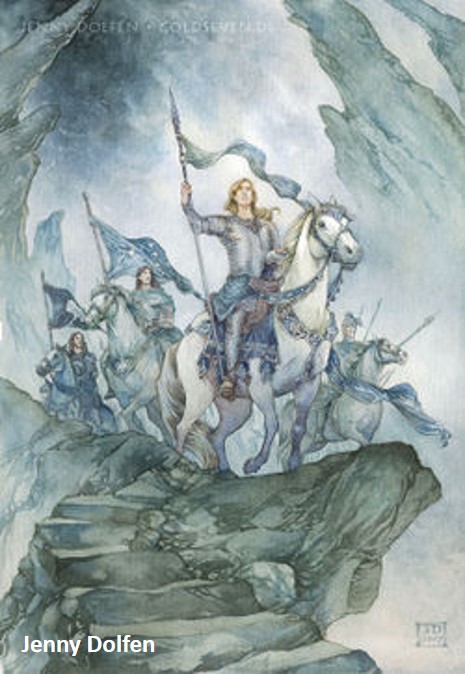
The Last Alliance of Elves & Men is formed (SA 3430): With the One Ring and the Ringwraiths at his disposal, Sauron’s strength grew to be almost insurmountable by the end of the Second Age. It became apparent to the leaders of the free people that only through their combined strength could they hope to stop the Dark Lord. To that end, an alliance was formed between Elendil and Gil-galad. After gathering and making plans in Rivendell, the armies made their way to the plains of Dagorlad outside of Mordor. Forcing their way into Mordor, they besieged Barad-dûr for seven years. Elendil’s son, Anárion, perished during the siege.
The Last Alliance of Elves and Men
Sauron overthrown by Elendil & Gil-galad, who both perish (SA 3441): In a desperate attempt to end the siege of the Last Alliance, Sauron sent out his host once more to confront the forces of the enemy. To bolster his forces and intimidate the enemy, Sauron himself left Barad-dûr to engage in direct combat. After a long battle, Sauron was felled by Gil-galad and Elendil, who both perished in the attempt.
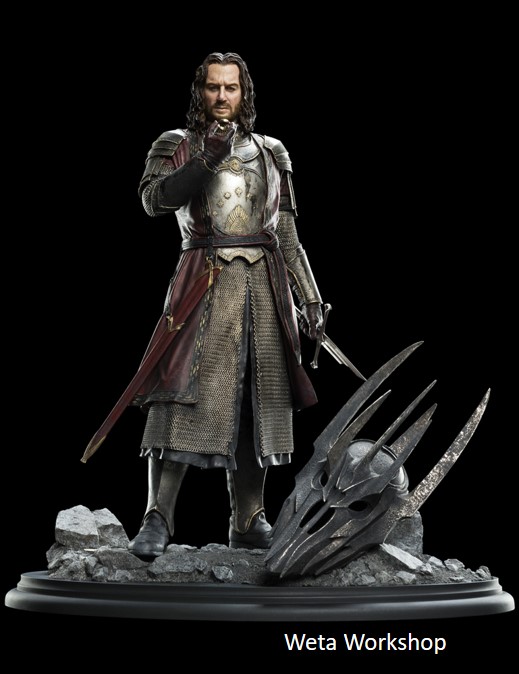
Isildur cuts the One Ring from Sauron’s finger (SA 3441): As Elendil died, he fell on his sword, Narsil, which broke under him. Immediately thereafter, to help ensure Sauron’s power was truly ended, Isildur took the hilt shard of his father’s sword and cut the One Ring from Sauron’s finger. Without the power of the One Ring, Sauron’s spirit dissipated and disappeared from Middle-earth until later in the Third Age. Elrond and Círdan, lieutenant of Gil-galad, urged Isildur to destroy the Ring once and for all. Instead, Isildur claimed it for himself as wergild for the deaths of his father and brother. Thus, both the One Ring and Sauron survived to wreak havoc once again in the Third Age.
Isildur takes the One Ring
P.S. a word about Galadriel!
Given the important role she played in the events of the Third Age, the absence of Galadriel as a player in the important events of the history of Arda is noticeable. It’s not that we’re ignoring her, it’s just that Tolkien didn’t write her into many, if any really, of the large events, such as the founding of kingdoms and the great battles. From sources like The Silmarillion and Unfinished Tales, we know that she was born in Valinor, made her way to Middle-earth by crossing the Ice of the ice of the Helcaraxë, and spent much of the First Age living in Doriath with Thingol and Melian.
At the beginning of the Second Age, she and her husband Celeborn led many of the Noldor who lived in Eriador, eventually settling in Eregion, ruled by Celebrimbor. When Annatar/Sauron came among the Elves of Eregion, it was Galadriel who was mistrustful of him. She counseled Celebrimbor to keep the Three Elven Rings safely hidden from Sauron, which he did, sending Vilya to Gil-galad, Narya to Cirdan the Shipwright, and giving Nenya to her. After living in various places throughout the rest of the Second Age, she and Celeborn finally settled in Lórien.
So, Galadriel was always in the picture, just not as closely involved in the ‘greatest’ events as others were. Her time to shine would, of course, come in the Third Age and the War of the Ring.
Refresh your memory on Pre-First and First Age events in our previous posts! Ready to VOTE? Click here! You have until end of day Thursday 24th March to vote in Round One; winners will be declared and Round Two launched on Friday 25th. Which event is THE crucial one in the history of Middle-earth? You decide!
My learned colleagues at TORnCentral have weighed in on the 23 images released yesterday by our good friends at Amazomg, but I’m keen to zero in on one and put it under the microscope.
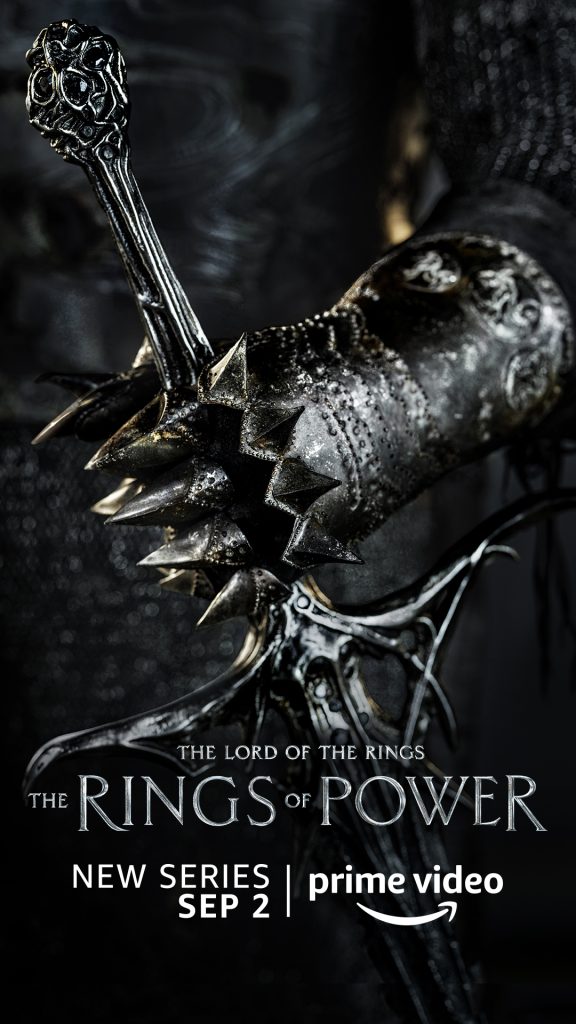
It’s this one — let’s call it Gauntlet and Sword.
Gauntlet and Sword.
Gauntlet and Sword immediately recalls Jackson’s Third Age armoured Sauron. But there are obvious discrepancies when you compare it against the visual aesthetic that the Peter Jackson productions established.
First, at the Last Alliance confrontation between Gil-galad, Elendil and Sauron in the Fellowship of the Ring prologue, the latter bears a gigantic flanged mace, not a sword. (You can rewatch the entire prologue scene here if you like; Sauron appears about two minutes in.)
Gauntlet and Sword, on the other hand, shows, well, a sword. A blackened sword with a remarkably ornate hilt. But, still, a sword.
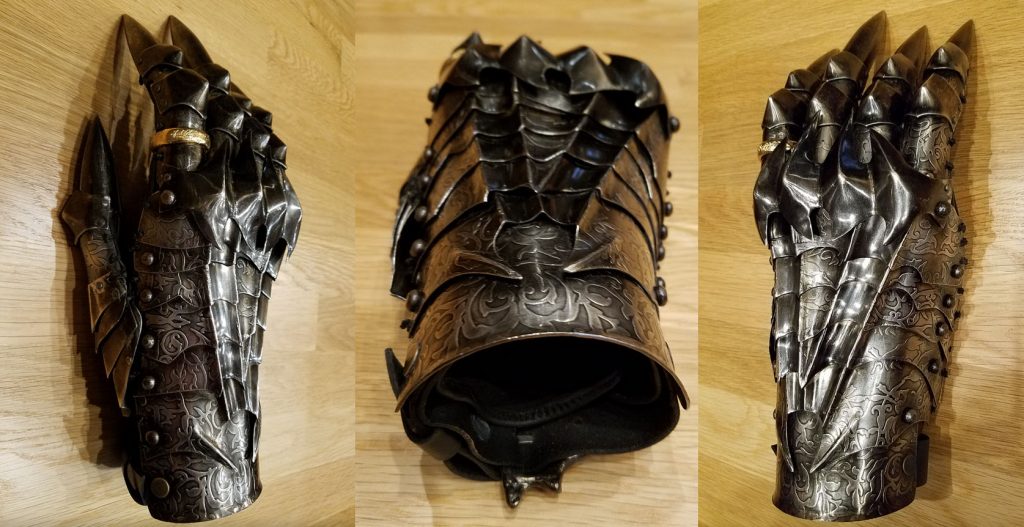
Second, the Amazon Studios gauntlet does not fully correspond to the one designed by WETA Workshop head Richard Taylor and his staff. The WETA gauntlet is a metal one, with articulated metal plates all the way past the wrist.
United Cutlery Sauron gauntlet reproduction. Source.
Sure, the gauntlet we see in Gauntlet and Sword is black and spiky, but from the promotional image provided, it lacks the articulated and overlapping metal plates that go all the way to the wrist. Instead, the articulation appears to stop at the knuckles. The general effect looks more like a studded, heavy leather gauntlet than one carefully assembled from many metal plates.
Finally, it’s important to note that before the Akallabêth — the period that Rings of Power seems likely to focus on at first, Sauron was not bound to that terrible and intimidating form. Instead:
…in his earlier incarnation he was able to veil his power (as Gandalf did) and could appear as a commanding figure of great strength of body and supremely royal demeanour and countenance.
The Letters of J.R.R. Tolkien. Letter #246.
One must conclude that either:
1) This is not actually Sauron 2) It is Sauron, but Amazon Studios is moving away from “the PJ look”
When we have cosplayers doing intensive research and nailing all the details with incredible detailed replica Sauron costumes, it defies logic that Amazon Studios couldn’t do the same with their sky-high budget. If they so desired.
The impression that I have long had is that Amazon Studios has been trying to hew to the aesthetic Jackson created. In itself, choosing New Zealand as the original shooting location fits this thesis — although I am sure financial considerations come into play there, too.
It makes sense — the PJ aesthetic has a lot of penetration through the popular consciousness and pop culture. Leveraging it is a low-effort way to get buy-in from viewers.
And the original Amazon Studios tease image carries a great deal of PJ aesthetic in the architecture of Tirion upon Túna.
So I don’t think Amazon Studios is drifting from the PJ look . Instead, what we have is some artful misdirection — we are being teased with the superficial appearance of Sauron using typical signifiers that we subconsciously associate with the lord of Barad-dûr, but there are enough clues for us to dismiss it.
This is not Sauron.
For similar reasons I would discard the Witch-king of Angmar — the gauntlet doesn’t match (you can get a good look at Wiki’s gauntlet at 1 min and 6 secs in this clip where he confronts Éowyn) , and although Wiki carries a sword (as well as a massive flail), its design is a lot cleaner than the one in Gauntlet and Sword. In fact the swords of all the Nazgul are very minimalist with flat or slightly curved crossguards.
The Nazgul draw swords at the Ford of Bruinen.
So, who is it?
I’m going to outline a handful of outlandish possibilities. All speculation, of course.
Option 1. Túrin.
Black sword, right? Also, The Silmarillion outlines how the folk of Nargothrond equip Túrin with “dwarf-mail, to guard him”. Further, The Silmarillion describes from the perspective of Tuor and Voronwë the following scene at the Well of Ivrin after the sack of Nargothrond.
But even as they gazed upon it they saw one going northward in haste, and he was a tall Man, clad in black, and bearing a black sword. But they knew not who he was, nor anything of what had befallen in the south; and he passed them by, and they said no word.
Of Tuor and the Fall of Gondolin
Nevertheless, the other image with a broken black sword somehow seems a better fit for Túrin.
Option 2. Eölor Maeglin.
Gurthang (or Anglachel, if you prefer) is not the only black sword to feature in The Silmarillion. There is another: Anguirel. Eöl, the Dark Elf, forges both as a pair. The former he gave to Thingol, the latter he kept for himself. Anguirel then ends up in the hands of his son, Maeglin, when Aredhel and Maeglin flee Eöl’s controlling nature.
Canonically, both Eöl and Maeglin meet nasty ends in Gondolin; the ultimate fate of Anguirel is unknown. Because Maeglin is tossed over the walls of Gondolin during its sack, it’s only a bit of a stretch that he might have survived (but it is a stretch). And the emblem of Maeglin’s house was a plain black field with no symbol whatsoever.
Could Tolkien Estate be convinced to allow Maeglin to be used as a returning Second Age antagonist? I don’t know. It’s a thought.
Props to posters over on the LOTR on Prime sub-reddit for raising this one. Intriguing.
Option 3. Morgoth.
Must confess, I started considering this because of John Howe’s famous image of Ungoliant and Melkor about to do the dirty on the Two Trees. Melkor, all in black, has in hand an enormous black greatsword. Not canonical — in The Silmarillion he uses a spear: “Melkor sprang upon the mound; and with his black spear he smote each Tree to its core, wounded them deep”. However, John Howe has been providing art for the Amazon Studios production.
In The Silmarillion, Beleg also uses the appellation “Black Hand” at one point to describe Morgoth. If we get the Two Trees, we must surely get Morgoth at some point. Right?
The current rumour: Adar
The current suggestion via Fellowship of the Fans is that it corresponds to a character known as “Adar” (originally codenamed “Oren”). Adar is a Sindarin word that translates as “father” and the role is supposedly being filled by Joseph Malwe.
To reprise, Adar is said to be an “corrupted” and “tortured” elf who oversees a group of orcs who see him as a father figure. Hence the name, Adar. Further, the rumour states that this elf is one of the brothers of Galadriel — but not Finrod Felagund. This offers two choices: Angrod and Aegnor, both of whom canonically perished in The Battle of Sudden Flame (Orodreth should properly be considered to be Angrod’s son).
These are choices that seem much more out of canon than, say, the Maeglin option. The Silmarillion’s text declares “the sons of Finarfin bore most heavily the brunt of the assault, and Angrod and Aegnor were slain”.
Could they work? I guess.
There’s this to consider:
But ever the Noldor feared most the treachery of those of their own kin, who had been thralls in Angband; for Morgoth used some of these for his evil purposes, and feigning to give them liberty sent them abroad, but their wills were chained to his, and they strayed only to come back to him again. Therefore if any of his captives escaped in truth, and returned to their own people, they had little welcome, and wandered alone outlawed and desperate.
Of the Ruin of Beleriand and the Fall of Fingolfin
Additionally, in the Lord of the Rings, Gandalf says to Frodo:
The Elves may fear the Dark Lord, and they may fly before him, but never again will they listen to him or serve him [emphasis mine].
Many Meetings
And service need not be direct, or knowing as in the case of Húrin.
When therefore he judged the time to be ripe, [Morgoth] released Húrin from his bondage, bidding him go whither he would; and he feigned that in this he was moved by pity as for an enemy utterly defeated. But he lied, for his purpose was that Húrin should still further his hatred for Elves and Men, ere he died.
Of the Ruin of Doriath
Placed against that, consider Gwindor son of Guilin. An escaped thrall, he not only assists Beleg and succors Turin at risk to himself, he is also seemingly welcomed back to Nargothrond without suspicion or fear.
Still, there might be a way for Amazon Studios to work a story of pathos and miscalculation, if they can find some subtlety. We’ll see.
Here’s a question. If you’re LOTR on Prime, and if your main series material is centered on the Second Age, why tease/lead with an image that show something from a vastly earlier period in the history of Tolkien’s world?
I’ve been pondering this a lot.
Unless LOTR on Prime has gone collectively mad, then there has to be a purpose — some link between that panorama, and the Second Age story that we know is coming.
So, let’s analyse that.
The location itself may offer a link.
Why? Because Númenor — much, much later — tries to invade Valinor. Problem is, that period of Númenor’s history has little to do with the dwarf-elf interactions we seem to be promised if spy reports are correct. So, it’s probably not Valinor itself that’s important, nor the Two Trees in themselves (sorry TREES! fans, I empathise).
That leaves the events that happen in Valinor, and the key protagonists in those events.
Events are — by and large — resolved by The War of Wrath. However, some of those protagonists remain and become involved in the new dramas of the Second Age in Middle-earth (and Númenor).
And I feel this could offer a clue to what’s going on.
Of the chief actors through the events of the Second Age, I can think of four (five, technically) who are also players in during the final Years of the Trees.
Sauron
The first is Sauron. But the link between Sauron and Valinor/The Two Trees is tenuous to non-existent. According to The Silmarillion, he rebelled much earlier and then spent much of Melkor’s imprisonment lurking in and around Angband. He doesn’t really feature strongly in First Age events until Beren and Lúthien’s quest.
Neither the trees — nor any of the events that occur around them — are useful to solidify the background of Sauron for the audience. If you wanted to use Sauron as a link, you’d need to begin somewhere else. For this reason I eliminate Sauron.
Galadriel and Celeborn
The next two come as a pair: Galadriel and Celeborn.
Here, it’s a twofold opportunity.
One, it’s a way to establish Galadriel’s prominence among the Noldor, and the strength of her ambition. Recall Galadriel’s role in the rebellion of the Noldor and their exile. Fëanor is instigator, but in the Silmarillion version she is also involved:
Galadriel, the only woman of the Noldor to stand that day tall and valiant among the contending princes, was eager to be gone. No oaths she swore, but the words of Fëanor concerning Middle-earth had kindled in her heart, for she yearned to see the wide unguarded lands and to rule there a realm at her own will.
Of the Flight of the Noldor, The Silmarillion.
My thinking is that portraying some of Galadriel’s early life in Valinor could be used as a way to support her desire and capacity to (at least to according one tradition outlined in Unfinished Tales) establish Eregion much later in the Second Age with the assistance of Celeborn.
It would also serve to underpin — whether through continued pride, or Ban (or both) — why she did not return to Valinor for so long. There’s vast amounts of drama to be wrung here should LOTR on Prime do it right. A sort of “How I became a massive troublemaker and learnt to love the Ban” sort of thing.
Galadriel is also LOTR on Prime’s most natural and relatable link to Peter Jackson’s movies: well-liked and well-remembered even among those who aren’t Lord of the Rings aficionados.
Celebrimbor
Next is Celebrimbor. To my surprise (for I wasn’t aware of it until very recently), Tolkien outlined that Celebrimbor was born in Valinor during the Years of the Trees, not in Beleriand during the First Age. That he subsequently followed his father, Curufin, into exile, while his mother remained behind, suggests to me that he was well into adulthood by the time of the Noldor’s rebellion against the Valar.
His identity as the grandson of Fëanor makes him a close witness to events in Valinor while his (presumably) growing talents as a smith and craftsmen can be contrasted against the immense skill of Fëanor (and Galadriel). In particular, Fëanor’s achievements with the Silmarils could be used as a dramatic spur for his own creations.
For Celebrimbor, Eregion is not so much a place to rule but a place where he can be free to create with the ultimate aim of someday surpassing the works of his grandfather. Celebrimbor is also a more natural tie for recent spy reports of dwarves and elves meeting. Unless it’s a very frosty meeting, that’s not very likely to be one involving Galadriel and Celeborn (even if Galadriel is not entirely unreceptive to dwarves).
Glorfindel
Glorfindel is the final option. Also an exile, also born in the Years of the Trees. Coincidentally, also blonde. As The Fellowship of the Ring describes it, “his hair was of shining gold”.
Moreover, Glorfindel returns to Middle-earth sometime during the Second Age to play a role in helping keep Sauron at bay after he forges the One Ring. Tolkien writes that this was probably sometime between SA1200 and SA1600 though, and I wonder whether even the first full season would get that far.
Any other elf is a poor fit.
Cirdan did not make the journey to Valinor. Gil-galad is too young — born near the end of the First Age in Beleriand. Elrond is in the same boat. And the rest of the chief Noldorin exiles either died in the long wars against Melkor, or returned to Valinor at the conclusion of the War of Wrath.
If you have a Tolkien/Middle-earth inspired poem you’d like to share, then send it to poetry@theonering.net. One poem per person may be submitted each month. Please make sure to proofread your work before sending it in. TheOneRing.net is not responsible for poems posting with spelling or grammatical errors.
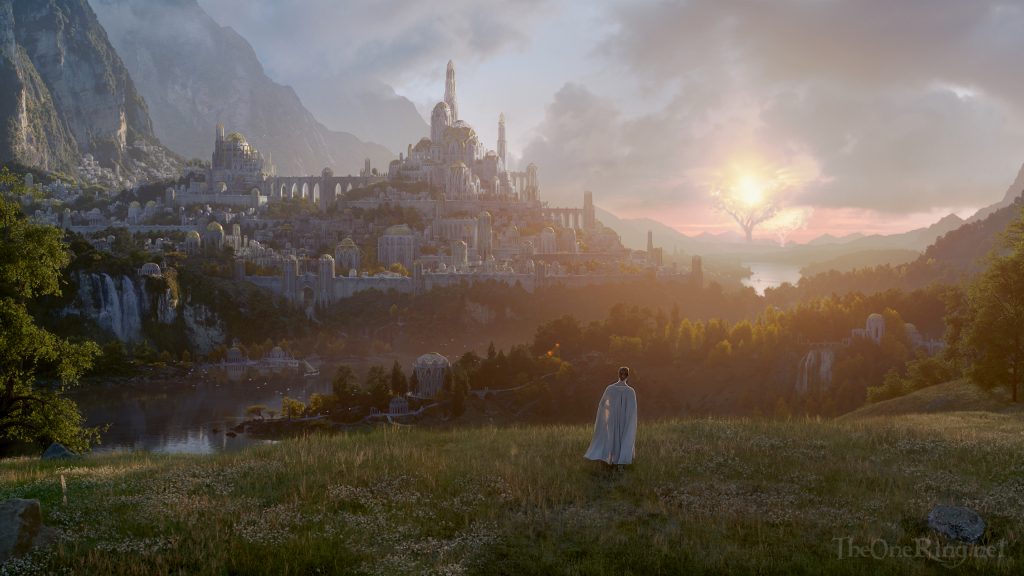
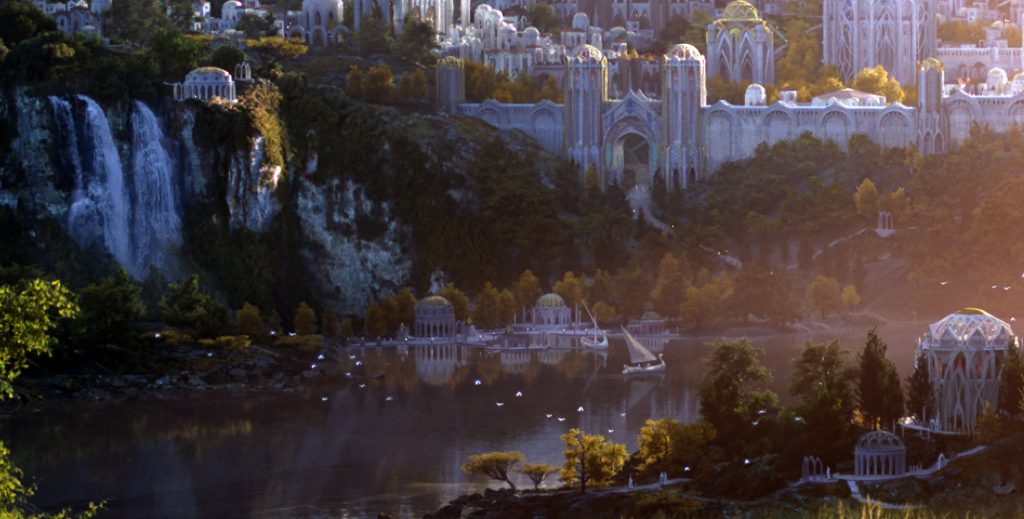
There is no doubt that the first promotional image from LOTR on Prime is simply amazing. But what is actually going on here?
Rather than blather on with superlatives, let’s just dive on in, and take a detailed look at what it reveals.
Fair warning, though: there will be spoilers for some key elements of The Silmarillion. So, if you’ve just started reading and you have no idea what happens and avoiding story spoilers is important to you, now is the time to step away!
The Two Trees
The obvious place to begin is the trees since, as Tolkien writes in The Silmarillion, “about their fate all the tales of the Elder Days are woven”. They’re also what firmly locates this panorama in Valinor — all our conclusions derive from their presence.
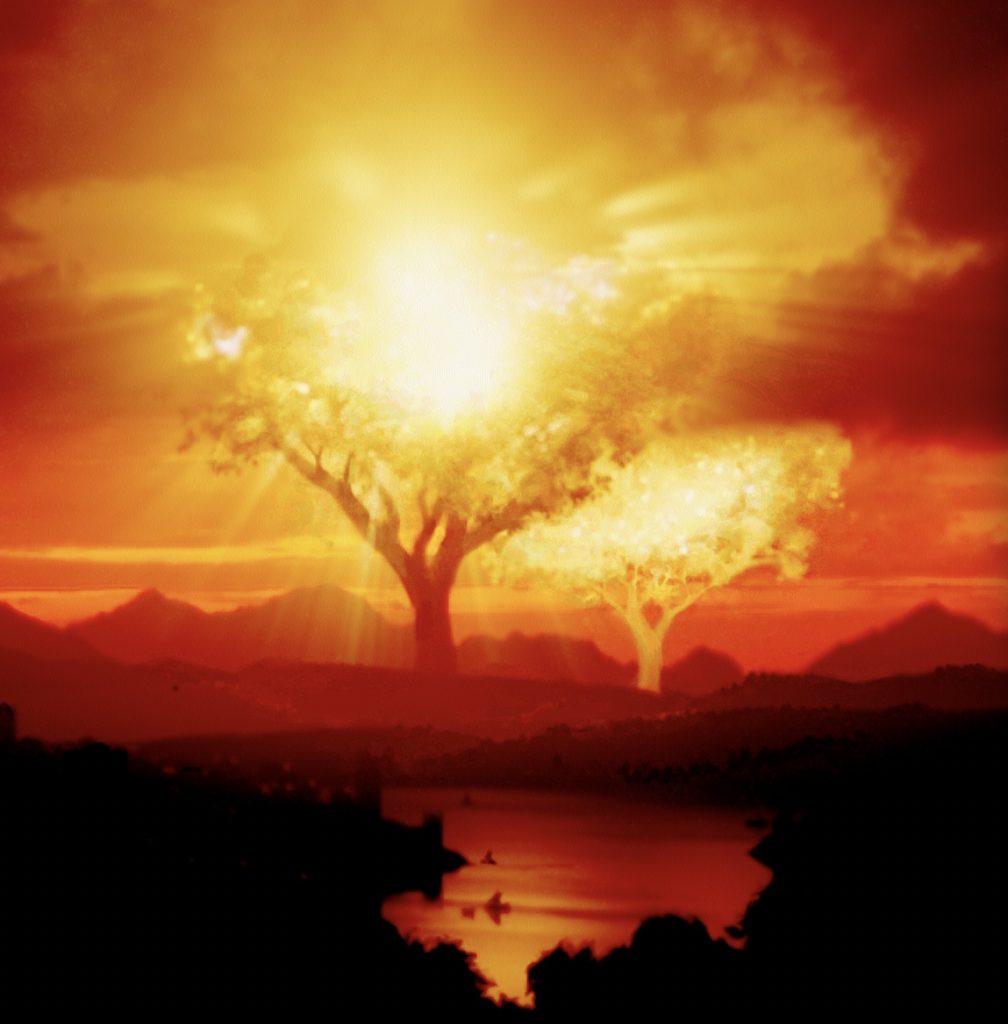
The Two Trees of Valinor. Laurelin at front, with Telperion behind.
[Telperion] had leaves of dark green that beneath were as shining silver, and from each of his countless flowers a dew of silver light was ever falling, and the earth beneath was dappled with the shadow of his fluttering leaves.
[Laurelin] bore leaves of a young green like the new-opened beech; their edges were of glittering gold. Flowers swung upon her branches in clusters of yellow flame, formed each to a glowing horn that spilled a golden rain upon the ground; and from the blossom of that tree there came forth warmth and a great light.
Of the Beginning of Days, The Silmarillion.
The trees in the LOTR on Prime panorama cannot be anything else. In the hidden city of Gondolin in Beleriand, Turgon famously created his own reproductions of the Two Trees in silver and gold. However, they emitted no light and were located within the city itself, not out on the plain. No, these are the Two Trees and that means this is Valinor.
You may wonder which tree is which.
My belief is that Laurelin — the tree of gold — is the one nearest the camera. Its shape more closely resembles that of the common beech (Fagus sylvatica). The dark trunk and boughs seem at odds with Telperion’s descritpion and the glow that emanates from it is a warm golden-yellow. And the silvery hue of the tree behind fits Tolkien’s vision of the Telperion much better.
The Two Trees: Alive? Or not?
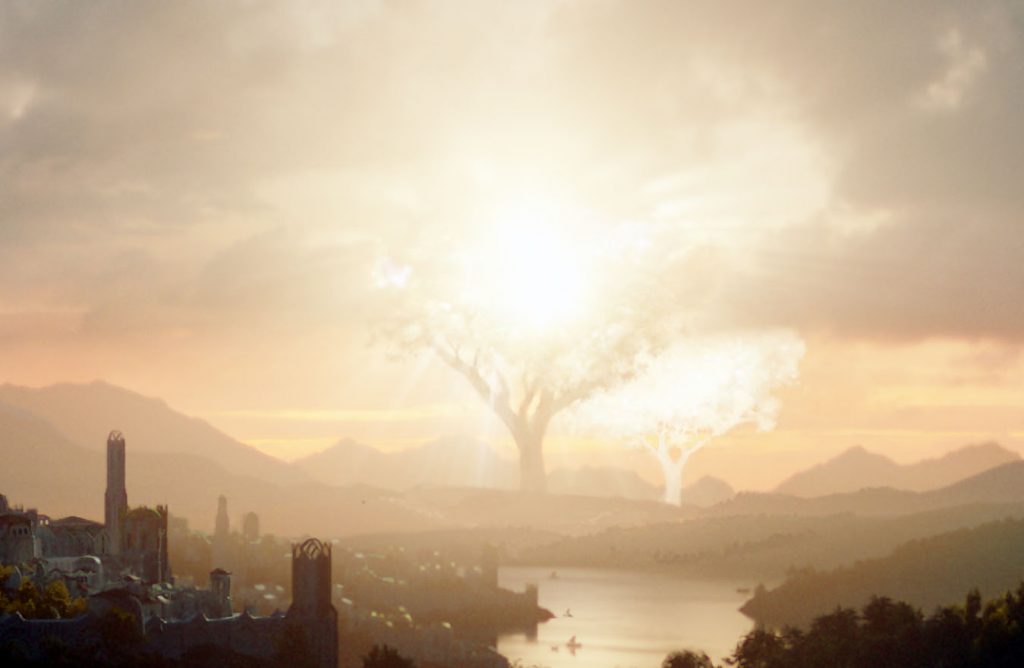
The next key question is whether the trees are alive in this image. Is this the Years of the Trees? Or is LOTR on Prime using a clever fake-out as Professor Corey Olsen suggested may be the case on TORn Tuesday? Is the scene actually set later — long after Melkor and Ungoliant have paid their fateful visit — during the Years of the Sun, and the sun just happens to be positioned behind Laurelin?
The Two Trees closeup with level and brightness heavily adjusted.
I’ve gone back and forth between the two opinions.
One the one hand, when you adjust the levels in the image and pull the brightness down, the light out of (or through) Laurelin dominates, while the glow emanating from Telperion is muted enough that it could simply be reflected sunlight.
We do know from The Silmarillion that the trees were preserved: “their lifeless stems stand yet in Valinor, a memorial of vanished joy.”
On the other hand, the trees do not appear lifeless stems. They are not “withered” and drained of life as The Silmarillion describes it. In fact, Telperion’s trunk positively gleams.
Nor do they seem brittle. The Silmarillion also states:
Yavanna arose and stood upon Ezellohar, the Green Mound, but it was bare now and black; and she laid her hands upon the Trees, but they were dead and dark, and each branch that she touched broke and fell lifeless at her feet.
Of the Flight of the Noldor, The Silmarillion.
Moreover, something about the way Telperion would be reflecting the sun just doesn’t seem right. The sun should be so far behind the trees that any reflection should be much more muted than shown. I’m no ray-tracing expert, though! (If you are and have a better idea, let us know.)
Nevertheless, I feel the weight of evidence leans to this showing a scene from The Years of the Trees sometime near the end of the Noontide of Valinor. Perhaps even the very end.
The city of white walls and towers
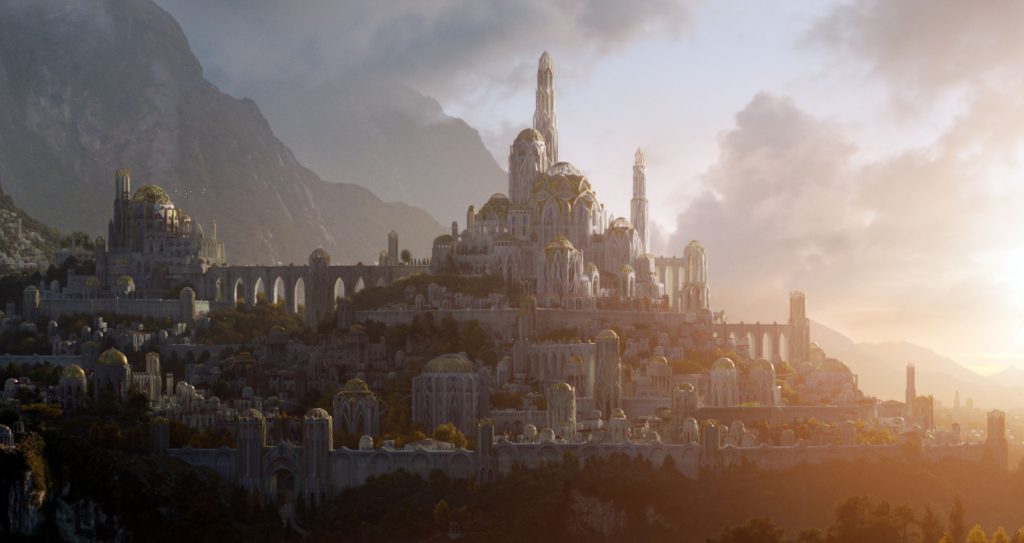
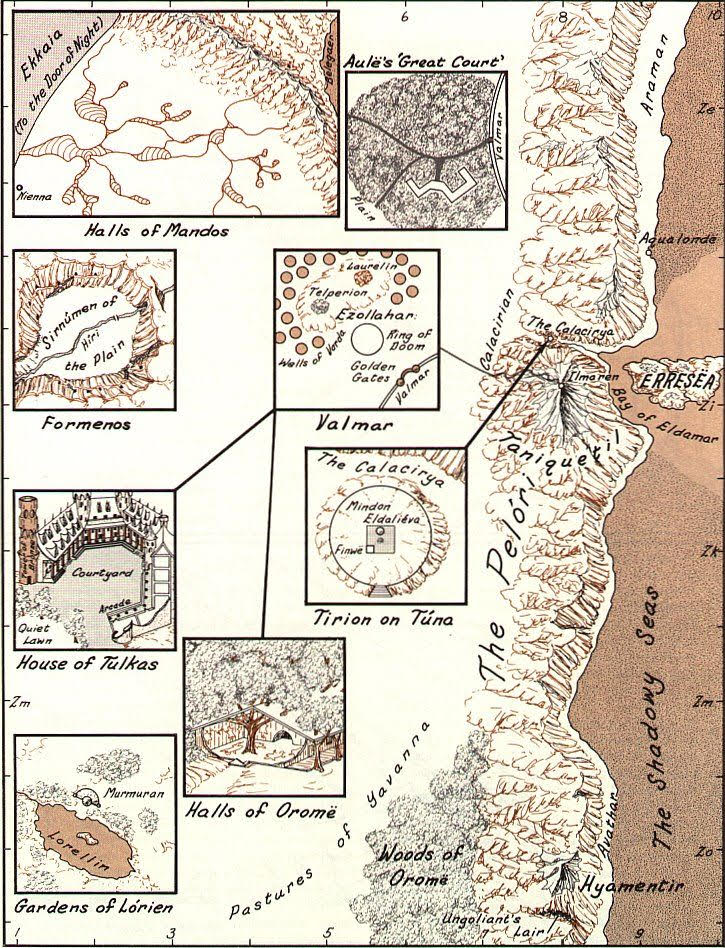
Next, there’s the city on the hill. I feel comfortable in saying that this is Tirion — the city of many white towers that the Noldorin and Vanyarin elves established together after first arriving in Valinor.
Tirion upon Tuna.
Tirion stands upon the hill of Túna at the entrance to the Calacirya (a Quenya word that translates as “The Cleft of Light”). To either side, you have the Pelóri — the immense mountain chain that walls off the interior of Aman from the rest of the world. By the time the Years of the Trees draw to a close, the Calacirya is more or less the only way through from the outside.
Conforming to that description, we see to the left and to the right in the image the slopes of steeply rising mountains. The southern side is most likely the northern shoulder of Taniquetil — the impossibly tall mountain where Manwë and Varda dwell.
However, there are some textual inconsistencies if you want to pick nits (and what are we here for if not to pick nits?).
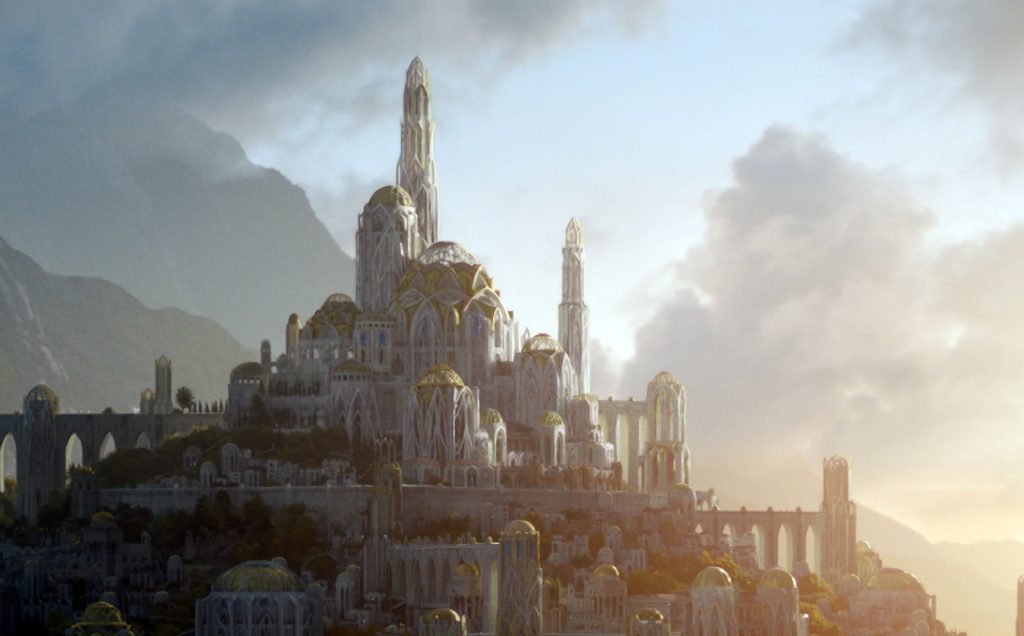
First, there’s the city’s tall tower.
The Tower of Ingwë. Note the absence of the light mentioned in the text of The Silmarillion.
This tower is the Mindon Eldaliéva. Notably, in The Silmarillion it is reported to feature a silver lamp that was said to “shine far out into the mists of the sea”. Famously, it guides the folk of Finarfin back to the city after they turn their backs on the rebellion of Fëanor. That lamp does not seem to be shining here.
…the highest of the towers of that city was the Tower of Ingwë, Mindon Eldaliéva, whose silver lamp shone far out into the mists of the sea. Few are the ships of mortal Men that have seen its slender beam.
Of Eldamar and the Princes of the Eldalië, The Silmarillion.
Additionally, despite looking closely at the city, I see nothing that could be Tirion’s own White Tree — Galathilion.
Yavanna made for [the Noldor] a tree like to a lesser image of Telperion, save that it did not give light of its own being; Galathilion it was named in the Sindarin tongue. This tree was planted in the courts beneath the Mindon and there flourished.
Of Eldamar and the Princes of the Eldalië, the Silmarillion.
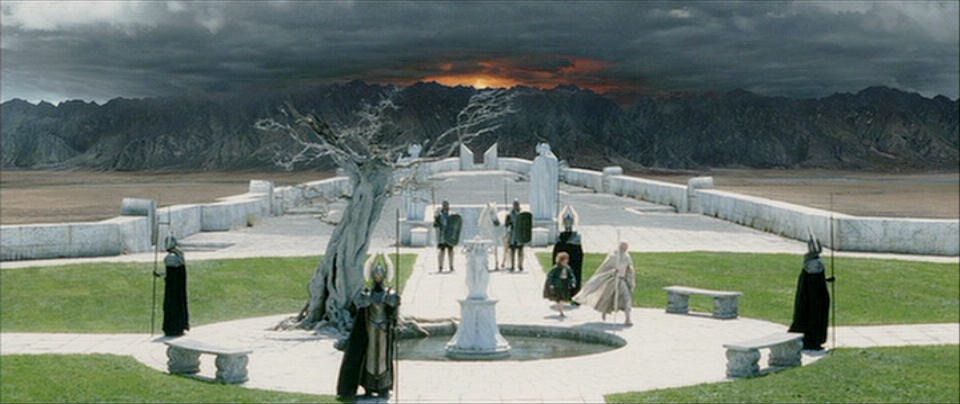
Galathilion would surely have a unique appearance compared to the other flora of the city. And it would probably draw upon similar aesthetic to Peter Jackson’s depiction of the White Tree of Gondor. Admittedly, Gondor’s White Tree is quite dead when we see it in the Return of the King.
The White Tree of Gondor from Peter Jackson’s The Return of the King.
The White Tree of Tirion might also not be especially prominent. It could be, compared to the structures about it, quite small. Or its placement might be out of picture, on the far side of the hill so it receives direct light from the Two Trees.
Finally, there’s the shape and position of Túna.
The Silmarillion states that after the Valar created a gap in the Pelóri, in the “deep valley that ran down to the sea the Eldar raised a high green hill: Túna it was called.”
Should Túna be more centrally located, rather than to one side of the Calacirya? Certainly, this is how Karen Wynn Fonstad envisages it — and her sketches in The Atlas of Tolkien’s Middle-earth were made with the backing of Harper Collins and the assistance of resources like the Boedlian Library.
Karen Wynn Fonstad’s map of Valinor shows Tirion raised upon a distinctly circular mound.
Nevertheless, the location feels more or less correct, and Wynn Fonstad’s cartography is not — as far as I know — explicitly textually supported. So the LOTR on Prime team probably can get away with playing it a little fast and loose even though they are certainly drawing on her maps.
The small river and the swan-prowed boats
Wynn Fonstad also documents one other geographical feature that is not revealed in the text of the Silmarillion — a stream or river that winds its way up the Calacirya toward Tirion. This probably explains the small river we see in the image. The question is whether it reaches all the way into the far distance. It’s hard to tell, but probably.
Are these the ocean-going White Ships of the Teleri? Or rivercraft made in their likeness?
I feel that is less important than the opportunity to reveal several swan-prowed boats that we see upon the river. The question is whether these boats could be the famous White Ships of the Teleri — or smaller, but similar, pleasure craft.
The Silmarillion speaks of Alqualondë:
…the Haven of the Swans, lit with many lamps. For that was their city, and the haven of their ships; and those were made in the likeness of swans, with beaks of gold and eyes of gold and jet.
Of Eldamar and the Princes of the Eldalië, the Silmarillion.
Fëanor, of course, had those White Ships burnt after taking them by force from the Teleri in order to transport his folk to Beleriand during the Flight of the Noldor. If these are those White Ships, then this is another piece of evidence to place the image firmly within the Years of the Trees, before the destruction of Laurelin and Telperion.
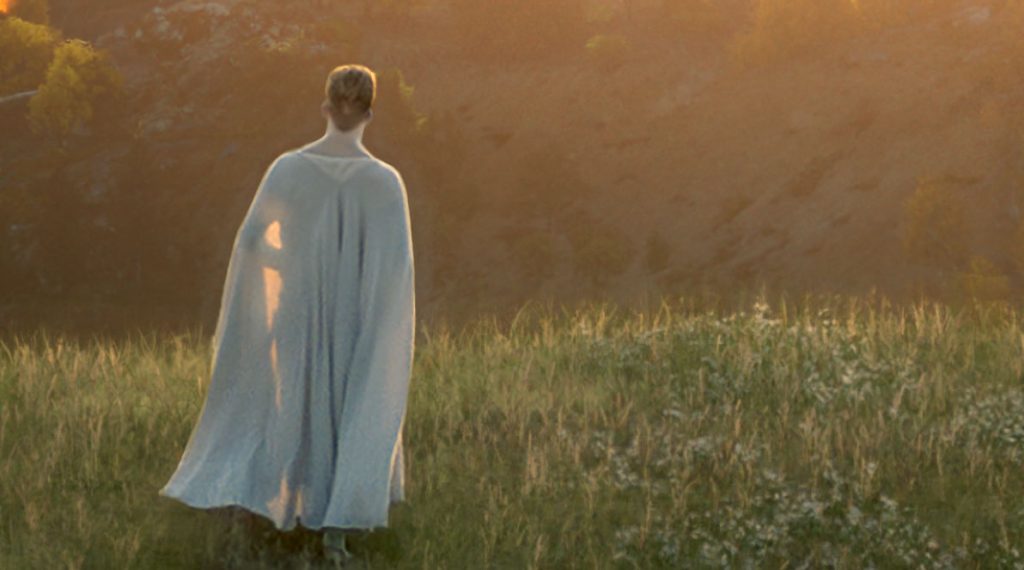
The lone figure in white
Finally, we have the mysterious, lone figure in white in the foreground.
The figure in white has light-coloured hair, and carries a sword at the left hip.
This person is blond (or blonde), has short hair (or long hair in some sort of up-do), and is attired in what is typically regarded as elvish fashion. The pose also strongly suggests that the figure is carrying a sword at the left hip.
The presence of the sword is useful, as that would definitively place the action after the release of Melkor from bondage. As The Silmarillion records, it was Melkor who “spoke to [the Noldor] concerning weapons; and in that time the Noldor began the smithying of swords and axes and spears.”
If we accept there is a sword (likely, I think), and that the Two Trees are still alive (also likely, I think) we can narrow the time period for this image.
Melkor is released from captivity in Year of the Trees (YT) 1400 according to the Annals of Aman. By YT 1450 he’s been in the ear of the Noldor sowing dissension to the point where they start making weapons — swords, axes, and shields featuring personal insignia.
But, none of the Noldor carry their weapons abroad openly for a long time after that. Not until Fëanor recklessly and publicly puts a sword at the chest of his half-brother. That might allow us to place this image to sometime after the exile of Fëanor from Tirion, but before the destruction of the trees in YT 1495.
It’s worth noting here that, according to this same timeline, Galadriel is born in YT 1362. Galadriel would be a full-grown adult. It could be her.
Might Galadriel have carried a sword in her youth? I think she might have. During the rebellion of the Noldor, The Silmarillion records that:
…Galadriel, the only woman of the Noldor to stand that day tall and valiant among the contending princes, was eager to be gone. No oaths she swore, but the words of Fëanor concerning Middle-earth had kindled in her heart, for she yearned to see the wide unguarded lands and to rule there a realm at her own will.
Of the Flight of the Noldor, The Silmarillion.
A late essay of J.R.R. Tolkien’s that Christopher Tolkien recounts in Unfinished Tales reinforces this:
She was proud, strong, and selfwilled, as were all the descendants of Finwë save Finarfin; and like her brother Finrod, of all her kin the nearest to her heart, she had dreams of far lands and dominions that might be her own to order as she would without tutelage.
The History of Galadriel and Celeborn, Unfinished Tales of Middle-earth.
The same essay also underscores Tolkien’s vision of her exceptional physique and athleticism and how she “grew to be … strong of body, mind, and will, a match for both the loremasters and the athletes of the Eldar in the days of their youth.” Plus a letter from 1973 describes the youthful Galadriel in similar fashion (while also, potentially, explaining the seemingly short-cropped hair):
[Galadriel] was [in her youth] of Amazon disposition and bound up her hair as a crown when taking part in athletic feats.
Letter #348, The Letters of J.R.R. Tolkien.
A Galadriel who in her early years of life is much more oriented to martial activities in not utterly out of Tolkien’s thinking.
Finally, there’s a treatise of Tolkien’s published in Morgoth’s Ring that outlines that while gender traditions — and individual occupational inclinations — exist among elves, these are by no means rigid, or absolute: “there are … no matters which among the Eldar only a [male elf] can think or do, or others with which only a [female elf] is concerned.”
Further, it concludes with the statement that “all … matters of labour and play, or of deeper knowledge concerning being and the life of the World, may at different times be pursued by any among the Noldor.”
If you don’t think this is possible for Galadriel, how else how do you explain Elrond’s trajectory from commander of Gil-galad’s expeditionary force to Eregion in the Second Age (and Herald of Gil-galad during the War of the Last Alliance) to renowned master of healing of the Third Age?
Other options for the figure in white
But, let’s say it’s not Galadriel. Who else might it be?
Hair colour immediately rules out most key Noldor of the time such as Finwë, Fëanor, Finrod, and Fingolfin. They are all dark-haired (as are the vast majority of Noldor). However, Galadriel’s father, Finarfin, or her grandmother, Indis, are options.
She was golden-haired, and tall, and exceedingly swift of foot. She laboured not with her hands, but sang and made music, and there was ever light and mirth about her while the bliss of Aman endured … and she walked often alone in the fields and friths of the Valar, filling them with music.
The Later Quenta Silmarillion II, The History of Middle-earth: Morgoth’s Ring.
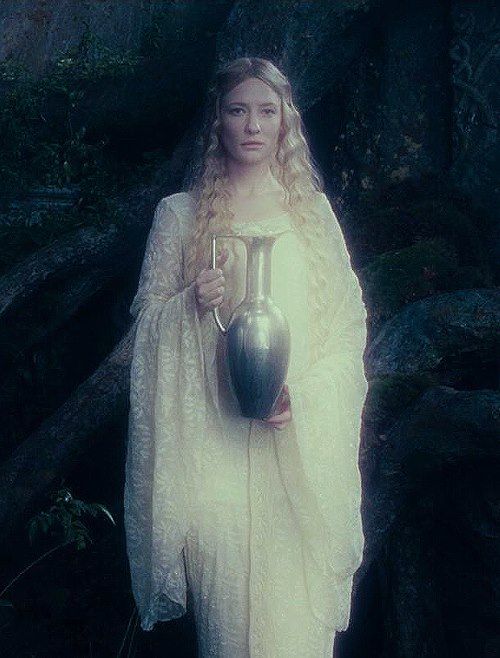
Still, I don’t really see Indis as the sword-carrying sort. I might be wrong, but it doesn’t match my perception of her personality and her ambitions. Finarfin would, but some costumers have suggested that the outfit the figure wears is more reminiscent of Galadriel’s attire in Peter Jackson’s The Lord of the Rings.
Galadriel in Peter Jackson’s Fellowship of the Ring.
As an aside, I also like the concept of elves with short-cropped hair because it challenges an aesthetic that is ambiguously supported in canon. Would LOTR on Prime be brave enough to do that, though?
After that, we’re down to edge cases.
The radical options: Melkor or Sauron
We know that the Valar had no bodies but could assume shapes more or less at will. Morgoth’s Ring reveals that “after the coming of the Eldar they most often used shapes of ‘human’ form, though taller (not gigantic) and more magnificent”.
We don’t know Melkor’s precise form during those years before the destruction of the Two Trees. One revision (The Later Quenta Silmarillion (II)) probably made during the 1950s describes the countenance he presented to the elves as “most fair of all”. It was only after the trees had been destroyed that Melkor-as-Morgoth became fixed in the classical form we know from the Quenta Silmarillion that Chris Tolkien published in 1977 — the tall and terrifying figure clad in black armour who ever-so-reluctantly comes forth to duel Fingolfin.
However, The Silmarillion records that Melkor carried a black spear to the destruction of the Two Trees. Moreover, without any sign of his spider-shaped partner in crime, Ungoliant, there’s nothing conclusive to suggest this scene is a direct prelude to that event.
A similar shapeshifting argument applies to Sauron, who most famously assumes the fair form “Annatar” in order to win over the elven-smiths of Eregion. Sauron, of course, remained at-large in Middle-earth during the Years of the Trees, presumably busily refortifying the fortress of Angband while awaiting the return of his master.
It’s not out of the question that Sauron might have ducked across the great ocean for a bit of a peek at what was going on in Valinor with his master. Against that, such a journey is never mentioned. Still, keep in mind that Tom Shippey mentioned in an interview that LOTR on Prime has creative wiggle room as long as it doesn’t directly contradict what Tolkien himself wrote.
Why Sauron? Well, Sauron is, ultimately, the chief antagonist of this series. Alongside Galadriel, he is one of the very few consistent presences throughout Middle-earth’s history. An opening (or prologue) that directly involves Sauron may be another way for LOTR on Prime to establish the foundations of a series that is going to span a very long period of time.
The human options: Eärendil or Ar-Pharazôn the Golden
While Eärendil‘s hair colour is up for debate, he is the son of two golden-haired parents. Most art depicts him as a blonde.
But what truly interested me was the circumstances in which Eärendil arrives at Tirion: alone.
And he went up alone into the land, and came into the Calacirya, and it seemed to him empty and silent; for even as Morgoth and Ungoliant came in ages past, so now Eärendil had come at a time of festival, and wellnigh all the Elvenfolk were gone to Valimar, or were gathered in the halls of Manwë upon Taniquetil, and few were left to keep watch upon the walls of Tirion.
Of the Voyage of Eärendil and the War of Wrath, The Silmarillion.
I’ve always liked Ted Nasmith‘s illustration of this scene, and there’s something about the LOTR on Prime panorama that evokes that passage, too. The only thing that’s missing is anything that looks like the glow of a Silmaril for there those were “who saw him from afar, and the great light that he bore”. Like the Phial of Galadriel, the Silmarils emit their own light.
Still, as Eärendil’s arrival in Middle-earth is the beginning of the closing act of the First Age, and leads more-or-less directly to the founding of Númenor, could something like this offer a tighter link to the major story that LOTR on Prime wants to tell?
Finally — more for the sake of elimination — there’s the last king of Númenor, Ar-Pharazôn the Golden.
For Ar-Pharazôn wavered at the end, and almost he turned back. His heart misgave him when he looked upon the soundless shores and saw Taniquetil shining, whiter than snow, colder than death, silent, immutable, terrible as the shadow of the light of Ilúvatar. But pride was now his master, and at last he left his ship and strode upon the shore, claiming the land for his own, if none should do battle for it. And a host of the Númenóreans encamped in might about Túna, whence all the Eldar had fled.
AKALLABÊTH, The Silmarillion.
But. The apparel on our lone figure isn’t really ideal for battle and war. Certainly not in the fashion reminiscent of our closest visual parallel to Númenór — the Arnorian and Gondorian warriors of the War of the Last Alliance. And the figures on river do not appear alarmed in the slightest — which they would if there was a vast, approaching army of Númenóreans behind the camera.
Finally, a curveball idea: what if it actually was Galadriel finally returning home at the very end of the Third Age? To start at the very end of the story, rather than the beginning.
In conclusion
After all that, what can we conclude? We’re looking at Valinor and the Two Trees. Definitively. And, despite a few topological and architectural quirks, we’re looking west from Tirion. I’m very confident of that, too.
But are those trees alive, or dead? I just can’t tell for sure. And it’s impossible to say for certain that the figure in white is Galadriel, even though it feels the most likely option.
But, since we are here to nail our colours to the mast, I will venture the following theory: the trees are alive, the figure is Galadriel, and this is somewhere near the end of the Noontide of Valinor.
Why? Primarily because in addition to the weight of evidence it simply makes the most sense to the story for the lone figure to be Galadriel. And — regardless of which Galadriel origin story you prefer — Galadriel left Valinor before the creation of the sun and the moon. Thus the trees must be alive.
I think. 🙂
Acknowledgements and thanks
This piece is not necessarily representative of the opinion of TORn staff. However, in assembling this, I have drawn on thoughts, theories and evidence that other staffers have been sharing over the last couple weeks. It would not have been nearly as good without their input. So, in no particular order, I’d like to thank JPB and Tookish for the long conversations, Mithril for the excellent find with Letter #343, Elessar, Josh, Kelvarhin, Garfeimao, Greendragon, Earl, and our TORn Tuesday team of Quickbeam and Justin.
Of course, any errors and oversights are my own.
If you have a Tolkien/Middle-earth inspired poem you’d like to share, then send it to poetry@theonering.net. One poem per person may be submitted each month. Please make sure to proofread your work before sending it in. TheOneRing.net is not responsible for poems posting with spelling or grammatical errors.
Our friends at Weta Workshop had themselves one heck of a Comic-Con at Home 2021, with the goodies they’ve unveiled for us. We have a new Mini Epic, helms, a premium statue, a new master collection statue – and that’s just from Middle-earth! The new Mini Epic is this year’s Comic-Con Exclusive. It’s a variant of Saruman, but this time holding his staff and Gandalf’s staff as well. This piece comes in with a price tag of $49.99(US), and an edition size online of only 400 pieces.
If you’re a fan of the helm line then this Comic-Con was for you, as you got three new additions: two from The Hobbit Trilogy and one from The Lord of the Rings Trilogy. The two from The Hobbit represent helms we saw on the Ringwraiths during the Dol Guldur sequence. Fans can add the helm of the Ringwraiths Khand and Harad, with both pieces coming in at $79.99(US). The Lord of the Rings is being represented by the Uruk-hai Captain’s Helm, which also comes in at $79.99(US). The edition size of these three pieces will be set by the number of orders placed by August 5th.
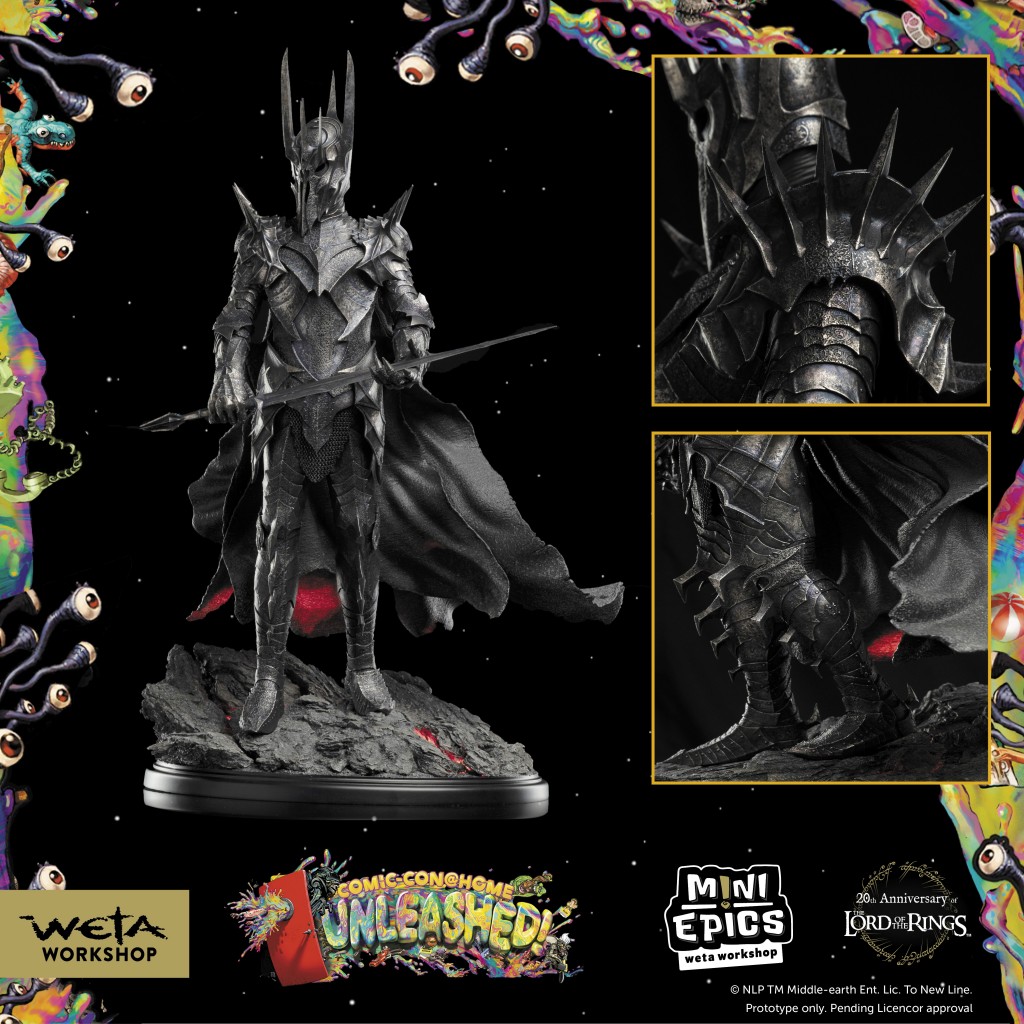
This year’s premium statue is the Lord of the Rings himself, Sauron. This statue is a monster in size, and amazing in paint as well as detail. Fans who order him will get – for the first time ever – alternate weapons, with one of them being from a deleted scene! He also comes with a base which contains led lights, to give a glowing lava effect. Sauron comes in with a price tag of $999(US), and fans have time to save for this superb piece as he’s not shipping until 2nd quarter of next year. Like the helms, Sauron’s edition size is being set by orders received through August 5th.
We here at TORn are very happy to introduce something new within the collectibles arena. We’ve been doing reviews and news blurbs under ‘Collecting The Precious’ for a decade now; so we’ve decided to branch out and add something new! MadeyeGamgee and myself (Elessar) are excited to sit down and talk about various collectibles topics, ranging from new collectibles and interviews with the artists, to tips to help new and old collectors alike. The very first episode is on YouTube now, and you can watch it below. In this first episode we cover mostly the cool things that came out of San Diego Comic-Con at Home 2021. We hope you enjoy this first episode, which comes in at just a little under three hours.