One of the pieces I had been dying to get my order in for, since I saw it at SDCC 2024, was the classic series Boromir. The reason? Well, I fell in love with the choice of the pose and the look of the piece. This is a version I wasn’t sure we’d ever get but was blown away when it happened. When this statue went up for pre-order there were two versions like the recent Legolas statue. You could get the Boromir with 1:4 Horn of Gondor, which was limited to 400 pieces total or you could get the standard classic series. That version is still available for $399 and in-stock. I think this statue is just fantastic with great paint, details, and likeness. I could not be happier to have this in my collection and I hope you will do the same.
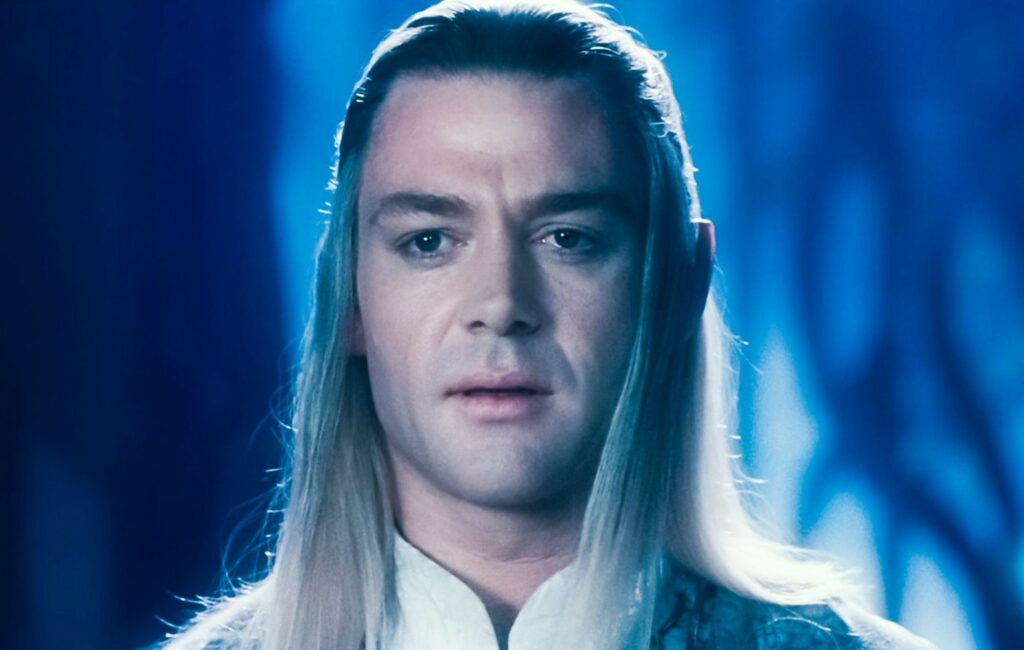
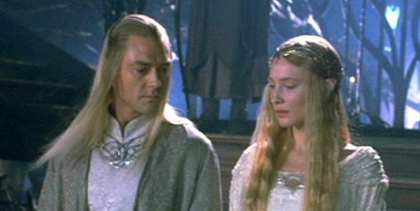
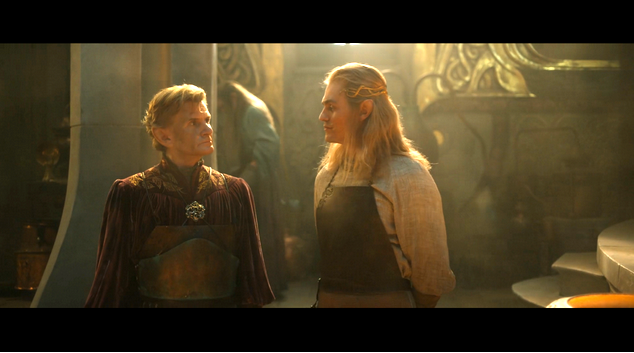
No doubt about it, shoehorning Celeborn (the Wise) into The Rings of Power storyline is one of the trickiest problems that the show must navigate. Importantly, for it to matter, I feel the show has to do it soon — this coming season, even.
But as my TORn Discord colleague, Webcrawler, points out, this is a self-inflicted challenge — the showrunners did this to themselves. They consciously chose to absent Celeborn from the story (a story where, by some of Tolkien’s drafts, he plays more than a minor part in events). Thus, I would assert (I would hope) that they must have some clever idea or resolution in mind.
Once you grasp this rather important fact, it also prompts the question: “Why did they choose to do this?”.
Hold that thought, we’ll return to it later. First, I’d like to posit four different scenarios for finally bringing Celeborn into the story.
Of course, keep in mind this is my own theory-crafting, not set rumours.
THEORY ONE: Re-embodiment in Valinor
This is the most straightforward solution I can think of right now. Per Laws and Customs Among the Eldar (sometimes abbreviated to LACE) in HOME Volume X, it is possible for elves to re-embody post-death after a time spent in the Halls of Mandos.
Tolkien Gateway has an excellent and succinct summarisation of the process Tolkien outlined in LACE:
A houseless fëa that chose or was permitted to return to life was typically only able to be reembodied through childbirth. The reborn fëa would experience childhood again, but would only remember its previous life upon achieving mastery of its body. Through the joy of this second childhood, the griefs of the fëa’s previous life could be redressed.
The most well-known instance is that of Glorfindel, re-embodied after his death in the Fall of Gondolin and subsequently sent back to Middle-earth by the Valar to assist with the Second and Third Age struggle against Sauron. (Aside: arguably, if the show had been going to introduce Glorfindel, then S2 and the destruction of Eregion would have been the ideal time since as Tolkien outlines in HOME XII: Last Writings, assisting survivors out of the destruction and pairing up with Elrond and Gil-galad against Sauron’s war in Eriador is his big Second Age moment.)
What if the show were to, instead, apply this re-embodiment to Celeborn?
What if Celeborn had, in fact, perished on the field of … the Nirnaeth, I guess, that we saw in the S1 prologue, and his spirit was summoned to the Halls of Mandos.
It would provide a thoroughly logical explanation for exactly what Celeborn has been doing for the last 1,000 years and more: he’s been stuck in the Halls of Mandos, and then, quite literally, growing up all over again – and for an elf to grow to adulthood is around 100 years, minimum — in Valinor.
It would fit with Galadriel’s words to Theo in S1: “When he went to [the war], I chided him. His armour didn’t fit properly. I called him a silver clam. I never saw him again after that.”
Now, at the right time, he might return to Middle-earth either of his own volition, or at the behest of the Valar. That’s right, kindasorta stealing Glorfindel’s role.
This is a complete invention at odds with, well, every variation of the Galadriel and Celeborn story. But given the many unresolved contradictions within Celeborn’s (and Galadriel’s) textual history, it’s probably better for The Rings of Power to strive for its own internal consistency.
Re-embodied Celeborn might actually offer the cleanest resolution.
A re-embodied Celeborn could also be an interesting boost to his character — LACE states that “the Re-born (they say) are stronger, having greater mastery of their bodies and being more patient of griefs.” Galadriel, in LOTR, tells the members of the Fellowship that “…the Lord of the Galadhrim is accounted the wisest of the Elves of Middle-earth, and a giver of gifts beyond the power of kings.”
Re-embodiment could help make him less anodyne than the “Cele-boring” we see in PJ’s rendition.
THEORY TWO: Imprisoned by Thranduil
This idea is, I think, kinda cracked, but it’s inspired by recently re-reading The Hobbit. What if Thranduil* had imprisoned Celeborn at the turn of the Second Age, and simply not informed anyone?
Just riffing off what occurs with Thorin in Mirkwood:
“Very well!” said the [elven]-king. “Take him away and keep him safe, until he feels inclined to tell the truth, even if he waits a hundred years [emphasis mine].'”
Then the elves put thongs on him, and shut him in one of the inmost caves with strong wooden doors, and left him.
Flies and Spiders, The Hobbit
But what could even prompt Thranduil to imprison Celeborn — a fellow Sindar — for more than 1,000 years, and not tell anyone? Simple trespassing seems an enormous stretch.
One explanation that comes to mind from The Silmarillion is Thingol’s choice to not join Maedhros and Fingon’s assault on Angband that becomes the Nirnaeth Arnoediad, and his reluctant assent for Mablung and Beleg to join Fingon’s force.
This feels a bit of a reach, but, what if Celeborn (a kinsman of Thingol according to the Silmarillion tale) had also gone to the battle, but without Thingol’s permission? Galadriel does state in The Rings of Power that she “chided him”, and that his armour did not fit. This sounds tender, but could also hint at some underlying “sneaking away” subterfuge — if the writers chose to interpret it like that.
Further, what if, much, much later, he somehow, ended up in Thranduil’s realm. Might Thranduil (also a Sindar elf of the former realm of Doriath) imprison him, exactly like with Thorin, as a long-delayed punishment for such an disobedience.
Like I said, it does feel a crack theory. Holding a continuing (well-documented) grudge against dwarves for perceived ancient wrongs is one thing; holding one against one of your own folk over someone else’s ban on consorting with the Noldor seems quite another. More, you have to set against that the technicality that Thranduil and Oropher spent much of the early Second Age in Lindon and did not migrate to Greenwood, east of the Misty Mountains until at least SA750.
* I’ve written Thranduil here since I feel for the sake of story simplification, we’ll never see his father Oropher in The Rings of Power. Simple as that.
THEORY THREE: Lost in the woods
Consider, first, the situation of Thingol and Melian, lost in each other’s eyes in the deep woods of Nan Elmoth for a vast stretch of time.
Alternatively, consider how Old Man Willow trapped Pippin and Merry by the Withywindle, or how Nimrodel goes missing for a long time after being separated from Amroth on the long journey from then-Lorinand to Edhellond in Gondor’s south.
Or consider how Morwen goes conveniently missing between Glaurung’s assault on Nargothrond, and the end of the Narn i Hîn Húrintale where she meets Húrinat Cabed-en-Aras.
I think it’s fair to conclude from these handful of examples that folks get lost or trapped (in the woods) in Middle-earth now and then.
I want to pair this observation with Celeborn’s curious warning to the members of the Fellowship against Fangorn.
‘Yet [the Fellowship] should not go too far up that stream, nor risk becoming entangled in the Forest of Fangorn. That is a strange land, and is now little known. But Boromir and Aragorn doubtless do not need this warning.’
Farewell to Lórien, The Lord of the Rings
Aragorn also says in LOTR in an exchange with Legolas:
‘Yes, it is old,’ said Aragorn, ‘as old as the forest by the Barrow-downs, and it is far greater. Elrond says that the two are akin, the last strongholds of the mighty woods of the Elder Days, in which the Firstborn roamed while Men still slept. Yet Fangorn holds some secret of its own. [emphasis mine]’
The Riders of Rohan, The Lord of the Rings
What if Celeborn’s long disappearance involved Fangorn? Might he have been trapped there somehow — long-captured by some angry Huorn in an episode resembling what happened to Pippin and Merry in the Old Forest? Even if something like that occurred though, there’s the challenge of elegantly explaining how Celeborn got all the way from Beleriand to Fangorn (or even to the Old Forest if you used that area).
Perhaps the best option here is actually the old lost-my-memory-and-ran-away trick (similar to Nienor’s experience) as the consequence of some significant battlefield trauma. Perhaps even as the result of a confrontation with Glaurung. I’m pretty sure the showrunners did at one point say at an event or convention that they wanted a dragon, and there’s been discussion of the possiblity since.
Bringing him all the way to Fangorn (a place that, despite the “strangeness” Celeborn describes, does not seem hostile towards elves) might be a little hard to convincingly sustain, but it is usefully close to Lorien — a location we will hopefully be introduced to in Season 3.
I’m worried that amnesia is a little too much like what happened with Gandalf. I’m not sure I like that. Convenient amnesia is one of the Celeborn theories that Cliff and Justin considered on TORn Tuesday a while back as well. If you want to listen in, the discussion starts around 25 minutes into the VOD.
THEORY FOUR: Shamed thrall of Morgoth
Alternatively, Morgoth might have imprisoned Celeborn. Angband contained many elven thralls during the First Age. We could see a scenario where Celeborn was captured in the aftermath of the battle Galadriel refers to in The Rings of Power and forced to labour for the Enemy until the War of Wrath and Morgoth’s overthrow.
Many of the Noldor and the Sindar they took captive and led to Angband, and made them thralls, forcing them to use their skill and their knowledge in the service of Morgoth.
Of the Ruin of Beleriand and the Fall of Fingolfin, The Silmarillion
Alone that’s insufficient to explain Celeborn’s thousand-year absence. But consider also the experience of the vast majority of escaped elven thralls…
…ever the Noldor feared most the treachery of those of their own kin, who had been thralls in Angband; for Morgoth used some of these for his evil purposes, and feigning to give them liberty sent them abroad, but their wills were chained to his, and they strayed only to come back to him again. Therefore if any of his captives escaped in truth, and returned to their own people, they had little welcome, and wandered alone outlawed and desperate[emphasis mine].
Of the Ruin of Beleriand and the Fall of Fingolfin, The Silmarillion
Yes, there are exceptions such as the ease with which Gwindor son of Guilin slots back into the hierarchy of Nargothrond. Yet Húrin Thalion is shunned by his folk — and Turgon — after his release from Angband. Even once he realises he is no longer Morgoth’s thrall, “he wanders out of all knowledge” and supposedly throws himself into the sea.
Similarly, even if the source of the angst is different, Maglor commits himself to a perpetual exile of regret, wandering the shores of Middle-earth after he and Maedhros take the remaining Silmarils from Eönwë by force in the wake of the War of Wrath.
What if, in The Rings of Power, after the overthrow of Angband, Celeborn was one of the “multitude of slaves” who came forth from its deep prisons, “looked upon a world that was changed” and, whether through shame or PTSD, turned away to become a solitary recluse who avoids all society.
One might protest that this overlaps Adar’s background. But Adar’s corruption is a bit different. He has become an Uruk. In this instance the thrall concept is not a rerun; it’s exploring a different phenomenon entirely.
Where would Celeborn be, though? Well, there’s an awful lot of Middle-earth coastline that hermit!Celeborn could share with Maglor. A lot of dense, unexplored forest, too, especially around Eryn Vorn given that during the Second Age much of southern Eriador was still heavily forested.
…in the earlier days, at the time of the first explorations of the Númenóreans… Minhiriath and Enedwaith were occupied by vast and almost continuous forests, except in the central region of the Great Fens.
The History of Galadriel & Celeborn, Unfinished Tales of Númenor & Middle-earth
There’s something appealing, to me at least, about the thought of the Telerin/Sindar Celeborn hiding out (maybe even with a handful of Ents or some of the Drúedain) somewhere around Drúwaith Iaur, or even the Belfalas coast and spending S3 raging against the rapacious logging efforts of Kemen and friends. It’d be a nice nod to the temporary Third Age sojourn of Galadriel and Celeborn in that area that Tolkien described in his initial iteration of their story.
Where is less important than why
The reality is that it doesn’t really matter where Celeborn actually is in this scenario — the showrunners will manufacture a way and a reason for Galadriel to find him.
What is more important, I think, is why Celeborn exists — the role he’ll play in the drama.
Of course, Celeborn is a box that The Rings of Power needs to tick if only for continuity. Mechanically, to not have Celeborn co-ruling Lorien with Galadriel so that together through ages of the world they can fight “the long defeat” would be, well, outrageous.
And that need to ultimately match both the book text and PJ’s LOTR is why I’ve always thought it was a bit mad to insist “Celeborn is dead”, and should stay that way.
Who dis?
But the showrunners have always stated that The Rings of Power is about the characters becoming the individuals we know at the end of the Third Age.
Right now, Galadriel’s personality flips between “Artanis” and “Nerwen”: she’s very capable of being the lady of the court — the noble woman of her father-name — but undeniably The Rings of Power has leaned heavily into the “man-maiden” warrior nature of her mother-name.
Still in Season 2 she regularly wears her hair in some sort of crown. It’s surely a nod to “Galadriel” — the epessë (a nickname or honorific) given to her by none other than Celeborn. What better way for Galadriel to rediscover her true self (and stop being torn every which way) than by finding the lover who gave her that name in the first place?
This does not have to be boring.
In the first instance there’s the fact that, in-show, Galadriel seems to have blithely assumed that Celeborn perished in the Nirnaeth yet spent 1,000 years obsessively criss-crossing Middle-earth trying to hunt down Sauron.
Depending on Celeborn’s recent history, the obverse could apply, too — especially if he’s hidden himself away. The text of LACE mentions that elven couples “do not necessarily dwell or house together at all times” despite remaining wedded forever, so the passage of time should not be an insurmountable barrier to the pair reconnecting. Still, they must decide if (and why) it’s worth resurrecting their relationship in such circumstances.
What if Celeborn is mentally, or physically, scarred from his experiences? Consider Gwindor’s return to Nargothrond:
At first his own people did not know Gwindor, who went out young and strong, and returned now seeming as one of the aged among mortal Men, because of his torments and his labours…
Of Túrin Turambar, The Silmarillion
It feels reductive to say this a “she can fix him” situation, but there’s a precedent with what happened with Nenya and Adar in the final episode of S2. It could help bring a blighted Celeborn back to himself. More prosaically, Galadriel also (inadvertently) uses Nenya to heal a fellow elf in S2 E4.
In “fixing” Celeborn (props to Webcrawler for pointing this out), Galadriel can also heal herself. It’s a chance to recognise a healthy partnership and true love — as opposed to the poisonous, controlling version that Sauron/Halbrand keeps trying to offer. One with things like not using each other for personal gain, and not flipping out when you get corrected. Simple stuff!
It’s still going to be a long journey for Galadriel to reach that point where she has the strength to reject the One Ring when Frodo finally offers it. But, for The Rings of Power, accepting Celeborn should be the start.
About the author:Staffer Demosthenes has been involved with TheOneRing.net since 2001, serving first as an Associate News Editor, then as Chief News Editor during the making of the Hobbit films. Now he focuses on features and analysis. The opinions in this article are his own and do not necessarily represent those of TheOneRing.net and other staff.
If you have a Tolkien/Middle-earth inspired poem you’d like to share, then send it to poetry@theonering.net. One poem per person may be submitted each month. Please make sure to proofread your work before sending it in. TheOneRing.net is not responsible for poems posting with spelling or grammatical errors.
Recently, the Robinson Map Library at UW-Madison exhibited many of the manuscripts that cartographer Karen Wynn Fonstad developed in making the groundbreaking The Atlas of Middle-earth.
TORn Discord member Alida Mau shares this report of the exhibit’s showcase of original, hand-drawn maps together with examples of her finalized published works, explanations of her techniques, and stories of her experience turning written, fictional geographic information into visual representations.
Middle Earth Map Exhibit Makes Appearance at UW-Madison
By Alida Mau
UW-Madison’s Robinson Map Library recently held an exhibition that might be unfamiliar to many of Earth’s cartographers, but will certainly resonate with fans of JRR Tolkien’s The Lord of the Rings. There the works of the late Karen Fonstad lay on display. The sprawling collection contained drafts and finalized hand drawn maps from her original publication and revised edition of The Atlas of Middle-earth, published in 1981 and 1991 respectively.
The public exhibit ran from July 21 to 31, and was curated by her son, Mark Fonstad, who has been digitizing her full works. The collection included world and regional maps spanning all three ages, along with migration and battle maps, linguistic distribution, and city plans. The exhibition spanned the entirety of the library’s tables yet is estimated to only include 5% of her work, which humbly began sketched out on her kitchen floor.
Developed as a visual tour to supplement reader’s journeys through Tolkien’s literary works. Mapping Arda was a lofty task, for a world that was developed as an alternative history to England, it is not an exact match and landmarks were often amplified from those present in the modern Earth. So she relied upon distances as listed in the books, often in leagues, to set the proper scale for the atlas and expanded upon those descriptions using her geography background and how those landscapes might manifest in a more realistic sense. To give readers a sense of how the world fit together, Karen erred on providing more detail to help fill in some of the blank spaces on the map. Take for example the expansion of Trollshaw forest in the draft of her travel map depicting Frodo’s journey to Rivendell.
Map cataloguing Frodo’s journey from Bag End to Rivendell. UW-Madison Karen Wynn Fonstad Exhibition.
What started the endeavor to make an atlas of Middle-earth was a fateful encounter with a student who wanted to build a map of Middle-earth while Karen was a TA in grad school. Upon realizing an atlas would be better suited to Tolkien’s writings than a world map after the publication of the Silmarillion, Karen pitched the idea to Houghton Mifflin almost a decade later and it was quickly greenlit with the blessing of the Tolkien estate.
She would go on to release a revised edition in 1991, informed by previously unreleased details as the History of Middle-earth was published, such as the circles of the world and geography of Numenor. In an ironic twist, Christopher Tolkien in part credited the initial Atlas of Middle-earth for helping the History of Middle-earth get published upon realizing that the public interest and readership was great enough to warrant undertaking that project.
Early version of the 2nd Age voyages of Numenoreans. UW-Madison Karen Wynn Fonstad Exhibition.
Final draft of the 2nd Age voyages of Numenoreans. UW-Madison Karen Wynn Fonstad Exhibition.
She went off of drafts available in Marquette library which could sometimes be complicated as Tolkien’s canon would change between revisions and sometimes be contradictory. Some of the details of Gondolin’s city layout, for example, were not fully published in a final form.
Unbeknownst to Karen until 2004, Alan Lee mentioned that he and the crew often heavily utilized her Atlas around with them while locations scouting in New Zealand while developing the films. And her reconstruction of Minas Tirith (seen below) based on Tolkien’s own sketches in the Marquette archives helped inform the design decisions of the Jackson films.
From here the collection will be transferred to the American Geographical Society Library in Milwaukee, Wisconsin where it will stay in perpetuity. Karen’s revised edition of Atlas of Middle Earth is still in print and available for purchase.
If you have a Tolkien/Middle-earth inspired poem you’d like to share, then send it to poetry@theonering.net. One poem per person may be submitted each month. Please make sure to proofread your work before sending it in. TheOneRing.net is not responsible for poems posting with spelling or grammatical errors.
Oaths hold an astonishing power in Tolkien’s Middle-earth. Here, TORn Discord member Narrative Epicure explores how Sauron and Elrond’s understanding of this fact drives each to behave very differently toward others.
~ Staffer Demosthenes
Concerning Oaths in Middle-earth
by TORn Discord member Narrative Epicure
In December 3018 of the Third Age, everybody’s lucky number was nine. After an involuntary white-water rafting trip down the Bruinen, Sauron’s Nazgûl returned to Mordor. These servants, so long bound to him by works he wrought in ages past, gathered once more in the dark shadow of Barad-dûr. In the Elven realm of Rivendell, Lord Elrond prepared a Fellowship whose journey would determine the fate of Middle-earth.
“The Company of the Ring shall be Nine;”1 he declared, “and the Nine Walkers shall be set against the Nine Riders that are evil.”2
Contrasts between the Ringwraiths and the Fellowship are legion, but in their preparations, one particular distinction reveals the nature of the hands that send them: while Sauron insists on sending servants bound to him by rings of power, Elrond demands nothing of anyone but Frodo (to not cast away the ring or deliver it to an Enemy). To the fellowship, he says, “no oath or bond is laid upon you.”3
As they depart on their journey south, he demands no promise from the nine he sent.
This difference between Elrond and Sauron is illustrative of each lord’s perspective on oaths and—to a larger degree—of the way each lord interacts with and treats the people of Middle-earth.
Concerning Oaths
Oaths and promises are fascinating subjects that could fill volumes on their own. On a surface level, an oath is a set of words promising some conduct or restraint. Yet, the way we treat an oath transforms it from a set of words to a power. In our own world, this power is usually subtle, intangible, and typically confined to the effects on psyche, trust, or the occasional legal ramification. In large part, oaths have over us what power we give them. In Middle-earth, this intangible power becomes tangible. Tolkien writes of oaths not only as if they have power, but as if they behave.
Oaths are living things that bless those who honor them, and occasionally impose consequences on oathbreakers. Tolkien describes the Oath of Fëanor (an oath that drives much of the action and conflict of the First Age) as “ever at work,”4 and on other occasions he says it has “slept now for a time.”5
In The Lord of the Rings, we see the terrible result of going back on your word when the Men of Dunharrow break oaths to fight Sauron and Isildur curses them to “rest never until [their] oath is fulfilled.”6
Tolkien’s writing ascribes another unique trait to oaths: they bind people to each other. Tolkien’s Legendarium offers many examples of this: the Oath of Eorl bound Rohan and Gondor together, the Oath of Finrod bound him to aid the kin of Barahir (at the cost of his life), and the sons of Fëanor were “bound by the oath”7 they swore.
But the people of Middle-earth can be bound even without oaths. When Melkor darkened the two Trees of Valinor, the Valar determined that the light of the Silmarils could restore the trees if Fëanor allowed their use. Fëanor refused. The Silmarillion describes him as “fast bound” to the Silmarils. Long before his oath, the love of his crafts bound him.
It was this binding power that Sauron would seek to replicate. In the Second Age, he bent the power of oaths back on itself, twisting it into the shape of rings, “for his desire was to set a bond upon the Elves.”8
Bound by Oaths
In Season 1 of the Rings of Power, young Elrond describes his outlook on oaths. “To some, [oaths] may now hold little weight, but in my esteem, it is by such things our very souls are bound.”9
He sees oaths as Tolkien wrote of them, and he uses them to build a web of collective strength. Elrond gives oaths. He enters them freely as a show of loyalty to those he cares about. Some may argue he enters them too freely.
Yet, despite the impetuous manner in which he binds himself to others, he’s hesitant to let others make oaths to him. When the Fellowship departs, and he asks no oath or bond, he explains some of his reasoning (paraphrased to just dialogue):
Gimli: “Faithless is he that says farewell when the road darkens.” Elrond: “Maybe, but let him not vow to walk in the dark who has not seen the nightfall.” Gimli: “Yet sworn word may strengthen quaking heart.” Elrond: “Or break it.”10
He’s cautious to hold others to promises made without all facts. We see this again in the mines when he stops Durin from sharing his true name—an act that, while not an overt oath, would have bound the two together. And while he freely binds himself, he’s cautious with whom he makes such promises. Note that in Season 2, when Galadriel asks, he immediately refuses to swear any promise “whose asking is born of that ring.”11
But seconds later, he swears exactly what she wishes, only this time to her. He will not suffer himself to be bound to or by her ring, but holds no qualms for his friend. And despite his fears that she is bound to Sauron through that ring, he demands no similar oath from her lips.
At his core, Elrond believes oaths are about people. He cares much more about binding himself to others than binding them to him. He cares deeply about them. When he stumbled into Durin’s Mithril mine in Season 1, he wasn’t looking for mithril itself like Durin suspected. He was looking for his friend. He worried about Durin’s secrets and went there to maintain trust between them.
After swearing an oath to Durin, he’s given a nugget of mithril, which he immediately offers to return. His king sought that ore, but to Elrond, this was always about his friend. Incidentally, this outlook works to his favor. Durin never would have given him the mithril if it were why he came lurking.
Bound in Darkness
If Elrond is the give, Sauron is the take. Elrond builds strength, Sauron builds power. To the dark lord, the purpose of oaths is to ensure those beneath him remain subservient. We see this in the very terminology he uses. He almost always eschews the word “oaths” in favor of “binding.” He doesn’t want to forge webs like Elrond; he wants to forge chains.
Sauron is cautious about oaths he swears. When faced with no alternative, he tries to manipulate them in his favor. “I swear to serve the lord of Mordor”12 is the juicy example that springs to mind. He’s there to bind others to him, not the other way around. Oaths don’t show loyalty or closeness, they keep others in line.
In the finale of Season 1, he asks Galadriel to bind herself to him. What he wants from Galadriel is a promise—an oath—so he can make her a queen, fair as the sea and the sun, stronger than the foundations of the earth. But notice again his subtlety. He offers her effectively nothing. “You bind me to light, and I bind you to power.”13
In exchange for her legitimizing his “healing” of Middle-earth, he binds her to power. But in Sauron’s estimation, he is that power. He binds her to him, and in exchange, she validates his rule. But as Gandalf famously warned Saruman, “he does not share power.”14
He’s promised her only chains.
Since he cannot elicit true loyalty, Sauron must demand it. He can deceive and win hearts, but he cannot keep them. It is this inability to earn true loyalty that—in part—drives Sauron’s need for the rings. Elrond cares for people while Sauron seeks only what he can use from them.
Each ring of power is a literal manifestation of that search for utility. If the people of Middle-earth will not swear to him, he will find some other way to bind them to him.
Frodo observed that “the Shadow . . . can only mock, it cannot make: not real new things of its own.”15
Unable to make bonds and elicit oaths, Sauron mocks, imitating the power of an oath’s bond with his rings. That involuntary bond shreds trust, but he doesn’t need trust when he has control. Dominate some creatures, bind others, make empty promises, and—when your army is threatening enough—maybe some people will swear with less coercion and deception.
And so, nine walkers set out from Rivendell, each a hero, while nine riders set out from Mordor, each a thrall. Sauron told us his plan from a prison cell in Númenor: “identify what it is that [a person] most fears . . . [and] give them a means of mastering it so you can master them.”16
Elrond’s line of thinking would likely be more along the lines of “identify what it is that a person most fears, and swear to protect them from it.”
With that contrast laid out, it’s clear in which fellowship you’d find better company.
About the author:Narrative Epicure is an aspiring loremaster and practicing attorney longing to read or write things that aren’t legal. When he’s not buried in Tolkien’s Legendarium, he enjoys books, board games, and other activities with his Fellowship, which includes his wife and three daughters.
If you have a Tolkien/Middle-earth inspired poem you’d like to share, then send it to poetry@theonering.net. One poem per person may be submitted each month. Please make sure to proofread your work before sending it in. TheOneRing.net is not responsible for poems posting with spelling or grammatical errors.
Webcrawler is back this week to break down the events of Episode 4 of The Rings of Power. Read and enjoy!
~ Staffer Demosthenes
Recap: The Rings of Power Episode 4
by TORn Discord moderator Webcrawler
Season 2, Episode 4
Titled “Eldest”, a direct reference to Tom Bombadil calling himself Eldest in The Lord of the Rings: The Fellowship of The Ring.
“‘Don’t you know my name yet? That’s the only answer. Tell me, who are you, alone, yourself and nameless? But you are young and I am old. Eldest, that’s what I am. Mark my words, my friends: Tom was here before the river and the trees; Tom remembers the first raindrop and the first acorn.”
The Lord of the Rings: The Fellowship of The Ring. Book 1, Chapter 7: In The House of Tom Bombadil
There are also other references to “Eldest” in Tolkien’s The Lord of the Rings that may be worth mentioning:
‘Hoo now!’ replied Treebeard. ‘Hoo! Now that would be telling! Not so hasty. And I am doing the asking. You are in my country. What are you, I wonder? I cannot place you. You do not seem to come in the old lists that I learned when I was young. But that was a long, long time ago, and they may have made new lists. Let me see! Let me see! How did it go?
Learn now the lore of Living Creatures! First name the four, the free peoples: Eldest of all, the elf-children; Dwarf the delver, dark are his houses; Ent the earthborn, old as mountains; Man the mortal, master of horses:
The Lord of the Rings: The Two Towers Book 3 Chapter 4: Treebeard
Then Treebeard said farewell to each of them in turn, and he bowed three times slowly and with great reverence to Celeborn and Galad- riel. ‘It is long, long since we met by stock or by stone, A vanimar, vanima ́lion nostari!’ he said. ‘It is sad that we should meet only thus at the ending. For the world is changing: I feel it in the water, I feel it in the earth, and I smell it in the air. I do not think we shall meet again.’
And Celeborn said: ‘I do not know, Eldest.’ But Galadriel said: ‘Not in Middle-earth, nor until the lands that lie under the wave are lifted up again. Then in the willow-meads of Tasarinan we may meet in the Spring. Farewell!’
The Lord of the Rings: The Return of the King. Book 6 Chapter 6: Many Partings
Synopsis
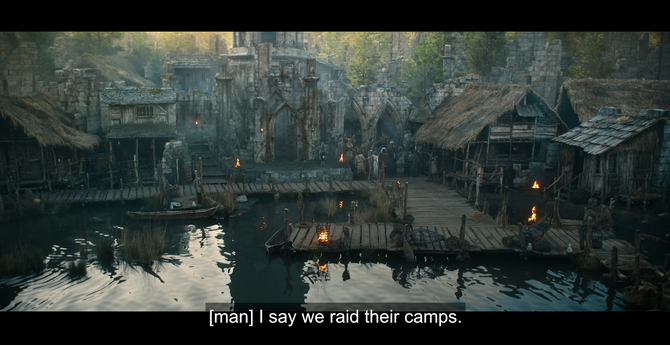
There are four plots we follow in this episode — the Rhûn storyline gets split.
Rhûn
The Stranger
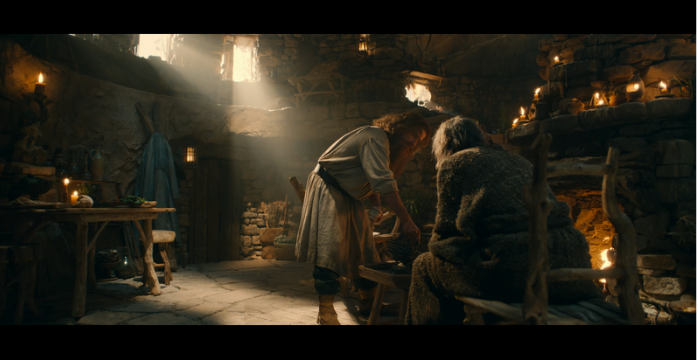
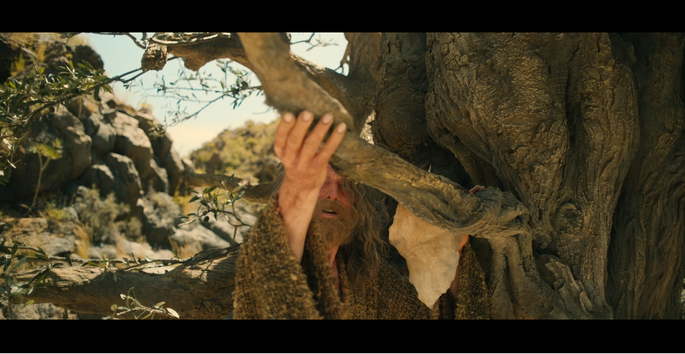
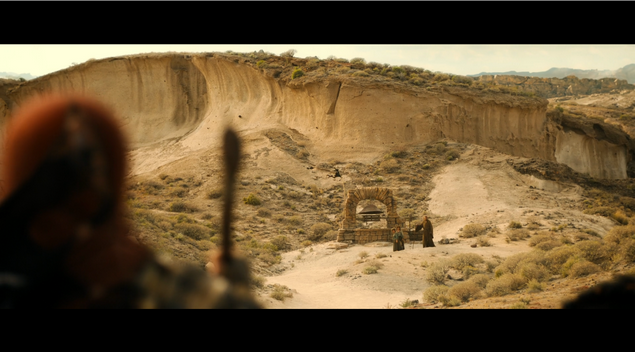
Last time we saw The Stranger, he had conjured up a sandstorm to blow away the Gaudrim riders, inadvertently lifting away Nori and Poppy with his uncontrollable power. We see him searching for the two harfoots, when he comes across and follows a baby goat. The goat leads him to a goat herder tending to a garden while singing and humming to himself. The Stranger asks this herder about the harfoots and the map of the stars; a gust of wind then blows away the map which lands on a tree. The tree has a branch which looks like the staff in the Stranger’s visions; he attempts to snap it off, at which point the tree (a Huorn) awakens, grabbing The Stranger and entombing him inside.
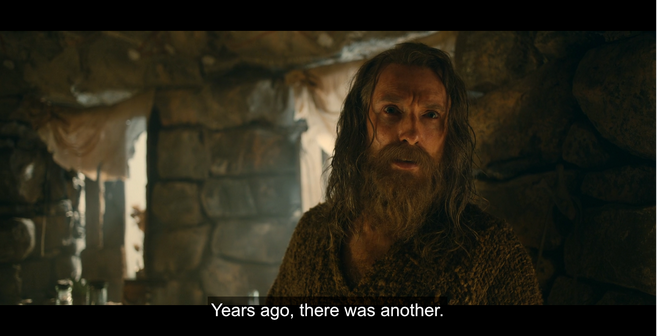
The Gaudrim Rider, Brânk, is talking to The Dark Wizard, telling him the Stranger and the harfoots have been separated. The Dark Wizard tells Brank to go after the harfoots, and then he stands up and proclaims he will handle The Stranger. Meanwhile, the goat herder pulls the Stranger out of the Houron and reveals himself to be Tom Bombadil. Tom invites the Stranger in, and after a bath and a meal, The Stranger asks questions of Tom. It is revealed that the Dark Wizard is an Istar who had come to Tom in the past, seeking him in mastering a wizard’s staff. Tom reveals that the Stranger is meant to face the Dark Wizard, and Sauron.
Nori & Poppy
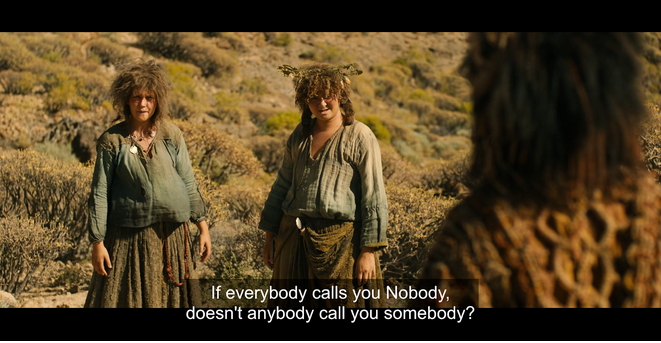
The two harfoots awake far from The Stranger in the desert, after being blown away in a sandstorm. They learn the Gaudrim are still searching for them, so Nori and Poppy attempt to escape; after jumping over a small cliff, they run into a Stoor named Merrimac, who reluctantly takes them to the Stoor Village. Nori tells the leader of the Stoors, Gundabel, that The Stranger is an Istar, a wizard; but Gundabel assumes they must mean the Dark Wizard and locks them up.
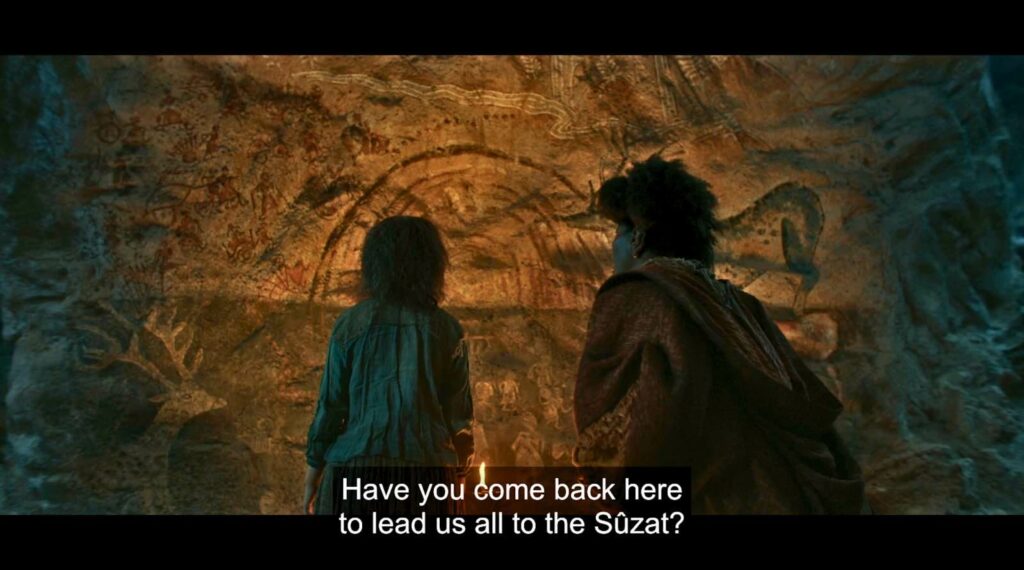
Gundabel asks Nori more about the Harfoots, and after Nori mentions Sadoc Burrows, Gundabel takes her to see a cave painting highlighting the stories of the Stoors. One painting shows Rorimas Burrows, an ancestor of Sadoc, who set out with a caravan of Stoors to search for a new home for them alll. Nori realizes he never found it, and that is why all the Harfoots just became wanderers instead. Brânk comes to the Stoor Village, demanding they turn over the harfoots; when Gundabel refuses, Brânk threatens to return with The Dark Wizard.
Pelargir
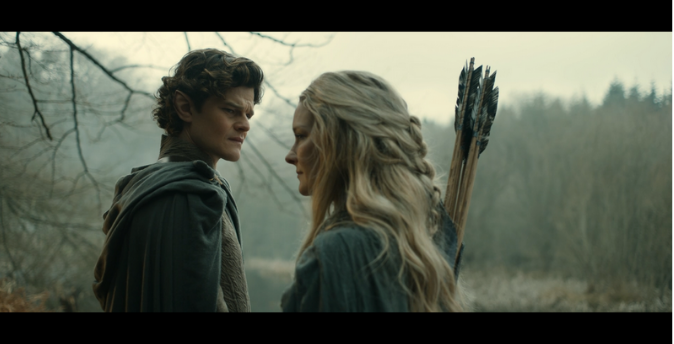
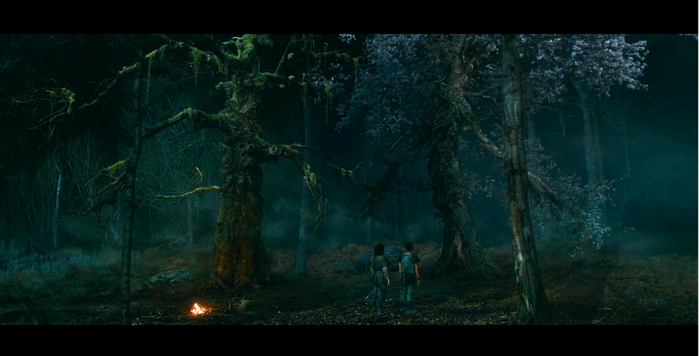
Isildur, Arondir and a company of Southlanders are in a forest at night, searching for Theo. Arondir comes across axes, tools, and severed limbs, concluding that it was not Wildmen who attacked this camp and kidnapped Theo. Back in Pelargir, the Southlanders and our heroes discuss where to look for Theo next; Estrid mentions looking up in the north because “that part of the forest is old”. Later, Arondir questions her about a mark on her back, revealing that she is one of the Wildmen who bore the mark of Adar. They use her to find the Wildmen’s camp, and along the way discover a trail of cherry blossom petals.
As Isildur, Estrid and Arondir track Theo, they come across a muddy swamp; Isildur falls into quicksand and Arondir tries to get him out. They both get pulled in, but luckily Estrid is able to coax the mud monster out, allowing Arondir to cut their way out through its belly. This allows Isildur and Arondir to trust Estrid again. Isildur sets Estrid free, but she draws a sword on him and attempts to escape. Suddenly two Ents, Winterbloom and Snaggleroot attack the trio, but Arondir is able to talk to them, and seek forgiveness. The ents free their captives, including Theo, and inform the party that an army of orcs were seen marching west. Arondir makes amends with Theo and takes his leave, to go confront the army and Adar.
Grey Havens/Road To Eregion
A contingency of elven soldiers begin to board ships at the Grey Havens; Galadriel and Elrond discuss the team required for their secret journey to Eregion. They decide to take a small group of 6 elves across the Axa bridge, but when they arrive, they find the bridge destroyed by lightning. Their map-reader, Camnir, recommends taking Tyrn Gorthad to cut across and shorten the journey; but Galadriel’s ring, Nenya, shows her visions of ghostly figures and chains. Elrond however, refuses to heed Galadriel’s advice from her ring, and they attempt through Tyrn Gorthad (Barrow-downs) with the company. Something has brought the bodies in the tombs to life, and the Barrow-wights attack the company, killing the elven warrior Daemor.
Thanks to Elrond though, they manage to defeat the barrow-wights. While the other elven soldiers mourn and honor Daemor, Elrond and Galadriel have a conversation about the ring, and Sauron. Camnir warns them of drums nearby, and they discover an orc encampment. The orcs notice them and fire arrows, hitting Camnir. While trying to tend to his wound, Galadriels finds that Nenya heals Camnir completely; she gives Elrond the ring and tells him to take the company and leave. She creates a diversion allowing them to do so, and is captured by the orcs. Then, Adar comes forward, greeting her and calling her Altariel.
Overall Thoughts on Episode 4
At first I felt that this was largely a set-up episode, similar to season 1, episode 5, “Partings”; This episode moves characters into position for their story arcs in the latter half of the season. Arondir is headed towards Eregion, The orc army is already there, Galadriel has been captured, the Stranger knows his purpose, and Elrond now has Nenya, etc. A lot happened in this episode, but none of it seems tied to the main plot, that of the rings being made in Eregion, or of Sauron’s machination. But I noticed there is a theme throughout this episode.
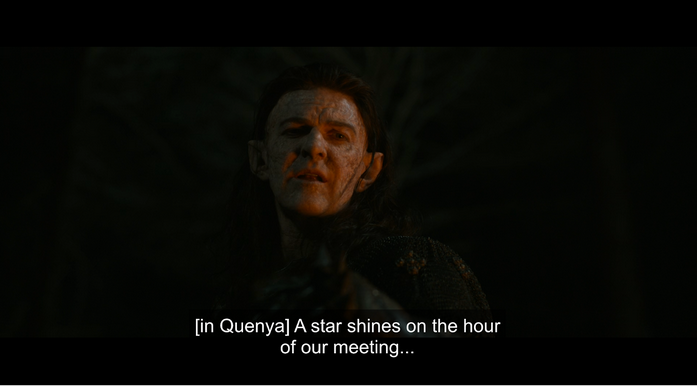
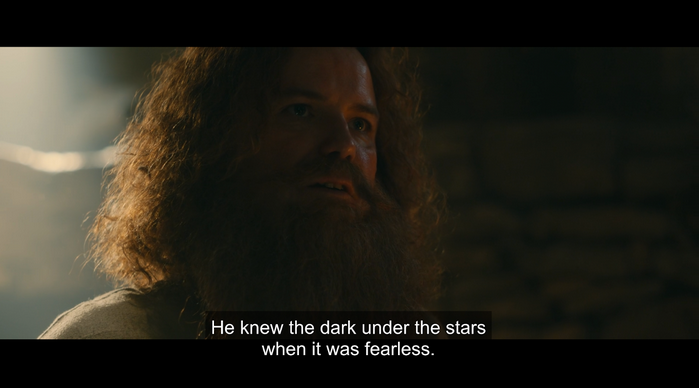
There is Tom Bombadil, “Eldest”, who talks about being there “before the river and the trees”, of knowing “the dark under the stars when it was fearless”; The Ents who talk about knowing peace as “When the only sound here was light upon the moss. Both of these invoke the memory of an ancient past, for Tom, long before evil or darkness touched the world, and for the Ents, before Melkor irreparably marred Arda.
“For even if we under Eru have the power to return to Middle-earth and cast out Morgoth from the Kingdom of Arda, we cannot destroy all the evil that he has sown, nor seek out all his servants—unless we ravaged the whole of the Kingdom and made an end of all life therein; and that we may not do.”
Mandos, from The History of Middle-earth: The Peoples of Middle-earth
On the other side you have the barrow-wights poem, which is used in the soundtrack by Bear McCreary, with the following last four lines:
In the black wind the stars shall die, and still on gold here let them lie, till the dark lord lifts his hand over dead sea and withered land
This is looking forward, forward to a future where darkness has taken over the lands. It stands in stark contrast to the world as described by Tom in his memories, or the Ents in theirs.
There is also Galadriel and Elrond’s conversation, about the rings and Sauron. Throughout the season we’ve seen them have this discussion, twice in Episode 1, once in Episode 2, and now reprised in Episode 4. In their conversations lie the thematic link; Galadriel fears the future shown to her by Nenya, as envisioned by the barrow-wights poem, where darkness wins and reigns over Middle-earth. And so she would use the rings to preserve Middle-earth, maybe not as Tom Bombadil or the Ents remember it, but as the Elves remember Middle-earth.
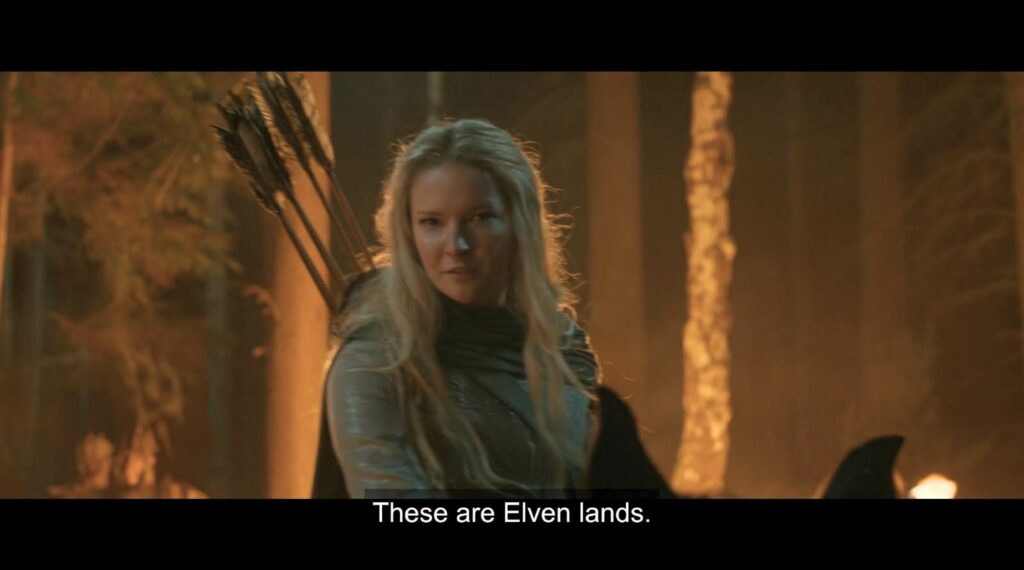
As such, when later in the episode, Galadriel defiantly tells the orcs surrounding her, “These are Elven lands!”, one can read it to mean not just the area surrounding Eregion, but a claim by the elves upon all of Middle-earth. The Elves are the “Eldest” of the Children of Illuvatar (and immortal), and as such have a relationship with Middle-earth unlike the dwarves or men.
Yet, there is one who is obviously missing from this episode, whose actions are driving the plot; It is Sauron’s vision for Middle-earth’s future that puts the Ents, the Elves and even Tom, all of Middle-earth at risk for being without peace.
Rating: I would give this episode an 8/10. Overall a good episode that does the work to setup the plot for the second-half of the season; characters like Arondir and Galadriel are moved into the parts of the stories they need to be in. There are some disappointments; for one, the barrow-wights fight sequence did not really live up to the hype; it was a very short action sequence, not very special or significant fight choreography, and it also ended kind of abruptly. On the other hand, Galadriel’s solo fight against the orcs at the end of the episode was well-cut, well-paced, with great choreography and angles, and a surprise ending sure to leave everyone anticipating the next episode.
In terms of other plots, Pelargir has shaped up to have interesting moments, although it’s hard to say where it goes from here now that Arondir is headed to Eregion. There’s an opportunity for a compelling exploration of Isildur’s motivations for sticking around the region that one day becomes Gondor; we’ll see if the show can maintain the audience’s interest in that plot. The plotline with Estrid and her supposed betrothed being alive is also intriguing; Could these be the Men of the Mountain whom Isildur will one day take an oath of fealty from?
Lastly, Tom Bombadil somehow managed to fit into the story and feel right; much of that success belongs to Rory Kinnear, who brings a light touch that hints at the more playful and jolly Tom we know from the books, while still grounding him in the show so as to not be too distracting. Nori discovering more depth to the backstory of the Harfoots seems to be setting up a plotline we all expected; but we’ll see where this idea of the “Sûzat” goes by the end of this season.
About the author: Webcrawler is a full-time data analyst and a part-time Tolkien aficionado and moderator on TheOneRing.net’s Discord Server.When he’s not working or in the discord, Webcrawler is horsing around on Twitter
It’s not long at all until Episode 4 of The Lord of the Rings: The Rings of Power airs. If you’re feeling twitchy while waiting, check out this fantastic Episode 1 to Episode 3 recap from TORn Discord moderator Webcrawler.
~ Staffer Demosthenes
Recap: The Rings of Power Episodes 1 to 3
by TORn Discord moderator Webcrawler
The Lord of The Rings: The Rings of Power returned on Amazon Prime last Thursday for it’s second season with a whopping three-episode premiere. Many fans across the USA were also able to attend special screenings of the first two episodes at select theatres, including our very own TORnTuesday hosts, Cliff & Justin
The episodes premiered to some very strong reviews, some quite negative but most extremely upbeat. This highlights big improvements from Season 1: tighter, more-focused storytelling, better pacing between plotlines and episodes, and stronger dialogue. Season 2 of The Rings of Power currently sits at 84% on Rotten Tomatoes, “Certified Fresh”, with 91 Critic Reviews.
There are plenty of reviews and breakdowns already available to view online, including from friend of TORn, Tea with Tolkien; but of course, don’t forget to check out yesterday’s TORnTuesday episode where Cliff and Justin spend over three hours examining the three-episode S2 premiere in great detail!
Season 2, Episode 1
Titled “Elven Kings Under the Sky”, a direct reference to the first line of the Ring Verse.
“Three Rings for the Elven-kings under the sky, Seven for the Dwarf-lords in their halls of stone…”
Synopsis
There are three plots we follow in this episode:
Sauron
A parallel prologue to that of Season 1, Episode 1 “A Shadow of the Past”, where we get answers to some important lingering questions from Season 1: What was Sauron doing after Morgoth’s defeat? Where did he get the sigil of the lost King of the Southlands? And how did Sauron get on a raft in the Sundering Seas?
After that we catch up to Sauron in the present day, where he turns himself over to Adar. Using his Halbrand form, he somehow convinces Adar to let him travel to Eregion, where he waits to speak with a reluctant Celebrimbor.
Lindon
Galadriel and Elrond return to Lindon with the Three Rings made by Celebrimbor. There, the elves, along with Gil-galad (and later Círdan) discuss the merits and dangers of using the Three Rings to heal The Great Tree of Lindon. After some time has passed, and Gil-galad tells the Elves to prepare to leave Lindon, Círdan shows up wearing Narya and convinces Gil-galad to use the rings.
Rhûn
The Stranger has a recurring dream or vision of a staff; he and Nori have been lost in their attempt to get to Rhûn, and find that they are being followed. It turns out Poppy has tracked them down and decided to join in their journey. Poppy, using some of Sadoc’s maps, helps them navigate to Rhûn.
Overall Thoughts on Episode 1
Episode 1 is a very strong start to Season 2. The main plot, following Sauron, presents a compelling journey that asks us to consider whether or not he ever truly repented. One particular scene stands out in this regard, where he talks to a Southlander (played by Nicholas Woodeson), on a ship, about overcoming an evil past; the response reminded me of Gandalf’s comment to Galadriel in The Hobbit: An Unexpected Journey:
Gandalf : I don’t know. Saruman believes that it is only great power that can hold evil in check. But that is not what I have found. I’ve found it is the small things, everyday deeds of ordinary folk that keeps the darkness at bay.
It’s telling that, immediately after this, Sauron leaves the man to die after the ship is attacked by the wyrm in the Sundering Seas (first seen in Season 1, Episode 2), but not before grabbing the sigil that hung around the Southlander’s neck.
The Lindon plot is also filled with fantastic, Tolkienian moments that show us Season 2 has risen in terms of dialogue and storytelling. Círdan’s introduction is about as close to perfection you can get for a character introduction, as we see him stare out into the seas while a variation of Bear McCreary’s “Valinor Theme” plays, indicating to lore fans that this is the elf who has long awaited the day he shall sail West to Aman.
Galadriel, Elrond, and Gil-galad debating whether to use the rings sets up new and interesting dynamics, with slight role reversals for the former two, as it is now Elrond who refuses to obey the High King. (personally, I’m glad they had Galadriel just plainly state that Halbrand is Sauron; good to see they’re not trying to drag things out for drama).
Of course, there is also the scene where The Three Rings are used and The Great Tree is healed; it’s a moment that should stand out as one of the more truly magical moments of a show. It also features a quick call back to the Peter Jackson films, when the Three are shown together in the prologue of The Fellowship of The Ring.
Lastly we come to the Rhûn plot, whose primary interesting moment was The Stranger’s vision: a staff floating and changing forms. The first form was the staff he’s been shown with in some promotional images. But the second form looks much more familiar…
Yes, it’s quite evocative of Gandalf’s staff in The Fellowship of the Ring.
The other significant development in the Rhûn plot was the return of Poppy, and a shorter rendition of “Wandering Day” from S1. This time it sets our three heroes off on a path to discovering the way into Rhûn. It’s a clever bit of storytelling that provides us with some depth to the Harfoots, and hints at future events to come.
Rating: I would give this episode an 8.5/10. The Sauron and Lindon plots were excellent ways to kick-off the story, while the Rhûn plot gives us some mysteries and some heartwarming moments.
Season 2, Episode 2
Titled “Where the Stars are Strange”, a direct reference to a quote from Aragorn…
“I have crossed many mountains and many rivers, and trodden many plains, even into the far countries of Rhûn and Harad where the stars are strange.”
The Fellowship of the Ring. The Council of Elrond
It’s interesting to note that according to Unfinished Tales, the stars were strange, not in Rhûn, but Harad.
This passage is the only evidence that survives for his having extended his travels further South. Aragorn claims to have penetrated “the far countries of Rhûn and Harad where the stars are strange” (The Fellowship of the Ring II 2). 10
10 The “strange stars” apply strictly only to the Harad, and must mean that Aragorn travelled or voyaged some distance into the southern hemisphere. [Author’s note.]
Unfinished Tales Part 4: II: The Istari
Synopsis:
There are four plots we follow in this episode:
Khazad-dûm
The evil spreading from Mount Doom after it’s eruption has sent shockwaves across Middle-earth; nowhere is that more literal than in Khazad-dûm, where an earthquake destroys the mirrors, removing the dwarves’ ability to get light into the depths of the great city’s caverns. Disa and others attempt to sing to the mountain to find passages through which to repair the damage, but the singers fail to communicate with the mountain, bringing more worry to the dwarven realm.
On a personal level, Durin IV and Disa are struggling to make ends meet, as the two Durin’s are no longer communicating, and Durin IV has been cut off from his inheritance. It all looks dire, until a mysterious letter arrives from Lord Celebrimbor of Eregion, with an invitation for the dwarves to meet with him in Eregion.
Eregion
Halbrand continues to lurk around the gates of Eregion, while Celebrimbor begins to get impatient as he awaits any news from Lindon regarding the Three Rings. As he waits, he continues his work, this time showing a young apprentice his latest creation, Ithildin, which is only visible under moonlight. Finally, Celebrimbor decides to speak with Halbrand, who informs him that the Three Rings did indeed work, and Lindon is healed, the elves are saved, and now Halbrand has returned to ask for Rings of Men.
At first Celebrimbor rejects this aspiration, until Halbrand reveals himself as Annatar, Lord of Gifts.
Lindon
Having worn her ring, Nenya, for some (indeterminate) time now, Galadriel has a vision of Celebrimbor being wrapped in vines and killed, as he recites the first three lines of the Ring Verse in Black Speech. A concerned Galadriel tells Gil-galad, who reveals ominous visions of his own.
Galadriel, convinced that Sauron must be in Eregion, requests Gil-galad’s leave to go and face Sauron herself; but Gil-galad refuses. Elrond supports Gil-galad in this decision, as he doesn’t trust Galadriel because of her role in helping return Sauron to power; nonetheless, after a conversation with the ever-wise Círdan, Elrond decides a small band of elves will attempt to travel to Eregion and speak with Celebrimbor, and he will lead the group, not Galadriel.
Rhûn
As Nori, Poppy and The Stranger make their way through Rhûn, a band of horse riders seem to be tracking them from a distance; they are revealed to be Gaudrim, and they are allied with a mysterious Dark Wizard in Rhûn who is also the leader of the Mystics. The Dark Wizard brings The Dweller, one of the Mystics who we saw in Season 1, back to life. The Dweller provides a report on Sauron’s whereabouts, which he shows keen interest in. The Dark Wizard tasks the Guadrim with capturing The Stranger.
Meanwhile, our trio in Rhûn have found the desert too taxing, and The Stranger collapses from thirst. Nori and Poppy drag him to a nearby well and fetch a pail of water. Unfortunately it has a bell which alerts the nearby Guadrim, and the trio are discovered. The Stranger however has woken up, and sees nearby the staff from his visions. Using the staff he creates a sandstorm to blow away the Gaudrim, but it goes out of control, and leads to Nori and Poppy also being pulled into it and blown away.
Overall Thoughts on Episode 2
Episode 2 was even stronger than Episode 1; it begins with an ominous look at the recently activated Mount Doom, which now continues to spew lava. Then we transition to a map and see its darkness spread, reminding us that this season, things will get worse for the free peoples of Middle-Earth.
This is reiterated with a very surprising scene of Celebrimbor reciting the Ring Verse in Black Speech to Galadriel in a vision; we know from S1 Episode 3, when Galadriel went to Númenor that she can read Black Speech, and so she was able to understand his words. Conveniently, the One Ring portion of the Ring Verse was left out. Galadriel’s connection to Sauron continues to be questioned, and this is thematically related to the question of the influence of Sauron on the Three Rings of the Elves.
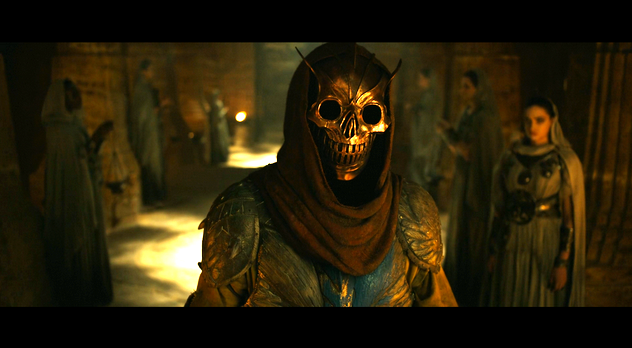
This connection of Sauron is further brought up in Rhûn where we learn the Dark Wizard is keeping track of Sauron through his Mystics. Recall in S1, The Mystics thought The Stranger was Sauron, and sought to bring him to Rhûn. But their purpose remains unclear. The mysteriously masked riders are even more intriguing; one of them tells the Dark Wizard (played by Ciaran Hinds) to remove the “curse of the flesh” from them, but we do not yet learn what that curse is.
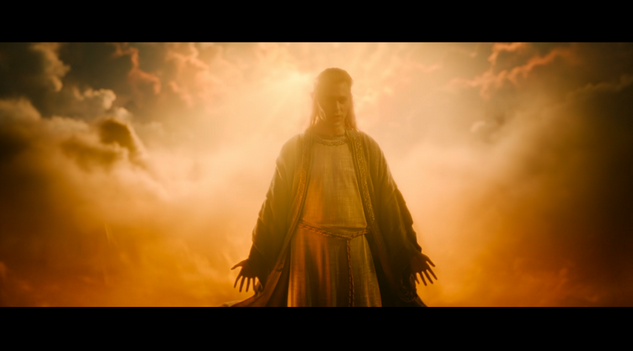
Lastly, but certainly most important, is Halbrand showing Celebrimbor his Annatar form. It’s a moment of pure maximalist fantasy; swirling lights and colors, a flowing white gown as Annatar walks toward Celebrimor and seduces him.
Rating: Overall I give this episode a 9.5/10. All the storylines are paced well, and the moment with Annatar’s reveal should go down in television history. Both Charlies did an incredible job in this scene.
Season 2, Episode 3
Titled “The Eagle and The Sceptre”, two important references to Númenorean lore.
“Thrice only in each year the King spoke, offering prayer for the coming year at the Erukyermë in the first days of spring, praise of Eru Ilúvatar at the Erulaitalë in midsummer, and thanksgiving to him at the Eruhantalë at the end of autumn. At these times the King ascended the mountain on foot followed by a great concourse of the people, clad in white and garlanded, but silent.” [Ed.: emphasis added]
The Fall of Númenor
And…
“It is written that ‘the sceptre was the chief mark of royalty in Númenor’18 from the reign of the First King to that the Twenty-Fifth King and that having survived for 3,287 years it was lost with Ar-Pharazôn at the Downfall.”
The Fall of Númenor
Synopsis:
There are six (!) plots we follow in this episode:
Southlands
Berek the horse ventures into Mordor, and after having an encounter with orcs, he finds Isildur. Unfortunately, Isildur has been webbed up by Shelob, and a fight ensues before Isildur and Berek can ride to safety. Isildur comes across an attacked caravan. As he is investigating it, he’s stabbed by a Southlander girl, Estrid, who thought he was an orc. Estrid tells Isildur that some of the Southlanders and Númenoreans had set up camp at the abandoned colony of Pelargir, and they make their way there.
Pelargir
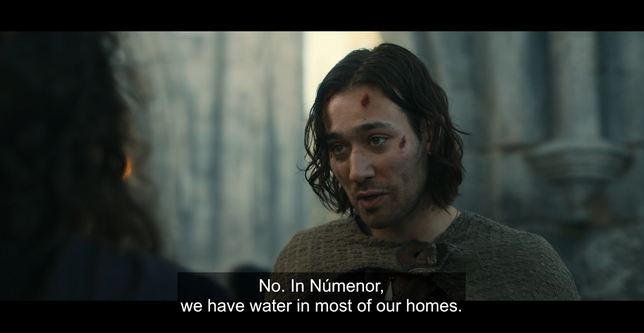
Isildur and Estrid make their way to Pelargir, stopping to help an attacked caravan. It turns out to be a trap, and after a scuffle, Berek is stolen by these Wild Men; luckily Arondir comes in and saves Isildur and Estrid. He takes them to Pelargir, where a funeral pyre has been set up; Bronwyn has died, succumbing to poison from the arrows the orcs shot at her. Theo and Arondir are struggling to deal with this loss and maintain their father-son relationship without Bronwyn to connect them. Isildur talks to Theo about Númenor; Theo tells him he can help him get Berek back.
Estrid and Isildur talk about their mothers, we learn Isildur’s mother died while saving him, which has left him with a sense of profound guilt. After Isildur leaves, Estrid uses a hot knife to burn out a brand that has been put on her, Adar’s brand, indicating at some point she swore fealty to him. Theo and Isildur go to the camp where Berek is being held; they free Berek, but a complication arises as someone or something attacks the Wild Men’s Camp.
Númenor
Elendil is paying his respects to the deceased King at his funeral; Eärien tells him that he doesn’t need to blame himself for Isildur’s death, they can blame the Queen. Míriel shows up to her father’s funeral, and is confronted by a woman who lost her son in the expedition to Middle-earth; Miriel comforts her.
Later, Pharazôn talks to Míriel about her coronation, and hints that she should choose to move Númenor forward, and not backwards in a return to the Faithful ways as her father tried. However, she seems to refuse. Pharazôn, Kemen and Eärien are in a bar talking to Lord Belzagar, a Númenorean lord from the north who dislikes Míriel and thinks Pharazôn should rule.
Valandil confronts the table, and makes a clear threat to Kemen. Eärien tells Lord Belzagar about the Palantír. During Míriel’s coronation, Eärien reveals the Palantír to the Númenorean court, inciting the crowd against Míriel. A Great Eagle of Manwë swoops in on the open perch; Pharazôn walks up to it, and Lord Belzagar starts a Pharazôn chant, leading the crowd to join in and proclaim their desire for Pharazôn to be their new ruler.
Khazad-dûm
Durin talks to his father about Celebrimbor’s new proposal; he tells King Durin that he’s uncertain about this, and how they had talked previously about the elves trying to cheat death. King Durin brushes off Durin IV’s concerns, as the needs of Khazad-dûm are too great right now.
Eregion
Celebrimbor tells Disa and Durin about the rings, and how he can make more to help them if they provide him with mithril. Durin is a bit more skeptical and explains that he is not on speaking terms with his father, King Durin, and cannot bring a new proposal to him.
Annatar interjects, and after a failed attempt at flattering Durin, tries to convince them they need the rings. Later, Annatar tells Celebrimbor that Gil-galad did not want him to make any more and doesn’t even know that Annatar is in Eregion. Celebrimbor takes offense to this and pens a letter to Gil-galad, lying about closing up shop so that they can let the work continue. Later on, King Durin arrives with mithril, which Celebrimbor and Annatar use to make new rings.
Mordor
The orcs prepare for war, and Glûg talks to Adar about his concerns regarding this new direction; why go to war when they already have a home now? Adar assures him that there will be no peace for orcs unless they make sure Sauron is no more.
The Hill Troll known as Damrod arrives at Adar’s camp, and asks “Where is Sauron?”
Overall Thoughts on Episode 3
Episode 3 has a lot of plots to juggle and that ends up affecting the pacing. Despite this being the first episode where we see Númenor this season, there’s really only four scenes, and it jumped from the end of last season so that we don’t get to see Míriel’s initial reaction to learning her father died, nor Eärien’s reaction to the loss of Isildur. Instead we are thrown right into the politics of Númenor, which some could argue have not been thoroughly set up to warrant such jumps.
Conversely though, the Pelargir plotline was really well done. We’re introduced via an ambitious five-minute scene from Berek’s point of view, as the horse journeys to find his rider, Isildur. From there we expand to the addition of a new character and then a new location in Pelargir. As this happens we learn more about where the characters are at now, and it feels a lot more natural than Númenor.
But it benefits from having the most screen time of any plot this episode.
We don’t get much of Eregion, Khazad-dûm or Mordor, and we do not see Lindon or Rhûn in this episode. It’s still a gripping episode, particularly the end scene where the Seven Rings are made, but the sheer number of plotlines being followed makes it feel a bit more disjointed compared to the first two.
Rating: Overall I give this episode a 8.0/10. There are some interesting developments (Seven Rings, Great Eagle, Shelob battle, the hint of Ents, Damrod), but it feels a bit like too much to juggle in one episode.
The first three episodes of Season 2 are more cohesive than Season 1. S1 had a two-episode premiere, but both episodes ended with Galadriel stranded in the middle of the ocean, so it felt like we were still getting started.
Season 1 also had a lot more setup to do, whereas with the first three episodes of Season 2 we jump right into the story. Theres also less mystery: Galadriel tells Gil-galad the truth about Halbrand right away, and we follow Sauron around and see his manipulations with Adar and Celebrimbor go into effect. The pacing of the episodes are more favorable too as significant events happened in each of the first three episodes of Season 2: the Great Tree of Lindon is healed, Annatar has arrived, the seven rings are being made, and so on.
About the author: Webcrawler is a full-time data analyst and a part-time Tolkien aficionado and moderator on TheOneRing.net’s Discord Server.When he’s not working or in the discord, Webcrawler is horsing around on Twitter


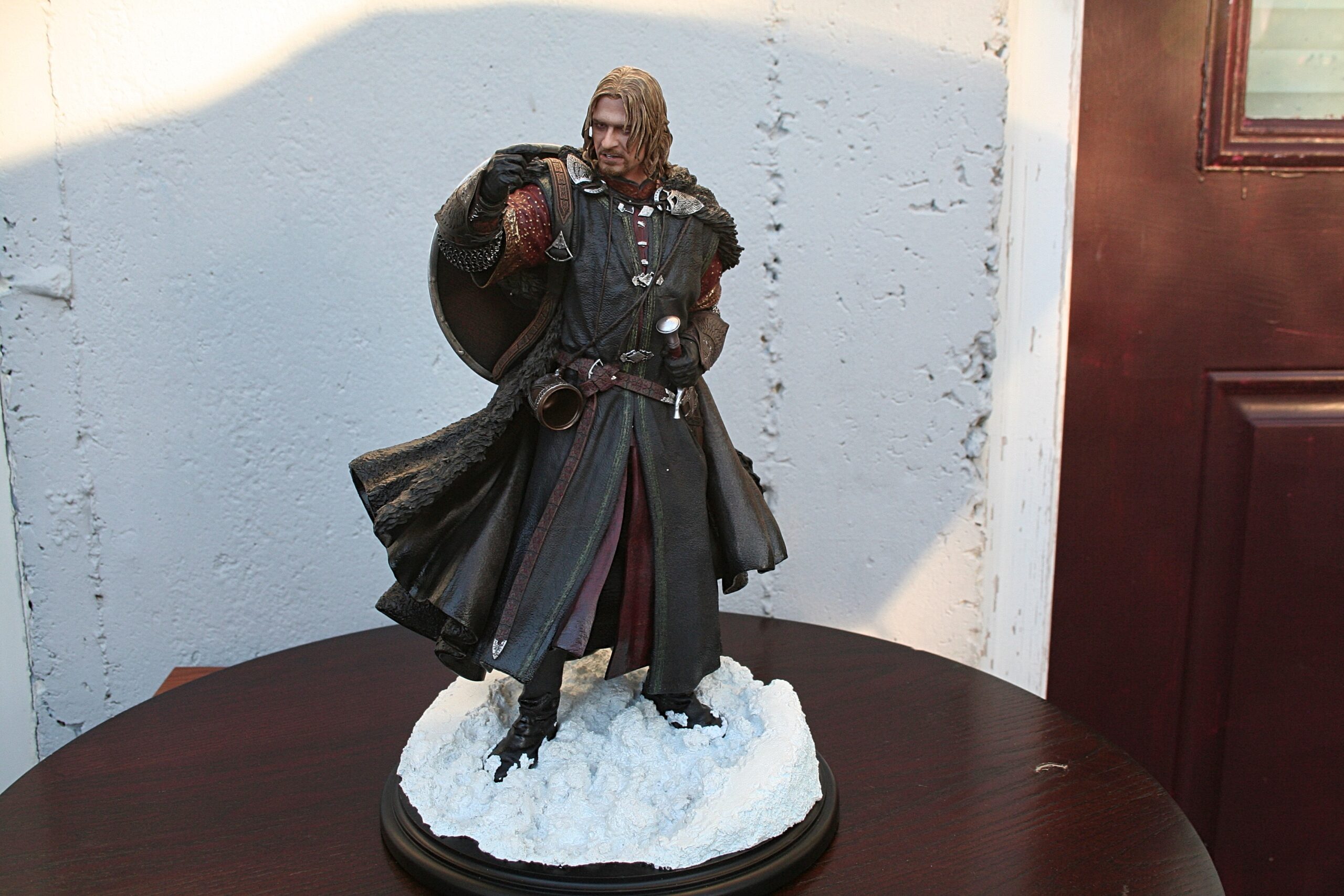 One of the pieces I had been dying to get my order in for, since I saw it at SDCC 2024, was the classic series Boromir. The reason? Well, I fell in love with the choice of the pose and the look of the piece. This is a version I wasn’t sure we’d ever get but was blown away when it happened. When this statue went up for pre-order there were two versions like the recent Legolas statue. You could get the Boromir with 1:4 Horn of Gondor, which was limited to 400 pieces total or you could get the standard classic series. That version is still available for $399 and in-stock. I think this statue is just fantastic with great paint, details, and likeness. I could not be happier to have this in my collection and I hope you will do the same.