Last weekend, the Hall of Fire crew delved into the Two Towers chapter Treebeard. Belatedly, for those who couldn’t attend, here’s a log. It’s a bit choppy to start but bear with it — my fault for still being half asleep when we kicked off.
Also, TORn regular Puma linked this excellent Youtube video of JRR Tolkien reading from the chapter when the Ents come from Entmoot to march on Isengard. Continue reading “Hall of Fire log: Treebeard”
If you have a Tolkien/Middle-earth inspired poem you’d like to share, then send it to poetry@theonering.net. One poem per person may be submitted each month. Please make sure to proofread your work before sending it in. TheOneRing.net is not responsible for poems posting with spelling or grammatical errors.
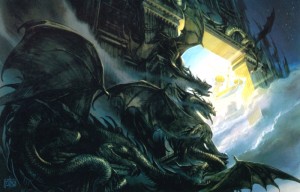
The quest for Middle-earth canon. In some ways it always feels a bit of a Sisyphean endeavour.
You know the story of the mythological Greek king, Sisyphus, right?
For those who don’t recall, Sisyphus was just too crafty for his own good. So the Greek gods, never tolerant of being made to look foolish, designed for him the most frustrating of punishments: Sisyphus was compelled to roll a huge boulder up a steep hill. Just before he could reach the top, it would roll back down, forcing him to begin all over again. Continue reading “Why inconsistency in Tolkien’s canon is actually a good thing”
If you have a Tolkien/Middle-earth inspired poem you’d like to share, then send it to poetry@theonering.net. One poem per person may be submitted each month. Please make sure to proofread your work before sending it in. TheOneRing.net is not responsible for poems posting with spelling or grammatical errors.
Note:A photo gallery follows the text and videos, click for larger versions.
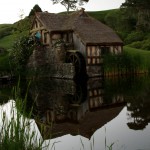
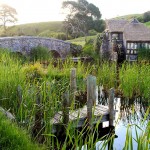
The mill at Hobbiton Movie SetNEW ZEALAND — During the world premiere of “The Hobbit: An Unexpected Journey,” New Zealand wisely took the opportunity to show journalists from around the world (and Australia) a lot of the amazing things its island nation has to offer. TheOneRing.net was part of one of the tours and rather than regurgitate all the footage, photos and writing we gathered at once, exactly when all the other journalism outlets of the world did, we thought it would be great to disperse it and share it over the course of 2013 in the lead up to “The Hobbit: The Desolation of Smaug.”
After all, Tourism New Zealand’s motto is “New Zealand is Middle-earth” and this is true in so many ways and for much longer than just the weeks after the debut of the film. For example, above is the video made for TORn by fellow filmmaker Dan McBride who shot and edited the video tour you probably have already watched. We, and a gaggle of other media, toured the Hobbiton Movie Set and witnessed Prime Minister John Key open the new Green Dragon building accompanied by a bunch of actors who reminded us a whole lot of a company of Dwarves. (Incidentally, we had just talked to him the day before so when he showed up again, we wondered why we were being followed and what we had done wrong.)
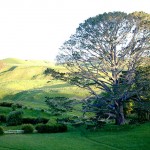
The video speaks for itself but this remarkable property is, as far as I know, unique in all the world for its ability to transport visitors inside a book, or a movie for that matter. Being there doesn’t feel like walking on a set, rather it feels like immersion. It looks, smells, sounds and feels like one imagines Hobbiton would if you could take a magic wardrobe to J.R.R. Tolkien’s Middle-earth. The Hobbit holes scattered about are, more or less, as they were for filming of “The Hobbit,” movies. It seems safe to assume we will see more of The Shire in subsequent movies and in the Extended Edition on home video before the end of the year.
At the Green DragonMeanwhile, not far from Auckland, sits this unique and amazing tourism experience. The still functioning sheep and cattle farm where the now-permanent movie set is placed, is owned by the Alexander family, as it was when discovered for “The Lord of the Rings,” films. Their television rugby match interrupted by strangers led to parts of the family farm being among the most beloved locations in fantasy film and literature. Now visitors take tours daily, either by booking directly through the farm or through travel agents, tours or cruise ships. There are several options available, including overnight farm stays, private tours and lunch options. Matamata, as authentic a small New Zealand town as you will find, serves as a gateway to the farm, offering transportation daily and had just opened a visitor’s center when we visited.
Hamilton is also near with more accommodations and an airport. Not far from Auckland, 160 kilometers in fact, visitors can easily manage the two hour car ride. It goes without saying that driving through the countryside is spectacular as well. My dream would be to meet with TheOneRing.net staff and friends in The Green Dragon, which can be reserved for private functions. They serve food and drink and I just bet you can guess what size the ale comes in. Weddings have and will happen here. The atmosphere and the finish on the place are just as good as you hope they are. In truth, for movies fans and Tolkien fans, the entire movie set experience is simply magic.
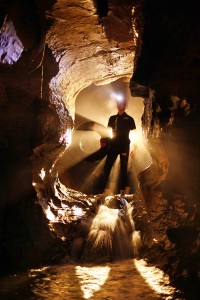
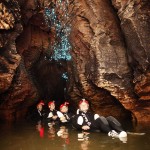
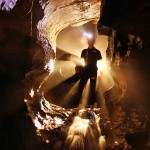
Waitomo Caves Black Water RaftingSome tourists will hop off the cruise ship or land in Auckland and make the farm their only stop in the region and in my opinion if you made it all the way to New Zealand and don’t see more of the region you are doing it all wrong. The tour also provided us the opportunity to visit the world famous Waitomo caves. They contain the exceptionally cool glow worms and there are different ways to experience it all, including the black water rafting experience that I couldn’t resist. Hamilton serves as a good gateway to both spots and neither is to be missed. In the gallery below I will drop in a few Waitomo photos but it is an entirely different story to be told and if there is any need to explain the importance of caves to Middle-earth, you might be at the wrong website.
The region is full of food and drink, excellent accommodations and plenty more worth-while excursions. We will tackle them all in a future story. But add the farm visit and Waitomo Caves to your bucket lists. They really are wold-class destinations not to be missed but especially not by Tolkienites.
While you are here, please enjoy other videos from the premiere. First, actors talking about rings:
And Red Carpet highlights.
New Zealand
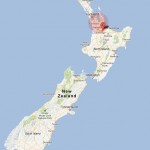
A map of the New Zealand region with Auckland and Matamata.
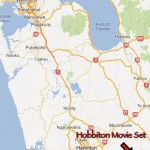
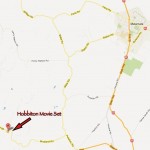
A detailed map of where The Hobbit Move Set is located near Matamata.
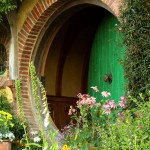
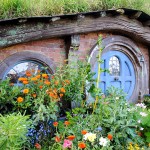
The door of Bilbo and Frodo Baggins.
Seems like a good place for a party
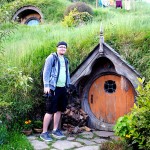
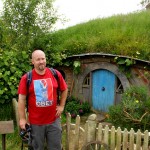
An average human male (Dan McBride) stands in front of a small Hobbit door.
The mill at Hobbiton Movie Set
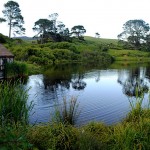
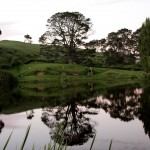
Water at Hobbiton Movie set
They may not like boats but Hobbits have docks.
The visitor’s center in Matamata, New Zealand.
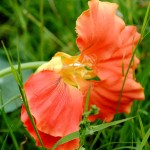
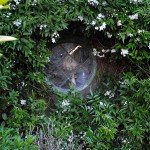
Flower at Hobbiton Movie Set
Hobbiton water
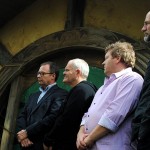
Actors look on at the opening ceremony of the Green Dragon
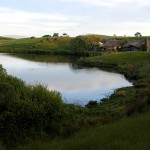
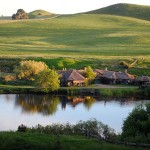
Still water, a view of Hobbiton Movie Set
For scale, an average sized adult (MrCere) at a Hobbit door.
A Hobbit window at Hobbiton Movie Set
Flowers and door at Hobbiton Movie Set
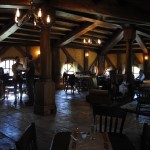
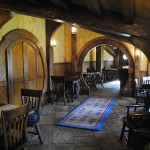
The interior of the Green Dragon
At the Green Dragon
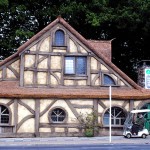
By the lake and the mill sits the Green Dragon
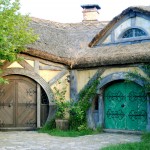
The exterior of the Green Dragon
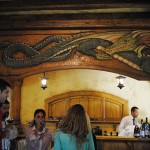
The bar at The Green Dragon
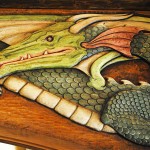
Detail of the carved green dragon in the Green Dragon
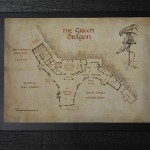
Floor plan on the wall of the Green Dragon of the Green Dragon.
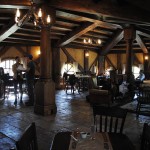
Inside the Green Dragon
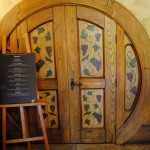
Door and menu at the Green Dragon
At the Green Dragon
Interior of the Green Dragon
Waitomo Caves black water rafting with glow worms.
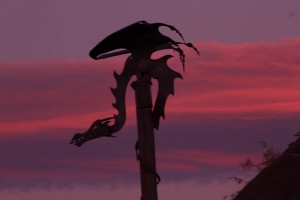
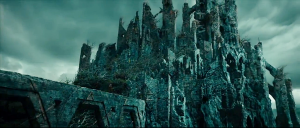
Several strongholds of elves and men are besieged while Frodo and Sam are trudging laboriously through Mordor to Mount Doom. In particular, Lothlórien repels three such assaults before Galadriel and Celeborn finally lead a counter-offensive against Dol Guldur.
“…the assaults were driven back; and when the Shadow passed, Celeborn came forth and led the host of Lórien over Anduin in many boats. They took Dol Guldur, and Galadriel threw down its walls and laid bare its pits, and the forest was cleansed.” Appendix B, Lord of the Rings.
If you have a Tolkien/Middle-earth inspired poem you’d like to share, then send it to poetry@theonering.net. One poem per person may be submitted each month. Please make sure to proofread your work before sending it in. TheOneRing.net is not responsible for poems posting with spelling or grammatical errors.
A little earlier, Hall of Fire regulars and guests concluded a lively discussion about the enigma of Idril and Tuor. For those who missed it, here’s a log to peruse. Next weekend, we’ll be returning to The Two Towers and chatting about the chapter “Treebeard”. Continue reading “Log of Hall of Fire’s Idril and Tuor chat”
If you have a Tolkien/Middle-earth inspired poem you’d like to share, then send it to poetry@theonering.net. One poem per person may be submitted each month. Please make sure to proofread your work before sending it in. TheOneRing.net is not responsible for poems posting with spelling or grammatical errors.
Welcome to our collection of TORn’s hottest topics for the past week. If you’ve fallen behind on what’s happening on the Message Boards, here’s a great way to catch the highlights. Or if you’re new to TORn and want to enjoy some great conversations, just follow the links to some of our most popular discussions. Watch this space as every weekend we will spotlight the most popular buzz on TORn’s Message Boards. Everyone is welcome, so come on in and join in the fun!
If you have a Tolkien/Middle-earth inspired poem you’d like to share, then send it to poetry@theonering.net. One poem per person may be submitted each month. Please make sure to proofread your work before sending it in. TheOneRing.net is not responsible for poems posting with spelling or grammatical errors.


 Last weekend, the Hall of Fire crew delved into the Two Towers chapter Treebeard. Belatedly, for those who couldn’t attend, here’s a log. It’s a bit choppy to start but bear with it — my fault for still being half asleep when we kicked off.
 The quest for Middle-earth canon. In some ways it always feels a bit of a Sisyphean endeavour.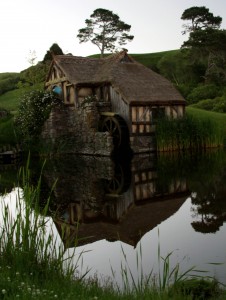
 Several strongholds of elves and men are besieged while Frodo and Sam are trudging laboriously through Mordor to Mount Doom. In particular, Lothlórien repels three such assaults before Galadriel and Celeborn finally lead a counter-offensive against Dol Guldur.
  Welcome to our collection of TORn’s hottest topics for the past week. If you’ve fallen behind on what’s happening on the Message Boards, here’s a great way to catch the highlights. Or if you’re new to TORn and want to enjoy some great conversations, just follow the links to some of our most popular discussions. Watch this space as every weekend we will spotlight the most popular buzz on TORn’s Message Boards. Everyone is welcome, so come on in and join in the fun!