In 1967, Tolkien began writing a letter to his son, Michael, where he shared his perspectives on cultivating faith. Tolkien likened the character of faithfulness (‘loyalty’) to that of a full-grown tree — a living organism that must be tended to by its keepers (Letter 306).
While the reasons for this letter may be forever lost to time, the excerpt reveals a fundamental notion in Tolkien’s mind: The symbolism of great faithfulness with the thriving health of trees.
There is no resemblance between the ‘mustard-seed’ and the full-grown tree. For those living in the days of its branching growth the Tree is the thing, for the history of a living thing is pan of its life, and the history of a divine thing is sacred. The wise may know that it began with a seed, but it is vain to try and dig it up, for it no longer exists, and the virtue and powers that it had now reside in the Tree.
Very good: but in husbandry the authorities, the keepers of the Tree, must look after it, according to such wisdom as they possess, prune it, remove cankers, rid it of parasites, and so forth. […] But they will certainly do harm, if they are obsessed with the desire of going back to the seed or even to the first youth of the plant when it was (as they imagine) pretty and unafflicted by evils.
The other motive […] aggiornamento: bringing up to date: that has its own grave dangers, as has been apparent throughout history.
Letter #306, The Letters of J.R.R. Tolkien
In my previous article, we discussed clues from the trailer and images of Amazon’s The Rings of Power that directly led us to identifying Sauron’s haunting presence on Middle-earth. Here, I will discuss how The Rings of Power might be using trees to illustrate the shrinking faith of the Númenoreans (Men) and the Noldor (Elves).
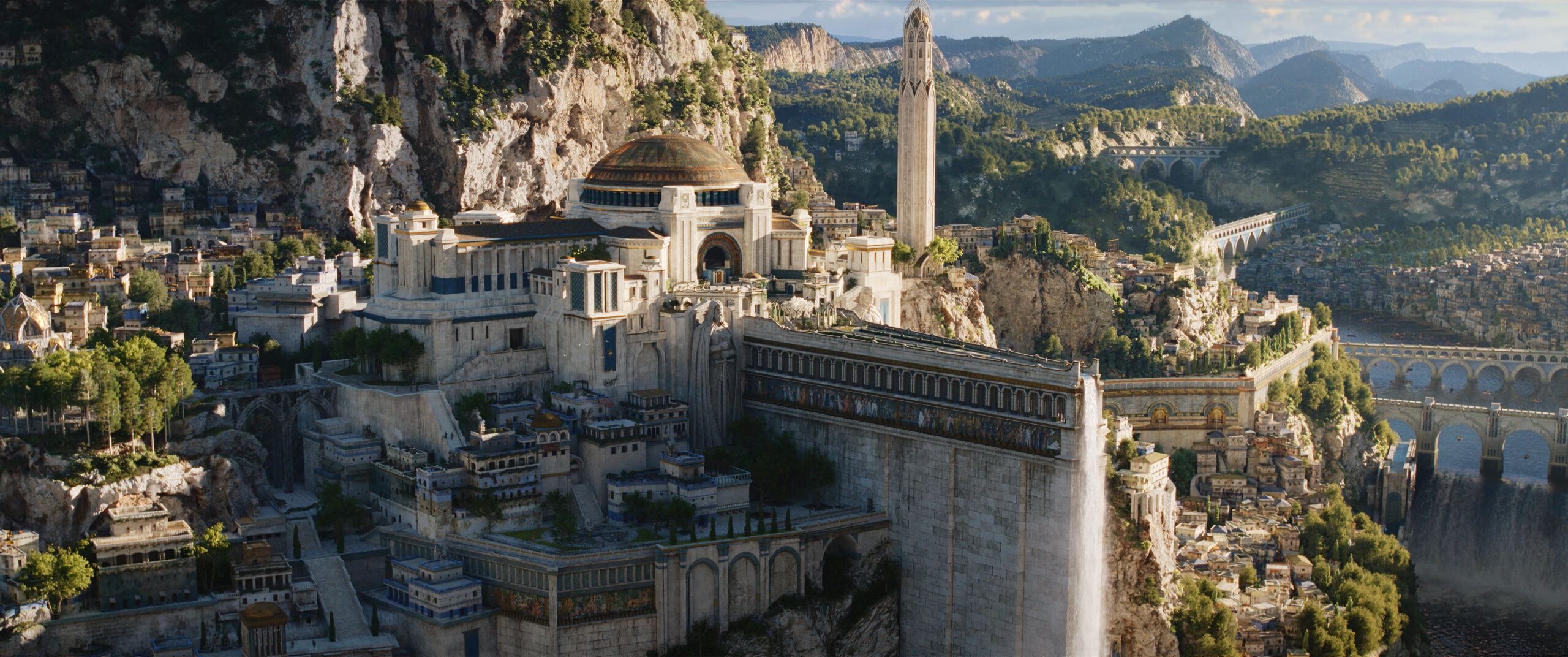
We begin in the island nation of Númenor. The Númenoreans are Men descended from the line of Elros, brother of Elrond. The line of the Kings of Numenor going back to Lúthien, daughter of the Sindarin King Thingol and Melian the Maiar. Of Lúthien’s descendants, Tolkien writes that ‘her line shall never fail’ (A Knife in the Dark, The Fellowship of the Ring).
In the King’s Court at Armenelos, Númenor’s capital, a white tree blooms: Nimloth thefair (Nimloth is Sindarin for ‘White Blossom’). Descended from a tree made in the likeness of Telperion for the Noldor of Tirion (Galathilion, the’White Tree’ of Yavanna, The Silmarillion), Nimloth was gifted as a seedling by the Eldar of Tol Eressëa in Aman. Her white petals gleam with the setting Sun and her scent fills the air of King’s court. Nimloth is the symbol of friendship between Men and Elves. (Cite.) A sign of the Númenor’s faithfulness to Eru and her Elven heritage.
The Númenoreans retained the dedications and order, but altered the fourth day to Aldëa (Orgaladh) with reference to the White Tree only, of which Nimloth that grew in the King’s Court in Númenóreans [my emphasis] was believed to be a descendant.
Appendix D, The Lord of the Rings
Nimloth, the White Tree in the Courts of Armenelos
The significance of the blooming white tree is not lost to readers of Tolkien. Soon after arriving in Gondor, Aragorn discovers the sapling borne from the fruit of Nimloth. The discovery astonishes Aragorn, but Gandalf recalls the significance of the sapling:
Verily this is a sapling of the line of Nimloth the fair; and that was a seedling of Galathilion, and that a fruit of Telperion of many names, Eldest of Trees. Who shall say how it comes here in the appointed hour? But this is an ancient hallow, and ere the kings failed or the Tree withered in the court, a fruit must have been set here. For it is said that, though the fruit of the Tree comes seldom to ripeness, yet the life within may then lie sleeping through many long years, and none can foretell the time in which it will awake.
The Steward and the King, The Return of the King
In Gandalf’s words, we see the link between preservation and renewal. The line of Telperion preserved from the days of the Two Trees, and the promise of renewal to its former glory.
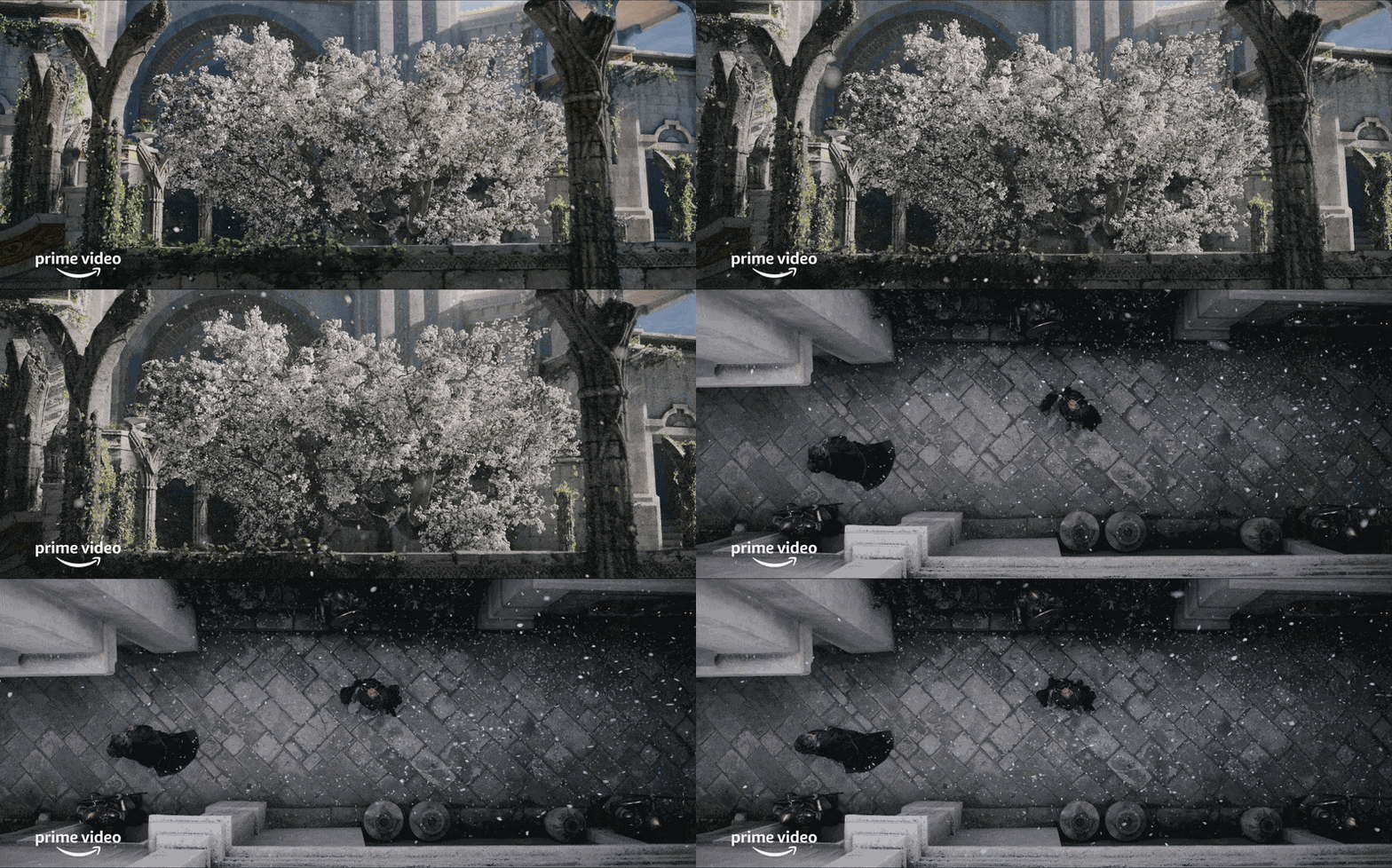
But, alas, our first sight of Nimloth in The Rings of Power is a solemn one. Unlike the sapling of Gondor emerging from the snow, we instead witness the opposite, the beginning stages of a fully-grown white tree beginning to wither.
Nimloth is weeping.
Her blossoms scatter onto the royal courts as Queen Regent Míriel and her advisor Pharazôn pause to make note of the moment. Míriel’s face flushes with unmistakable desperation.
Nimloth, the White Tree in the Courts of Armenelos
Is this then the first of many signs and warnings of Númenor’s descent to her watery grave?As steward-keeper of Nimloth (Faith), is Míriel’s faith in Eru and Númenor’s alliance with the Elves starting to crumble?
From what we are seeing, Nimloth is shedding her crown; Númenor is dying.
Mortality is, of course, a theme central to Tolkien’s works. Endings are inscribed to the life and stories of every creature on Middle-earth. It is this ill-fate that Tolkien has termed “fading” that the immortal Elves seek to halt. As Tolkien writes of the Second Age in a letter to Milton Waldman:
All through the twilight of the Second Age the Shadow is growing in the East of Middle-earth, spreading its sway more and more over Men — who multiply as the Elves begin to fade.
Letter #131, The Letters of J.R.R. Tolkien
Following the destruction of the Two Trees, their great Elf-king Finwë’s death at the hands of Morgoth, the theft of the Silmarils, and in defiance of Eru and the Valar, the arrival and lingering presence of the Noldor (tribe of Elves descended from Finwë) on Middle-earth resulted in their inevitable decline as a people. Yet, the hubris, ingenuity, and might of the Noldor also meant they were a great force to be reckoned with.
They are the chief artificers of devices (“rings”) that halt fading in the Second and Third Age.
In The Rings of Power, the fading of the Noldor is discreetly translated through the Tolkienian metaphor of suffering trees. Given their presence on Middle-earth is consequential to their continued defiance to the Valar, the Noldor’s faltering faith is represented in their inability to keep their beloved Mallorn trees (plural Mellyrn) from fading.
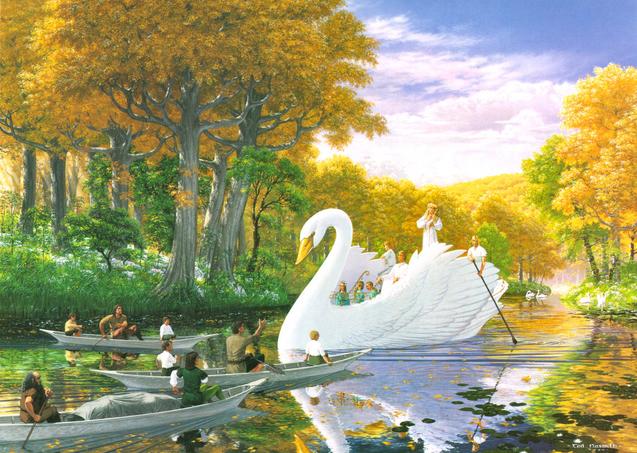
Farewell to Lorien by Ted Nasmith.
We are quite familiar with the description of the Mallorn Tree from several Tolkien texts (Letter to Minchin (1956), The Fellowship of The Ring, Unfinished Tales). It is prominently described as having a single smooth bark (“pillar”) of grey silver whose leaves turn to pale gold in the autumn, which carpeted the forest floor through spring and summer.
Its bark was silver and smooth, and its boughs somewhat upswept after the manner of the beech; but it never grew save with a single trunk. Its leaves, like those of the beech but greater, were pale green above and beneath were silver, glistering in the sun; in the autumn they did not fall, but turned to pale gold.
In the spring it bore golden blossom in clusters like a cherry, which bloomed on during the summer; and as soon as the flowers opened the leaves fell, so that through spring and summer a grove of malinorni was carpeted and roofed with gold, but its pillars were of grey silver. Its fruit was a nut with a silver shale.
A Description of the Island of Númenor, Unfinished Tales of Númenor and Middle-earth
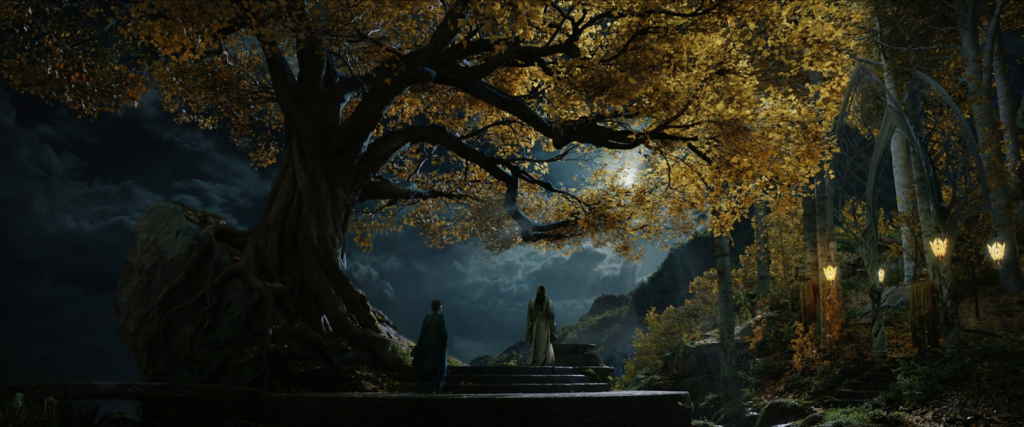
Unlike the description of the Mallorn given by Tolkien, we instead witness a dark, crudely shaped, and twisted bark of a large, and what we presume is an ancientMallorn Tree.
From stills and footage, we can construct a working hypothesis that the Noldor are experimenting with planting a Mellyrn forest in Lindon. As Gil-galad and Elrond commune among the trees at night, our eyes are drawn to the sharp contrast of the younger Mellyrn (right) and the dark, brooding, and ancient Mallorn (left). It appears that the ancient Mallorn is fading, albeit gradually. What may have begun as a silver pillar for a bark has gradually twisted unto itself; stopping the Mallorn from growing to its magnitudinous heights. Her golden leaves also appear to be much darker compared to the younger ones.
The Lindon Mallorn forest.
Further evidence for this hypothesis is the telltale presence of a Mallorn saplinginKhazad-dûm. While we cannot confirm why a sapling might be growing in the deep underground caverns of Moria, it is curious that the Elves as keepers of the Mallorn sought the Moria Dwarves as collaborators in testing the possible thriving conditions for Mellyrn.
A simpler explanation might be that the Mallorn sapling was grown from a seed gifted to the Moria Dwarves in lieu of friendship. A possible callback to Galadriel gifting Samwise Gamgee a single Mallorn nut that was consequently planted in the Shire.
Even so, the fading of the Mallorn will be an ongoing leitmotif that will marshal the Noldor into seeking and creating the Rings of Power as a means to halt the Fading of the Elves and their realms.
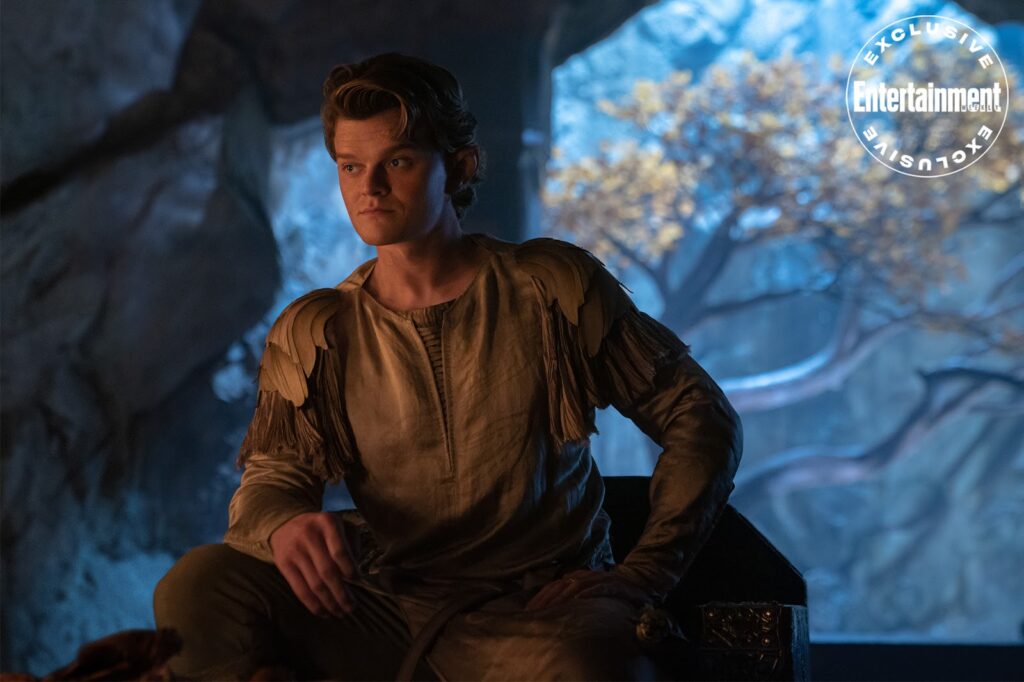
The Lord of the Rings: The Rings of PowerElrond (Robert Aramayo) is pensive during a visit to Khazad-dûm.
Extra
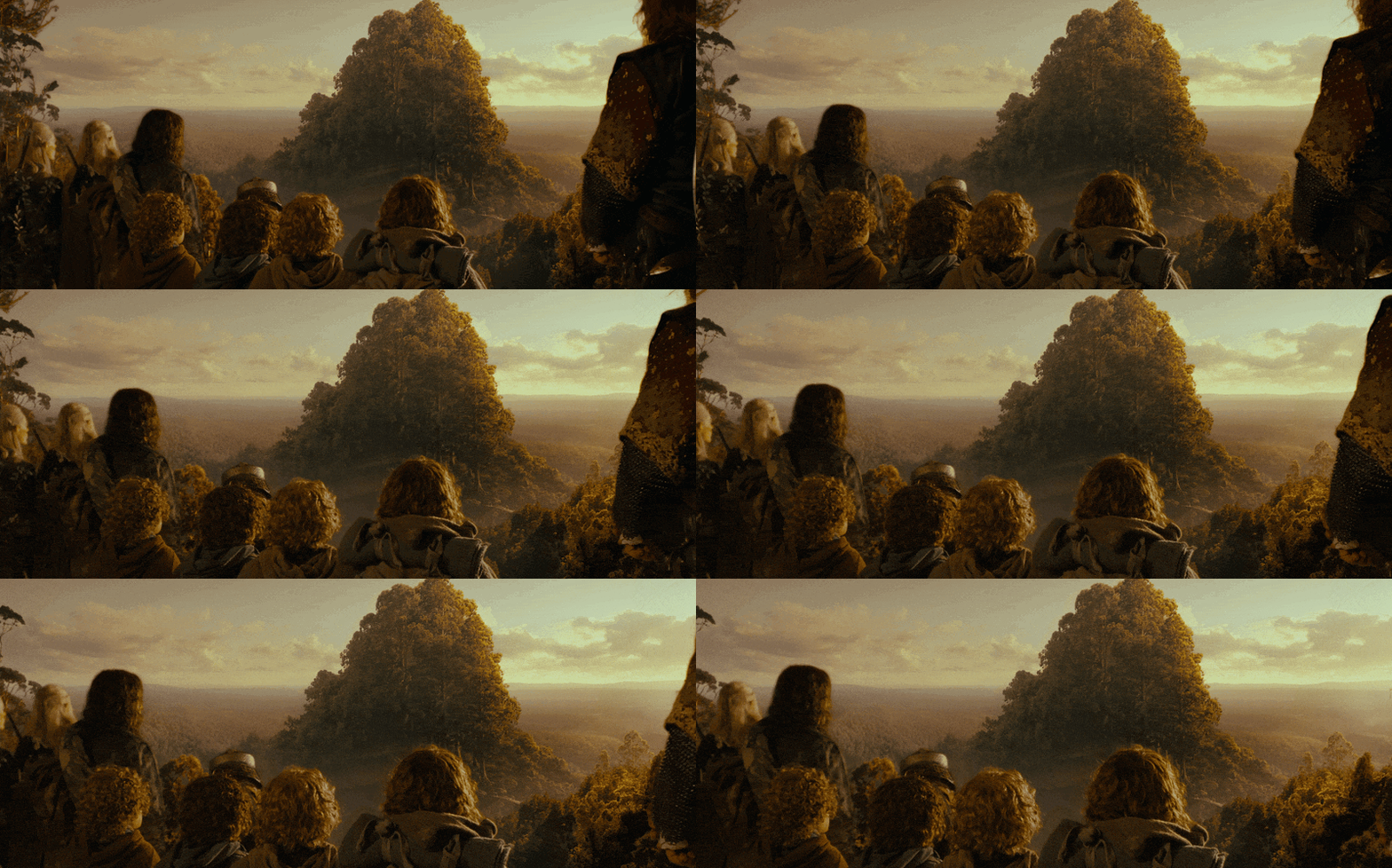
The Mallorn of Lothlórien.
Source: The Fellowship of the Ring, New Line Cinema.
About the author: DrNosy is a scientist (physical science), scholar, and Tolkien enthusiast. Her primary interests lie in review and analysis of The Lord of the Rings: The Rings of Power. She is an active contributor and Reading Room Moderator on TheOneRing.net Discord where she also hosts live open-forum panel discussions on The Rings of Power, The Silmarillion, and a variety of Tolkien-related topics. You can reach her on Twitter.
If you have a Tolkien/Middle-earth inspired poem you’d like to share, then send it to poetry@theonering.net. One poem per person may be submitted each month. Please make sure to proofread your work before sending it in. TheOneRing.net is not responsible for poems posting with spelling or grammatical errors.
Is The Rings of Power drawing inspiration from Tolkien’s incomplete Fourth Age work, The New Shadow?
Upfront: I’m a big believer in Betteridge’s law of headlines. This maxim states that: any headline that ends in a question mark can be answered by the word “no”. There’s every chance that “no” is the right answer to this lede.
Yet, the idea that Rings of Power — in its use of cults — could be cribbing ideas from Tolkien’s fragmentary Fourth Age story remains an alluring one that my mind keeps circling back to.
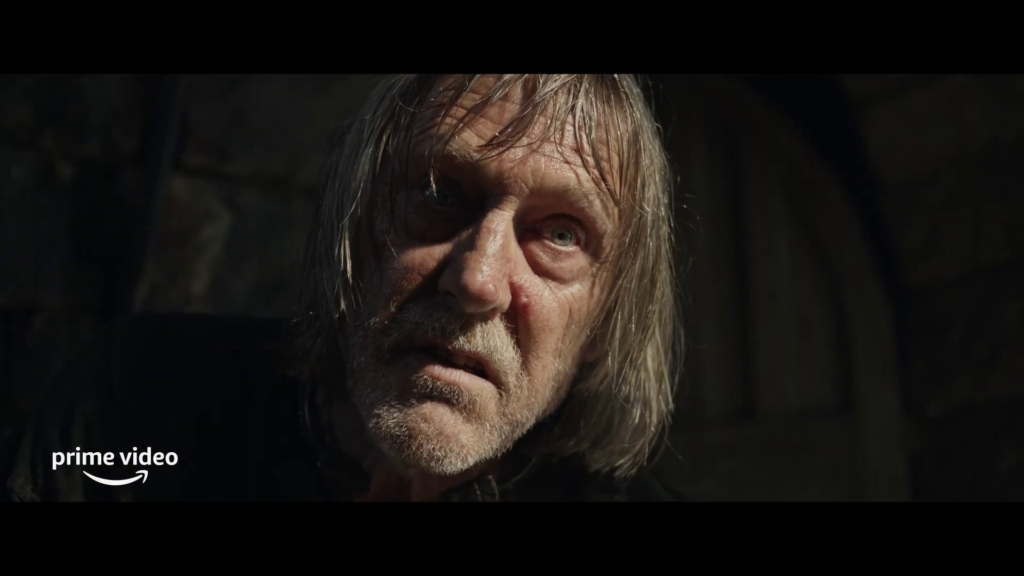
In part, it’s because of the creepy and unsettling power of that exchange between the as-yet-unidentified wild-eyed fellow and Theo in the trailer: “Have you heard of him, boy? Have you heard of Sauron?”
“Have you heard of him, boy? Have you heard of Sauron?” SDCC Season 1 trailer.
What is The New Shadow?
The New Shadow is found in the final volume of The History of Middle-earth amongst a number of essays that Chris Tolkien classified as “Late Writings”. It’s actually quite slim, totalling only 13 pages in my edition — including CJRT’s page-and-a-half introduction and footnotes.
Much of it is a slow-moving philosophical meditation as the two characters — the aging but steadfast Borlas, and the youthful, but seemingly embittered and restless, Saelon — trade barbs about the “roots of Evil”.
Then, in the final few pages this key exchange occurs:
‘You have heard then the name?’ With hardly more than breath he formed it. ‘Of Herumor?’
Borlas looked at him with amazement and fear. His mouth made tremulous motions of speech, but no sound came from it.
‘I see that you have,’ said Saelon. ‘And you seem astonished to learn that I have heard it also. But you are not more astonished than I was to see that this name has reached you. For, as I say, I have keen eyes and ears, but yours are now dim even for daily use, and the matter has been kept as secret as cunning could contrive.’
The New Shadow, The Peoples of Middle-earth
Perhaps it’s mere coincidence. Yet the similarity to the dialogue from the teaser with what Tolkien wrote is startling. There’s also a strong parallel in the visual reaction of Theo and the written one of Borlas: surprise, trepidation, fear.
Who is recruiting whom?
Is Saelon recruiting to a dark cause? Is the wild-eyed crazy fellow in the trailer doing likewise?
While we shall eventually find out the answer to the latter, we’ll never know the answer to the first question for certain.
Saelon certainly seems fishy — and his later invitation to Borlas to attend a shady, night-time rendezvous to learn more about the mysterious Herumor contains the scent of deceit.
But Tolkien never continued the story.
Within his reasons for abandoning the tale are some illuminating nuggets — nuggets that are, I think, relevant to the reasons for Númenor’s ultimate fall, and what Rings of Power may be trying to achieve with its own Sauron cult(s).
Since we are dealing with Men it is inevitable that we should be concerned with the most regrettable feature of their nature: their quick satiety with good. So that the people of Gondor in times of peace, justice and prosperity, would become discontented and restless…
[and]
I found that even so early [after the death of Aragorn] there was an outcrop of revolutionary plots, about a centre of secret Satanistic religion; while Gondorian boys were playing at being Orcs and going round doing damage.
Letter #256, Letters of J.R.R. Tolkien
Discontented and restless: when enough is still not enough
This is the very essence of the Akallabêth tale.
The Dúnedain of Númenor want for nothing, and live long lives in peace and prosperity, yet it’s not enough. They grow increasingly unsatisfied with all that they already have. Then, by gradual steps, they “fall”: transforming from helpers in Middle-earth to colonial conquerors and ultimately embarking on a doomed rebellion against the powers of Valinor in a vain quest for immortality.
Sauron’s presence merely hastens a process that was already occurring. Remember that the White Tree in Armenelos — a metaphor for the spiritual well-being of Númenor — was already in decline during the reign of Ar-Pharazôn’s grandfather.
Restless folk “playing at orcs”
One wonders if that’s exactly what we’re looking at with the trio of dissatisfied-looking folk in white robes in the trailer: “discontented and restless” folk “playing at being Orcs”. Or as Tolkien further outlines in Letter #338: “owing to the (it seems) inevitable boredom of Men with the good: there would be secret societies practising dark cults, and ‘orc-cults’ among adolescents.”
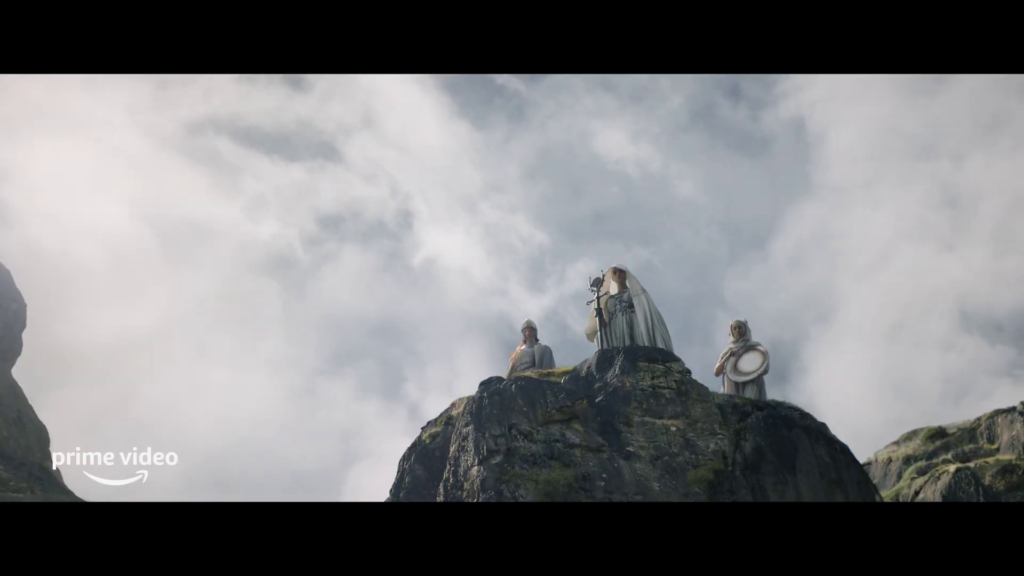
The cultists are watching. SDCC Season 1 trailer.
If it looks like a cult…
Can we even be sure these people are part of a cult?
First there’s the implication from the dialogue that, more or less, accompanies those frames: “Evil does not sleep. It waits.”
Consider how that parallels the thrust of the very opening of The New Shadow:
‘Deep indeed run the roots of Evil,’ said Borlas, ‘and the black sap is strong in them. That tree will never be slain. Let men hew it as often as they may, it will thrust up shoots again as soon as they turn aside. Not even at the Feast of Felling should the axe be hung up on the wall!’
The New Shadow, The Peoples of Middle-earth
At a surface level, visual tropes further reinforce that assessment.
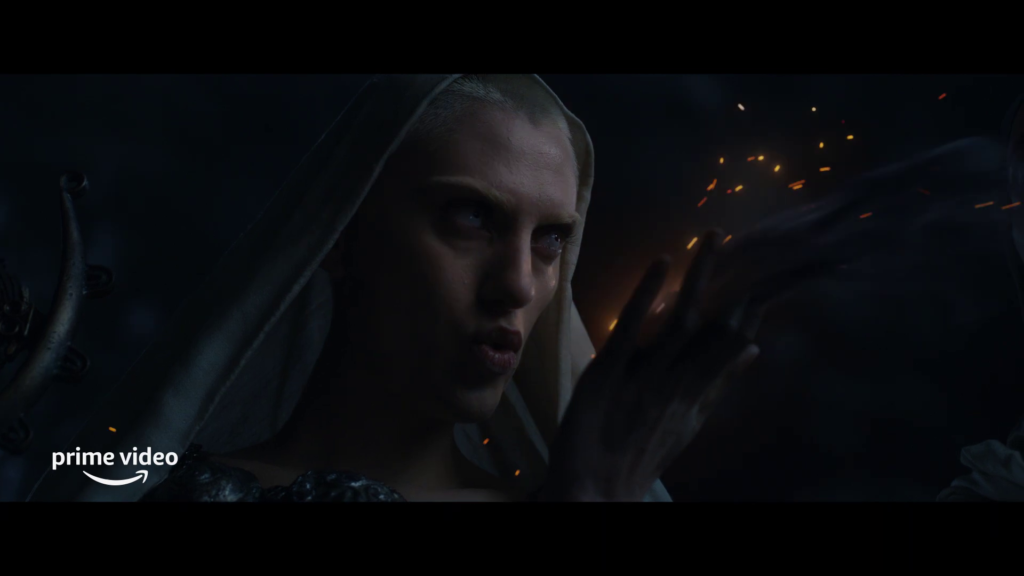
Hooded robes. Because every cult needs robes.
The staff and mirror. Every cult also needs its own hermetic symbology and gear.
Scene composition. This suggests both insularity (and groupthink), and an unobserved surveillance of events (ie: panopticon-style powers).
None of these is individually conclusive; together, they are highly suggestive.
Yet there are aspects that depart from the stereotypical visuals that we might expect from a Sauron cult.
Visual oddities: white robes
In particular, Sauron’s minions never use white. In the Lord of the Rings, the Eye is always said to be red. The hand is referred to as the black hand.
‘S is for Sauron,’ said Gimli. ‘That is easy to read.’
‘Sauron does not use the Elf-runes.’
‘Neither does he use his right name, nor permit it to be spelt or spoken,’ said Aragorn. ‘And he does not use white. The Orcs in the service of Barad-dûr use the sign of the Red Eye.’
The Departure of Boromir, the Lord of the Rings
And:
He [Mouth of Sauron] it was that now rode out, and with him came only a small company of black-harnessed soldiery, and a single banner, black but bearing on it in red the Evil Eye [my emphasis].
The Black Gate Opens, The Lord of the Rings
And, in The New Shadow, Saelon suggests that Borlas should wear black robes when he extends an invitation to join one of Herumor’s secret meetings.
One might argue that these are all post-Akallabêth developments — after Sauron loses any ability to assume a fair-hue. In fact, Unfinished Tales describes how in Lindon “Gil-galad shut out Sauron’s emissaries and even Sauron himself”, indicating that Sauron used others to further his long deception of being an emissary of the Valar sent to aid the elves.
Those others would have to appear just as innocent as their master regardless of who they were approaching.
Still, white-robed cultists are a visual contradiction to our textual knowledge. Depending on your attitude to the production, that’s either puzzling or concerning.
Visual oddities: the sigil on the staff
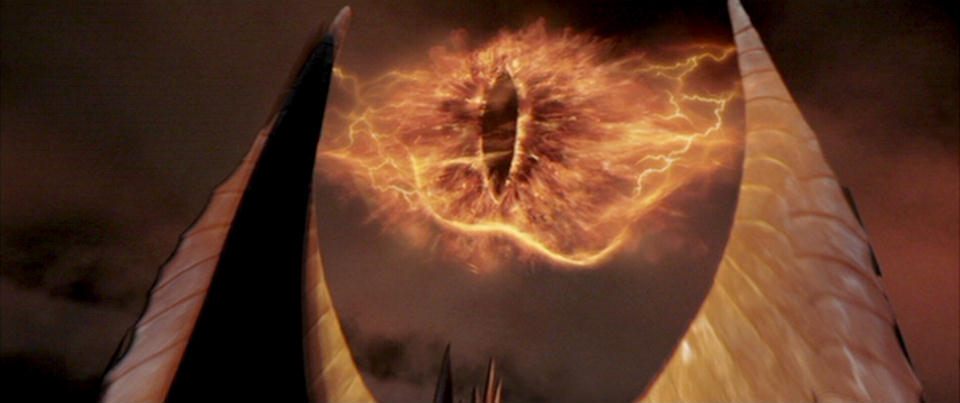
The second conundrum is the design of the staff of the apparent leader of our trio of cultists. This design seems to employ the symbolism of an eye.
Peter Jackson’s iconic Eye of Sauron atop the highest spire of Barad-dûr.
Parallels with Peter Jackson’s “The Eye of Sauron” atop the two spires of Barad-dûr are obvious.
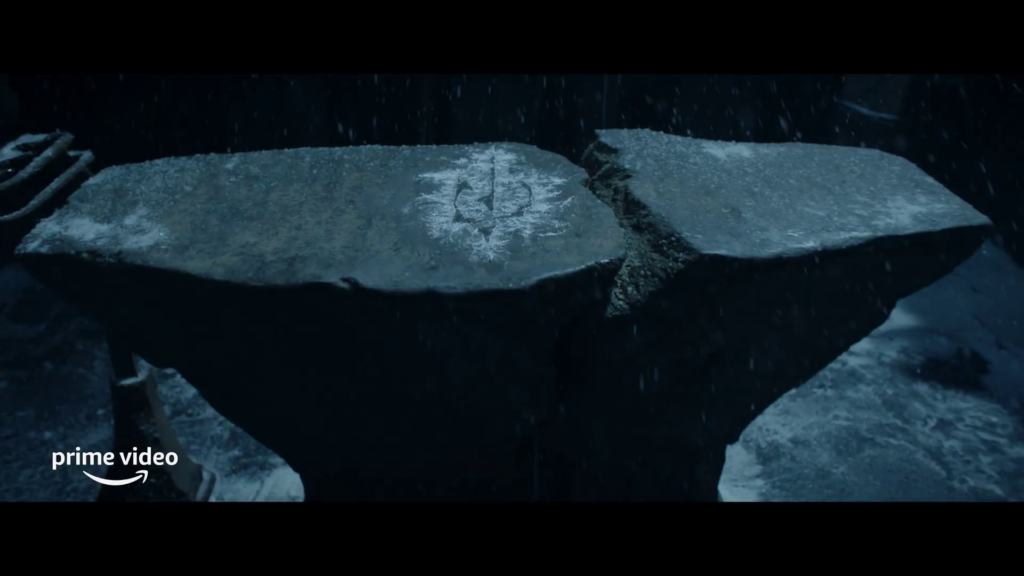
The Rings of Power series designated “Sauron rune” in a long-disused anvil. SDCC Season 1 trailer.
One could refer back to Aragorn’s statement that “neither does he use his right name, nor permit it to be spelt or spoken”. But that’s trying to have it both ways: the rune barred to his minions, but white being okay.
Right now, I can’t readily reconcile this.
Cults and “magics” in Middle-earth
Still, between our wild-eyed fellow and Theo and the various appearances of white-robed and hooded individuals, the SDCC trailer feels determined to suggest a dangerous cult with nefarious purposes and uncanny powers.
A glance through the Legendarium reveals fertile ground for cults in Middle-earth.
The very beginning of Akallabêth states:
Men came into the world in the time of the Shadow of Morgoth, and they fell swiftly under his dominion; for he sent his emissaries among them, and they listened to his evil and cunning words, and they worshipped the Darkness and yet feared it.
Akallabêth, the Silmarillion
In The Lord of the Rings, Aragorn tells how the folk of Erech refused the summons of Isildur because they had “worshipped Sauron in the Dark Years”.
And, in outlining the origins of the Mouth of Sauron, The Lord of the Rings tells us of Black Númenoreans who “established their dwellings in Middle-earth during the years of Sauron’s domination, and they worshipped him, being enamoured of evil knowledge.”
A Rings of Power cult need not even be inspired by Sauron. In a 1958 letter Tolkien wrote of the Blue Wizards, guessing that they “were founders or beginners of secret cults and ‘magic’ traditions [my emphasis] that outlasted the fall of Sauron.” Something similar could explain the white robes — although such an explanation raises equivalent problems with the “cult leader’s” staff.
Plus, some of those followers are practitioners of dark art.
Mouth of Sauron is said to have learned “great sorcery” as he gained favour. Gandalf describes the Witch King of Angmar as a “great king and sorcerer… of old”, while The Peoples of Middle-Earth briefly describes not only that Sauron enslaved the spirits of some elves to his will, but that he taught the same necromancies to his followers.
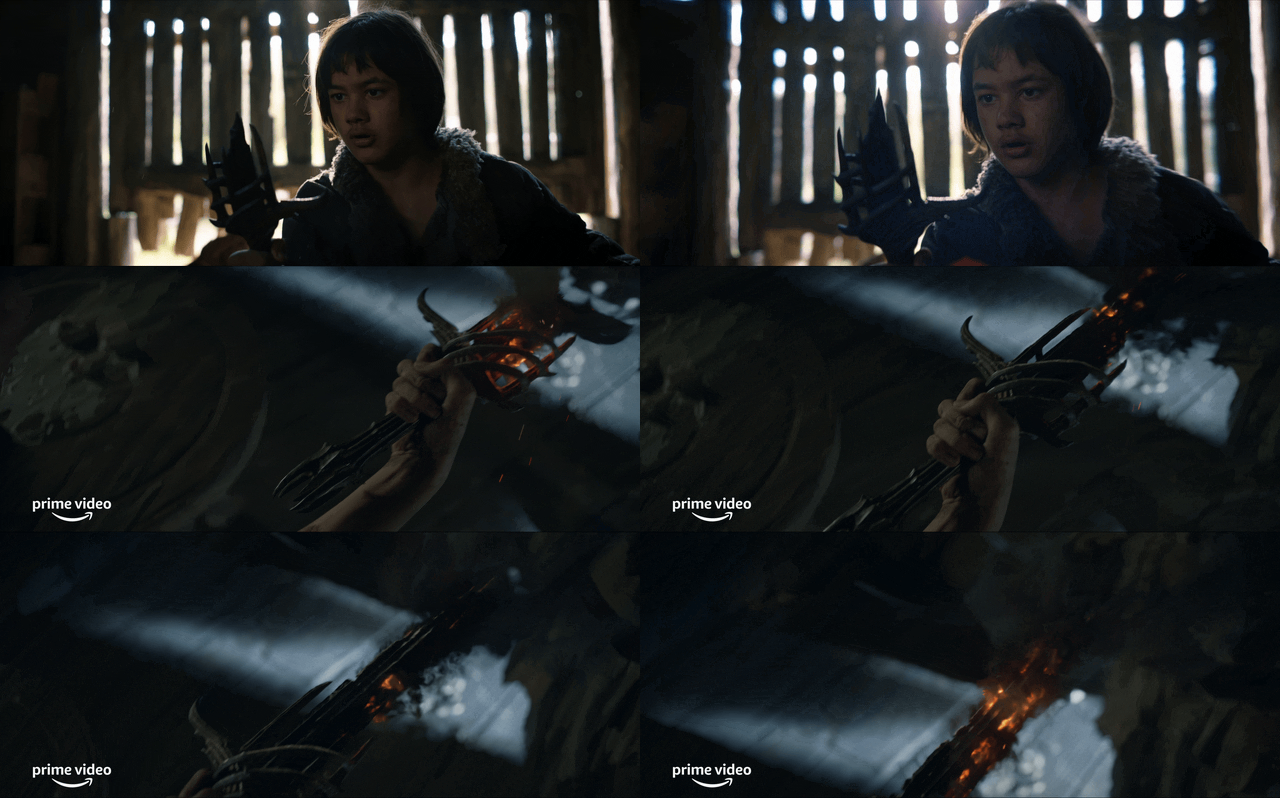
Sauron’s black hand burns like fire. What of his minions? SDCC Season 1 trailer.
Now, this might not seem much like necromancy, but also recall that Sauron’s nature is one of fire and that, until he was seduced by Morgoth, he was a student and follower of Aule.
A final parallel with The New shadow
Returning to The New Shadow, there’s one final — if slight — parallel with Rings of Power. In one of the recent interviews at San Diego Comic-con, Tyroe Muhafidin observes about his character:
“We find Theo — he’s not the most happy-going guy; he’s not living in the greatest circumstances. He’s living in what you could call the slums. So he’s a bit angsty towards the world.
He finds something in the bottom of a barn, and there’s lot of secrets to it – and he’s dying to find out [them].”
Now, that’s not a life of prosperity. Theo is not driven by “boredom of Men with the good”.
But it does sound as though there’s a chip on Theo’s shoulder — and that’s something that is characteristic of Tolkien’s Saelon — embittered as he remains over being accused by Borlas of “Orcs’ work” after stealing fruit as a young child.
That may prove fertile ground for the creepy old guy in the trailer. Theo might not have previously been attracted, as Tolkien describes it in The New Shadow, to “tales of the Orcs and their doings”.
“I had not been interested till then. You turned my mind to them.”
BOOTNOTE
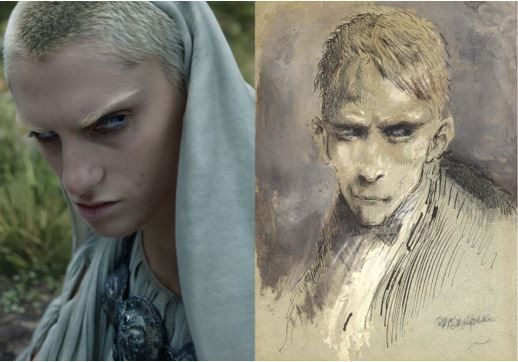
There is one other comparison with these cultists that I simply cannot overlook. But it’s not a Tolkien-based one — it’s one with Mervyn Peake, the famed author of the gothic masterwork, Gormenghast.
One of Mervyn Peake’s Steerpike sketches alongside a certain brodding Rings of Power cultist.
Peake was also an impressively talented sketch artist, and a friend pointed out that one of Peake’s sketches of his arch-villain Steerpike bears an uncanny resemblance to a certain cultist. Now, having seen it, I can’t get it out of my head.
Acknowledgements: Many thanks to all the Discord Reading Room mods for their feedback on this piece and especially DrNosy for the structural critique. GIF courtesy of the ever-talented WheatBix.
About the author:Staffer Demosthenes has been involved with TheOneRing.net since 2001, serving first as an Associate News Editor, then as Chief News Editor during the making of the Hobbit films. Now he focuses on features and analysis. The opinions in this article are his own and do not necessarily represent those of TheOneRing.net and other staff.
If you have a Tolkien/Middle-earth inspired poem you’d like to share, then send it to poetry@theonering.net. One poem per person may be submitted each month. Please make sure to proofread your work before sending it in. TheOneRing.net is not responsible for poems posting with spelling or grammatical errors.
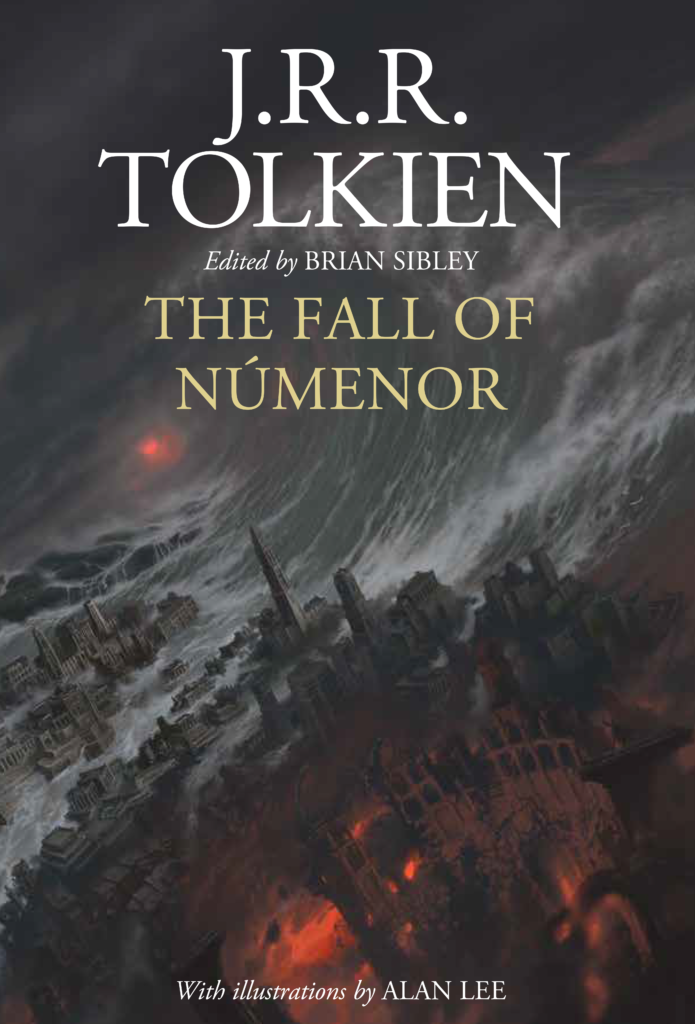
In response to a question on twitter, editor Brian Sibley has given a few more details about the contents of The Downfall of Númenor.
Sibley says the book will draw on Akallabêth and Of the Rings of Power (from The Silmarillion) plus material from The Peoples of Middle-earth (HOME Vol XII), Sauron Defeated (HOME Vol IX), The Lost Road and other Writings (HOME V), The Nature of Middle-earth, Letters of J.R.R. Tolkien, and The Lord of the Rings.
He makes no mention of new, previously unpublished material.
Previous promotional blurb has described that “J.R.R. Tolkien’s The Fall of Fall of Númenor collects all of Tolkien’s Second Age writings together, following the chronology of The Tale of Years.”
It also includes ten new color paintings by Alan Lee. The book is out in November.
The newly released teaser trailer for Prime Video’s The Lord of the Rings: The Rings of Power dropped on July 14 and sent ripples of excitement throughout Tolkien fandom, including through the ranks of TORn staff. Here below is a presentation of spur of the moment reactions; there will be another post soon that delves deep into some of the lore being presented in this teaser trailer.
But first, if this two and a half minutes is a ‘Teaser Trailer’ in Amazon’s estimation, we can’t wait to see what they consider a full Trailer! Check out our post from Thursday morning about the teaser trailer; and not to be lost in all the flash and bang from the teaser trailer, take a moment to read the official Amazon Press Release at the bottom of the post, and note that when the show debuts on September 2, it will be an 8-part series. It’s still not clear if the episodes will drop all at once or one episode a week. Hopefully we’ll find out that answer during Amazon’s panel at San Diego Comic-con next week, so keep an eye out for our reports from the panel and exhibit hall floor throughout the week.
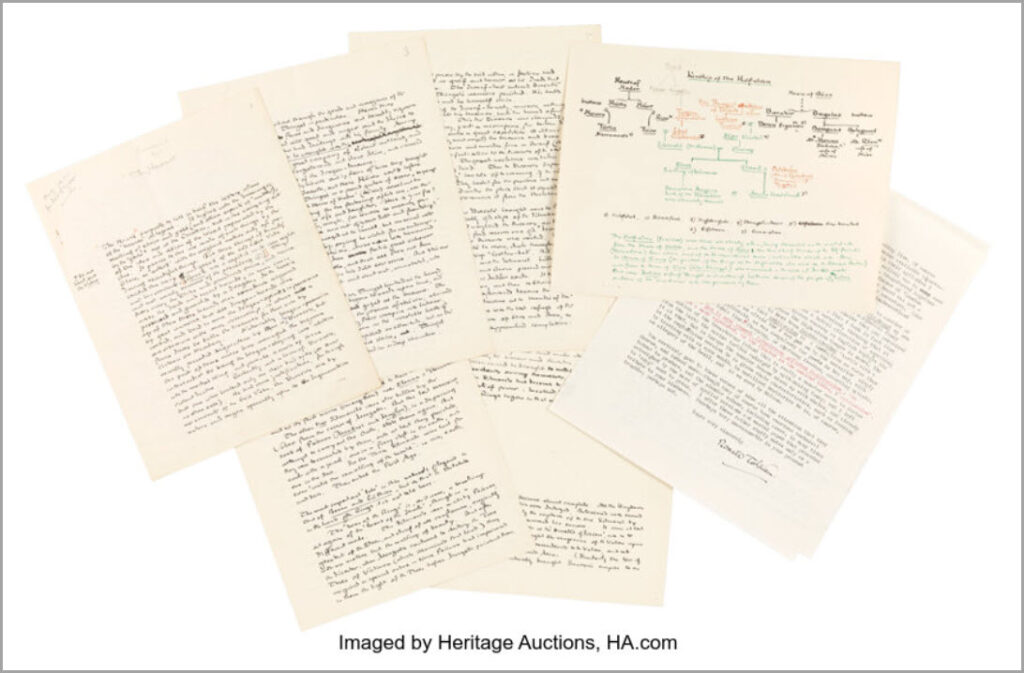
It’s the discovery of a lifetime: a handwritten manuscript by JRR Tolkien, penned and signed in 1964, has surfaced. This nine-page text, which Christopher Tolkien painstakingly recreated from memory, tells a mostly familiar story for readers of The Silmarillion in chapter 22. Yet, as the ‘original’ manuscript for this part of the story, it contains new treasures to delight the serious Tolkien reader.
First Report
The Italian Tolkien Society’s group Associazione Italiana Studi Tolkieniani broke the news yesterday in this phenomenal write-up: Il Silmarillion, scoperto un manoscritto inedito Bring your Italian for this one! I sure wish I had mine…
Opening Bid: 15 Large via Heritage Auctions
This treasure goes under the auction gavel in two weeks with a starting bid of $15,000! Looking over the offerings for this lot is impressive, as The Professor keeps company with the likes of Poe, Dickens, Doyel, Washington, Jefferson, Einstein, Beethoven, and some other incredible artifacts and memorabilia. The manuscript includes a rare genealogy chart titled “Kinship of the Half-Elven,” a signed letter to Mrs. Eileen Elgar in transmission of the manuscript, and “Concerning… The Hoard,” the manuscript itself.
Check out the auction lot here at Heritage Auctions, and be prepared for beauty.
Courtesy of Heritage Auctions
Here’s to hoping this find becomes available for scholarly study far and wide! A special, “Thag you berry buch!” to Lasswen and DrNosy for bringing the news to our Discord chat this morning.
For those within easy travelling distance of Bradford in the UK, this weekend is going to be a good one! Bradford Literature Festival is happening; and there are several talks related to JRR Tolkien.
Tolkien taught at Leeds University from 1920 to 1925, before his teaching career at Oxford began. It was during his years at Leeds that he wrote A Middle English Vocabulary and his definitive edition of Sir Gawain and the Green Knight (with E. V. Gordon). Like many other areas of England’s ‘green and pleasant land’, there are stunning landscapes across West Yorkshire which lay claim to be (at least partly) inspiration for the Shire.
What was Tolkien’s intended ending for The Lord of the Rings? What was the audience’s response to the first ever adaptation of The Lord of the Rings – a radio dramatisation that has now been deleted forever from the BBC’s archives? The University of Oxford’s Grace Khuri will be joined by Tolkien Archivist Catherine McIlwaine and biographer John Garth to explore J.R.R. Tolkien’s mammoth legacy and his son’s tireless work in sharing it with the world.
Catherine McIlwaine, John Garth, Grace Khuri: Tolkien: The Great Tales Never End (Saturday 25th June at 10.30am). More information and tickets available here
From Norse mythology and Christian faith to his fellow fantasy writers and the very real battlegrounds of World War I, join us as we explore the varied and unlikely inspirations that shaped J.R.R. Tolkien’s much-loved fantasy worlds – including Catherine J. Blatt, John Garth, and Alaric Hall.
Catherine Batt, Alaric Hall and John Garth: Where Did Tolkien Find His Inspiration? (Saturday 25th June at 11.45am). More information and tickets available here
Author of The Worlds of J.R.R. Tolkien, John Garth will take audience on a journey through the places that inspired the Shire, Rivendell, Helms Deep and Mordor and will discuss how the West Midlands and Oxford, alongside Yorkshire, played their part in the creations.
John Garth on The Worlds of JRR Tolkien: The Places that Inspired Middle-Earth (Sunday 26th June at 11.45am). More information and tickets available here
Tolkien has inspired many writers across all genres to follow in his footsteps. Samantha Shannon, Courttia Newland and David Barnett will discuss Tolkien’s vast impact within literature, and how his writing has influenced them personally as writers.
Samantha Shannon, Courttia Newland and David Barnett: Inspired By Tolkien (Sunday 26th June at 4pm). More information and tickets available here