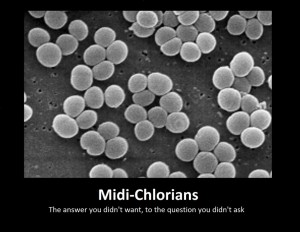
…The boy nodded his understanding. “Can I ask you something?” The Jedi Master nodded. “What are midi-chlorians?” Wind whipped at Qui-Gon’s long hair, blowing strands of it across his strong face. “Midi-chlorians are microscopic life-forms that reside within the cells of all living things and communicate with the Force.”…
…”Use the Force, Luke.”…
…Raistlin lifted his thin, frail hand and allowed the spell component he had taken from his pouch to fall slowly from between his fingers onto the deck of the boat. Sand, Tanis realized. “Ast tasarak sinuralan krynawi,” Raistlin murmured, and then moved his right hand slowly in an arc parallel to the shore….
…”The One Power,” Moiraine was saying, “comes from the True Source, the driving force of Creation, the force the Creator made to turn the Wheel of Time.”…
Bibbidi, bobbidi, boo.
There seem to be almost as many ways of representing magic as there are fantasy writers. Role-players know the whole system with mages, spell components, spellbooks, the language of magic, etc. Jordan fans can tell you the ins and outs of the One Power, complete with a discourse on the varying characteristics of saidar and saidin, and the innumerable levels of strength among Aes Sedai. And Star Wars geeks (a word I use with love, considering that I myself am a dyed-in-the-wool geek!) were stunned when Lucas started explaining the universe-balancing Force with microscopic middlemen, instead of with the innate power of Luke Skywalker and Darth Vader. What ties them in common is that they each have a system, a framework with rules and laws almost more complicated than those of physics. Mages lose their spells after one casting, and must rest and recommit the words to memory before casting again. Aes Sedai spend years in training, because abuse of the One Power can too easily lead to death… and evidently you’ve got to be well-stocked on single-celled symbionts (is that even a word? My spellchecker sure doesn’t like it) to even make a dent in the Force. Fantasy writers delight in coming up with their own, hopefully brand-new systems, to give their books that added twist, that spark that no other sword-swinging Elf-hopping kender-singing dragon-flying books have. But what about Tolkien? Where is the system? What are the rules which govern the making of Rings of Power, which delineate the powers and limits of Istari, of Maiar, of Valar? He never talks about a framework or physical laws; we only see the results of the power’s use. Where does the power come from?
If you have a Tolkien/Middle-earth inspired poem you’d like to share, then send it to poetry@theonering.net. One poem per person may be submitted each month. Please make sure to proofread your work before sending it in. TheOneRing.net is not responsible for poems posting with spelling or grammatical errors.
Arrived Thursday for the start of Phoenix Comicon, and the first thought is the heat in Phoenix in May, can’t even imagine what it would be like in July and so glad San Diego is next to water. That being said, there were cosplayers galore regardless of the heat.
Tonight will be ‘The Desolation of Smaug: Sneak Peek’ panel from TheOneRing.net in room 122ABC, join us if you are attending comicon. And if you are not going to be able to make the panel, or even make the convention, there is going to be an AZ Ringer Moot on Sunday evening after the end of the convention at the Greenhouse Grill on Adams street right across the street from the convention center and the Hyatt hotel. We will be gathering at 7pm on Sunday night and talking Tolkien and Middle-earth and The Hobbit and whatever else strikes your fancy (for this reporter, that may well be the Los Angeles Kings in the Stanley Cup Playoffs). The restaurant closes at 9pm, but if there are enough Mooters, we can always take the party over to one of the hotel bars. If you wish to attend on Sunday evening, please email me at Garfeimao@TheOneRing.net so I can give the restaurant an approximate attendance by Sunday morning.
Few Numenorean heroes have a more remarkable history – or a more ambiguous persona.
He was capable of great deeds – at great cost to himself he saved the seed of the White Tree from under the nose of Sauron and bore it to Middle Earth.
Sauron hated him above all other men and elves, and even after Isildur was long dead, poured all his malice and hatred into the destruction and corruption of Minas Ithil – Isildur’s city. Continue reading “Isildur: shaper of the Third Age?”
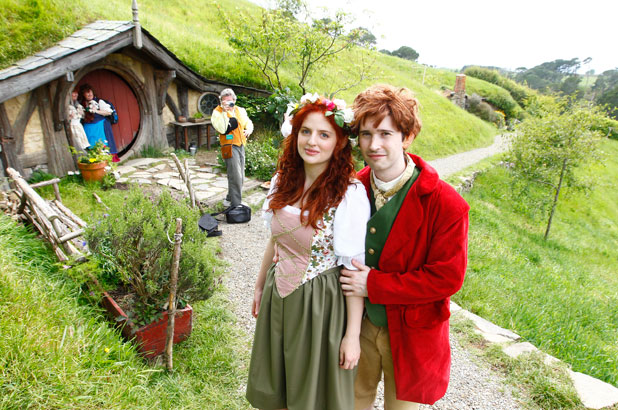
Red Carpet’s Premiere Tour group dressed up for their Hobbiton visit
Red Carpet is steadily adding new locations into its tours in the light of the new Hobbit movie, says director Vic James.
“We’re pretty excited because since the Unexpected Journey came out, we’ve been able to add new sites and new people,” James says. “We visit landowners and check out new locations on a regular basis, as information and invitations come to hand.
“The Premiere Tour last November was the first to visit some of the new places and when the time is right for further landowners to allow visits, we will add them in.”
The north island leg of the tour includes, as before, Hobbiton and the central volcanic plateau that served as Mt Doom. A new feature are some rapids where the dwarves’ more hair-raising barrel-riding scenes were filmed.
The ‘top’ of the South Island is a beautiful addition to the tour, James says. Nelson, with its sunny bay ringed by mountains, is reached by a ferry cruise through the beautiful fjords of Marlborough Sounds. There’s a stop along the way at Pelorus Bridge, scene of Bilbo and the dwarves’ barrel-riding adventures.
Red Carpet’s LOTR tours always include visits to extras, artisans, actors and crew members for the films. Halfdan Hansen, son of the real-life Ringmaker for LOTR, has his studio in Nelson and has created a new version of the Ring, invisibly weighted with some denser metal so that it lies strangely heavy on the palm of the hand.
In Nelson there is also the option to take a two-and-a-half hour helicopter flight to Dimrill Dale and South of Rivendell. The flights have been a huge success with tour guests.
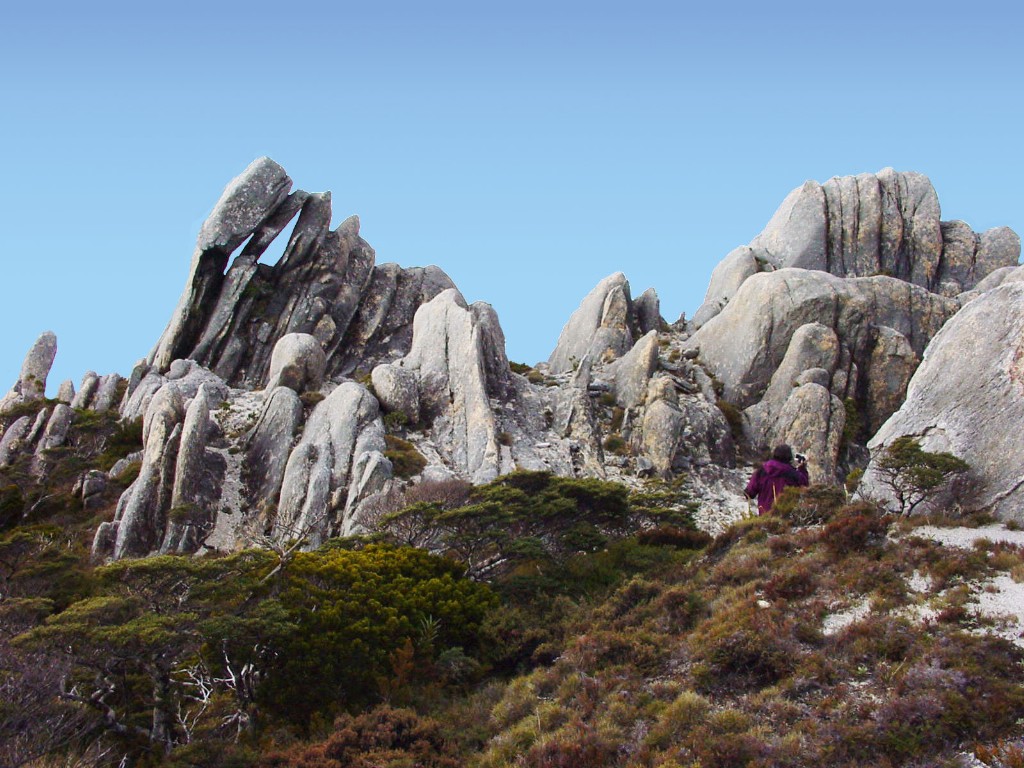
Olympus Rocks – a place to hide from the spies of Saruman
To accommodate the extra locations, tours are now 14 days duration. People can also choose to join the North Island 6 day or the South Island 10 day options. “It’s a long way to come to not see it all,” James says.
As we all know, J R R Tolkien was, from an early age, fascinated by myth and heroic legend, reading all he could of the romances and epics of many nations. In a letter to Milton Waldman, which appears in the Preface to the second edition of The Silmarillion, he wrote that he was ‘grieved by the poverty of my own beloved country: it had no stories of its own … Of course there was and is all the Arthurian world, but powerful as it is, it is imperfectly naturalized, associated with the soil of Britain but not with the English; and does not replace what I felt to be missing…’
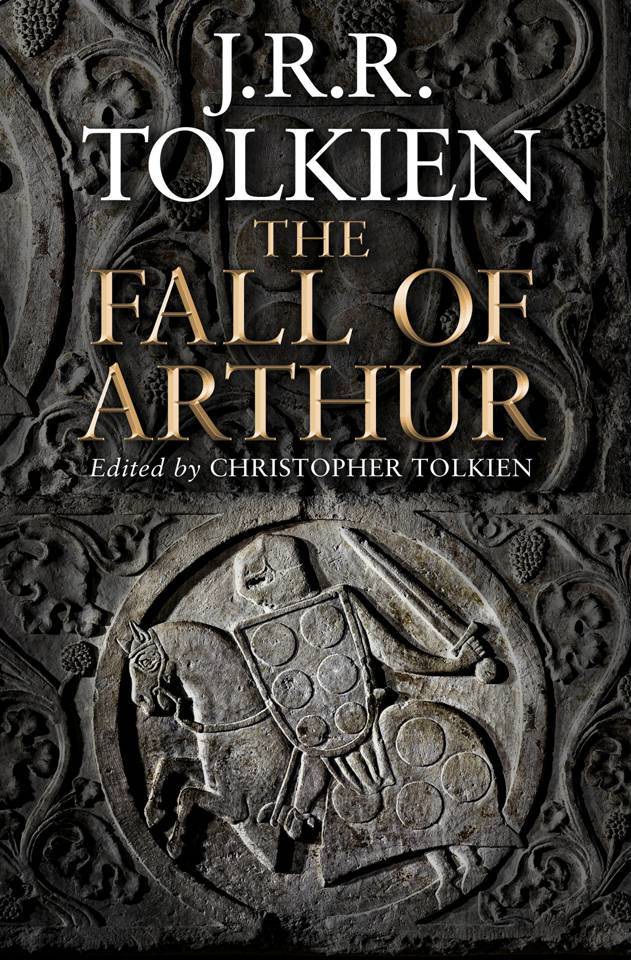
The Professor, then, had little time for the legends of King Arthur; but he did make one foray into those tales, and we are about to be able to read for ourselves the results of those labours! Tomorrow, publishers Houghton Mifflin Harcourt release Tolkien’s narrative poem The Fall of Arthur, edited as ever by his son Christopher. HMH’s press release tells us:
‘The Fall of Arthur, the only venture by J.R.R. Tolkien into the legends of Arthur, king of Britain, may well be regarded as his finest and most skillful achievement in the use of Old English alliterative meter, in which he brought to his transforming perceptions of the old narratives a pervasive sense of the grave and fateful nature of all that is told: of Arthur’s expedition overseas into distant heathen lands, of Guinevere’s flight from Camelot, of the great sea battle on Arthur’s return to Britain, in the portrait of the traitor Mordred, in the tormented doubts of Lancelot in his French castle.’
Alas, Tolkien never finished his poem; but amongst his manuscripts were sketches and drafts, which included ‘significant tantalizing notes. In these notes can be discerned clear if mysterious associations of the Arthurian conclusion with The Silmarillion, and the bitter ending of the love of Lancelot and Guinevere, which was never written.’
It’s a day of celebration for Tolkien fans whenever we have a chance to read more of the Professor’s work, and gain further insight into the explorations which lead to his great myth of Middle-earth. You can read Houghton Mifflin Harcourt’s full information about the book here; and you can order your copy from Amazon by clicking here. The Fall of Arthur will also be available as an e-book. Happy reading!
In his second of many articles for our worldwide community, Tedoras, long-time audience participant on our TORn TUESDAY webcast brings us a fascinating idea: a lost connection to the Beacons of Gondor perhaps… Read on for a short but very interesting look at how an ancient Biblical account may have inspired Tolkien! Take it away, Tedoras….
————————————————————————————-
The (Biblical) Beacons of Gondor
By Tedoras — special to TheOneRing.net
This past April 28th happened to be the Jewish holiday of Lag B’Omer (the 33rd day of the Counting of the Sheaves, to be more precise). Now, you are probably wondering how this little-known holiday relates to The Lord of the Rings(and, if you’re like me, you’d like to know what a “sheaf” is, too). It turns out a sheaf is a bundle for cereal plants—fortunately for us all, though, my story has nothing to do with Biblical agriculture. Rather, it begins with The Return of the King.
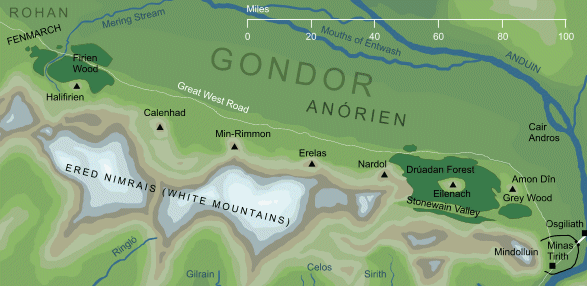
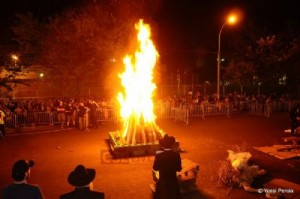
If you are like me, you love those amazing fly-by shots from The Lord of the Ringsfilms. One of the most epic sequences of such shots is the lighting of the beacons in ROTK(refresh your memory here). Whether your first encounter with these mountaintop fires was in literature or film, you probably thought it was an ingenious mode of communication. Certainly, they are by far the best means for sending urgent messages across long distances (and I hope the Gondorian who urged their construction was handsomely rewarded). In order to see the connection between these beacons and the aforementioned holiday, it is important to know the story of Lag B’Omer.
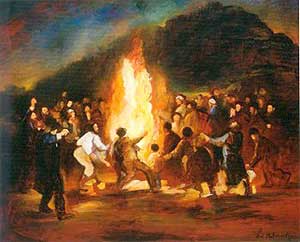
In short, Lag B’Omer commemorates a revolt in the year 131 CE. The Israelites, under the leadership of Bar Kochba, rose up against the Romans, who ruled the land at that time. Years before the Romans came, the Israelites had built a series of m’durot, or bonfires, upon the surrounding mountains. So, when the revolt began, (you guessed it) Bar Kochba ordered a beacon lit. A soldier took a torch to the top of a mountain, lit one the beacons, and thus sent word around the land that war had begun.
Certainly, the use of the beacons of Gondor to call for Rohan’s aid is reminiscent of this episode. Yet, was Tolkien inspired by this Biblical tale in his creation of the beacons? On the one hand, we know Tolkien was well-versed in the Bible; his contemporaneous English education saw to that. Furthermore, Tolkien was a lifelong scholar—thus, if not in school, it is likely he would have encountered this story on his own. Assuming Tolkien was acquainted with this tale, the unanswerable question here, of course, is whether or not he consciously recognized the Bible as their source.
However, on the other hand, a case can certainly be made that Tolkien knew not of the story of Bar Kochba’s revolt. For a realm the size of Gondor, it would make sense to have a system for mass-communication in the event of any important occurrence. And, while these beacons also housed fresh horses on stand-by for couriers, it is clear that signal fires would be a much faster means. The independent invention of the beacons is not only possible in terms of the technology available to Gondor at the time, but it is also becoming of the prudence and wisdom of the Gondorian kings of Old.
This is one of many familiar situations to us Tolkien fans: is there a “right” answer here? Personally, I do not think it really matters; I intended only to present a surprising and uncanny resemblance upon which I happened to stumble. But, of course, such a topic is up for interpretation—so I will let you decide for yourself.




 Few Numenorean heroes have a more remarkable history – or a more ambiguous persona.