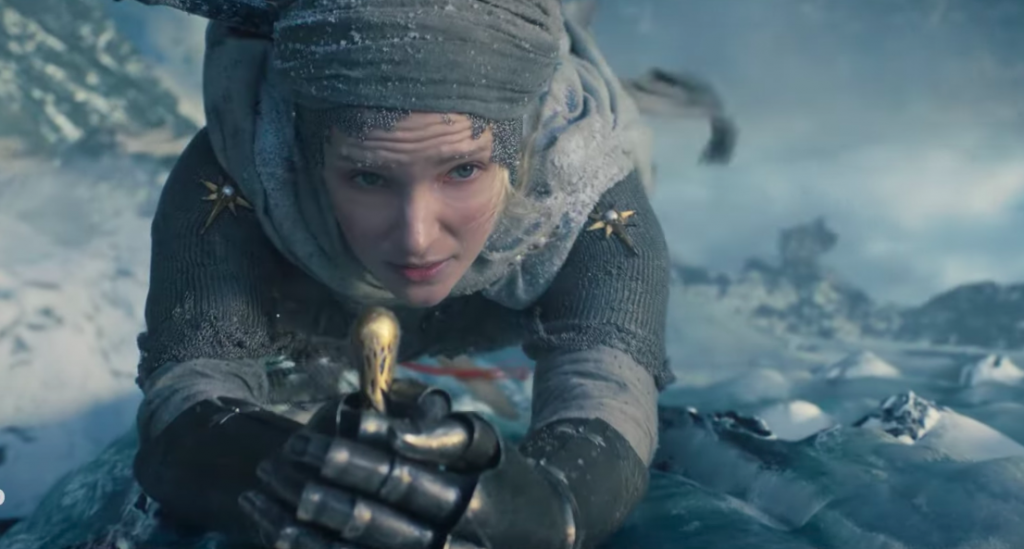
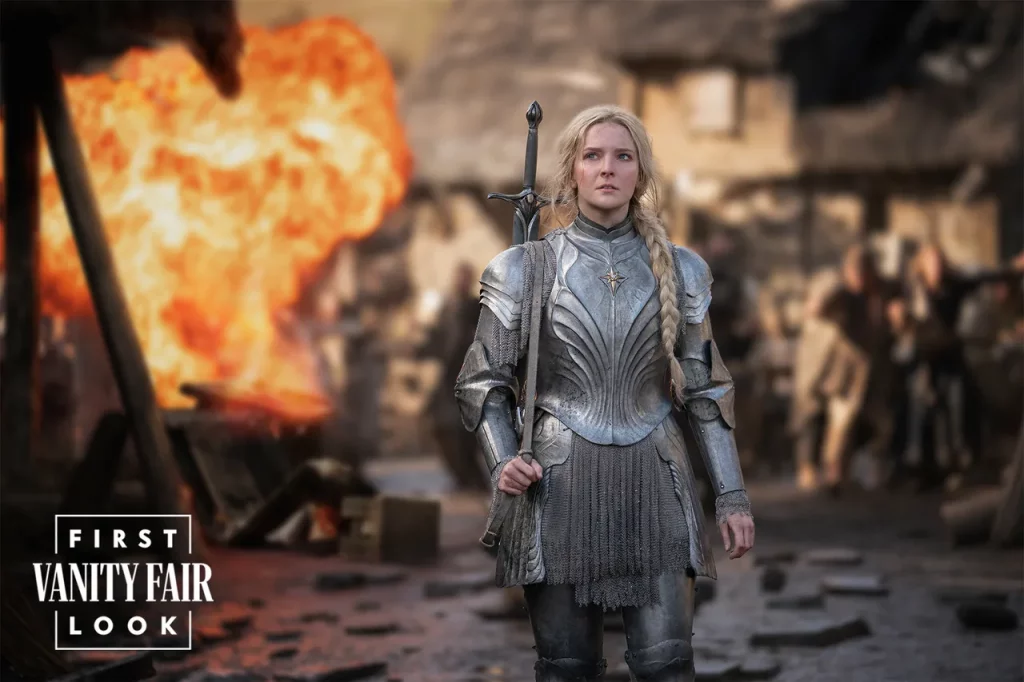
You’ve probably noted that in the various promo imagery we’ve seen, Galadriel bears a star-shaped emblem. It’s most prominent on her breastplate, but in the teaser trailer we also see the device used as shoulder pins.
The device that Galadriel bears upon her plate armour (left), and on either shoulders in the teaser trailer.
Is it some sort of heraldic device? If so, is it meant to be a personal device? Is it one for elves in general? Specifically for Noldorin elves? Or a particular branch of Noldor?
Let’s examine.
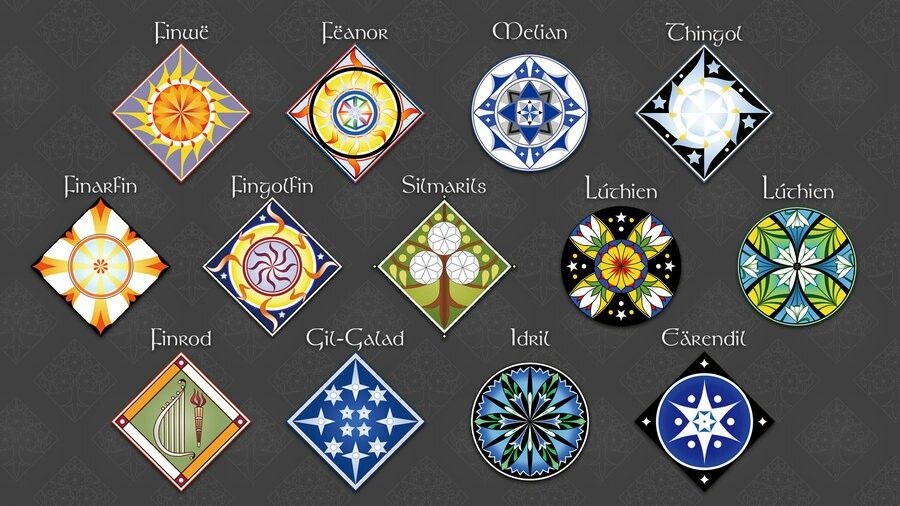
As I noted in my analysis of the Rings of Power Sun Sword poster, Tolkien developed a codified system of heraldic devices — examples of which can be found on the covers of the first UK edition of the Silmarillion. Many key characters involved in events of the First Age have their own associated device that they — and those of their house — employed.
Galadriel is not among those, though. We have no Galadriel device for direct comparison. Instead we must look at those of her near — and far — relatives.
Finarfin’s eight-rayed lozenge-shaped device (see above middle-left) offers a lot of similarity. However, the rays do not taper in the same way as the devices Galadriel bears in The Rings of Power material. That being said, there is an intriguing note that “this device was also used by Finarfin’s heirs, and apparently especially Finrod (though he was also given another device).”
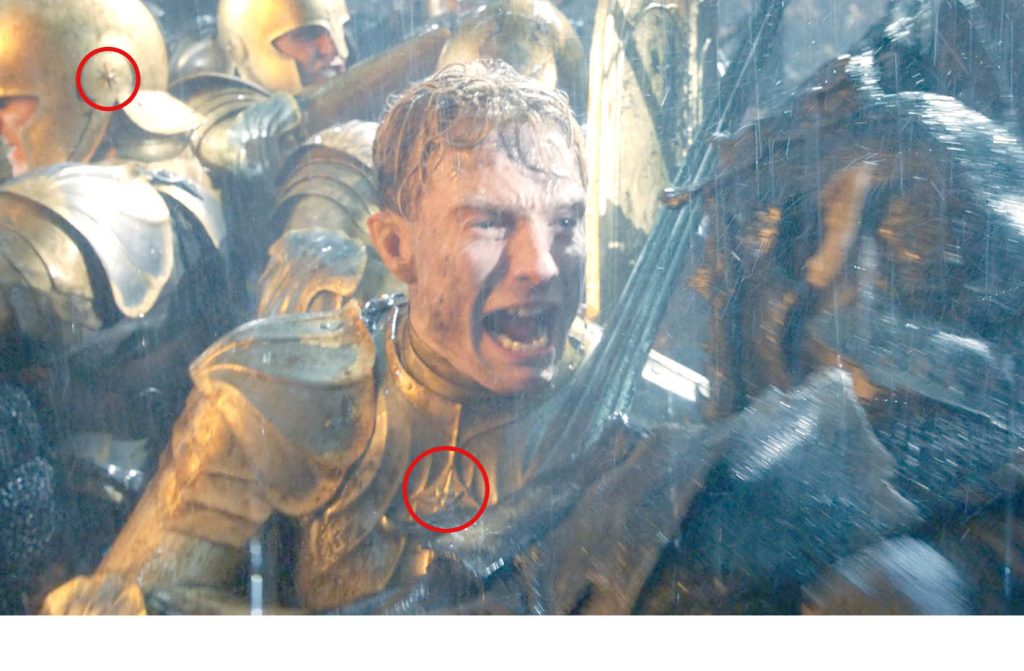
This becomes more curious since in The Rings of Power teaser trailer we see Finrod wearing the exact same device as Galadriel in a scene where he and other elves battle desperately against a host of orcs. Could this device be a House of Finarfin thing?
Well, we also see in the same scene that some of Finrod’s equally embattled retinue sport the self-same device. Now, one might observe that folk of Finrod’s own house might bear the same device. Absolutely, they might.
Both Finrod and his embattled retinue bear the same sigil on their armour in the flash scene we see near the end of the first teaser trailer. I’ve brightened this screenshot to make the sigils more visible.
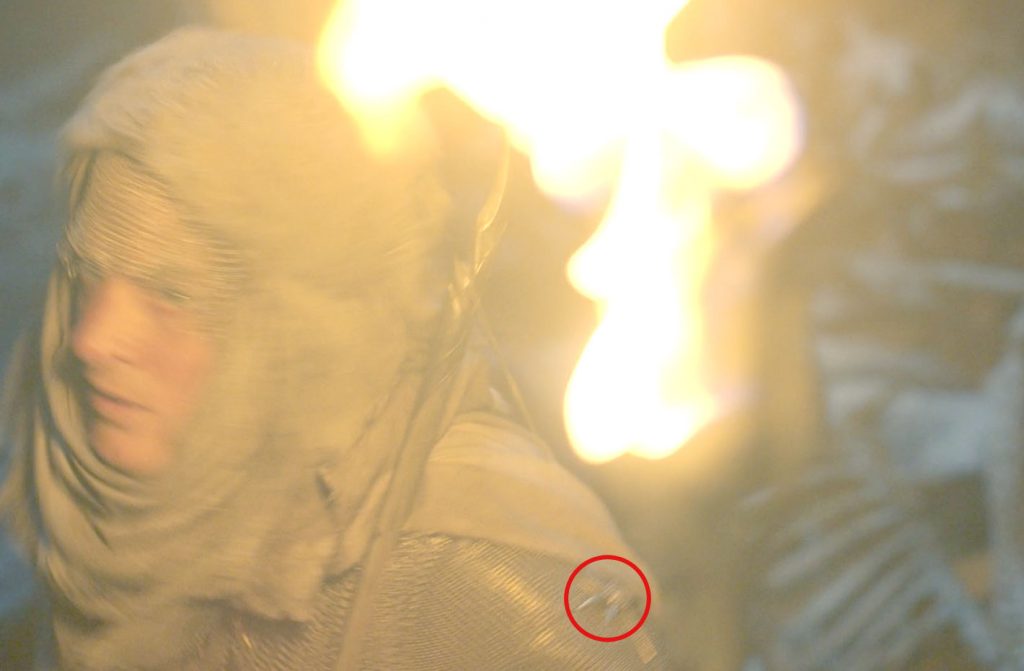
The same device is also present on the shoulder of the as-yet-unidentified fellow caught up in an unfortunate encounter with some kind of troll in the Amazon teaser trailer. Is that another member of Finarfin’s house? Could it be Angrod, or Aegnor? As yet, we don’t know for sure.
This unknown person — clad in a similar maille outfit as Galadriel in the teaser trailer — bears the same symbol pinned on the shoulder in the exact same position. Again, this image is slightly brightened for better visibility although it’s tricky to get a crisp focus.
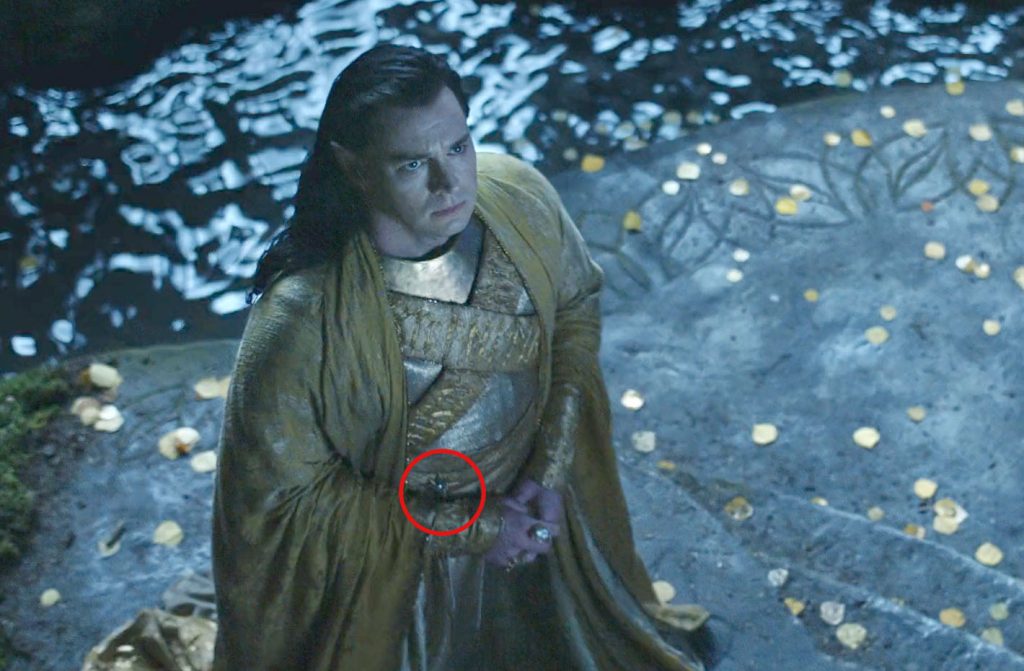
One also observes the exact same device on the waist of the attire of an individual dressed in gold on one of the The Rings of Power teaser posters and in the teaser trailer. We believe this individual to be Gil-galad.
Now, Gil-galad is not of Finarfin’s house; he wouldn’t wear Finarfin’s device. In fact, Tolkien gives Gil-galad his very own device — one of white stars set on a blue field (or sky). This seems to be a strong argument against any conclusion that it’s Finarfin’s device. It seems we must search elsewhere for better answers.
UPDATE: please check the bootnote at the end for an addendum on Gil-galad’s parentage.
Gil-galad bears the exact same symbol at the waist of his attire in both teaser poster, and teaser trailer.
Arguably, Eärendil’s sign might be something they could all unite under — if it matched. The Silmarillion recounts how he become a symbol of hope for all:
Now when first Vingilot was set to sail in the seas of heaven, it rose unlocked for, glittering and bright; and the people of Middle-earth beheld it from afar and wondered, and they took it for a sign, and called it Gil-Estel, the Star of High Hope. And when this new star was seen at evening, Maedhros spoke to Maglor his brother, and he said: ‘Surely that is a Silmaril that shines now in the West?’
Of the Voyage of Eärendil and the War of Wrath, The Silmarillion
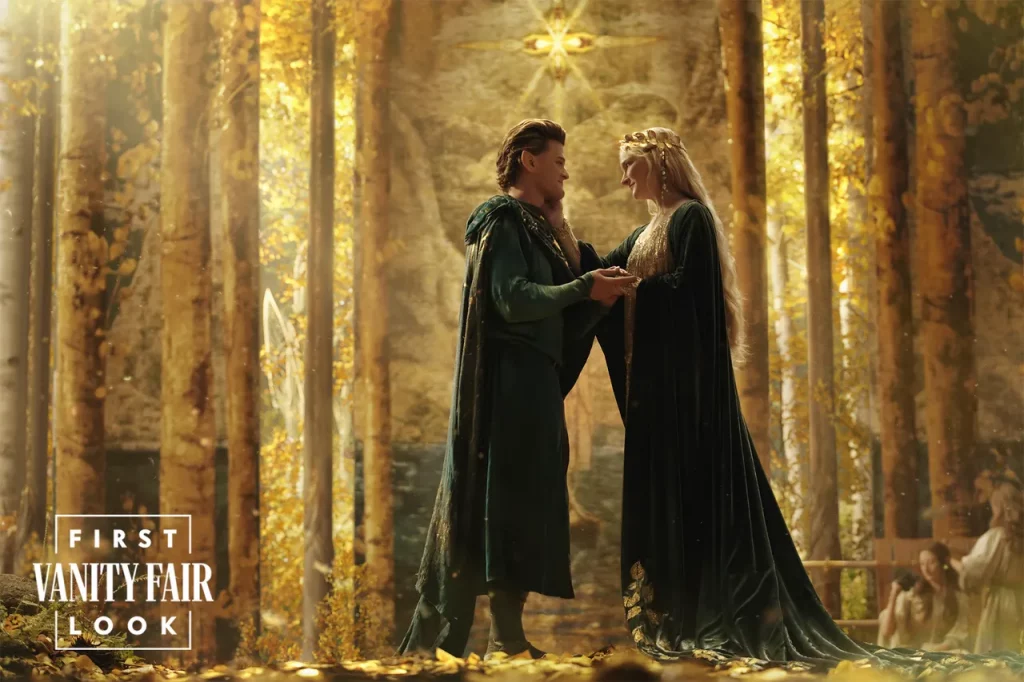
Some support for this perspective can be gleaned from one of the Vanity Fair “First Look” images. In the one that seems to show Galadriel and Elrond re-uniting in Lindon, there is a large tapestry in the background. This tapestry shows a stylised rayed star very similar to those worn by Galadriel, Gil-galad, Finrod and others.
Elrond and Galadriel are reunited in the majestic elven kingdom of Lindon. Courtesy of Amazon Studios. Note the the ship on the background behind them and the eight-rayed star at the very top of image.
This tapestry also depicts a ship or a boat, seemingly travelling toward, or guided by, the rayed star. Although probably a representation of a ship of the elves taking the journey to Valinor (it’s not yet the Straight Road because this is still the Second Age), the effect of the tapestry still feels evocative of the Star of High Hope mentioned above.
However, the heraldry of Eärendil is a six-pointed star, not one with eight points. I guess elven representations of Gil-Estel could be different — but the fact remains that what we see is just not Eärendil’s emblem.
There is one star that does seem a better visual fit: the Star of Fëanor that we encounter in the Lord of the Rings on The Doors of Durin at the west-entrance to Khazad-dûm.
‘There are the emblems of Durin!’ cried Gimli. ‘And there is the Tree of the High Elves!’ said Legolas. ‘And the Star of the House of Fëanor,’ said Gandalf.
A Journey in the Dark, The Lord of the Rings
The Doors of Durin from The Lord of the Rings as sketched by J.R.R. Tolkien. The Star of Fëanor can be seen at the centre of the image.
Like the emblem of Finarfin, there is a resemblance: eight rays and a distinct tapering. Perhaps more resemblance because of the tapering. Yet, it is also not exact: the four ordinal points are noticeably shorter than those we see on the device Tolkien created for The Doors of Durin.
There are additional (non-visual) contradictions.
Galadriel wouldn’t wear a symbol of the House of Fëanor. First, she’s of Finarfin’s house and would use his badge first. Second, Tolkien observes in Unfinished Tales that Galadriel had an abiding dislike of Fëanor. It’s that simple.
Just as importantly, Gil-galad wouldn’t either — not even as some symbol of solidarity. That’s because, throughout the Second Age, Gil-galad is the (undisputed) high-king of the Noldor in Middle-earth. The House of Fëanor is subsidiary to him in the Noldorin hierarchy.
Maedhros begged forgiveness for the desertion in Araman; and he waived his claim to kingship over all the Noldor, saying to Fingolfin: ‘If there lay no grievance between us, lord, still the kingship would rightly come to you, the eldest here of the house of Finwë, and not the least wise.’ [and] even as Mandos foretold the House of Fëanor were called the Dispossessed, because the over-lordship passed from it, the elder, to the house of Fingolfin, both in Elendë and in Beleriand.
Of the Return of the Noldor, The Silmarillion
Unfortunately, none of the options above fits neatly — every option creates unsatisfactory questions.
If this is the case, this prompts the question: why the lack of a good match?
Likely, the answer simply boils down to the intellectual property rights that Amazon holds for its TV series. (You might note that PJ’s Gil-Galad actually bears his Tolkienian heraldic symbol. The reason is probably down to a difference in the rights available.)
The showrunners have clearly stated (via Vanity Fair) that Amazon bought rights “solely to The Fellowship of the Ring, The Two Towers, The Return of the King, the appendices, and The Hobbit.” Nothing else.
That would place all the heraldic devices that Tolkien crafted out of reach — except the Star of Fëanor. But the showrunners are likely well-aware of the lore-clash of directly applying the Fëanorian star unilaterally.
Instead, it appears they’ve opted for something similar, but not exact — a generic derivation that they hope is symbolically evocative of elven heraldry and the elven reverence for Varda as the Lady of the Stars without directly contradicting one of the more obscure parts of the Legendarium (I love this stuff, but let’s face it — it is super-obscure).
That’s what I suggest is most likely occurring here.
Have they succeeded with that? On this point, I’m not convinced. Yes, it’s evocative — without a doubt. Yet the design still seems a little too similar to Fëanor’s star. I think it also leaves their hands tied when it comes to Celebrimbor. Because Celebrimbor should be the one using the Fëanorian star. Now, if they do try to replicate that, precisely as shown in The Lord of the Rings, will it even look different enough for us to notice?
BOOTNOTE: AlexP reminded me of something that I’d forgotten: Gil-galad’s parentage is complicated. The Silmarillion and Unfinished Tales as edited by Christopher Tolkien state that Gil-galad is the son of Fingon. Later, in preparing The History of Middle-earth, CJRT decided this was an editorial error and that his father’s final decision was that Gil-galad was a son of Orodreth. At the same time, Tolkien switched Orodreth to being a son of Angrod.
What does that mean?
Well, if Amazon were to leave the parentage of Gil-galad implied rather than stated (CJRT himself felt he should have, in retrospect left it obscure in The Silmarillion), then maybe Tolkien Estate would allow it. All three wearers of the badge — Galadriel, Gil-galad and, we presume, our unknown troll fighter — become Finarfin’s heirs. As such it could be argued that it’s fitting for them to use his symbol for the reasons discussed above. It could be a gesture of family solidarity. Even the star we see in the tapestry in the Gala-Elrond image is a fit, because Lindon is the heart of Gil-galad’s kingdom.
About the author: Staffer Demosthenes has been involved with TheOneRing.net since 2001, serving first as an Associate News Editor, then as Chief News Editor during the making of the Hobbit films. Now he focuses on features and analysis.The opinions in this article are his own and do not necessarily represent those of TheOneRing.net and other staff.
Acknowledgements: I got a lot of assistance from keen-eyed folks on our Discord in pulling this together. So in no particular order (and apologies to anyone else who contributed that I’ve missed), many thanks to DurinDeathless, LadyNico, Lasswen, AlexP, SirSquatch, Sid and Sir Skrilldor.
If you have a Tolkien/Middle-earth inspired poem you’d like to share, then send it to poetry@theonering.net. One poem per person may be submitted each month. Please make sure to proofread your work before sending it in. TheOneRing.net is not responsible for poems posting with spelling or grammatical errors.
There’s a particular letter in The Letters of J.R.R. Tolkien where Tolkien writes about his experience of dealing with a proposal from Forrest J. Ackerman to make an animated film of The Lord of the Rings.
Within that letter, there’s one revealing sentence.
Stanley U. &: I have agreed on our policy : Art or Cash. Either very profitable terms indeed ; or absolute author’s veto on objectionable[my emphasis] features or alterations.
Letter #202, The Letters of J.R.R. Tolkien.
The deal never happened, though Tolkien did subsequently sell film rights in 1969 to United Artists under the looming pressure of inheritance taxes.
These days, I suspect there’s no such pressure. More, the “Middle-earth universe” is seen as a proven starter for the world’s media companies. I think that has given Tolkien Estate leverage: the power to demand not just Cash, but Art as well.
In the context of the recent Vanity Fair feature, this explains not just the starting price for the Tolkien Estate’s rights auction a “gobsmacking” $200 million, but the documented demand for input into the direction of the series. In an early, seemingly unauthorised, interview, Tom Shippey described this “input” as a “veto power”.
It also says something about the power of Middle-earth that even with that eye-watering starting price and the attachment of certain pre-conditions, Netflix, HBO and Amazon all put their hand up and bid.
Still, even if Tolkien Estate was willing to put its foot down to get that capital-A Art, it was always going to take an equally ambitious (and well-resourced) studio to come through with the goods.
Despite Vanity Fair’s assurances (it’s pretty stunning that they’ve seen the first three episodes already), it’s too early for us ordinary punters to declare The Rings of Power a sure bet — in either the commercial sense, or the Art sense.
However, Vanity Fair’s first look under the bonnet shows there’s no lack of promise: the images are intriguing and suggestive, sets and costumes look suitably spectacular, and the production staff are making the right sort of noises about respecting the integrity of the source material.
But a show with the resources of The Rings of Power should (by default) have stunning production values and a real, lived-in feel. That’s just a given.
And it’s politic for showrunners to make the right noises (I would, too). The question is, can we identify instances of real substance to back those noises? Has the objectionable — as Tolkien might have seen it — been excised?
An Atlantis-like Númenor, the full glory of Khazad-dûm —- that vast dwarven metropolis carved out of the bones of the Misty Mountains, the puissance of the elven smith Celebrimbor, whose skills with metals and magic are crucial to the forging of the rings are all lore-friendly inclusions.
They’re also easy wins.
In a way, so too is the centrality of Galadriel.
Galadriel is a key player in the Second Age (fighting the long defeat, as she expresses in The Lord of the Rings). After the publication of that book, Tolkien increasingly came to view her as one of the most remarkable elves to play a role in Middle-earth’s history, and his later essays and notes paint her as an increasingly exceptional individual. She’s also incredibly peripatetic throughout the Second Age — wandering from Lindon, into Eriador and eventually south to Eregion, under the Misty Mountains to Lórien, back across to Imladris (Rivendell) and finally the south coasts of what would later become Gondor.
During all that, she’s a key participant in events. She joins Gil-galad to reject the approaches of Annatar, alternately collaborating and at loggerheads with Celebrimbor (and later advising him to hide Nenya, Vilya and Narya), before strengthening then-Lórinand (later Lórien). Unfinished Tales states that she views the dwarves of Khazad-dûm “with the eye of a commander”.
That bespeaks a driven individual — and this is something that the teasers from Vanity Fair support. I want to see lots of ambition from Galadriel — someone with just as much inner-belief and determination to make things happen as Fëanor, but with (even at the start of the Second Age) a touch more wisdom. I think you should too.
As showrunner McKay Patrick tells Vanity Fair: “This young hot-headed Galadriel… how did she ever become that elder stateswoman [who we meet in Lórien in The Lord of the Rings]?” The awareness of that difference is present; if the show is able to intelligently show this change, it will have taken a large step toward something that accords with J.R.R. Tolkien’s own musings.
Reassuring also is the gradual emergence of the Second Age threat — one that’s recognised by some, but not by others. After all, up until the forging of the One, Sauron (as Annatar) uses the velvet glove, not the iron fist. Very late writings recently published in The Nature of Middle-earth even suggest that his minions mocked him behind his back for this.
Again, direct statements from the McKay seem to back this: “We didn’t want to do a villain-centric thing. We wanted it [the first season] to be about introducing these worlds and the peoples who dwell in them and the major heroes and characters.”
And what is potentially one of the most contentious decisions — to include Hobbits as “Harfoots” — accords somewhat with both Gandalf’s description of Gollum’s folk (yes, I know those are, more correctly, Stoors): “a clever-handed and quiet-footed little people.”
And a note in the prologue chapter of The Lord of the Rings, “Concerning Hobbits” details that “even in ancient days [Hobbits] were, as a rule, shy of ‘the Big Folk’, as they call us, and now they avoid us with dismay and are becoming hard to find … [and] they possessed from the first the art of disappearing swiftly and silently, when large folk whom they do not wish to meet come blundering by…”
Is this one decision Tolkien Estate has weighed in on? Regardless, much will hinge on the execution of the concept.
Set against the above is the compression of the timeline that the showrunners discuss. First, kudos to the production staff for being clear on this. In fact, it recalls Peter Jackson’s bald statements that his films would include no Scouring of the Shire — a very real cause of fan angst at the time. (I still think that writing decision undersold some of the character development of the four key hobbits, but, weighing in at 201 minutes, PJ’s The Return of the King is already very long.)
I get the fact that it’s probably really difficult for any television series to traverse a 2,500-year history in a way that is not choppy and disjointed, and remains compelling viewing. Being able to see characters such as, say, Isildur and Ar-Pharazôn across a span of 5 seasons allows a great deal more screentime (and thus development and insight) than would be possible in a couple of seasons. A strictly linear structure would introduce them only at near the very conclusion of the entire series.
Still, I would have liked (as many speculated before the Vanity Fair article came out) to have seen Amazon be really daring and attempt to run two split, simultaneous timelines — one leading up to the forging of the One (and Sauron’s defeat by the elves and Númenor’s fleet), and another focused on Akallabêth and, perhaps, the War of the Last Alliance (also culminating in Sauron’s defeat, this time by the elves and the Dúnedain of Arnor and Gondor).
Doubtless, it would be demanding on the audience. But if it worked, it would have been amazing.
It’s worth noting, though, that J.R.R. Tolkien in his appraisal of the Morton Grady Zimmerrnan’s 1958 script made specific reference to his displeasure with time contraction of events.
There he states that:
I fail to see why the time-scheme should be deliberately contracted. It is already rather packed in the original, the main action occurring between Sept. 22 and March 25 of the following year. The many impossibilities and absurdities which further hurrying produces might, I suppose, be unobserved by an uncritical viewer; but I do not see why they should be unnecessarily introduced.
Letter #210, The Letters of J.R.R. Tolkien
Does that make this particular contraction objectionable?
In Letter #210, Tolkien points out that he doesn’t want to see “his work treated as it would seem carelessly in general, in places recklessly, and with no evident signs of any appreciation of what it is all about.” He does not want the tone lowered “towards that of a more childish fairy-tale.” Lastly, he does not wish for deliberate alteration of the story, in fact and significance, without any practical or artistic object [my emphasis].”
At least, those are my key takeaways.
Now, one observes that if the time scheme of The Lord of the Rings is packed, the precis account of the Second Age in The Tale of Years is most certainly not.
Tolkien also notes in Letter #210 that he closely observed the passing of seasons in The Lord of the Rings. He suggests that such pictorial representations could be used to non-explicitly indicate the passage of time. Similar effects might be employed for The Rings of Power series. Maybe not the thousands we are familiar with from “The Tale of Years”, but certainly dozens — or even the 100 to 200 that might encompass the lifespan of a Dúnedain of Númenor, or a dwarf of Durin’s line.
How much time is being contracted? Vanity Fair is not precise: the writers say that events are compressed “into a single point in time.” That might mean a span of a generation.
Here is where it would have been fascinating to be a fly on the wall in the discussions between Amazon Studios and Tolkien Estate.
Finally, keep in mind J.R.R. Tolkien’s letter to Milton Waldman outlining his artistic vision:
I would draw some of the great tales in fullness, and leave many only placed in the scheme, and sketched. The cycles should be linked to a majestic whole, and yet leave scope for other minds and hands, wielding paint and music and drama. Absurd.
Letter #131. The Letters of J.R.R. Tolkien
Absurd. Yet, here we are.
With this in mind, I think there are promising signs that Tolkien Estate (and indeed, Amazon Studios) is seeking Art, not just Cash. Early shoots with the promise of beautiful spring, you might say.
But there’s still an awfully long way to go.
As Galadriel says in The Lord of the Rings: “hope remains while all the Company is true.” We’ll see in September how true this particular company has been.
About the author: Staffer Demosthenes has been involved with TheOneRing.net since 2001, serving first as an Associate News Editor, then as Chief News Editor during the making of the Hobbit films. Now he focuses on features and analysis.The opinions in this article are his own and do not necessarily represent those of TheOnering.net and other staff.
If you have a Tolkien/Middle-earth inspired poem you’d like to share, then send it to poetry@theonering.net. One poem per person may be submitted each month. Please make sure to proofread your work before sending it in. TheOneRing.net is not responsible for poems posting with spelling or grammatical errors.
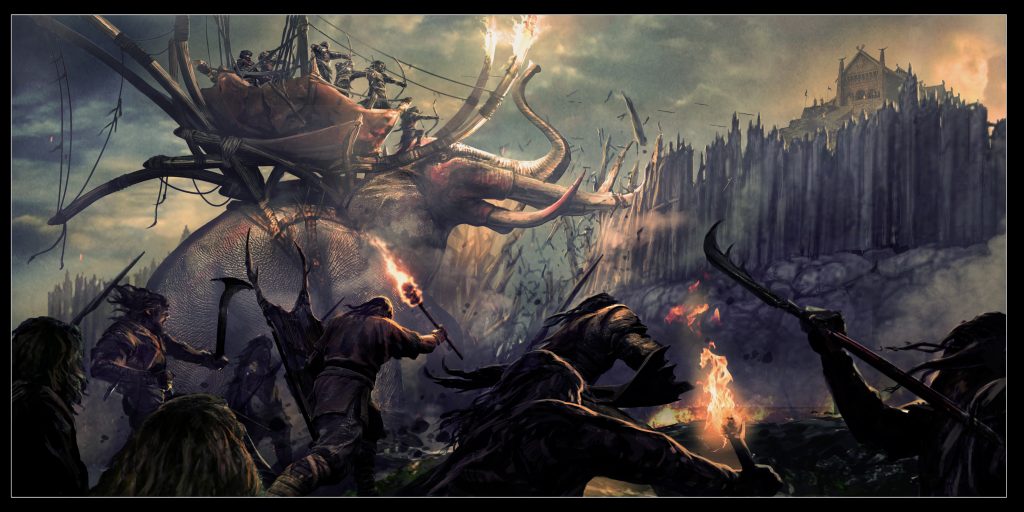
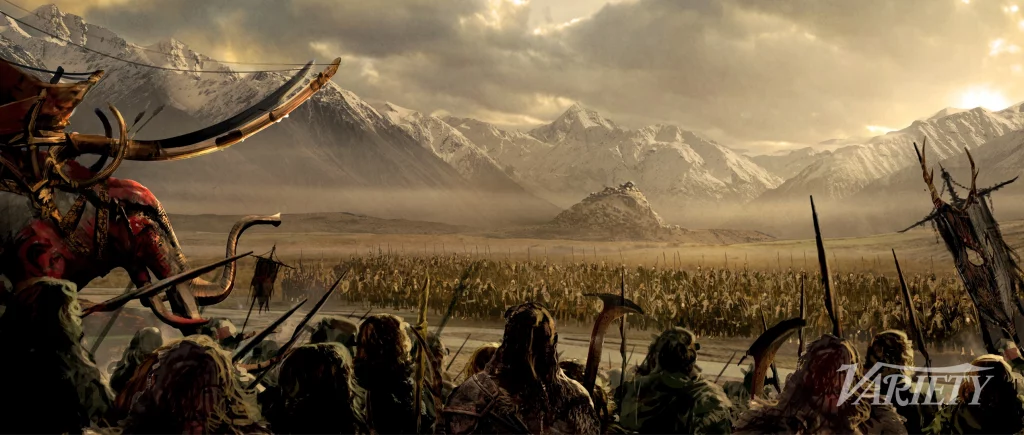
It appears that the appearance of Mûmakil in the recent Warner Bros. concept art has sparked dire thoughts that the production is already going off-track and that the apocalypse is nigh.
Fear not: I think people are misremembering the contents of Appendix A of The Lord of the Rings. That’s okay — I forget things all the time only to be reminded of something really obvious like “Oh, Finrod is a blonde, duh”.
The good news is that we don’t have to dig far here to get at the substance of the argument. First, Appendix A: II: The House of Eorl. Second, we want to look at the corresponding entries for the Stewards of Gondor. That is, anything mentioned during the stewardship of Beren.
This comprises the core of our knowledge about this period of the history of Gondor and Rohan.
Looking more closely at the histories, two passages stand out.
First, turning to the House of Eorl, we find this passage describing events in the years after Helm Hammerhand killed the Dunlending, Freca, with a blow from his fist at Edoras:
Four years later (2758) great troubles came to Rohan, and no help could be sent from Gondor, for three fleets of the Corsairs attacked it and there was war on all its coasts. At the same time Rohan was again invaded from the East [my emphasis], and the Dunlendings seeing their chance came over the Isen and down from Isengard. It was soon known that Wulf was their leader. The were in great force, for they were joined by enemies of Gondor that landed in the mouths of Lefnui and Isen.
Appendix A, The Lord of the Rings
Now, I’ll agree from the east is vague. Do the Balcoth, who assaulted Gondor during Cirion’s stewardship, still exist as a threat? Could that be referring to them? Or folk out of Rhûn? Not impossible. That the folk of Harad would circle all the way around Mordor in order to cross the Brown Lands and cross the Anduin at The Undeeps seems … less than likely.
But I don’t think it actually matters.
Because more details emerge from the Appendix A section that discusses events during the lifetime of the Steward of Gondor, Beren.
In the days of Beren, the nineteenth Steward, an even greater peril came upon Gondor. Three great fleets, long prepared, came up from Umbar and the Harad [my emphasis], and assailed the coasts of Gondor in great force; and the enemy made many landings, even as far north as the mouth of the Isen.
Appendix A, The Lord of the Rings
Joining these two together, I believe, solidifies an argument for the presence of Haradrim (and thus, potentially Mûmakil at Edoras when it’s taken by Freca’s son Wulf).
Because as Appendix A also states:
The Rohirrim were defeated and their land was overrun; and those who were not slain or enslaved fled to the dales of the mountains. Helm was driven back with great loss from the Crossings of Isen and took refuge in the Hornburg and the ravine behind (which was after known as Helm’s Deep). There he was besieged. Wulf took Edoras and sat in Meduseld and called himself king. There Haleth Helm’s son fell, last of all, defending the doors.
Appendix A, The Lord of the Rings
Thus, what the concept art shows is Wulf’s final assault on Edoras with the assistance of Haradrim allies. Haradrim allies who were part of those three fleets (along with the Corsairs of Umbar). Haradrim allies who landed at the mouths of the Lenfui and the Isen. And Haradrim allies who travelled all the way up from the south coasts to support Wulf in his invasion. His invasion of, first, Westfold, and subsequently the rest of Rohan.
If they happen to bring Mûmakil in tow, well is not that lore-accurate, too?
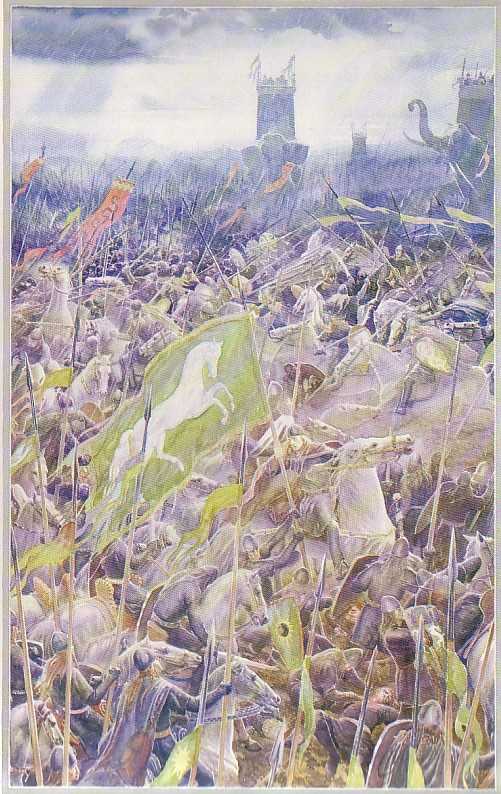
The Haradrim need not have invaded from the east at all. In fact, the invasion from the east is probably another, different folk. Rather, the Haradrim were with Wulf all along. And the Mûmakil? Well, what better weapon to overthrow the horselords? As we see in the Battle of the Pelennor Fields…
But wherever the mûmakil came there the horses would not go, but blenched and swerved away; and the great monsters were unfought, and stood like towers of defence, and the Haradrim rallied about them.
The Battle of the Pelennor Fields, The Lord of the Rings
The Battle of the Pelennor Fields by Alan Lee.
About the author: Staffer Demosthenes has been involved with TheOneRing.net since 2001, serving first as an Associate News Editor, then as Chief News Editor during the making of the Hobbit films. Now he focuses on features and analysis.The opinions in this article are his own and do not necessarily represent those of TheOnering.net and other staff.
If you have a Tolkien/Middle-earth inspired poem you’d like to share, then send it to poetry@theonering.net. One poem per person may be submitted each month. Please make sure to proofread your work before sending it in. TheOneRing.net is not responsible for poems posting with spelling or grammatical errors.
Here’s a question. If you’re LOTR on Prime, and if your main series material is centered on the Second Age, why tease/lead with an image that show something from a vastly earlier period in the history of Tolkien’s world?
I’ve been pondering this a lot.
Unless LOTR on Prime has gone collectively mad, then there has to be a purpose — some link between that panorama, and the Second Age story that we know is coming.
So, let’s analyse that.
The location itself may offer a link.
Why? Because Númenor — much, much later — tries to invade Valinor. Problem is, that period of Númenor’s history has little to do with the dwarf-elf interactions we seem to be promised if spy reports are correct. So, it’s probably not Valinor itself that’s important, nor the Two Trees in themselves (sorry TREES! fans, I empathise).
That leaves the events that happen in Valinor, and the key protagonists in those events.
Events are — by and large — resolved by The War of Wrath. However, some of those protagonists remain and become involved in the new dramas of the Second Age in Middle-earth (and Númenor).
And I feel this could offer a clue to what’s going on.
Of the chief actors through the events of the Second Age, I can think of four (five, technically) who are also players in during the final Years of the Trees.
Sauron
The first is Sauron. But the link between Sauron and Valinor/The Two Trees is tenuous to non-existent. According to The Silmarillion, he rebelled much earlier and then spent much of Melkor’s imprisonment lurking in and around Angband. He doesn’t really feature strongly in First Age events until Beren and Lúthien’s quest.
Neither the trees — nor any of the events that occur around them — are useful to solidify the background of Sauron for the audience. If you wanted to use Sauron as a link, you’d need to begin somewhere else. For this reason I eliminate Sauron.
Galadriel and Celeborn
The next two come as a pair: Galadriel and Celeborn.
Here, it’s a twofold opportunity.
One, it’s a way to establish Galadriel’s prominence among the Noldor, and the strength of her ambition. Recall Galadriel’s role in the rebellion of the Noldor and their exile. Fëanor is instigator, but in the Silmarillion version she is also involved:
Galadriel, the only woman of the Noldor to stand that day tall and valiant among the contending princes, was eager to be gone. No oaths she swore, but the words of Fëanor concerning Middle-earth had kindled in her heart, for she yearned to see the wide unguarded lands and to rule there a realm at her own will.
Of the Flight of the Noldor, The Silmarillion.
My thinking is that portraying some of Galadriel’s early life in Valinor could be used as a way to support her desire and capacity to (at least to according one tradition outlined in Unfinished Tales) establish Eregion much later in the Second Age with the assistance of Celeborn.
It would also serve to underpin — whether through continued pride, or Ban (or both) — why she did not return to Valinor for so long. There’s vast amounts of drama to be wrung here should LOTR on Prime do it right. A sort of “How I became a massive troublemaker and learnt to love the Ban” sort of thing.
Galadriel is also LOTR on Prime’s most natural and relatable link to Peter Jackson’s movies: well-liked and well-remembered even among those who aren’t Lord of the Rings aficionados.
Celebrimbor
Next is Celebrimbor. To my surprise (for I wasn’t aware of it until very recently), Tolkien outlined that Celebrimbor was born in Valinor during the Years of the Trees, not in Beleriand during the First Age. That he subsequently followed his father, Curufin, into exile, while his mother remained behind, suggests to me that he was well into adulthood by the time of the Noldor’s rebellion against the Valar.
His identity as the grandson of Fëanor makes him a close witness to events in Valinor while his (presumably) growing talents as a smith and craftsmen can be contrasted against the immense skill of Fëanor (and Galadriel). In particular, Fëanor’s achievements with the Silmarils could be used as a dramatic spur for his own creations.
For Celebrimbor, Eregion is not so much a place to rule but a place where he can be free to create with the ultimate aim of someday surpassing the works of his grandfather. Celebrimbor is also a more natural tie for recent spy reports of dwarves and elves meeting. Unless it’s a very frosty meeting, that’s not very likely to be one involving Galadriel and Celeborn (even if Galadriel is not entirely unreceptive to dwarves).
Glorfindel
Glorfindel is the final option. Also an exile, also born in the Years of the Trees. Coincidentally, also blonde. As The Fellowship of the Ring describes it, “his hair was of shining gold”.
Moreover, Glorfindel returns to Middle-earth sometime during the Second Age to play a role in helping keep Sauron at bay after he forges the One Ring. Tolkien writes that this was probably sometime between SA1200 and SA1600 though, and I wonder whether even the first full season would get that far.
Any other elf is a poor fit.
Cirdan did not make the journey to Valinor. Gil-galad is too young — born near the end of the First Age in Beleriand. Elrond is in the same boat. And the rest of the chief Noldorin exiles either died in the long wars against Melkor, or returned to Valinor at the conclusion of the War of Wrath.
If you have a Tolkien/Middle-earth inspired poem you’d like to share, then send it to poetry@theonering.net. One poem per person may be submitted each month. Please make sure to proofread your work before sending it in. TheOneRing.net is not responsible for poems posting with spelling or grammatical errors.
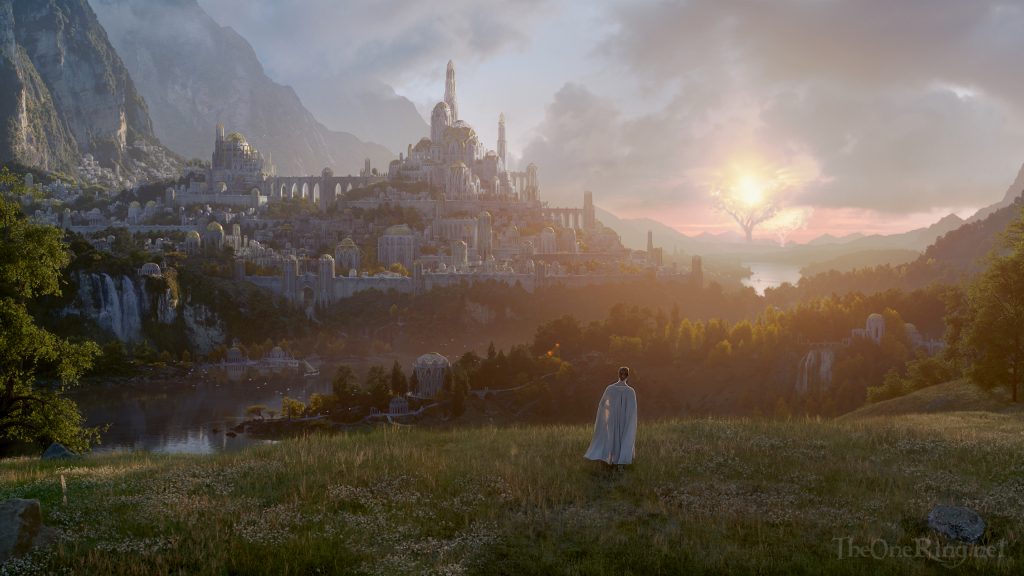
There is no doubt that the first promotional image from LOTR on Prime is simply amazing. But what is actually going on here?
Rather than blather on with superlatives, let’s just dive on in, and take a detailed look at what it reveals.
Fair warning, though: there will be spoilers for some key elements of The Silmarillion. So, if you’ve just started reading and you have no idea what happens and avoiding story spoilers is important to you, now is the time to step away!
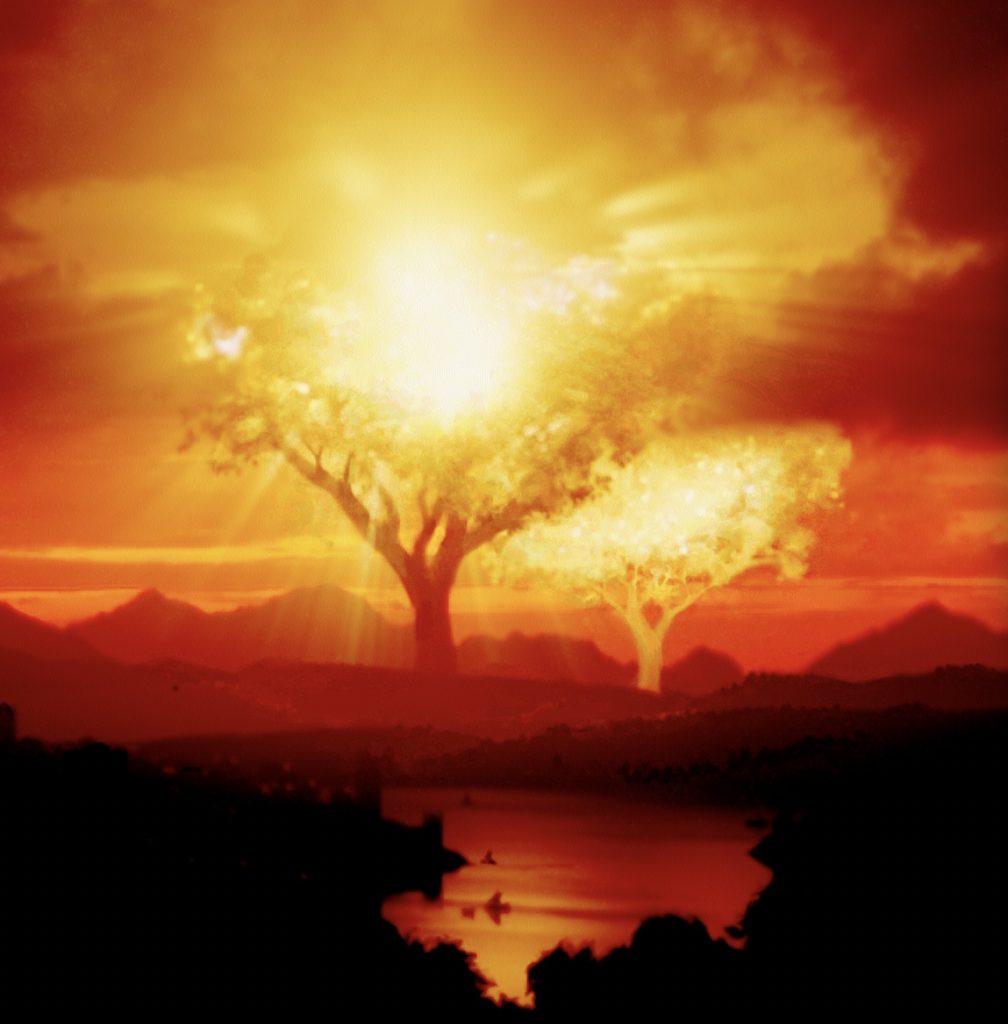
The Two Trees
The obvious place to begin is the trees since, as Tolkien writes in The Silmarillion, “about their fate all the tales of the Elder Days are woven”. They’re also what firmly locates this panorama in Valinor — all our conclusions derive from their presence.
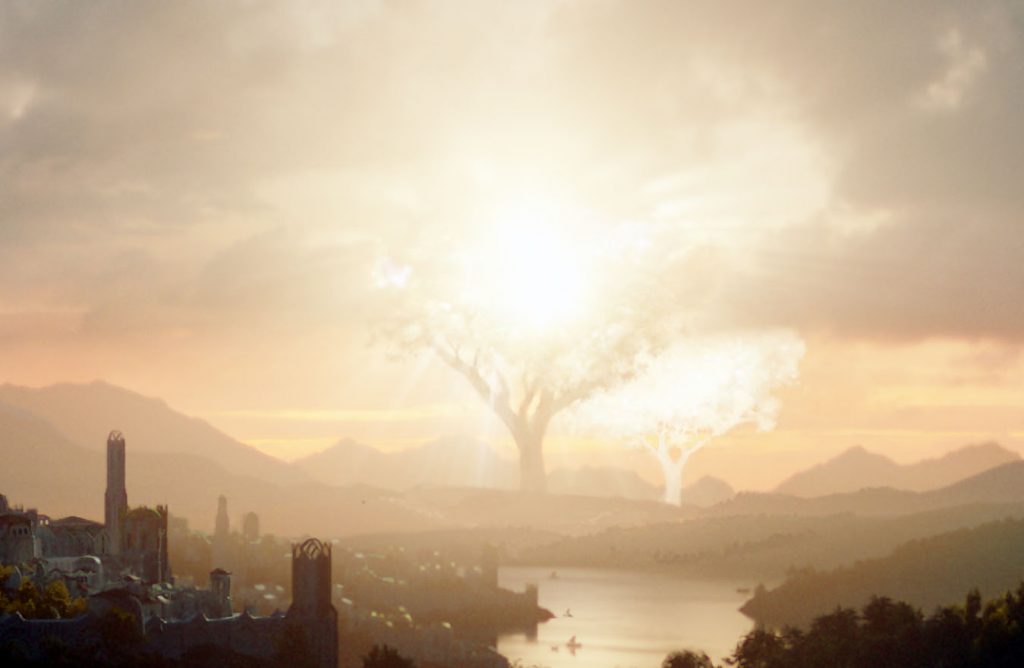
The Two Trees of Valinor. Laurelin at front, with Telperion behind.
[Telperion] had leaves of dark green that beneath were as shining silver, and from each of his countless flowers a dew of silver light was ever falling, and the earth beneath was dappled with the shadow of his fluttering leaves.
[Laurelin] bore leaves of a young green like the new-opened beech; their edges were of glittering gold. Flowers swung upon her branches in clusters of yellow flame, formed each to a glowing horn that spilled a golden rain upon the ground; and from the blossom of that tree there came forth warmth and a great light.
Of the Beginning of Days, The Silmarillion.
The trees in the LOTR on Prime panorama cannot be anything else. In the hidden city of Gondolin in Beleriand, Turgon famously created his own reproductions of the Two Trees in silver and gold. However, they emitted no light and were located within the city itself, not out on the plain. No, these are the Two Trees and that means this is Valinor.
You may wonder which tree is which.
My belief is that Laurelin — the tree of gold — is the one nearest the camera. Its shape more closely resembles that of the common beech (Fagus sylvatica). The dark trunk and boughs seem at odds with Telperion’s descritpion and the glow that emanates from it is a warm golden-yellow. And the silvery hue of the tree behind fits Tolkien’s vision of the Telperion much better.
The Two Trees: Alive? Or not?
The next key question is whether the trees are alive in this image. Is this the Years of the Trees? Or is LOTR on Prime using a clever fake-out as Professor Corey Olsen suggested may be the case on TORn Tuesday? Is the scene actually set later — long after Melkor and Ungoliant have paid their fateful visit — during the Years of the Sun, and the sun just happens to be positioned behind Laurelin?
The Two Trees closeup with level and brightness heavily adjusted.
I’ve gone back and forth between the two opinions.
One the one hand, when you adjust the levels in the image and pull the brightness down, the light out of (or through) Laurelin dominates, while the glow emanating from Telperion is muted enough that it could simply be reflected sunlight.
We do know from The Silmarillion that the trees were preserved: “their lifeless stems stand yet in Valinor, a memorial of vanished joy.”
On the other hand, the trees do not appear lifeless stems. They are not “withered” and drained of life as The Silmarillion describes it. In fact, Telperion’s trunk positively gleams.
Nor do they seem brittle. The Silmarillion also states:
Yavanna arose and stood upon Ezellohar, the Green Mound, but it was bare now and black; and she laid her hands upon the Trees, but they were dead and dark, and each branch that she touched broke and fell lifeless at her feet.
Of the Flight of the Noldor, The Silmarillion.
Moreover, something about the way Telperion would be reflecting the sun just doesn’t seem right. The sun should be so far behind the trees that any reflection should be much more muted than shown. I’m no ray-tracing expert, though! (If you are and have a better idea, let us know.)
Nevertheless, I feel the weight of evidence leans to this showing a scene from The Years of the Trees sometime near the end of the Noontide of Valinor. Perhaps even the very end.
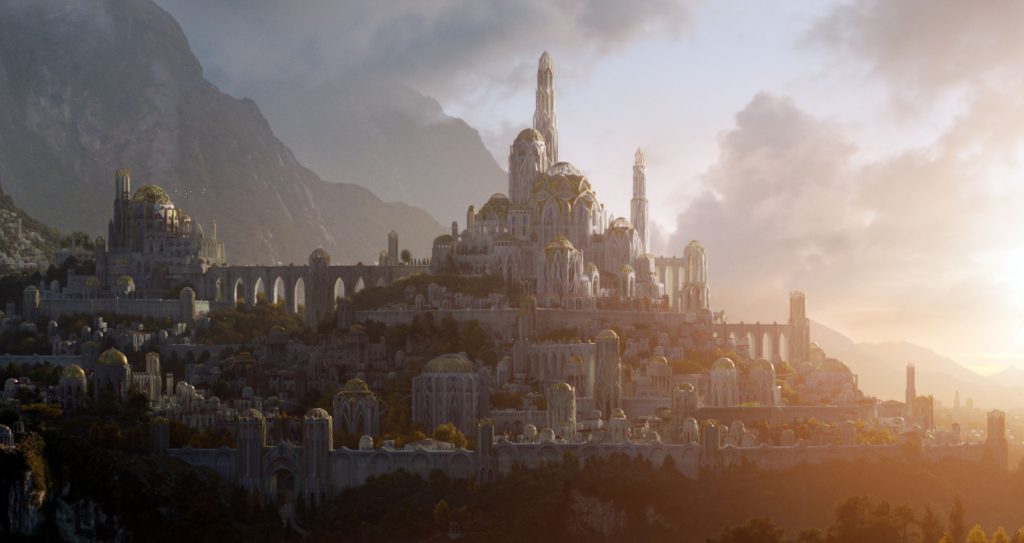
The city of white walls and towers
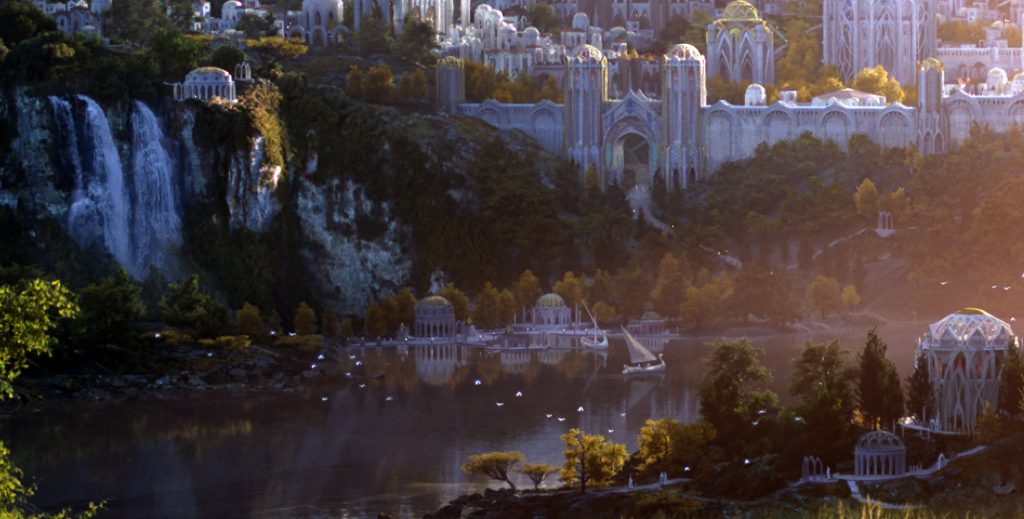
Next, there’s the city on the hill. I feel comfortable in saying that this is Tirion — the city of many white towers that the Noldorin and Vanyarin elves established together after first arriving in Valinor.
Tirion upon Tuna.
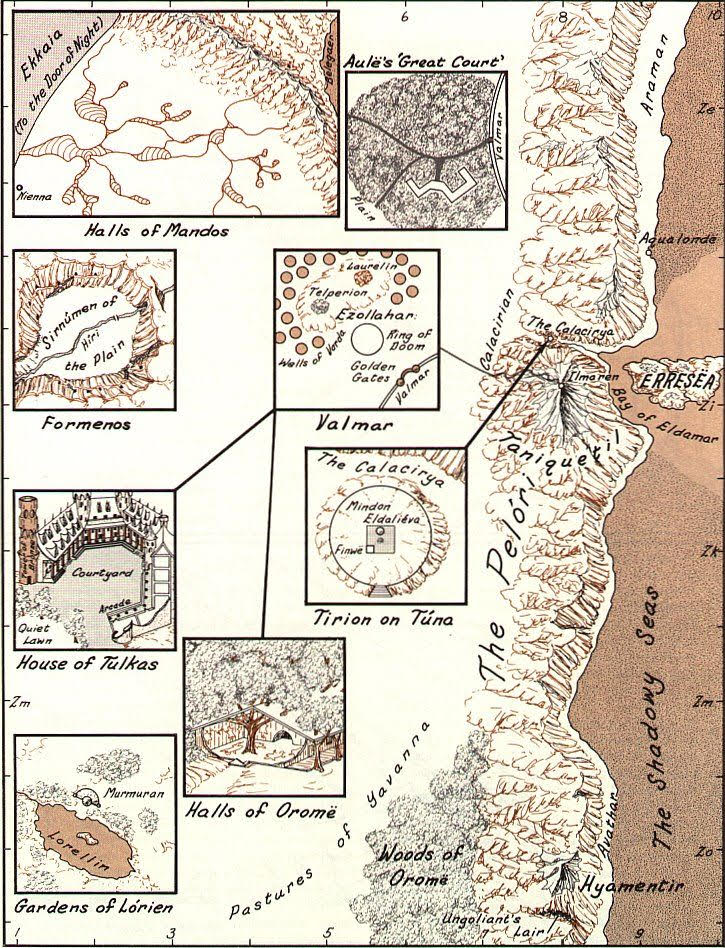
Tirion stands upon the hill of Túna at the entrance to the Calacirya (a Quenya word that translates as “The Cleft of Light”). To either side, you have the Pelóri — the immense mountain chain that walls off the interior of Aman from the rest of the world. By the time the Years of the Trees draw to a close, the Calacirya is more or less the only way through from the outside.
Conforming to that description, we see to the left and to the right in the image the slopes of steeply rising mountains. The southern side is most likely the northern shoulder of Taniquetil — the impossibly tall mountain where Manwë and Varda dwell.
However, there are some textual inconsistencies if you want to pick nits (and what are we here for if not to pick nits?).
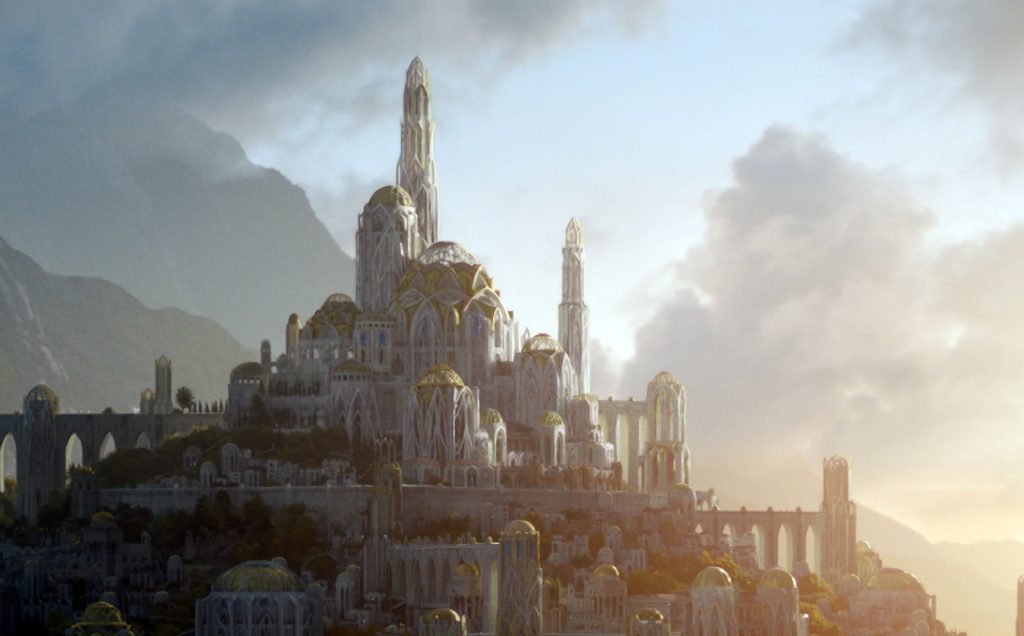
First, there’s the city’s tall tower.
The Tower of Ingwë. Note the absence of the light mentioned in the text of The Silmarillion.
This tower is the Mindon Eldaliéva. Notably, in The Silmarillion it is reported to feature a silver lamp that was said to “shine far out into the mists of the sea”. Famously, it guides the folk of Finarfin back to the city after they turn their backs on the rebellion of Fëanor. That lamp does not seem to be shining here.
…the highest of the towers of that city was the Tower of Ingwë, Mindon Eldaliéva, whose silver lamp shone far out into the mists of the sea. Few are the ships of mortal Men that have seen its slender beam.
Of Eldamar and the Princes of the Eldalië, The Silmarillion.
Additionally, despite looking closely at the city, I see nothing that could be Tirion’s own White Tree — Galathilion.
Yavanna made for [the Noldor] a tree like to a lesser image of Telperion, save that it did not give light of its own being; Galathilion it was named in the Sindarin tongue. This tree was planted in the courts beneath the Mindon and there flourished.
Of Eldamar and the Princes of the Eldalië, the Silmarillion.
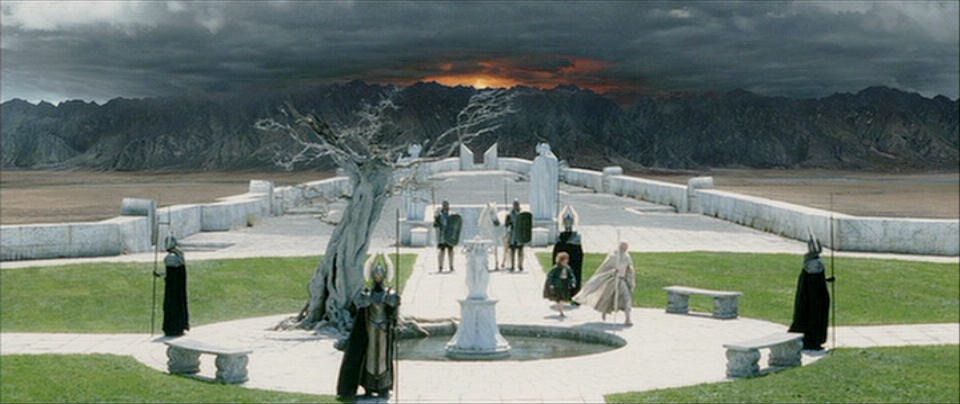
Galathilion would surely have a unique appearance compared to the other flora of the city. And it would probably draw upon similar aesthetic to Peter Jackson’s depiction of the White Tree of Gondor. Admittedly, Gondor’s White Tree is quite dead when we see it in the Return of the King.
The White Tree of Gondor from Peter Jackson’s The Return of the King.
The White Tree of Tirion might also not be especially prominent. It could be, compared to the structures about it, quite small. Or its placement might be out of picture, on the far side of the hill so it receives direct light from the Two Trees.
Finally, there’s the shape and position of Túna.
The Silmarillion states that after the Valar created a gap in the Pelóri, in the “deep valley that ran down to the sea the Eldar raised a high green hill: Túna it was called.”
Should Túna be more centrally located, rather than to one side of the Calacirya? Certainly, this is how Karen Wynn Fonstad envisages it — and her sketches in The Atlas of Tolkien’s Middle-earth were made with the backing of Harper Collins and the assistance of resources like the Boedlian Library.
Karen Wynn Fonstad’s map of Valinor shows Tirion raised upon a distinctly circular mound.
Nevertheless, the location feels more or less correct, and Wynn Fonstad’s cartography is not — as far as I know — explicitly textually supported. So the LOTR on Prime team probably can get away with playing it a little fast and loose even though they are certainly drawing on her maps.
The small river and the swan-prowed boats
Wynn Fonstad also documents one other geographical feature that is not revealed in the text of the Silmarillion — a stream or river that winds its way up the Calacirya toward Tirion. This probably explains the small river we see in the image. The question is whether it reaches all the way into the far distance. It’s hard to tell, but probably.
Are these the ocean-going White Ships of the Teleri? Or rivercraft made in their likeness?
I feel that is less important than the opportunity to reveal several swan-prowed boats that we see upon the river. The question is whether these boats could be the famous White Ships of the Teleri — or smaller, but similar, pleasure craft.
The Silmarillion speaks of Alqualondë:
…the Haven of the Swans, lit with many lamps. For that was their city, and the haven of their ships; and those were made in the likeness of swans, with beaks of gold and eyes of gold and jet.
Of Eldamar and the Princes of the Eldalië, the Silmarillion.
Fëanor, of course, had those White Ships burnt after taking them by force from the Teleri in order to transport his folk to Beleriand during the Flight of the Noldor. If these are those White Ships, then this is another piece of evidence to place the image firmly within the Years of the Trees, before the destruction of Laurelin and Telperion.
The lone figure in white
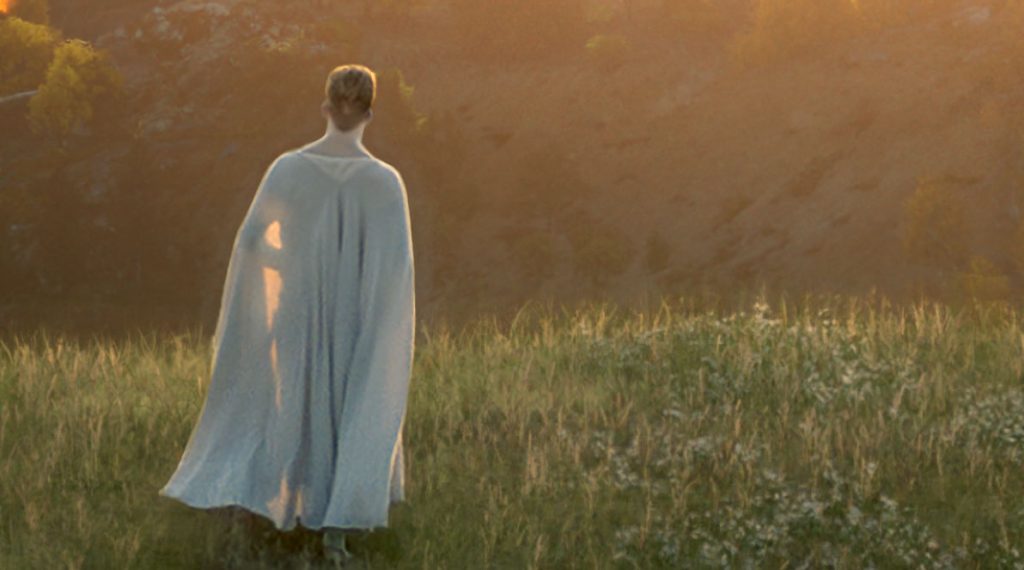
Finally, we have the mysterious, lone figure in white in the foreground.
The figure in white has light-coloured hair, and carries a sword at the left hip.
This person is blond (or blonde), has short hair (or long hair in some sort of up-do), and is attired in what is typically regarded as elvish fashion. The pose also strongly suggests that the figure is carrying a sword at the left hip.
The presence of the sword is useful, as that would definitively place the action after the release of Melkor from bondage. As The Silmarillion records, it was Melkor who “spoke to [the Noldor] concerning weapons; and in that time the Noldor began the smithying of swords and axes and spears.”
If we accept there is a sword (likely, I think), and that the Two Trees are still alive (also likely, I think) we can narrow the time period for this image.
Melkor is released from captivity in Year of the Trees (YT) 1400 according to the Annals of Aman. By YT 1450 he’s been in the ear of the Noldor sowing dissension to the point where they start making weapons — swords, axes, and shields featuring personal insignia.
But, none of the Noldor carry their weapons abroad openly for a long time after that. Not until Fëanor recklessly and publicly puts a sword at the chest of his half-brother. That might allow us to place this image to sometime after the exile of Fëanor from Tirion, but before the destruction of the trees in YT 1495.
It’s worth noting here that, according to this same timeline, Galadriel is born in YT 1362. Galadriel would be a full-grown adult. It could be her.
Might Galadriel have carried a sword in her youth? I think she might have. During the rebellion of the Noldor, The Silmarillion records that:
…Galadriel, the only woman of the Noldor to stand that day tall and valiant among the contending princes, was eager to be gone. No oaths she swore, but the words of Fëanor concerning Middle-earth had kindled in her heart, for she yearned to see the wide unguarded lands and to rule there a realm at her own will.
Of the Flight of the Noldor, The Silmarillion.
A late essay of J.R.R. Tolkien’s that Christopher Tolkien recounts in Unfinished Tales reinforces this:
She was proud, strong, and selfwilled, as were all the descendants of Finwë save Finarfin; and like her brother Finrod, of all her kin the nearest to her heart, she had dreams of far lands and dominions that might be her own to order as she would without tutelage.
The History of Galadriel and Celeborn, Unfinished Tales of Middle-earth.
The same essay also underscores Tolkien’s vision of her exceptional physique and athleticism and how she “grew to be … strong of body, mind, and will, a match for both the loremasters and the athletes of the Eldar in the days of their youth.” Plus a letter from 1973 describes the youthful Galadriel in similar fashion (while also, potentially, explaining the seemingly short-cropped hair):
[Galadriel] was [in her youth] of Amazon disposition and bound up her hair as a crown when taking part in athletic feats.
Letter #348, The Letters of J.R.R. Tolkien.
A Galadriel who in her early years of life is much more oriented to martial activities in not utterly out of Tolkien’s thinking.
Finally, there’s a treatise of Tolkien’s published in Morgoth’s Ring that outlines that while gender traditions — and individual occupational inclinations — exist among elves, these are by no means rigid, or absolute: “there are … no matters which among the Eldar only a [male elf] can think or do, or others with which only a [female elf] is concerned.”
Further, it concludes with the statement that “all … matters of labour and play, or of deeper knowledge concerning being and the life of the World, may at different times be pursued by any among the Noldor.”
If you don’t think this is possible for Galadriel, how else how do you explain Elrond’s trajectory from commander of Gil-galad’s expeditionary force to Eregion in the Second Age (and Herald of Gil-galad during the War of the Last Alliance) to renowned master of healing of the Third Age?
Other options for the figure in white
But, let’s say it’s not Galadriel. Who else might it be?
Hair colour immediately rules out most key Noldor of the time such as Finwë, Fëanor, Finrod, and Fingolfin. They are all dark-haired (as are the vast majority of Noldor). However, Galadriel’s father, Finarfin, or her grandmother, Indis, are options.
She was golden-haired, and tall, and exceedingly swift of foot. She laboured not with her hands, but sang and made music, and there was ever light and mirth about her while the bliss of Aman endured … and she walked often alone in the fields and friths of the Valar, filling them with music.
The Later Quenta Silmarillion II, The History of Middle-earth: Morgoth’s Ring.
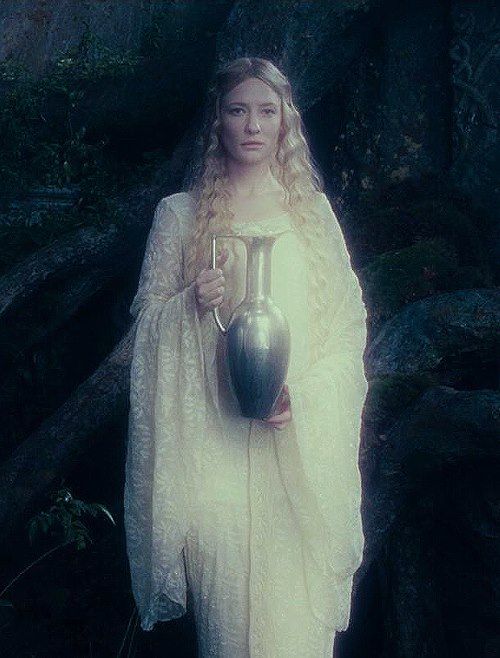
Still, I don’t really see Indis as the sword-carrying sort. I might be wrong, but it doesn’t match my perception of her personality and her ambitions. Finarfin would, but some costumers have suggested that the outfit the figure wears is more reminiscent of Galadriel’s attire in Peter Jackson’s The Lord of the Rings.
Galadriel in Peter Jackson’s Fellowship of the Ring.
As an aside, I also like the concept of elves with short-cropped hair because it challenges an aesthetic that is ambiguously supported in canon. Would LOTR on Prime be brave enough to do that, though?
After that, we’re down to edge cases.
The radical options: Melkor or Sauron
We know that the Valar had no bodies but could assume shapes more or less at will. Morgoth’s Ring reveals that “after the coming of the Eldar they most often used shapes of ‘human’ form, though taller (not gigantic) and more magnificent”.
We don’t know Melkor’s precise form during those years before the destruction of the Two Trees. One revision (The Later Quenta Silmarillion (II)) probably made during the 1950s describes the countenance he presented to the elves as “most fair of all”. It was only after the trees had been destroyed that Melkor-as-Morgoth became fixed in the classical form we know from the Quenta Silmarillion that Chris Tolkien published in 1977 — the tall and terrifying figure clad in black armour who ever-so-reluctantly comes forth to duel Fingolfin.
However, The Silmarillion records that Melkor carried a black spear to the destruction of the Two Trees. Moreover, without any sign of his spider-shaped partner in crime, Ungoliant, there’s nothing conclusive to suggest this scene is a direct prelude to that event.
A similar shapeshifting argument applies to Sauron, who most famously assumes the fair form “Annatar” in order to win over the elven-smiths of Eregion. Sauron, of course, remained at-large in Middle-earth during the Years of the Trees, presumably busily refortifying the fortress of Angband while awaiting the return of his master.
It’s not out of the question that Sauron might have ducked across the great ocean for a bit of a peek at what was going on in Valinor with his master. Against that, such a journey is never mentioned. Still, keep in mind that Tom Shippey mentioned in an interview that LOTR on Prime has creative wiggle room as long as it doesn’t directly contradict what Tolkien himself wrote.
Why Sauron? Well, Sauron is, ultimately, the chief antagonist of this series. Alongside Galadriel, he is one of the very few consistent presences throughout Middle-earth’s history. An opening (or prologue) that directly involves Sauron may be another way for LOTR on Prime to establish the foundations of a series that is going to span a very long period of time.
The human options: Eärendil or Ar-Pharazôn the Golden
While Eärendil‘s hair colour is up for debate, he is the son of two golden-haired parents. Most art depicts him as a blonde.
But what truly interested me was the circumstances in which Eärendil arrives at Tirion: alone.
And he went up alone into the land, and came into the Calacirya, and it seemed to him empty and silent; for even as Morgoth and Ungoliant came in ages past, so now Eärendil had come at a time of festival, and wellnigh all the Elvenfolk were gone to Valimar, or were gathered in the halls of Manwë upon Taniquetil, and few were left to keep watch upon the walls of Tirion.
Of the Voyage of Eärendil and the War of Wrath, The Silmarillion.
I’ve always liked Ted Nasmith‘s illustration of this scene, and there’s something about the LOTR on Prime panorama that evokes that passage, too. The only thing that’s missing is anything that looks like the glow of a Silmaril for there those were “who saw him from afar, and the great light that he bore”. Like the Phial of Galadriel, the Silmarils emit their own light.
Still, as Eärendil’s arrival in Middle-earth is the beginning of the closing act of the First Age, and leads more-or-less directly to the founding of Númenor, could something like this offer a tighter link to the major story that LOTR on Prime wants to tell?
Finally — more for the sake of elimination — there’s the last king of Númenor, Ar-Pharazôn the Golden.
For Ar-Pharazôn wavered at the end, and almost he turned back. His heart misgave him when he looked upon the soundless shores and saw Taniquetil shining, whiter than snow, colder than death, silent, immutable, terrible as the shadow of the light of Ilúvatar. But pride was now his master, and at last he left his ship and strode upon the shore, claiming the land for his own, if none should do battle for it. And a host of the Númenóreans encamped in might about Túna, whence all the Eldar had fled.
AKALLABÊTH, The Silmarillion.
But. The apparel on our lone figure isn’t really ideal for battle and war. Certainly not in the fashion reminiscent of our closest visual parallel to Númenór — the Arnorian and Gondorian warriors of the War of the Last Alliance. And the figures on river do not appear alarmed in the slightest — which they would if there was a vast, approaching army of Númenóreans behind the camera.
Finally, a curveball idea: what if it actually was Galadriel finally returning home at the very end of the Third Age? To start at the very end of the story, rather than the beginning.
In conclusion
After all that, what can we conclude? We’re looking at Valinor and the Two Trees. Definitively. And, despite a few topological and architectural quirks, we’re looking west from Tirion. I’m very confident of that, too.
But are those trees alive, or dead? I just can’t tell for sure. And it’s impossible to say for certain that the figure in white is Galadriel, even though it feels the most likely option.
But, since we are here to nail our colours to the mast, I will venture the following theory: the trees are alive, the figure is Galadriel, and this is somewhere near the end of the Noontide of Valinor.
Why? Primarily because in addition to the weight of evidence it simply makes the most sense to the story for the lone figure to be Galadriel. And — regardless of which Galadriel origin story you prefer — Galadriel left Valinor before the creation of the sun and the moon. Thus the trees must be alive.
I think. 🙂
Acknowledgements and thanks
This piece is not necessarily representative of the opinion of TORn staff. However, in assembling this, I have drawn on thoughts, theories and evidence that other staffers have been sharing over the last couple weeks. It would not have been nearly as good without their input. So, in no particular order, I’d like to thank JPB and Tookish for the long conversations, Mithril for the excellent find with Letter #343, Elessar, Josh, Kelvarhin, Garfeimao, Greendragon, Earl, and our TORn Tuesday team of Quickbeam and Justin.
Of course, any errors and oversights are my own.
If you have a Tolkien/Middle-earth inspired poem you’d like to share, then send it to poetry@theonering.net. One poem per person may be submitted each month. Please make sure to proofread your work before sending it in. TheOneRing.net is not responsible for poems posting with spelling or grammatical errors.
Speaking of translating Tolkien’s world to TV and cinema, we dug into our archives to find a rather relevant masterpiece from Green Books staffer Ostadan – originally posted November 4th, 2004. Enjoy!
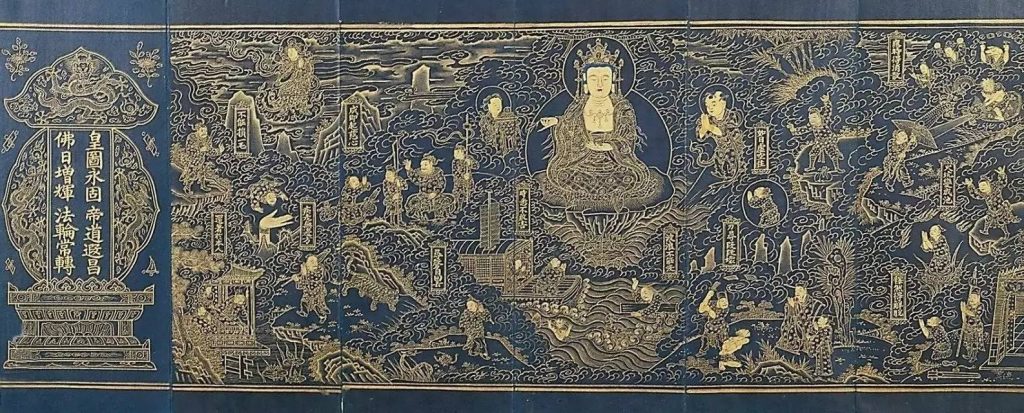
Golden copy of the “Universal Gateway”, Chapter 25 of the Lotus Sutra kept in Taiwan National Palace Museum. One of the many excellent works of Kumarajiva
“Translation is like chewing food that is to be fed to others who are unable to chew themselves. As a result, the masticated food is bound to be poorer in taste and flavor than the original.” [attributed to Kumarajiva, translator of Buddhist texts into Chinese. Translated.]
Unu Ringo ilin regas, Unu ilin prenas, Unu Ringo en mallumon ilin gvidas kaj katenas.
Let us look at this translation more carefully. If we were to take each word and translate it to English directly, it would read,
One Ring them rules, One them takes, One Ring into darkness them guides and chains.
Esperanto’s word order is more liberal than English, especially in verse; a more grammatically correct English translation would be “One Ring rules them, One takes them, One Ring guides them into darkness and chains them.” Those familiar with the English text will see many evident differences — the use of present tense; the reduction of “them all” to simply “them”; the change of “find” to “take”, and so on. Why should this be so? The main reason is that Bertil Wennergren, who translated the verse, was attempting to retain not only the sense of the text, but the rhyme scheme and general meter of the original. Esperanto, which uses suffixes as markers for such things as tense and part of speech, has few single-syllable words. In contrast, there is only one word of more than one syllable, “darkness”, in the entire English version of the Ring couplet (and few, indeed, in the entire Ring-verse). If any semblence of the poetry of the original is to be retained, then the meaning of the text must be altered somewhat to fit the restrictions imposed by the verse form and the language of translation.
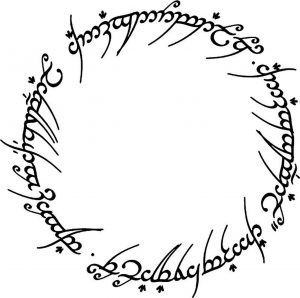
Of course, within the story, the famous couplet is itself only a translation, with a slight change in meter, of the Black Speech found on the Ring:
Gandalf says that his rendering in the Common Speech is “close enough” to what is said on the Ring. So the question arises: is the Esperanto translation similarly “close enough”? A “purist” might say, no: there are too many details lost or even changed by this translation, and Tolkien’s linguistic work has been undermined; someone reading the Esperanto text would come to very different conclusions about the vocabulary and grammar of Black Speech from those reached by English-speaking readers. But someone of a more “revisionist” bent sould say that the Esperanto Ring-inscription tells, probably as well as possible given the constraints of a verse translation in Esperanto, the same story as the original English. After all, it is certainly plausible that Celebrimbor, hearing these words spoken from afar as Sauron first took up the One Ring, would indeed know just how he had been betrayed and what Sauron’s true purpose behind the Rings of Power was.
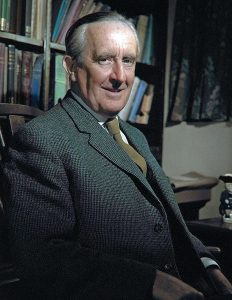
J.R.R. Tolkien
In a real sense, any translated work is a collaborative effort between the original author and the translator, much as a symphonic performance is a collaboration between the composer and the conductor. In a work as complex as The Lord of the Rings, the translator must be aware of the stylistic and linguistic techniques that Tolkien is using, and create them anew in the language of translation. For the result to have any artistry at all, the translator has to be as creative and capable in the language of translation as Tolkien was in his own. The result will not be pure Tolkien; it will be Tolkien as interpreted and re-told by the translator. Arden Smith’s irregular column in the journal Vinyar Tengwar, entitled “Transitions in Translations”, has documented a wide range of successful and unsuccessful translations. In some, little care is taken in style or nomenclature — one might be reminded of the infamous Japanese subtitles for the Fellowship of the Ring movie. In others, the translator may go as far as inventing Tengwar and Cirth modes for the language of translation and will re-draw the title page inscription in translation, as well as re-lettering the translation of the West-gate of Moria in the illustration. But in all cases, the result is not, and cannot be, identical to the experience of reading the original English text.
A “purist” might therefore conclude that because a translation necessarily loses some of the nuances and richness of the original, nobody should read Tolkien’s work in translation, and that the translators themselves are wasting their time in a futile exercise at best, or a fraudulent representation of their own works as being J.R.R. Tolkien’s at worst. To the purist, Tolkien’s original work is the only “true” account of events in a world that seems nearly as real as the ancient history of our own world, and deviation from that account seems to be somehow a distortion of a primary truth. But most people would agree that, given a certain minimum quality of translation, the defects inherent in reading a work in translation are outweighed by the availability of the book to people who cannot read it in English and would not be able to experience Middle-earth in any form without the translation, like the unfortunate soul in the quotation from Kumarajiva, who requires someone else to chew their food if they are to avoid starvation. Some of these people may even be motivated by a good translation to search out an English edition and laboriously work through it.
By now, the reader has probably anticipated the author’s conclusion from these musings about translation: the art of the filmmaker has much in common with the art of the translator. The requirements of film — or at least an artistically and commercially successful one — dictate particular rhythms and modes of expression in the storytelling that the original author contemplated no more than Tolkien considered how the Ring-verse would fit the rhythms of Esperanto or other languages. Even more than a translator, the filmmaker is a collaborator with the author, reinventing and recreating the author’s work so that it can be expressed as artistically as possible in the “language of film”. The result will not be purely Tolkien’s work, and will inevitably lose much of the delicious “flavor” of the original. It may even have serious defects in several particulars; but the real question is whether, like the Ring-verse translation, it tells the same essential story, “close enough”. If it does, then it does what any good translation does: it brings a great work to people who otherwise would not read it on their own.
“I cannot read the black and white letters,” he said in a quavering voice.
“No,” said Jackson, “but I can. The letters are English, of a narrative mode, but the language is that of the Epic Romance, which I will not utter here. But this in the Cinematic Tongue is what is said, close enough…”
If you have a Tolkien/Middle-earth inspired poem you’d like to share, then send it to poetry@theonering.net. One poem per person may be submitted each month. Please make sure to proofread your work before sending it in. TheOneRing.net is not responsible for poems posting with spelling or grammatical errors.