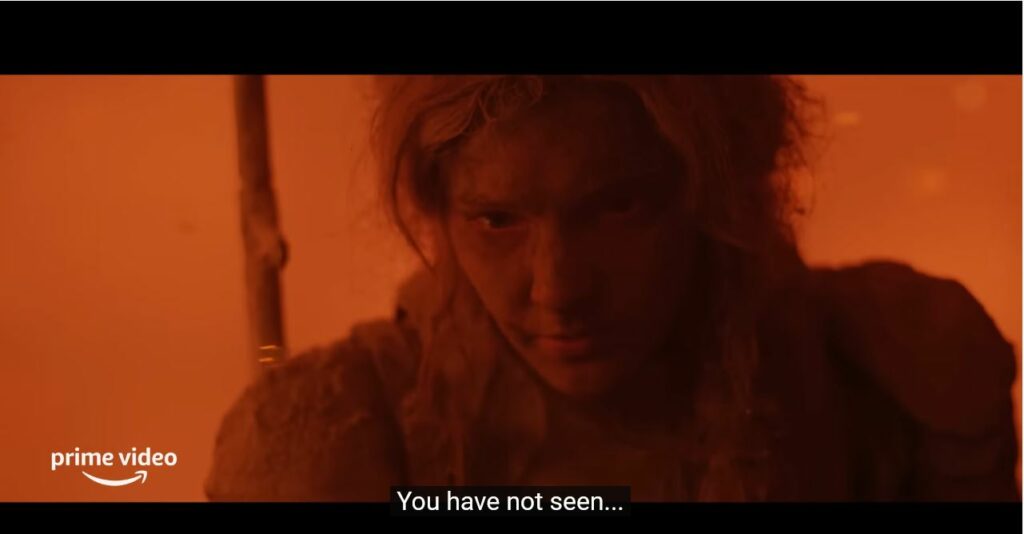
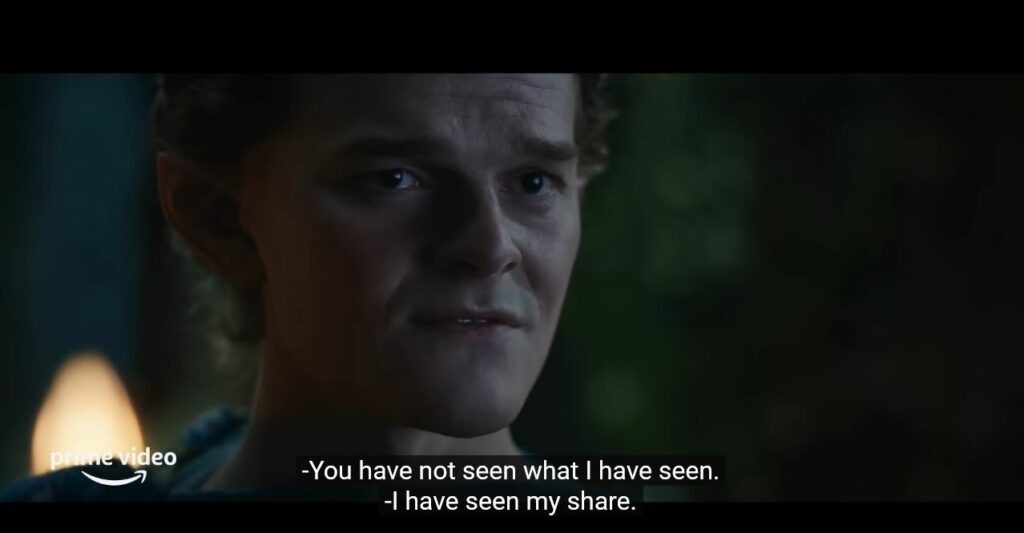
Right now, nothing about our shiny, new Rings of Power trailer is exercising my mind more than Galadriel’s statement to Elrond “You’ve not seen what I’ve seen”.
Key teaser discussion image 1: Galadriel gazes on something.
So you wouldn’t think that Galadriel means something similar, like that one time at Aqualondë when Fëanor decided to requisition some boats (or, later, when he decided to use said boats for tinder on the beach at Losgar).
It’s also likely that Elrond was involved in the The War of Wrath and present at Thangorodrim for the defeat of Morgoth at the conclusion of the First Age. It’s implicit in his statement during the Council of Elrond when he speaks of the Last Alliance.
Elrond declares “I have seen my share” … with some justification.
“I remember well the splendour of their banners,” he said. “It recalled to me the glory of the Elder Days and the hosts of Beleriand, so many great princes and captains were assembled. And yet not so many, nor so fair, as when Thangorodrim was broken…”
The Council of Elrond, The Lord of the Rings
Arguably that’s the defining event of the First Age (even if it’s the most-sketchily recorded). A dragon falls on and destroys a mountain chain. Later, an entire sub-continent sinks as a result. It is, quite literally, a world-changing event.
Let’s say your preferred canon is that Galadriel remained in Doriath into the later stages of the First Age (one option CJRT outlines in Unfinished Tales), the sacking of Menegroth doesn’t remotely meet that benchmark. Even were you to place Galadriel at the Nirnaeth Arnoediad (I wouldn’t), or the Dagor Bragollach (a big stretch, but I do wonder if the showrunners might), it’s just not comparable.
So what’s left?
I broached this with fellow staffers, suggesting that only one thing in Galadriel’s history is truly incomparable: the destruction of the Two Trees by Morgoth and Ungoliant.
But, generally, we agree that the description of that event given in The Silmarillion is a poor match for the imagery from the scenes that Galadriel’s voice-over cuts across in the trailer. The Silmarillion describes that Laurelin and Telperion wither as Ungoliant drains them of life. They do not burn. The assault causes a vast, ever-expanding gloom and darkness, and it is entirely unexpected and unanticipated.
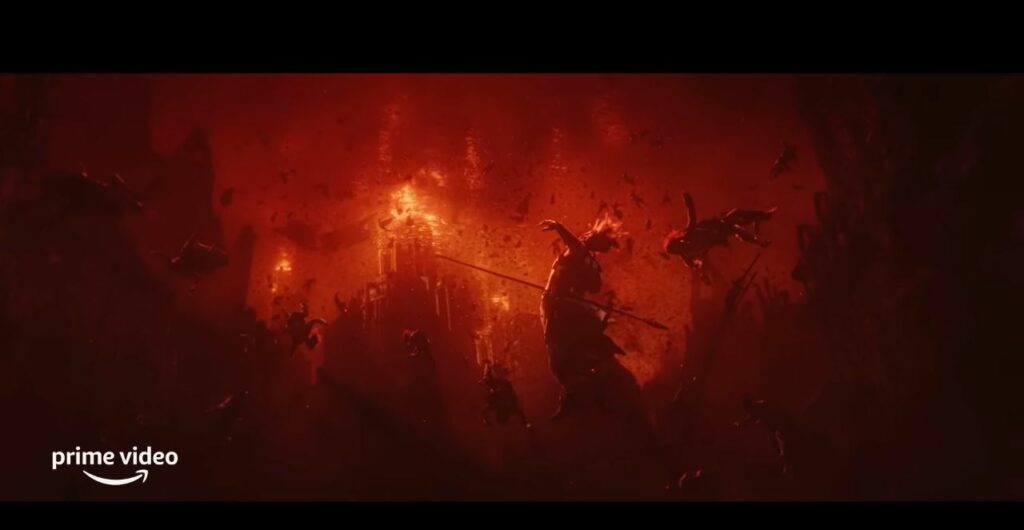
That’s very unlike what we see in the Rings of Power trailer scene. There’s a the red-hued background, flickering embers pass behind Galadriel, and there are bodies that seem to hang in space. Further, whatever Galadriel is looking on seems to centre on something that looks like a tower, or a fortress. Not trees.
Key teaser image 2: Galadriel seemingly gazes on this scene.
If it’s not something in Galadriel’s (distant) past, what is it then?
Perhaps it’s some Second Age event around or during timeline that The Rings of Power covers.
Here, fellow-staffer Garfeimao cleverly suggests that we should keep in mind that Galadriel has powers of foresight. This, after all, is how Sam is able to see a vision of The Shire getting, let us say, redeveloped.
“Many things I can command the Mirror to reveal,” she answered, “and to some I can show what they desire to see. But the Mirror will also show things unbidden, and those are often stranger and more profitable than things which we wish to behold. What you will see, if you leave the Mirror free to work, I cannot tell. For it shows things that were, and things that are, things that yet may be. But which it is that he sees, even the wisest cannot always tell. Do you wish to look?”
So … it’s probably not the destruction of the Two Trees.
I could see some pointing out that Elrond also has a mighty foresight. And that’s true.
For example, his concern for welfare of The Shire is not at all misplaced. But he also doesn’t intuit how critical Merry and Pippin would prove to the Quest to destroy the Ring. That’s not to say his foreknowledge is less, it’s more to showcase how imprecise such things can be in Tolkien. No-one ever sees the full picture — even the memories of the Valar of the Music are said to be fuzzy.
And a vision might explain the subtle differences between the two shots: Galadriel is not physically present at the second scene. Instead she’s perceiving it through the lens of vision — just as Frodo and Sam did in Lorien — from somewhere else that is distant in both place and time. Somewhere else that — in a sneaky bit of misdirection — just happens to have endured some sort of fire or assault.
Recall, also, that such visions and dreams in Tolkien can be the cause of great restlessness in the receiver. In The Silmarillion, Turgon and Finrod each receive a vision from Ulmo while resting by the banks of the Sirion.
“Unquiet was upon them ever after, and doubt of what should befall, and they wandered often alone in untrodden lands, seeking far and wide for places of hidden strength…”
Of the Return of the Noldor, The Silmarillion
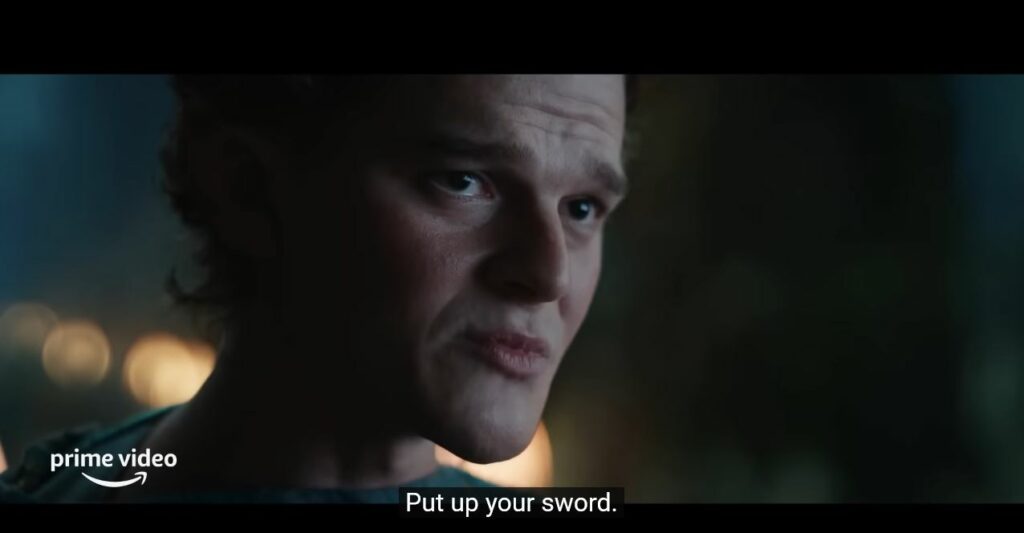
This might be a key reason why Galadriel is unable to, as Elrond suggests, put down her sword.
Elrond calls on Galadriel to put up her sword but Galadriel is adamant.
A vision opens up possibilities of things that we, as an audience, might not see come to pass in the first season of The Rings of Power.
Staffer Josh suggests that it might just be a vision of The Downfall of Númenor: Akallabêth, and perhaps even the Temple in Armenelos as it sinks below the waves.
Now, that seems appropriately apocalyptic.
It would explain why all the figures look like they’re floating — they are. And it explains the odd ripples through that scene — it’s distortions caused by the surface of the water.
The mist cleared and he saw a sight which [Frodo] had never seen before but knew at once: the Sea. Darkness fell. The sea rose and raged in a great storm. Then he saw against the Sun, sinking blood-red into a wrack of clouds [my emphasis], the black outline of a tall ship with torn sails riding up out of the West.
The Mirror of Galadriel, The Lord of the Rings
There might be powerful reasons for Amazon Studios to tip people to this end-scenario early. The fact is that most viewers won’t know what a Númenor is, let alone that it was an island-continent that was sunk after an entire people went off their collective trolley, implemented a system of human (and, presumably elven) sacrifice, and decided to invade the “land of the gods” out of a misplaced belief that conquering it would confer immortality.
Sure, even the most casual watcher will understand Ring Bad(tm), but this is vastly more tangible and visceral.
This would be one way to drive home the wider audience what’s at stake and, conceptually, I like it a lot.
Unfortunately, neither The Lord of the Rings nor its Appendices mention the “mighty temple” that Sauron has built in Armenelos, nor the sacrifices of the Faithful that are conducted inside. Those details are only found in the Akallabêth story in The Silmarillion.
However, Appendix A and Appendix B do mention that the Faithful are persecuted, and that rebellion and “civil war” occurred in the final years of Númenor.
That may be enough for the purposes of a vision. That may also satisfy a quite accurate objection that Staffer Earl raises — that the scene does have the appearance of being the outcome of battle. In fact, the most prominent floating figure seems to be run through with a spear.
Perhaps it reflects that, in those final, doomed years, “men took weapons … and slew one another for little cause; for they were become quick to anger.” Chaos and violence as the apocalypse literally occurs should not, I think, be unexpected.
But let’s say that’s incorrect and we’re not looking upon a scene of Akallabêth.
Is there something else it might be?
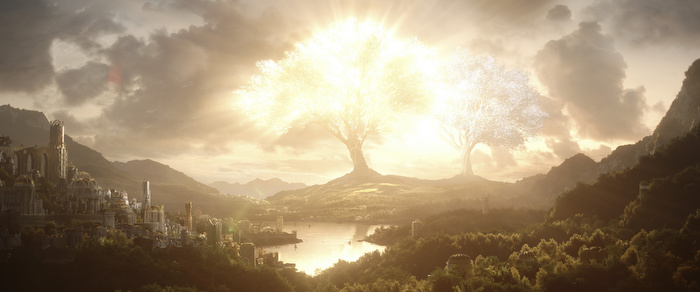
Here, I’m indebted to one of our Discord chatters DrNosy who informed me that the fan hivemind suspects that the trailer aerial of a city at the confluence of two rivers is Ost-in-Edhil, the chief city of Eregion.
This seems to be Ost-in-Edhil, the chief city of Eregion and the place of the forging of (most of) the Rings of Power.
“…the Elves of this land were of a race strange to us of the silvan folk, and the trees and the grass do not now remember them: Only I hear the stones lament them: ‘Deep they delved us, high they builded us, fair they wrought us, but they are gone.'”
The Ring Goes South, The Lord of the Rings
While not as apocalyptic as the end of Númenor, it is still the end of Eregion. More, it’s the civilisational high mark of the Noldor. Although Elrond establishes subsequently a refuge in Rivendell, never again would they attempt anything on a similar scale.
A vision of the dreams of the Noldor going up in flames might just suffice.
About the author: Staffer Demosthenes has been involved with TheOneRing.net since 2001, serving first as an Associate News Editor, then as Chief News Editor during the making of the Hobbit films. Now he focuses on features and analysis.The opinions in this article are his own and do not necessarily represent those of TheOneRing.net and other staff.
If you have a Tolkien/Middle-earth inspired poem you’d like to share, then send it to poetry@theonering.net. One poem per person may be submitted each month. Please make sure to proofread your work before sending it in. TheOneRing.net is not responsible for poems posting with spelling or grammatical errors.
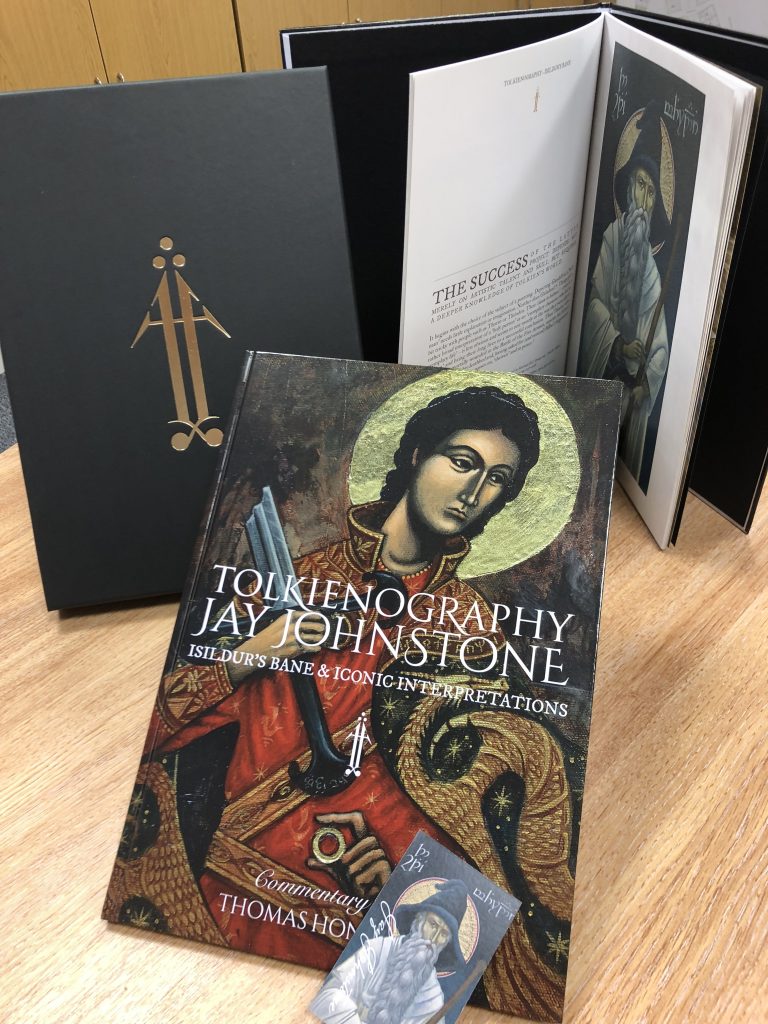
Over on Wraith Land, Thomas Kelley has just published the second part of his extended interview with Tolkien artist Jay Johnstone.
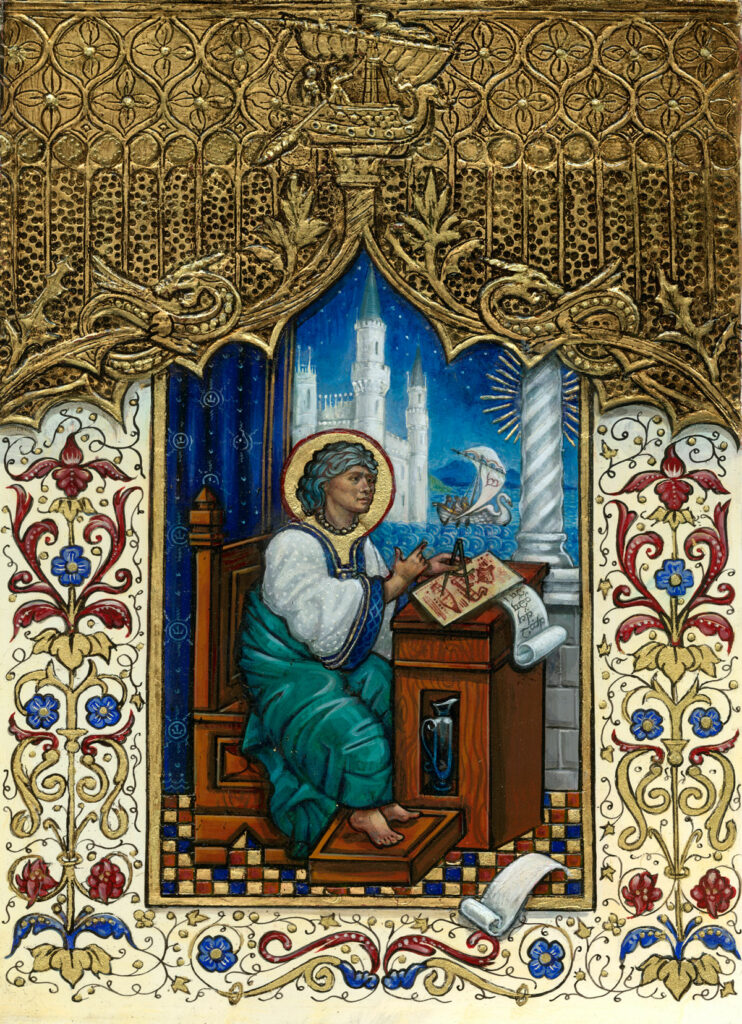
Jay’s artwork employs techniques from religious manuscripts, icon and fresco illustrations from the medieval period, and uses a variety of mediums — oils, watercolors, acrylics, egg tempera with gold powder and leaf. Striking detail and traditional techniques give the impression of artwork that could have been produced in the real Middle-earth.
The first part explored how Johnstone’s own dreams influence his art. In this second part, Kelly explores Johnstone’s medieval illumination approach to Tolkien art in detail.
An excerpt:
When I interviewed Jay last year in April, I asked him about this “text within a text” vision in his Tolkien art, which to me are of the same theme as his “dream within a dream” iconographies. Using his painting “Gandalf in the Library of Minas Tirith” as an example, I pointed out how he meticulously detailed the books and scrolls in that image with Tengwar lettering. You can also see this painstaking attention throughout, as in works like “The Dwarves,” which illuminates Thror’s map in Bag End from The Hobbit.
“You know, I can’t remember what it says but there’s two parchments on his desk and both of them are written on and the lettering is about a millimeter high,” he says of the Gandalf in Minas Tirith work, chuckling a bit under his breath. “It’s absolutely tiny. I literally do it with a magnifying glass and a precision brush, a brush with one hair on it. I do that in quite a lot of paintings.”
It’s another level of getting inside Middle-earth, down to the micro. Such works are a celebration of the writers and sages inside that meta world, and of writing and learning itself. Johnstone’s “Círdan the Shipwright” — with its Tengwar and ship schematics on parchment — and his “Bilbo at the Library at Rivendell” — with history flowing from Bilbo’s pen — give us a new window into time.
If you have a Tolkien/Middle-earth inspired poem you’d like to share, then send it to poetry@theonering.net. One poem per person may be submitted each month. Please make sure to proofread your work before sending it in. TheOneRing.net is not responsible for poems posting with spelling or grammatical errors.
Over on Wraith Land, Thomas Kelley has just published the first part of an extended interview with noted Tolkien artist Jay Johnstone.
Jay’s artwork employs techniques from religious manuscripts, icon and fresco illustrations from the medieval period, and uses a variety of mediums — oils, watercolors, acrylics, egg tempera with gold powder and leaf. Striking detail and traditional techniques give the impression of artwork that could have been produced in the real Middle-earth.
Kelley delves into the goals underpinning Johnstone’s unique approach, and some of the insights into Tolkien’s worksthat Johnstone himself has gained out of it. If the interesection of Tolkien, art, psychology and spirituality is your thing, you’ll find this a very interesting read indeed.
An excerpt:
Johnstone dreams in Tolkien. And through him and his artwork we can perceive anew what it would mean to live in Middle-earth and to create art inside it. While Tolkien himself made “sub-creation” the purview of his own characters, from the creation of the Silmarils by Fëanor to the writing of the Red Book of Westmarch by the hobbits, Johnstone imagines what it would be like to be a painter inside Tolkien’s world, and then paints that world and its history. Reminiscent of the religious medieval icon paintings by Duccio di Buoninsegna and Fra Angelico, Johnstone’s paintings work not just like time portals but dream portals.
If you have a Tolkien/Middle-earth inspired poem you’d like to share, then send it to poetry@theonering.net. One poem per person may be submitted each month. Please make sure to proofread your work before sending it in. TheOneRing.net is not responsible for poems posting with spelling or grammatical errors.
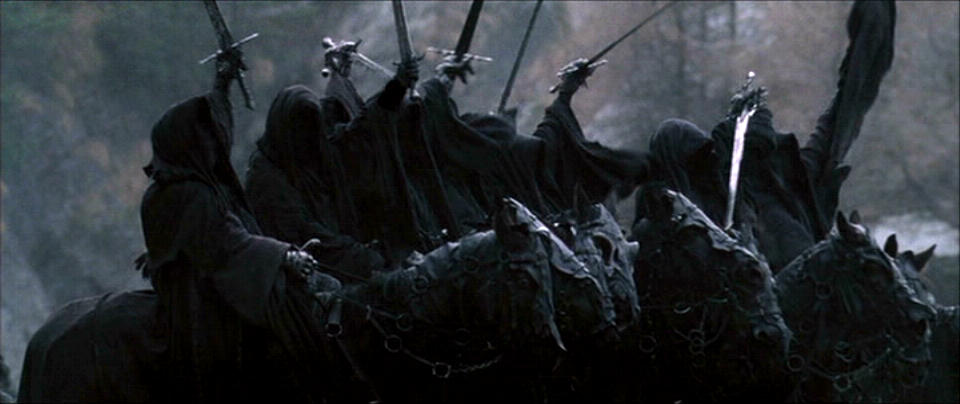
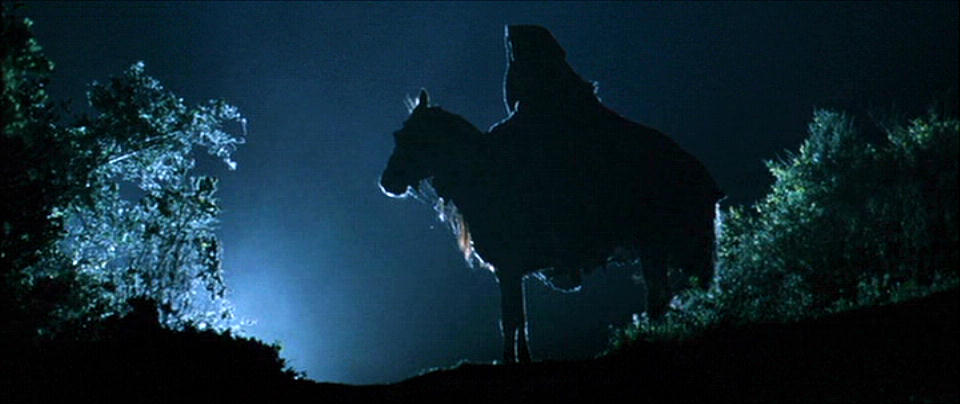
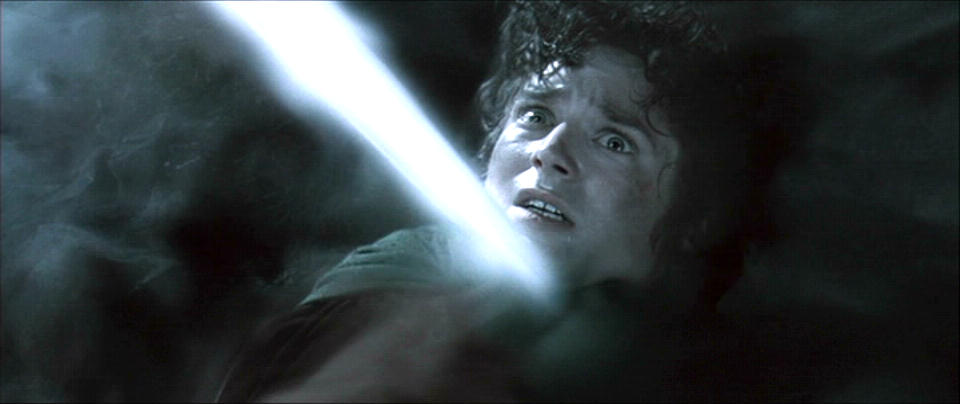
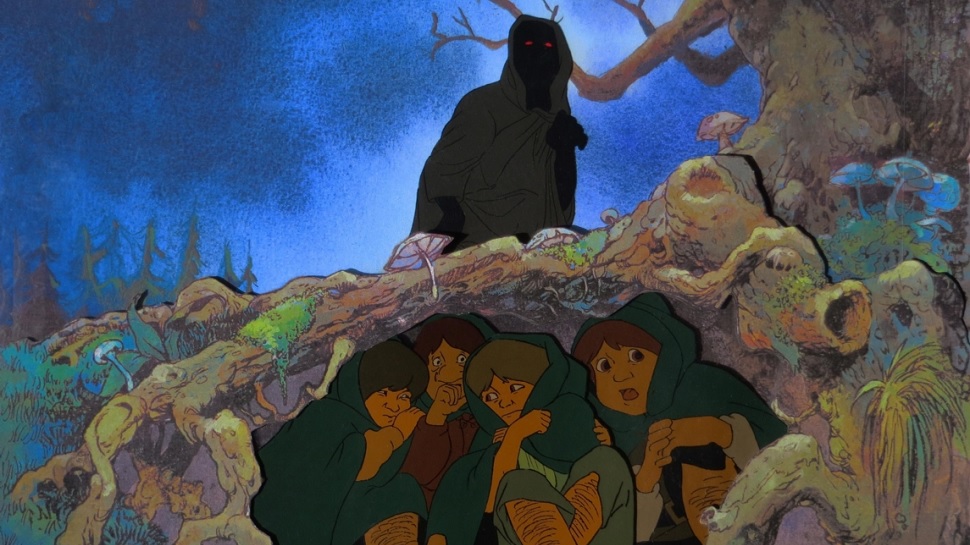
Why do some Nazgûl thrive when commanded to hunt down their master’s stolen Ring while others falter under pressure? Why do some revel in the responsibility of throwing down their enemy when others wither like fog in strong sunlight?
You might not know it, but nine (count them!) keenly honed success habits keep them hot on the trail. Nazgûl apprentices, here are those nine instinctive habits that the most successful Ringwraiths draw on in their daily unlife to keep the Dark Lord number one. Read and learn.
1) Let your powers combine.
Captain Planet does it. Voltron does it. The Power Rangers too. So take heed: when it matters, ensure you gather under your fell leader so that even the Wise might fear to face you.
2) Wear black. Lots and lots of black.
Black never goes out of style. And the effect is scary as the Dickens when when you loom menacingly into view of your prey just as the light fades.
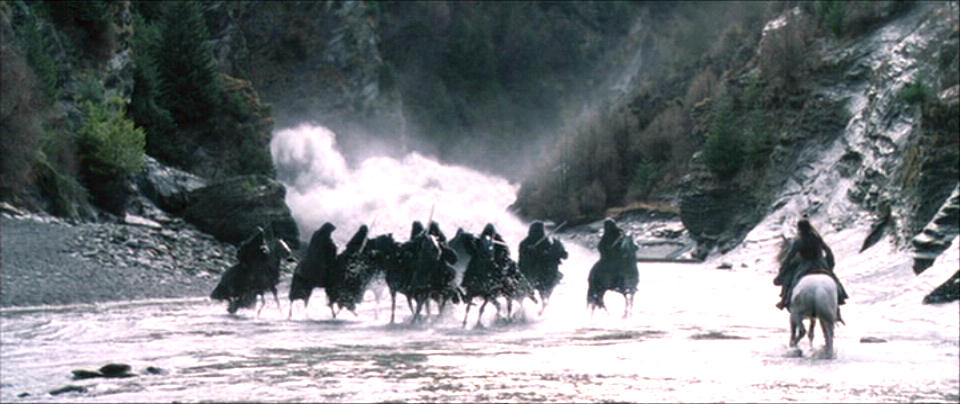
3) Embrace your hydrophobia!
Never forget that you and water do not get along. At all. In that sense, you might as well be the Wicked Witch-king of the West. Next time you consider fording that tiny creek? Think twice.
4) Don’t put a Ring on it, stick a Morgul Blade in it.
They say if you love it, put a ring on it. But only the Dark Lord may do that. Use a Morgul Blade to express your affection instead. It’s the smart way to ensure your new BFF will stay by your side always and forever!
5) Maintain a ready supply of remounts and robes.
There are few worse humiliations for a Ringwraith than having to crawl back naked and unclothed to your Dark Lord because you went for an impromptu dip and it all went pear-shaped. So for the love of Morgoth, pack extra robes (black, of course) and take a spare horse or an enormous flying raptor thing (or both!) just in case.
6) Let your minions do the dying for you.
Need to destroy the gates of the enemy fortress? Compel your horde of minions to do it for you! Drive them before you like cattle until they fear you more than the enemy’s darts and arrows. Don’t forget to ride to your glorious victory over the crushed, mutilated corpses of friend and foe for additional intimidation.
7) Remember, fear is your chief weapon.
And surprise. And fanatical devotion to The Po… err … Sauron. Anyway, the key point is intimidate your opponents (or your minions) until they give you what you want, or flee in terror.
8) Always stop to smell the roses.
Your sense of smell is even better than a labrador’s or a beagle’s. Only the foolish Nazgûl rush heedlessly ahead. Savour the scents and let your nose guide you to that which the Dark Lord desires.
9) Never reveal your name. Don’t encourage familiarity.
You are one of the Nazgûl, the chief and most-feared servants of the Dark Lord, not a camp counsellor. Be the Nameless Fear. Names are for lesser minions — and, seemingly, Khamûl. Because he just has to be different from everyone else.
Throwback to a post from some years ago, by the very excellent Staffer Demosthenes with help from LurkingLaurie.
Images from PJ’s LOTR via the very excellent FrameCapLib LOTR screecap project; and one from Ralph Bakshi’s LOTR (1978).
If you have a Tolkien/Middle-earth inspired poem you’d like to share, then send it to poetry@theonering.net. One poem per person may be submitted each month. Please make sure to proofread your work before sending it in. TheOneRing.net is not responsible for poems posting with spelling or grammatical errors.
Since the announcement of The War of the Rohirrim, I’ve been pondering how it might all come together. And, in particular, I’ve been pondering the potential role, actions and presence of Saruman.
Here’s why.
We know that after coming to Middle-earth (recorded as around TA 1000) Saruman does not settle down. He goes east (as do the Blue Wizards) into the lands beyond Mordor — presumably Harad, Khand and Rhûn. Unlike the Blue Wizards, he returns.
When is not precisely specified. However, in TA 2463 Galadriel summons the first meeting of the White Council (probably held in Rivendell). Given that the outcome of that meeting is that Saruman is appointed head of the council, he must surely have been present.
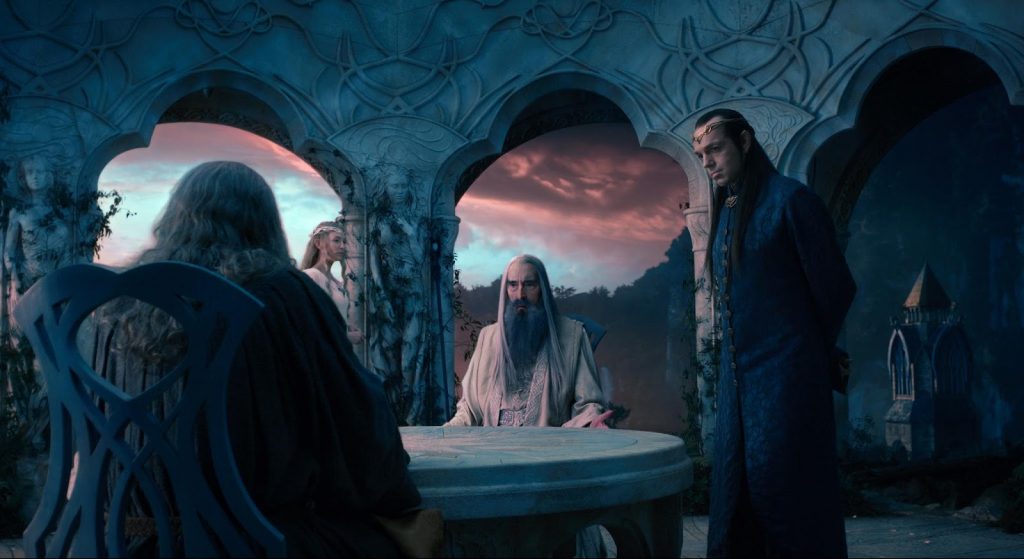
The White Council meets in Rivendell in Peter Jackson’s The Hobbit.
Might he have returned to the lands in the east following that? He may have. But another option occurs to me: a long sojourn in Minas Tirith — perhaps interrupted by occasional ventures into other lands.
`In former days the members of my order had been well received [in Gondor], but Saruman most of all. Often he had been for long the guest of the Lords of the City. Less welcome did the Lord Denethor show me then than of old, and grudgingly he permitted me to search among his hoarded scrolls and books. ‘”If indeed you look only, as you say, for records of ancient days, and the beginnings of the City, read on!” he said. “For to me what was is less dark than what is to come, and that is my care. But unless you have more skill even than Saruman, who has studied here long, you will find naught that is not well known to me, who am master of the lore of this City.”‘
The Council of Elrond, The Lord of the Rings
In fact, as the shiny new head of the White Council, Saruman may well have spent — on and off — several hundred years in Minas Tirith forging good relations with Gondor’s stewards because of its importance as a bulwark against the re-emerging threat of Mordor.
There is some support to be gleaned for this view from Unfinished Tales.
Now the White Messenger in later days became known Elves as Curunír, the Man of Craft, in the tongue of Northern Men Saruman; but that was after he returned from his many journeys and came into the realm of Gondor and there abode.
The Istari, Unfinished Tales of Númenor and Middle-earth
And key events occur in, or around, Gondor during that period. Attacks on Gondor began again in TA 2475. Osgiliath is finally ruined, and its stone-bridge broken. Then, in TA 2510 orcs and Easterlings overrun Calenardhon. Gondor is only saved by the assistance of Eorl the Young. That famous victory at the Field of Celebrant paves the way for the pact of then-Steward Cirion and Eorl that allows the Rohirrim to subsequently settle in Calenardhon.
These are all solid reasons for Saruman to spend time working behind the scenes in Minas Tirith during this period.
Set against all this, the headnote to Appendix B simply states that “Curunír journeyed often into the East, but dwelt at last in Isengard.” But, like, I said, he need not have been in Minas Tirith during all of that period.
At this point, Orthanc is long-unoccupied with the keys at Minas Tirith in the possession of the ruling Steward. Tolkien’s essay on The Palantíri describes how by the time of the rule of the Stewards only rustic “hereditary chieftains” remain in Isengard (Orthanc itself is empty and locked) and that even these are eventually supplanted, subverted, or slain, by Dunlendings.
It is this that gives the Dunlendings in TA 2758 — lead by Wulf — leverage for their campaign against Helm Hammerhand.
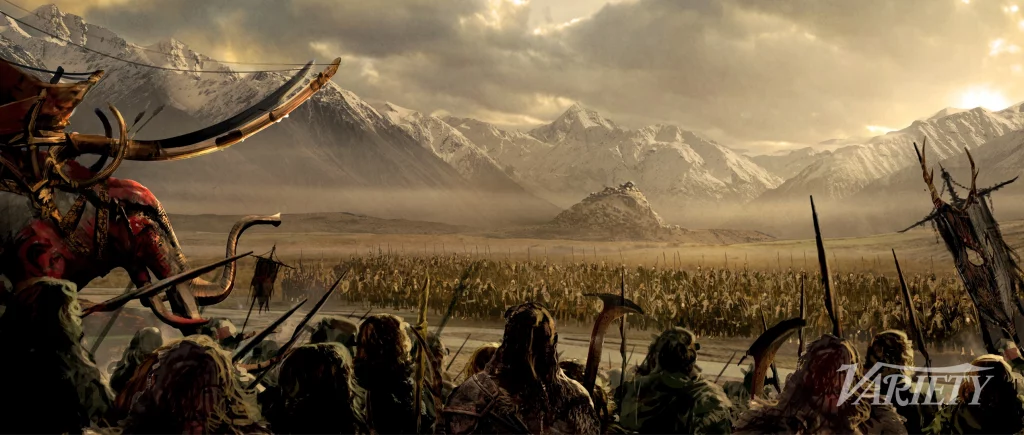
Concept art for The War of the Rohirrim showing showing Edoras being beseiged.
But, returning to Saruman, what might have he been doing during this period when both Gondor and Rohan are fighting for their very existence?
We know Saruman has the power to make a difference as Gondor struggled to repel the Corsairs raiding its own coasts. It also seems very possible he was residing in Minas Tirith at the time. But we also know he is constrained by the Valar’s exhortation to “avoid open display of power” and “seek to unite in love and understanding all those whom Sauron, should he come again, would endeavour to dominate and corrupt”.
Surely he wouldn’t just spend such a critical period merely sifting through Minas Tirith’s archives.
So let’s do some theory-crafting here.
What if Saruman had played some key role in repelling the Corsairs from the south Gondor coasts, allowing Gondor to finally come to Rohan’s aid? Surely that would earn him the gratitude of Gondor’s Steward and cement his reputation as a friend of the Dúnedain and the Rohirrim.
It need not have even been a dramatic display of power. After all, during the War of the Ring, Gandalf saves Theoden at Helm’s Deep through his efforts at gathering and coordinating those who opposed Saruman (and Sauron). He gathers the scattered forces of Erkenbrand. He gains the assistance of Treebeard and the loan of the Huorns.
Would Saruman have the humility to accomplish something in a similar vein? To be a facilitator rather than to seek to rule wills through open display of power? I’m not so sure about that — Unfinished Tales suggests that even at this point Saruman was disenchanted by the suggestion that Gandalf should head the White Council, and more generally jealous of the respect Gandalf was accorded. We don’t know for sure, but by this time he may even have been aware that Cirdan had given Gandalf the Narya, the ring of fire.
That might push Saruman to dramatic efforts to assist the Steward of the time, Beren, in repelling the Corsairs. Dramatic efforts that would gain greater recognition.
But what sort of efforts?
For The War of the Rohirrim anime, one answer might draw on the “canon” of the Peter Jackson films. In those, Saruman appears to harness the weather to command the snowstorm on the pass of Caradhras that dramatically halts the progress of the Fellowship.
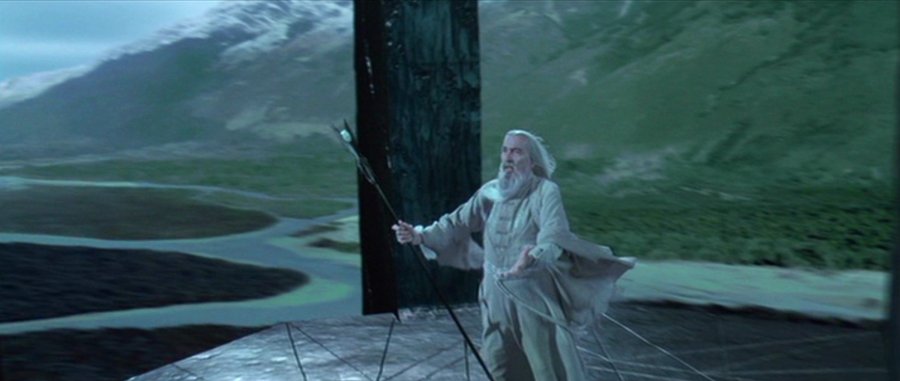
Saruman summon the storm on Caradhras in the PJverse in The Fellowship of the Ring.
What if, during The War of the Rohirrim he was to do the opposite — exerting his powers to halt the Long Winter that so devastated the Rohirrim? Or at least to lessen its effects?
The Tale of Years records:
In that year (2758) the Long Winter began with cold and great snows out of the North and the East which lasted for almost five months. Helm of Rohan and both his sons perished in that war; and there was misery and death in Eriador and in Rohan. But in Gondor south of the mountains things were less evil, and before spring came Beregond son of Beren had overcome the invaders.
The Tale of Years, The Lords of the Rings
The section detailing the history of the House of Eorl further adds that winter broke soon after the death of Helm. No date is given, but given that Rohan lay under snow from November to March of 2758-9, one could reasonably deduce that the snowmelt began in early-mid April.
Perhaps, in this WarnerBros-verse, Saruman could lend his efforts to keep winter’s effects from devastating Gondor, and/or contribute to breaking its deathly grip on Rohan. This would allow Beregond (son of the Steward, Beren) the opportunity to oust the Corsairs from Gondor’s southern coasts. Beregond can then finally come to the aid of the Rohirrim just as Helm’s sister’s son and heir, Fréaláf, completes his breakout from the fastness of Dunharrow and manages to surprise and slay Wulf in Meduseld.
Rohan and Gondor are saved. Apart from the proposed influence of Saruman, all this is per Tolkien’s given history.
In the aftermath, a grateful Beren asks Saruman what reward he would have. Saruman simply requests the guardianship of Orthanc and the Ring of Isengard in order to, as outlined in Unfinished Tales, “repair it and reorder it as part of the defences of the West.”
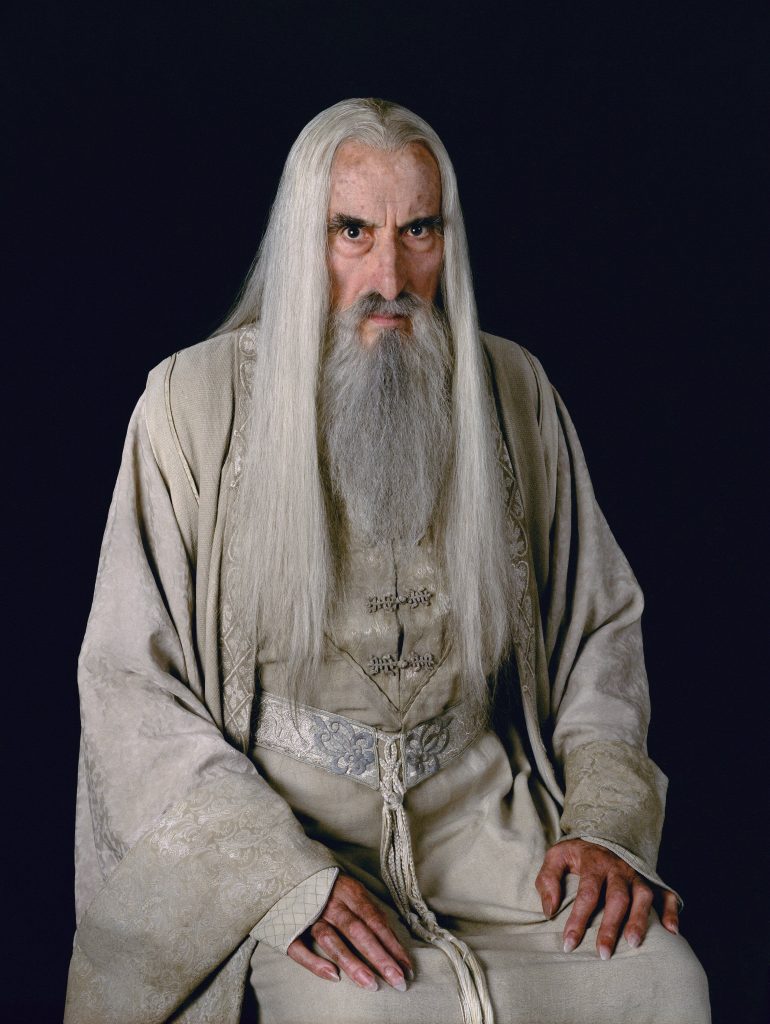
Chris Lee as Saruman the White.
What of Saruman’s motives here?
The Tale of Years records that “at the crowning of Fréaláf that Saruman appeared, bringing gifts, and speaking great praise of the valour of the Rohirrim. All thought him a welcome guest.”
He earns not just great prestige, but a seat of power that provides clear control over the Gap of Rohan. Was he intent on consolidating a powerbase even at that point? Or sensibly plugging a hole in the defences of the free peoples of Middle-earth?
Unfinished Tales records that Saruman “had no doubt from his investigations gained a special knowledge of the Stones… and had become convinced that the Orthanc-stone was still intact in its tower.” It further adds that if the then-Steward, Beren, considered the Stone at all when he handed over Orthanc’s keys “he probably thought that it could be in no safer hands than those of the head of the Council.”
In itself that is not damning as to Saruman’s intent. What is dubious is that Saruman never reports the existence of the Orthanc to his colleagues. But it’s not until TA 2850 that he sends servants to search in secret for the Ring at the Gladden Fields. The Tale of Years suggests that it was around that time that Saruman had begun to desire the the Ring for himself. Finally, in TA 2953 he completely stops cooperating with other members of the Council and begins spying on Gandalf.
Regardless, there’s an opportunity for director Kenji Kamiyama to include Saruman in The War of the Rohirrim as more than someone who merely shows up to occupy Orthanc at the end of the film. It will be interesting to see if (and how) he uses that opportunity.
About the author: Staffer Demosthenes has been involved with TheOneRing.net since 2001, serving first as an Associate News Editor, then as Chief News Editor during the making of the Hobbit films. Now he focuses on features and analysis.The opinions in this article are his own and do not necessarily represent those of TheOneRing.net and other staff.
If you have a Tolkien/Middle-earth inspired poem you’d like to share, then send it to poetry@theonering.net. One poem per person may be submitted each month. Please make sure to proofread your work before sending it in. TheOneRing.net is not responsible for poems posting with spelling or grammatical errors.
In the early 1990s, Russian director Roman Mitrofanov began working on an animated version of The Hobbit. The effort ultimately fizzled in the dissolution of the Soviet Union, but six minutes of footage survives and can be watched on Youtube to this day.
The footage functions more or less as a prologue that shows not much more than the destruction of Erebor and Dale by Smaug, and was clearly intended to be just the beginning of a complete adaptation.
It’s also full of delightful details such as the bells and the toy-market that Thorin Oakenshield describes to Bilbo during the Unexpected Party.
They built the merry town of Dale there in those days. Kings used to send for our smiths, and reward even the least skilful most richly. Fathers would beg us to take their sons as apprentices, and pay us handsomely, especially in food-supplies, which we never bothered to grow or find for ourselves. […] and the toy-market of Dale was the wonder of the North.
The Hobbit
Treasures under the Mountain, an incomplete Russian adaption of J.R.R. Tolkien’s The Hobbit from 1991.
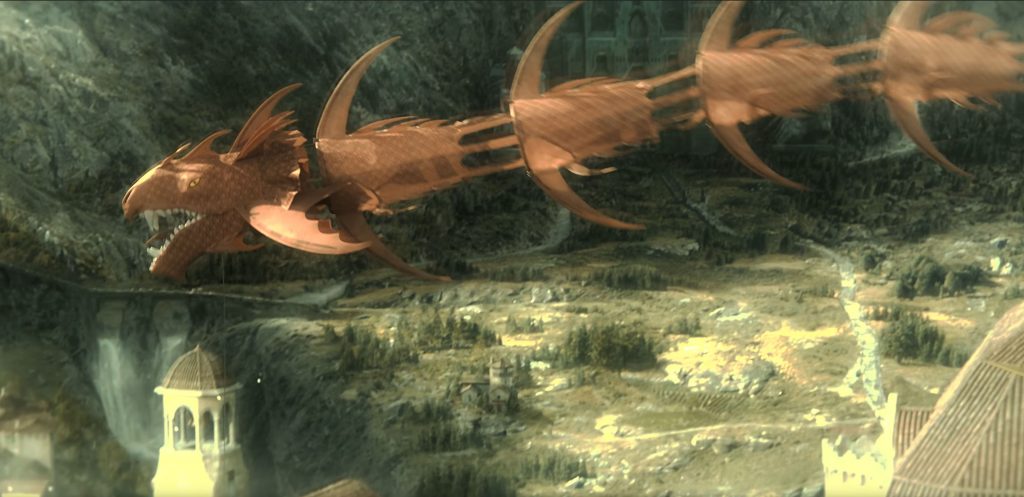
The bucolic imagery of Dale also includes a brief view (at approximately 2 mins 12 secs) of several people flying kites over the town square. If one squints just right (the quality is only 360p), one might construe one as having the shape of a dragon even.
Peter Jackson’s rendition of Dale shares many of the same details. Of course, this should not be surprising — they pull from the same source. But an inspection of the text of The Hobbit reveals no mention the people of Dale having kites or gliders. There’s nothing similar in The Lord of the Rings, either, not even when Frodo reminisces with Glóin in Rivendell.
This prompts the question: might Jackson — or one of his crew — have seen the Russian animation, liked the concept, and been inspired to use the kites in a similar fashion as a beautiful and poignant foreshadowing device?