In 1953, J.R.R. Tolkien visited the University of Glasgow, to give a lecture on the medieval poem Sir Gawain and the Green Knight. Later this month, the university’s Centre for Fantasy and the Fantastic will celebrate the anniversary of the event – and you can join them, in person or online!
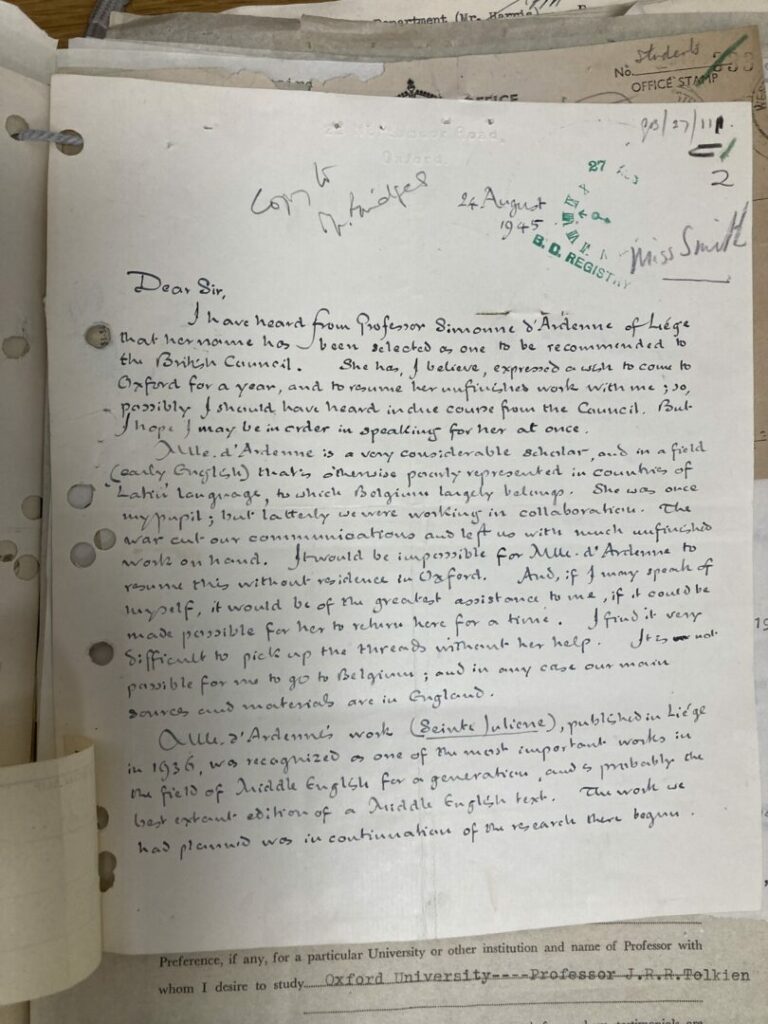
With an illustrious panel of speakers, chaired by Dr Dimtra Fimi, the event includes a pop-up exhibition featuring a handwritten letter from the Professor.
Here’s what the University’s official press release tells us:
UNIVERSITY OF GLASGOW TO CELEBRATE LORD OF THE RINGS AUTHOR JRR TOLKIEN
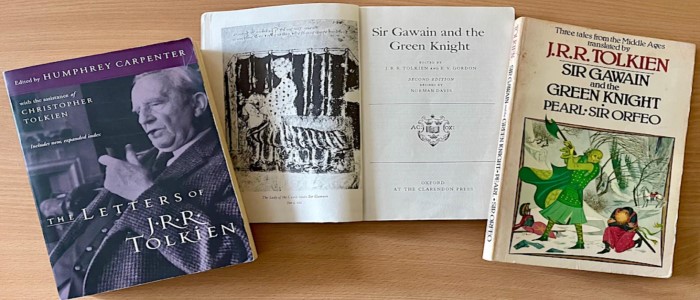
A selection of books by JRR Tolkien including Sir Gawain and the Green Knight (above)
Today he is remembered as the “father” of modern fantasy literature and the author of two of the best-loved and biggest-selling books of all time.
When JRR Tolkien visited the University of Glasgow 70 years ago, he had written The Hobbit to great acclaim and was on the cusp of publishing the 1st volume of The Lord of the Rings.
In 1953, Tolkien, then Oxford University Merton Professor of English Language and Literature, was in Scotland to give a lecture on late 14th-century poem Sir Gawain and the Green Knight – a key text in the Arthurian tradition featuring young King Arthur himself, the knight Sir Gawain, a mysterious green knight, and the sorceress Morgan le Fay. The poem is itself a source text for modern fantasy and was an inspiration for Tolkien in his Middle-earth mythology.
But it was obvious Tolkien’s popularity as a fantasy writer was on the rise in 1953, as the ticketed WP Ker Memorial Lecture was at its capacity with 300 people in attendance.
Now academics at the Centre for Fantasy and the Fantastic are celebrating Tolkien’s Glasgow connection with a special event to mark the 70th anniversary of Tolkien’s Sir Gawain and the Green Knight lecture.
Dr Dimitra Fimi, Senior Lecturer in Fantasy and Children’s Literature at the University of Glasgow and the Co-Director of the Centre for Fantasy and the Fantastic, said: “It was a thrill to discover more about Tolkien’s lecture at Glasgow and this fascinating connection to the city, including the venue it was held, and the handwritten letter by Tolkien in our archives.
“Today 70 years later at the University of Glasgow, Tolkien’s own work is on the curriculum of our Fantasy MLitt programme, and we have various PhD students working on Tolkien.”
Dr Andoni Cossio, Postdoctoral Fellow, Centre for Fantasy and the Fantastic, said: “As a schoolboy, Tolkien had a great affection for Sir Gawain and the Green Knight poem, which even led to occasional recitations of certain passages for his friends.
“By the time of the Glasgow lecture, Tolkien had a deep knowledge of the poem that he put to good use in his university teaching, supervision and lectures. Tolkien had also prepared and published an edition of Sir Gawain and the Green Knight in 1925 (together with his colleague EV Gordon), which is remains today an important textbook for students studying the poem and helped establish it as a canonical text in medieval studies.
“During his 1953 W. P. Ker lecture, Tolkien quoted from his own Sir Gawain translation, which was later broadcast by the BBC. The University of Glasgow lecture was only accessible much later to a wider audience when it was published in 1983.
The Tolkien Sir Gawain lecture 70th anniversary event is hybrid – both in person at the University of Glasgow and online. For those attending on-campus, there will be an opportunity to see a pop-up exhibition with documentation related to Tolkien’s appointment as the 1953 WP Ker Memorial Lecturer (including a hand-written letter by Tolkien), in collaboration with Archives & Special Collections, University of Glasgow.
Tolkien and Glasgow
On 15 April 1953, Tolkien delivered the WP Ker Memorial Lecture, on Sir Gawain and the Green Knight, to an audience of 300 at the University of Glasgow. The essay was published posthumously, in 1983, in The Monsters and the Critics and Other Essays, edited by Christopher Tolkien.
Join us at Glasgow on Thursday 27 April 2023, 5-6:30pm, on-campus (Joseph Black Building) or online, to celebrate the 70th anniversary of the lecture and its significance, Tolkien’s links to Glasgow, and the importance of the Sir Gawain poem in Tolkien’s creativity.
Our panel of speakers will feature:
- Professor Jeremy Smith, Honorary Senior Research Fellow, University of Glasgow
- Dr Lydia Zeldenrust, Lecturer in Middle English Literature, University of Glasgow
- Dr Andoni Cossio, Postdoctoral Fellow, Centre for Fantasy and the Fantastic
- Chair: Dr Dimitra Fimi, Senior Lecturer in Fantasy and Children’s Literature, and Co-Director of the Centre for Fantasy and the Fantastic
It’s free to attend this event – either in person or online – but you do need to book via Eventbrite.