The landlady of The Hobbit pub in Portswood is raising money to help pay legal fees as wrangling over the small print of a deal made over copyright with Hollywood’s Saul Zaentz Company (SZC) continues.
Pub landlady Stella Roberts said she could not discuss the negotiations as she had signed a confidentiality agreement but said “We are very frustrated. We’re living in limbo here. We just want the whole thing finished. We just don’t know what to do. We’ve been advised to carry on trading as we were, because we haven’t got a lot of choice.”
A letter from SZC in March had asked the pub to remove all JRR Tolkien branding. The company later agreed to license Tolkien brands in order to resolve the dispute over the pub’s name.
During the San Diego Comic-con Andy Serkis spoke extensively about his portrayal of the character Gollum. In doing so, he made some startlingly specific comments about the character’s age.
Here, TORn guest writer Elpidha Lirgalad examines the implications, and reaches some very interesting conclusions about what it could mean for the Hobbit trilogy. These views are her own, and do not necessarily represent those of TheOneRing.net or its staff.
WARNING: Spoilers and speculation!
How old is PJ’s Gollum? And what could that mean?
A guest post by Elpidha Lirgalad
Ever since the release of Peter Jackson’s The Fellowship of the Ring in 2001, some eagle-eyed fans have been asking why it appears that no time passes at all between Bilbo’s 111th birthday party and Frodo’s departure from the Shire. Continue reading “Greenbooks guest post: how old is PJ’s Gollum?”
If you have a Tolkien/Middle-earth inspired poem you’d like to share, then send it to poetry@theonering.net. One poem per person may be submitted each month. Please make sure to proofread your work before sending it in. TheOneRing.net is not responsible for poems posting with spelling or grammatical errors.
The International Astronomical Union (IAU) recently approved a proposal to assign names to nine impact craters on the planet Mercury.
What does this have to do with Tolkien fandom? Well, in keeping with the established naming theme for craters on Mercury, they are all named after famous deceased artists, musicians, or authors or other contributors to the humanities. One of the craters has been named in honour of JRR Tolkien.
The IAU has been the arbiter of planetary and satellite nomenclature since its inception in 1919.
Parma Eldalamberon (The Book of Elven-tongues) is a journal of the Elvish Linguistic Fellowship, a special interest group of the Mythopoeic Society. This new issue presents previously unpublished writings by J. R. R. Tolkien about an early version of one of his invented scripts, edited and annotated by Arden R. Smith, under the guidance of Christopher Tolkien and with the permission of the Tolkien Estate.
The Qenya Alphabet is an edition of Tolkien’s charts and notes dealing with the circa-1931 version of the writing-system later called Fëanorian Tengwar. It includes 40 documents in which Tolkien’s examples of the scripts are reproduced using electronic scans of black-and-white photocopies of the original manuscripts. Continue reading “New Eldalamberon from Elven Linguistic Fellowship”
Novelist Helen Cross, who herself lives in Birmingham, uncovers the story of the young J.R.R. Tolkien, falling in love with Edith Bratt. Their relationship was the inspiration for the love story of Beren and Luthien at the heart of The Silmarillion.
Listen to Cross in this BBC radio program broadcast just last weekend as she visits key locations in Birmingham, Cheltenham and Oxford, and tells the story of Tolkien’s young life and the love story at the heart of it. NB: you may have to be in the UK to listen to this. Thanks to Ringer David for the tip.
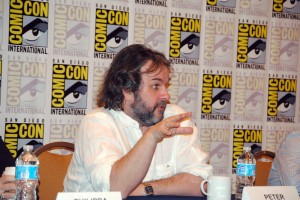
We all listened to and read Peter Jackson’s words from Comic-Con about three possible “Hobbit,” movies carefully. But we didn’t listen to all the words and we missed a few things.
He told us. He told us — he did.
He said exactly what he meant, he said it plainly and the media and fans (and me) tried to figure out what he meant when he told us in plainness. Monday, Jackson dropped an atomic bomb of news and fandom reacted accordingly.
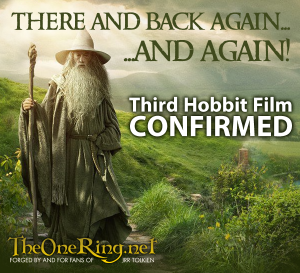
“The Hobbit,” adapted for the screen from the 300-page, 75-year-old book by J.R.R. Tolkien changed from from two movies to three in the blink of a Facebook post.
AMBITION
More on the words we ignored in a minute. We need to figure out when these films break, what it means for fans and websites and studios and cinema and the director, but lets not rush past the size and scope of this news. Lets not walk around Paris admiring all the cafes and churches without also pausing and noticing the big tower in the center of town.
We witnessed, the last few weeks since Comic-Con, something monumental, unprecedented, unparalleled and a little bit crazy. Jackson (and when we say “Jackson” we always mean the director and Walsh, Boyens and a team of others supporting their vision) is in unchartered territory here. Continue reading “The bold ‘Hobbit’ trilogy decision and what to expect”


 The landlady of The Hobbit pub in Portswood is raising money to help pay legal fees as wrangling over the small print of a deal made over copyright with Hollywood’s Saul Zaentz Company (SZC) continues.
 During the San Diego Comic-con Andy Serkis spoke extensively about his portrayal of the character Gollum. In doing so, he made some startlingly specific comments about the character’s age.
  The International Astronomical Union (IAU) recently approved a proposal to assign names to nine impact craters on the planet Mercury.
  Parma Eldalamberon (The Book of Elven-tongues) is a journal of the Elvish Linguistic Fellowship, a special interest group of the Mythopoeic Society. This new issue presents previously unpublished writings by J. R. R. Tolkien about an early version of one of his invented scripts, edited and annotated by Arden R. Smith, under the guidance of Christopher Tolkien and with the permission of the Tolkien Estate.
 Novelist Helen Cross, who herself lives in Birmingham, uncovers the story of the young J.R.R. Tolkien, falling in love with Edith Bratt. Their relationship was the inspiration for the love story of Beren and Luthien at the heart of The Silmarillion.