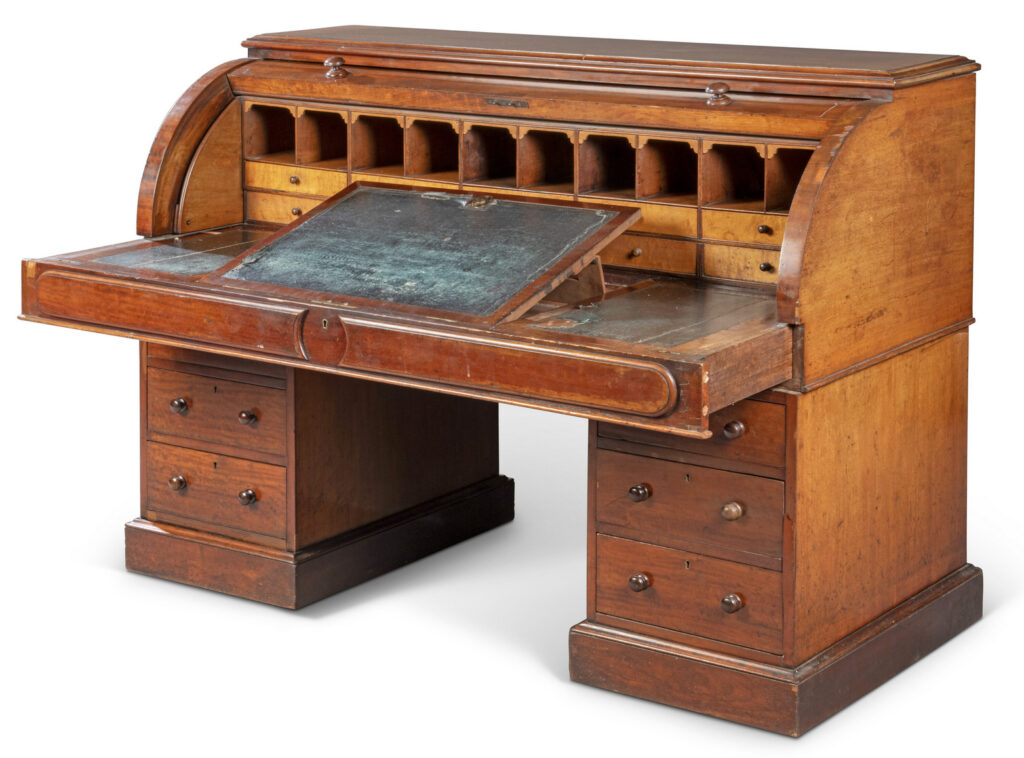
Imagine sitting and writing at the desk where J.R.R. Tolkien worked on The Lord of the Rings.
Someone will soon have the opportunity to do just that because the storied desk will soon be up for auction at Christie’s. Perhaps the new owner will consider the mid-Victorian roll-top too precious to use and will keep it as a shrine to the author.
J.R.R. Tolkien’s desk as Featured in Christie’s Auction
The desk was used by Tolkien from 1945-1959 when he was a professor of English language and literature at Merton College, University of Oxford, and later at his residence on Sandfield Road in Headington, Oxford. It is thought to be the desk he used while working on the final revisions for his epic fantasy. Photos of Tolkien sitting at the desk were taken by photographer Haywood Magee in 1955, shortly after the publication of The Lord of the Rings.
In 1953, J.R.R. Tolkien visited the University of Glasgow, to give a lecture on the medieval poem Sir Gawain and the Green Knight. Later this month, the university’s Centre for Fantasy and the Fantastic will celebrate the anniversary of the event – and you can join them, in person or online!
With an illustrious panel of speakers, chaired by Dr Dimtra Fimi, the event includes a pop-up exhibition featuring a handwritten letter from the Professor.
UNIVERSITY OF GLASGOW TO CELEBRATE LORD OF THE RINGS AUTHOR JRR TOLKIEN
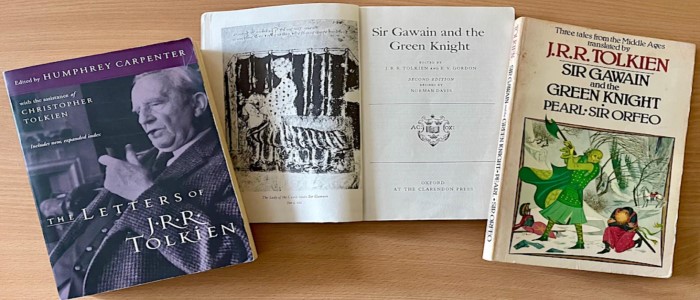
A selection of books by JRR Tolkien including Sir Gawain and the Green Knight (above)
Today he is remembered as the “father” of modern fantasy literature and the author of two of the best-loved and biggest-selling books of all time.
When JRR Tolkien visited the University of Glasgow 70 years ago, he had written The Hobbit to great acclaim and was on the cusp of publishing the 1st volume of The Lord of the Rings.
In 1953, Tolkien, then Oxford University Merton Professor of English Language and Literature, was in Scotland to give a lecture on late 14th-century poem Sir Gawain and the Green Knight – a key text in the Arthurian tradition featuring young King Arthur himself, the knight Sir Gawain, a mysterious green knight, and the sorceress Morgan le Fay. The poem is itself a source text for modern fantasy and was an inspiration for Tolkien in his Middle-earth mythology.
But it was obvious Tolkien’s popularity as a fantasy writer was on the rise in 1953, as the ticketed WP Ker Memorial Lecture was at its capacity with 300 people in attendance.
Now academics at the Centre for Fantasy and the Fantastic are celebrating Tolkien’s Glasgow connection with a special event to mark the 70th anniversary of Tolkien’s Sir Gawain and the Green Knight lecture.
Dr Dimitra Fimi, Senior Lecturer in Fantasy and Children’s Literature at the University of Glasgow and the Co-Director of the Centre for Fantasy and the Fantastic, said: “It was a thrill to discover more about Tolkien’s lecture at Glasgow and this fascinating connection to the city, including the venue it was held, and the handwritten letter by Tolkien in our archives.
“Today 70 years later at the University of Glasgow, Tolkien’s own work is on the curriculum of our Fantasy MLitt programme, and we have various PhD students working on Tolkien.”
Dr Andoni Cossio, Postdoctoral Fellow, Centre for Fantasy and the Fantastic, said: “As a schoolboy, Tolkien had a great affection for Sir Gawain and the Green Knight poem, which even led to occasional recitations of certain passages for his friends.
“By the time of the Glasgow lecture, Tolkien had a deep knowledge of the poem that he put to good use in his university teaching, supervision and lectures. Tolkien had also prepared and published an edition of Sir Gawain and the Green Knight in 1925 (together with his colleague EV Gordon), which is remains today an important textbook for students studying the poem and helped establish it as a canonical text in medieval studies.
“During his 1953 W. P. Ker lecture, Tolkien quoted from his own Sir Gawain translation, which was later broadcast by the BBC. The University of Glasgow lecture was only accessible much later to a wider audience when it was published in 1983.
The Tolkien Sir Gawain lecture 70th anniversary event is hybrid – both in person at the University of Glasgow and online. For those attending on-campus, there will be an opportunity to see a pop-up exhibition with documentation related to Tolkien’s appointment as the 1953 WP Ker Memorial Lecturer (including a hand-written letter by Tolkien), in collaboration with Archives & Special Collections, University of Glasgow.
Tolkien and Glasgow
On 15 April 1953, Tolkien delivered the WP Ker Memorial Lecture, on Sir Gawain and the Green Knight, to an audience of 300 at the University of Glasgow. The essay was published posthumously, in 1983, in The Monsters and the Critics and Other Essays, edited by Christopher Tolkien.
Join us at Glasgow on Thursday 27 April 2023, 5-6:30pm, on-campus (Joseph Black Building) or online, to celebrate the 70th anniversary of the lecture and its significance, Tolkien’s links to Glasgow, and the importance of the Sir Gawain poem in Tolkien’s creativity.
Our panel of speakers will feature:
Professor Jeremy Smith, Honorary Senior Research Fellow, University of Glasgow
Dr Lydia Zeldenrust, Lecturer in Middle English Literature, University of Glasgow
Dr Andoni Cossio, Postdoctoral Fellow, Centre for Fantasy and the Fantastic
Chair: Dr Dimitra Fimi, Senior Lecturer in Fantasy and Children’s Literature, and Co-Director of the Centre for Fantasy and the Fantastic
It’s free to attend this event – either in person or online – but you do need to book via Eventbrite.
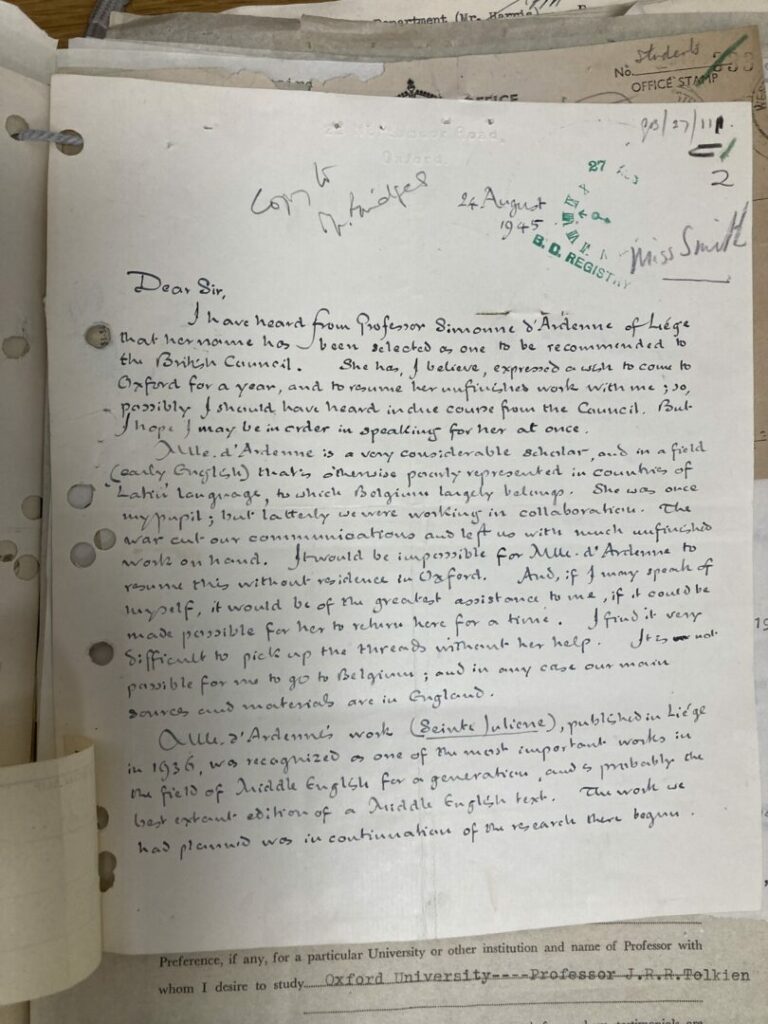
Two handwritten letters, from J.R.R. Tolkien to the British Council, have been uncovered by a volunteer at the National Archives in Kew.
In a recently published blog, we are told: ‘The correspondence centres on Tolkien’s research collaboration with Simonne d’Ardenne, a former student of his at Oxford, who shared his academic interest in historical languages.’
It’s always exciting to uncover new items related to the Professor – and especially to see that familiar and unique handwriting. The letters will remain at the National Archives, added to the previously catalogued Tolkien correspondence in their collection. You can read more about this unearthed treasure here.
Smith, killed by shrapnel near the end of WWI’s Battle of the Somme, was one of Tolkien’s closest friends from late childhood.
As an alumnus of Corpus Christi College, poet Smith may be best known for his work “A Spring Harvest,” and is a recognized influence in Tolkien’s life and writings. Tolkien and Smith were friends from King Edward’s School days and part of the tight-knit Tea Club and Barrovian Society.
Corpus Christi hosts this two-day series in honor of the 50th anniversary of the Professor’s passing, organized by Doug Anderson, Oronzo Cilli, and Beppe Pezzini. Confirmed speakers include John Garth, Grace Khuri, Mark Atherton, and many more.
Click here for lecture topics and further details, and here for more related reading (from 2016!) over at The Tolkien Society, including a link to “Tolkien’s Great War,” a halfling-sized documentary film published by King Edward’s School, Birmingham.
Those of you fortunate enough to get your “sticky paws” on the October issue of Smithsonian are in for a HUGE treat. John Garth, acclaimed author of The Worlds of J.R.R. Tolkien: The Places that Inspired Middle-earth, Tolkien and the Great War, and others, has penned (pixelled?) a phenomenal read for the complete Tolkien newbie as well as the Tolkien-lifers of the world.
Garth’s exposition provides the reader an important contextualization to better understand and appreciate Tolkien’s writing, and more specifically, the stories behind Prime Video’s Rings of Power. Part abbreviated biography, part history of Tolkien’s writing and publication journeys, and part Númenorian exposé, this essay covers a vast amount of ground with precision, passion, and poignant prose.
The author fused his inspirations into an alloy that he could shape freely. He also generated multiple stories from a single inspiration. What he called his “feigned history” lives on its own terms.
John Garth, Smithsonian
Coupled with Garth’s authorship are Kieran Dodd’s inspiringly rich photos. Dodd’s talents underscore and punctuate Garth’s narrative with stunning images of architecture and locations frequented by Tolkien. And yes! For those of us not fortunate to get our handses on this publication, the article is also available right here. Enjoy your read!
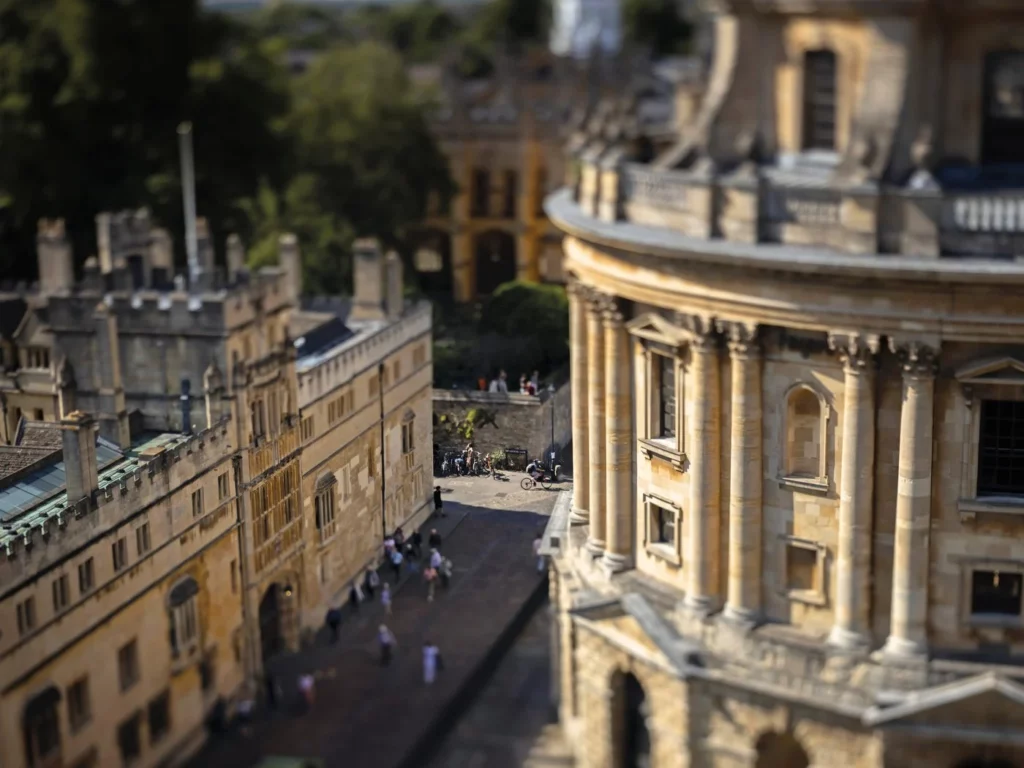
Radcliffe Camera in Oxford, inspirational to Tolkien’s concept of a Morgothian temple. Courtesy of Smithsonian. Photo by Kieran Dodds.
Priscilla Tolkien, the youngest of J.R.R. Tolkien’s four children, died on February 28 2022. She was 92 years old.
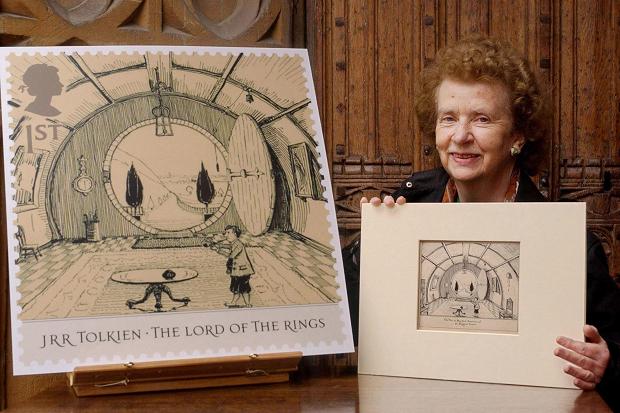
Born June 18 1929, Priscilla was the only daughter of the Professor and his wife Edith. They were already living in Oxford when she was born. At the age of fourteen, Priscilla typed up some of the early chapters of The Lord of the Rings for her father. She studied English at Lady Margaret Hall college in Oxford, who yesterday announced her passing.
Priscilla, like her older brother Christopher, was a champion of her father’s work. She was Vice-President of the Tolkien Society, and together with the oldest of the four children, her brother John, she published in 1992 The Tolkien Family Album. Frodo’s name in early drafts of The Lord of the Rings, Bingo Bolger-Baggins, apparently came from her names for a family of toy bears she had as a child.