British-born American actress Cynthia Addai-Robinson brings a broad range, strong epic roots, and even some LotR/Hobbit connections to Amazon’s new Middle-earth series.
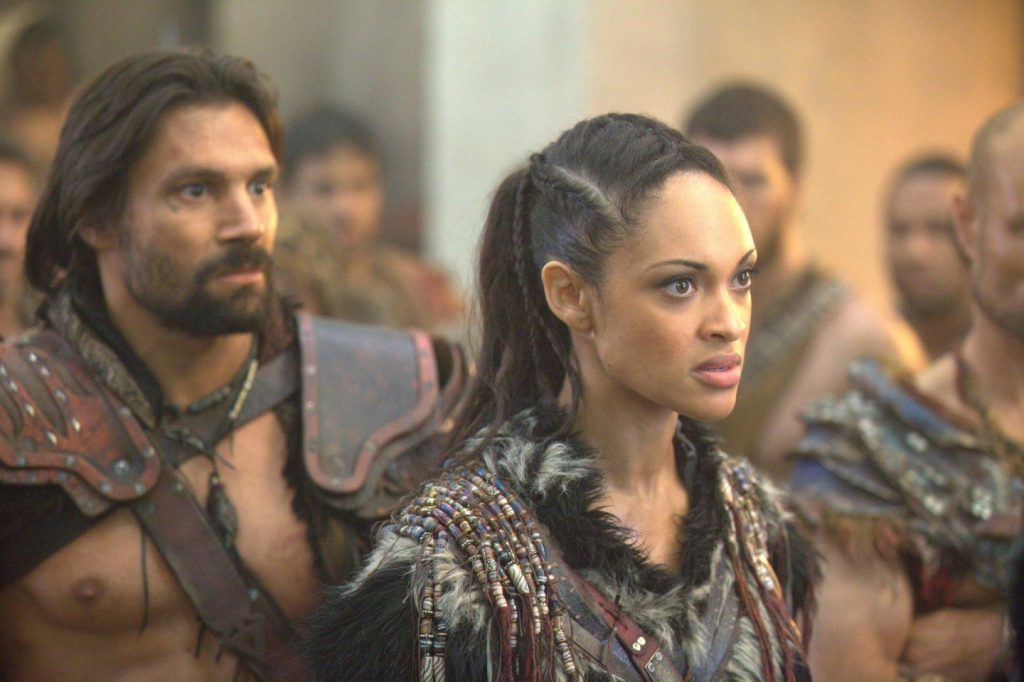
Cynthia Addai-Robinson and Manu Bennett in Spartacus
She’s experienced with episodic television, with a 2012-13 breakout role as Naevia, the slave turned warrior in the STARZ series Spartacus. The Naevia role brought with it some serious sword training, familiarity with New Zealand filming, and an overlap with some familiar folk to the Tolkien universe, including fan favorites Craig Parker, and especially Manu Bennett, who starred as Naevia’s lover, Crixus, in the series. Addai-Robinson’s credits stretch from drama (Marybeth Medina in the Ben Affleck vehicle “The Accountant”) to television series (appearing in all three CSI shows, and most recently in another STARZ series, Power), and geek-friendly offerings (like Aja in The Vampire Diaries and Amanda Waller in Arrow). Prior to taking up acting, she was an accomplished dancer, again with a broad repertoire from ballet to jazz. With that kind of range, an elven warrior role seems completely conceivable.
“The great thing about really heightened historical dramas is that they can convey much larger themes.”
Cynthia Addai-Robinson
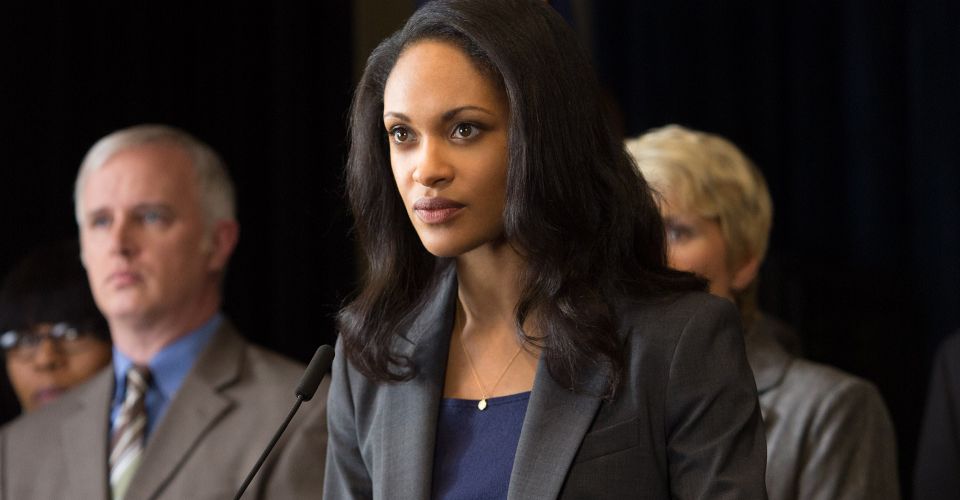
Cynthia Addai-Robinson as Treasury Department analyst Marybeth Medina in ‘The Accountant’
In reflecting on her acting opportunities, Addai-Robinson was quoted, “The great thing about really heightened historical dramas is that they can convey much larger themes.” That sounds like someone ready to take on Tolkien!
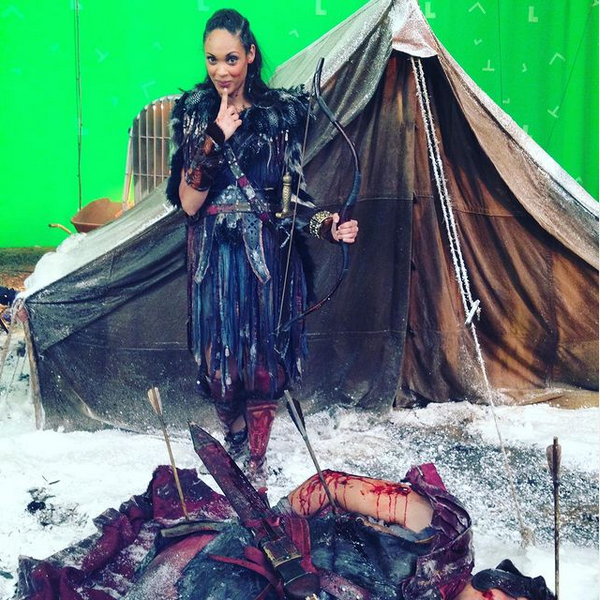
Cynthia Addai-Robinson merrily ready for some epic mayhem… Instagram @cynthiaaddairobinson
Editor Note: Join TheOneRing.net as we focus on the recent cast member announcements for Amazon TV’s The Lord of the Rings inspired TV series. Throughout the month, and as part of our Tolkien Advent Calendar celebration, we will be taking a deep-dive into their previous work, relating that to the world of J.R.R. Tolkien.
For Many First-Timers, 4K Ultra High Def LOTR/Hobbit Causes a Need for Upgrades, so Take the Deep Breath Before the 4K Plunge
From Guest Columnist Oscar Villanueva; a comprehensive breakdown of 4K Television tech to help us understand and prepare for the upcoming 4K Releases of the LOTR and Hobbit Trilogies:
So here we are now near the end of a very agitated 2020, almost 20 years after the original cinema release of The Fellowship of the Ring, and we have yet another home video release of our beloved six-film Middle-earth Saga around the corner. It’s almost as if it was coming back to our aid, to remind us there’s still light out there that no shadow can touch, and is worth fighting for. But what’s different now is that it will do it with a new acquired dimension.
It seems home entertainment gear changes about every ten years or so, and sometimes we feel we can’t keep up with it, or maybe we are just not willing to since of course there are real priorities out there especially in these troubling days. And yes, we certainly don’t need to, but there’s also the variable of how much the uptick of that technology really is in play here, so for many of us that may be the actual determining factor.
So now we have this 4K technology almost everywhere, and along with it we often hear or read terms such as HDR, Dolby Vision, Dolby Atmos, and also a weird-sounding thing called “Wide Color Gamut,” and the only thing it achieves is adding more to our already confused consumer minds. We only want to enjoy the movies and shows we love without the troubles of even thinking where to start.
Thankfully as we are about to find out none of it is that complicated in reality, especially since all of those different technologies are out already there in our favorite stores, and what’s even better they often come in one single package, so the only place drama belongs in that regard is still movies themselves. Don’t worry we’ll keep it simple, but first let’s check some basics.
Full HD
We’ve had FULL HD resolution for almost 15 years and we have used the term for all types of displays such as cinema, televisions, computers, even cellphones and most recently streaming services. Full HD in display gear means a high resolution image composed of 1920 pixels (horizontally) by 1080 pixels (vertically). In short is what blu-ray discs and players brought us the past decade.
4K
This is the “newest” standard, or at least is increasingly becoming it as it is being adopted more and more by manufacturers and streaming services. 4K is a very high resolution image composed of 3840 x 2160 pixels, which in theory is four times Full HD, at least for the vertical part.
HDR
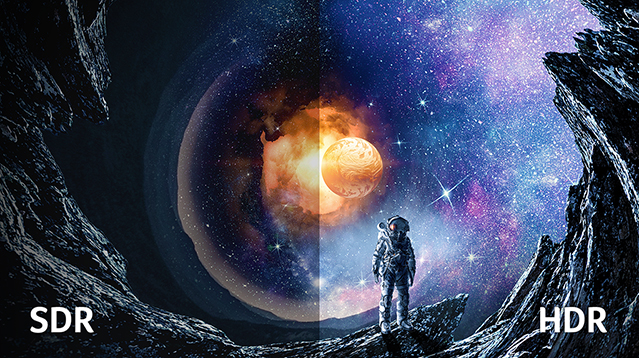
Here is where we enter the actual “new dimension” of 4K display technology, and no, we are not talking about 3D here nor will. HDR is a term we may have seen once in a while in professional photography gear, and maybe some cell phones, but although is the same basic concept, its application in home entertainment is totally different. It means High Dynamic Range hence HDR and it refers to difference, or range, between the brightest and the darkest part of the image. But then starts the interesting part; we are used to experience bright and dark sections of a single image, yes, but basically television sets always achieved this thanks to a combination of color and brightness, so when there’s the need to display something very bright lets say a sunset, that section of the screen turned very white or almost white, with little to non extra brightness from the tv, and of course the effect was successful, but for that to constantly work darkness could never be too dark and brightness could never be too bright, that is now called SDR or Standard Dynamic Range. Now what HDR tech allows is to have real deep darkness and real high brightness in one single shot giving images more of a real life quality and therefore a much more visceral feeling.
Dolby Vision
This one is just a refined form of HDR, developed by Dolby Laboratories, and maybe we should say it’s the ideal form of HDR. The issue with HDR is that it is not a defined standard in the sense that different movies are mastered at different luminance levels and this mastering may not fit our screen perfectly causing sometimes shadows or highlights eat up fine detail, this issue is also known as black crush and white clipping respectively. Well, none of this happens with Dolby Vision since basically it “communicates” with our display so it can set luminance and dark levels according to our TV’s capabilities, delivering the best HDR experience for our gear without any loss of detail.
Nits
Nit is the standard unit in which luminance levels of light sources are measured with, and this of course includes display sets. Common TVs have always been as bright as 300 nits, but now they can get to 500 nits in standard modes. But now with HDR they can get even higher, or should we say must? For a good HDR/Dolby Vision performance as designed a display must be capable of at least 700 nits of brightness, although ideally it would be about 1000 to fully appreciate the wide range of brightness and because is where the majority of films are mastered at. The only problem is that for a Tv to get a HDR certification it only needs to be able to reproduce the HDR algorithm but not necessarily to reach the levels of luminance, or nits, needed for a good HDR experience.
Wide Color Gamut
Also known as WCG this specification implies a wider range of color and tonalities. Whereas the full range of HD signal have always been the code named REC.709 color gamut, modern 4K UHD displays especially ones with HDR capabilities tend to reach the much wider BT.2020 color gamut, and although no display to this date can support the full spectrum of the BT.2020, they do reach the smaller DCI:P3 gamut which is contained in the BT.2020 one and is wider than REC.709 and is where the majority of UHD movies ara mastered at.
Dolby Atmos
It’s a relatively new enhanced audio format also developed by Dolby Laboratories that allows extra channels or speakers to fire up from above the listening position. This means you can place speakers in your ceiling, or ones that fire up to the ceiling and bounce back to you, to create this dome-like environment of sound around you, making it an even more immersive experience.
Now, these are some of the basics but they are just half of the equation for there’s still something that would materialize all that theory; a display of course. In the past it may have been more difficult to look for something akin to our precise needs as we were used to picking without knowing more beyond what we saw in stores. But nowadays not only there are more display brands than ever but also information is out there in the form of written reviews and youtube videos reviews, and they all get there earlier than a wizard so we can really know what we are going to get before we get it, and that’s saying a lot.
So, then, what do I need in order to maximize enjoyment of the upcoming Middle-earth 4K releases?
Well, ideally it would be a display whereas be a TV set or a home projector that includes as much of the previous specifications as possible. There are a number of technologies available right now and for different “pocketses,” so once we decided to upgrade our home theater gear it shouldn’t be too difficult to find something that accommodates us.
Here are some display types we have within our reach:
LCD TV
This has been the basic flat TV for years now. This type of TV is traditionally lit up by a series of light tubes mounted behind the screen. Along with the now extinct Plasma TV they made flat and wider panels possible.
LED TV
An LED TV is technically similar to a LCD TV but this one is backlit by LED (light-emitting diodes) which are usually placed in a row on the left and right edges behind the screen.
Limitations: Common issues with both types of TVs include very uneven brightness and light leaking from the edges.
Full Array LED
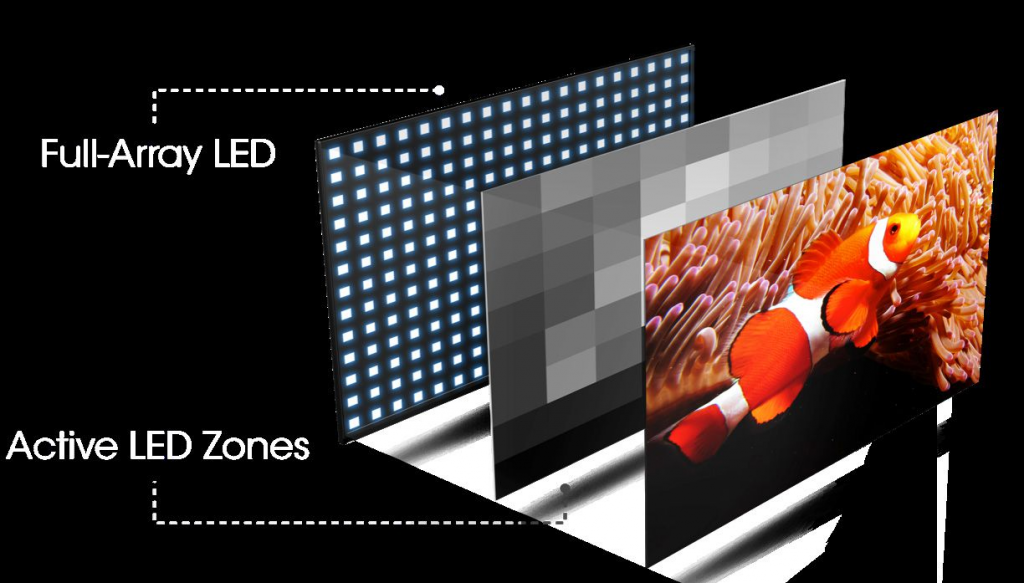
This type of TV is the best of the LED family since it can light up an specific segment of the screen while keeping the rest darkened thanks to its bigger number of led lights evenly placed throughout the back of the screen. It can achieve very high levels of luminance making HDR and Dolby Vision really work as were designed. This Full Array Local Dimming technology as is also known is commonly found in the ones marketed as Quantum TVs or QLED.
Limitations: One of the problems with having lights behind the screen is that no matter size or number of those lights, there always be some leaking of brightness outside the zone that is requiring that specific luminance, this is called Blooming. This may or not be noticeable to everyone, and although it happens it isn’t that distracting nor detract the HDR effect, specially in a well lit room.
OLED TV
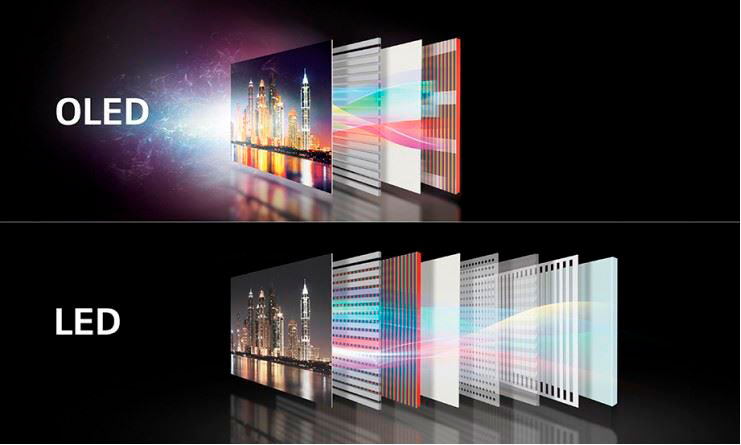
This TV is composed of organic light-emitting diodes thus OLED, and that means each pixel emits its own light individually when stimulated by electricity. So what happens when there’s no need for color in the image? Well, it turns completely off creating absolute blackness and therefore producing what is called Infinite Contrast. Not only that but since each pixel can turn on and off independently luminance is perfectly delimited to the part of the image that needs it which is why OLED gives us the best image possible to date. While full array local dimming TVs can make images pop thanks to their high light output, OLEDs do it by going negative; absolute black giving images a level of contrast with an almost tridimensional pop feeling to them.
Limitations: Of course no tech is perfect, so here we have two main issues with OLED displays related in fact to its organic components. First they can’t get too bright, at least not as much as a LED TV because in doing so they run the risk of burning pixels out, which leads us to the second issue; image retention. If a static image is displayed for too long it can be burned into the screen and kept for hours, days or even weeks if not permanently. There are solutions now to avoid this problem included in more modern OLED TVs, but it’s something the technology can’t still get rid of completely.
Projectors
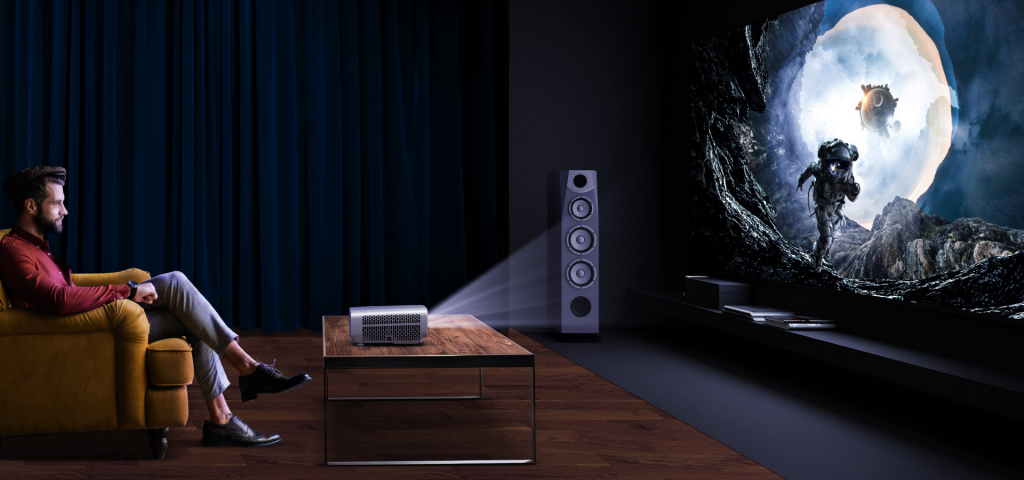
These may come as a surprise for some people because we are so used to the idea of a projector only belonging to theaters or classrooms, but now by 2020 home theater projectors have increasingly become part of the repertoire of possibilities for our private cinema and gaming entertainment. Projectors nowadays have become more compact, more advanced and more affordable than ever, and of all types of displays we’ve mentioned they still deliver the most cinematic and immersive experience of all thanks to that cinema size screen they produce. And yes, they come with 4K resolution and support HDR too.
Limitations: Projectors are very different type of technology altogether as they produce images using a beam of light, which means that even dark areas of the screen will have to be delivered using some light, so even the darkest areas will not get as dark as a good full array tv, much less an OLED, and it’s because of this and the fact that we are watching reflected light instead of a source of light that HDR rendering is fairly limited compared to TVs. Also affordable projectors and even not so affordable are limited to REC. 709 color gamut. But make no mistake, with its high level of contrast within a dark room and (preferable) darkened walls and ceiling and a good reflective surface (screen) projectors deliver the most breathtaking experience with very natural images and very natural HDR and color rendering, all while being very pleasant to the eyes because let’s be real for a moment here, nobody’s eyes could actually bare a 120″ screen shooting direct light at them.
“Now… what does it say about *recommendations* my precioussss?”
Well In the end we get what our real life priorities allow us and thanks to the increasingly growing home video market, options are richer than ever and although there are enough of them for every pocket out there we will be focusing on just some of the top quality and more complete displays sets that are also somewhat “pocketses-friendly” at the same time, more of a mid range budget sets. The point being starting from here everyone can enjoy the new Lord of the Rings and Hobbit releases without losing any of the 4K advantages image quality wise.
Full Array LED TV recommendation:
Hisense H9G (55”65”) TCL Q635 (55”65”75”) Both of these models give you one of the bests budget friendly TV performances of recent years. Not only both support HDR and Dolby Vision, but they can output as much as 1000 nits of luminance gloriousness and in the case of the Hisense even a bit more than that delivering truly breathtaking 4k HDR/Dolby Vision images. Both are great at streaming too, with the TCL also being more game orientated. Oh and the Hisense H9G also comes with an integrated Dolby Atmos system.
Worth keeping an eye on: SONY Bravia X900H: One of the most popular full array LED displays to hit the market in 2020. This full array display delivers stunning, high-end HDR and Dolby Vision at a fairly affordable, mid-tier price point suitable for most people not concerned with OLED.
If we want to spend a little less then the Hisense H8G would be a great choice. It can output about as much as 700 nits which is still pretty good for HDR/Dolby Vision performance.
Also Note: We know Samsung is one of the most, if not *the* most popular QLED TVs manufacturer on the market, but although it’s really good its flagship TVs are the only ones that do justice to HDR representation but those are neither affordable enough nor a complete package as the brand don’t’ support Dolby Vision in any of their sets.
OLED TV recommendation: In this category we only had one contestant given we are focusing on what’s mid-range affordable while keeping good quality and complete offerings.
VIZIO OLED H1 (55″65″) The first OLED TV by Vizio comes not only with maybe the most budget friendly price for an OLED but also comes with just the right bunch of specifications that includes HDR and Dolby Vision. Of course being an OLED TV It can’t get as bright as a LED TV but it certainly produces an outstanding very popping image thanks to its infinite contrast ratio exclusive of this type of technology.
Worth keeping an eye on: Sony A9G OLED and LG C9X/CX. These are of course more expensive but one cannot know what those Black Friday winds can bring right to us.
Also Noting: Of course remember an OLED is prone to burn in or image retention and the more expensive models are the ones that have better protection against this.
Worth keeping an eye on: BENQ HT3550, EPSON UB5050/6050. Both of these projectors are a bit more expensive but their performance is also a bit better delivering great black levels and a wider color gamut.
Also Note: These are some of the most affordable home theater projectors. ‘Affordable’ may be a very relative term here, but these are as budget friendly as they can get and still deliver maybe the most cinematic experience possible in the intimacy of home. All of those also deliver true 4K images thanks to shifting technology and also produce beautiful HDR rendering. We should note that there’s no projector at the time that support Dolby Vision, just HDR/HDR10 but it sure looks gorgeous.
Lastly, we cannot simply walk into a 4K blu-ray collection without a 4K player, so here are some of the best affordable 4K player on the market right now:
Sony UBP X700 Sony UBP X800 Panasonic DP UB450
Worth to keep an eye on: Panasonic DP UB820, which is more expensive but delivers amazing image performance.
Also Note: These 4K players can play both HDR and Dolby Vision which no console is able to at the present time.
TheOneRing.net extends gratitude for the effort of our Guest Contributor, Oscar Villanueva, whose passions include filmmaking, cinema, home theatre gear and of course LOTR, can be followed on Instagram @oscarilbo and Twitter @Oscrilbo [a play on Oscar + Bilbo]
For those of you who may not have been exposed to this tidbit of shareable humor, we thought we’d start the week off with a bit of fun. YouTube user BurtBot asks, ‘What if Uruk-hai had normal voices?’
During their New York Comic-Con Online, our friends at Sideshow Collectibles debuted a new collectible from Middle-earth.
If you’ve been following the line of collectibles from Iron Studios you would know that they’ve been creating the Balin’s Tomb sequence from The Fellowship of the Ring. We’ve already got Gimli and Legolas and now, taking this set up to the next level, we’ve got a Cave Troll! Fans can pre-order it right now for $725 with payment plans available, to add it to their collections next summer when it ships.
We’ve been digging through the Green Book archives a bit to find relevant articles discussing the ‘purity’ of Tolkien and his works. We came across this classic from Green Book author, Anwyn, where she addresses the questions that came out of watching the 2003 MTV Movie Awards. If you aren’t familiar with it…read on!
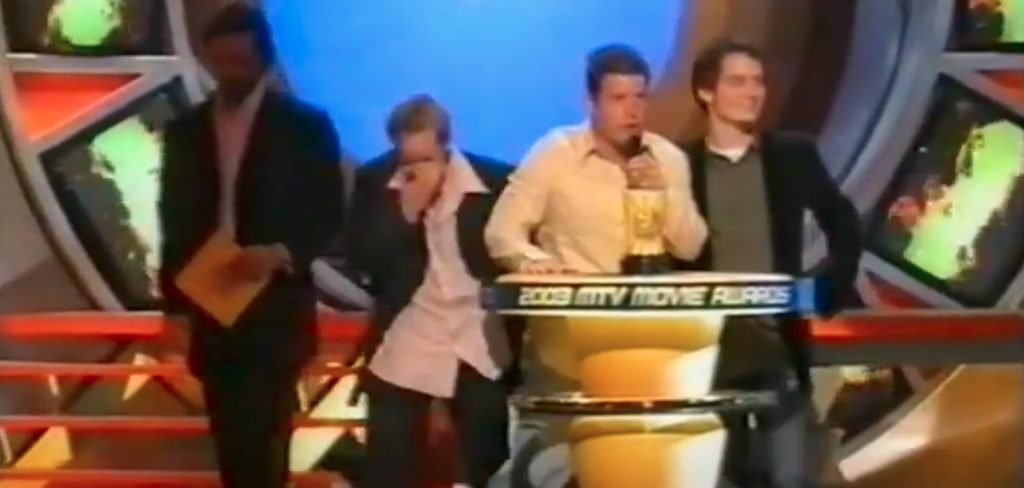
The Hobbits Accept ‘Best Movie’ at the 2003 MTV Movie Awards
I admit it. I’m at a loss for a stunning literary topic, one that will provoke your emotions, stimulate your mind, and offer some insight into Tolkien’s life or works. I sat down this evening with my brain half fried, knowing that I had a deadline to meet, and started flipping channels. Lo and behold, what did I pass but the MTV Movie Awards, and hark, who should be sitting behind Kirsten Dunst but the intrepid trio of Sean Astin, Elijah Wood, and Billy Boyd? Moreover, what award should they be announcing at that very moment but the award for “Best Movie?” I stayed to watch, having not bothered the first time they ran it.
I admit it. My finger is not on the pulse, as they say, of the pop-culture acclaim the Lord of the Rings movie phenomenon has generated and continues to stoke. I have not followed marketing trends; I couldn’t tell my father what TTT had grossed at the box office when he asked. I know, in a general way, that these films are wildly popular beyond the book’s fan base, that the movies have started their own fire that, due to the modern climate, burns higher than the literary one created when Tolkien was still living. What I don’t know is whether or not that’s a good thing.
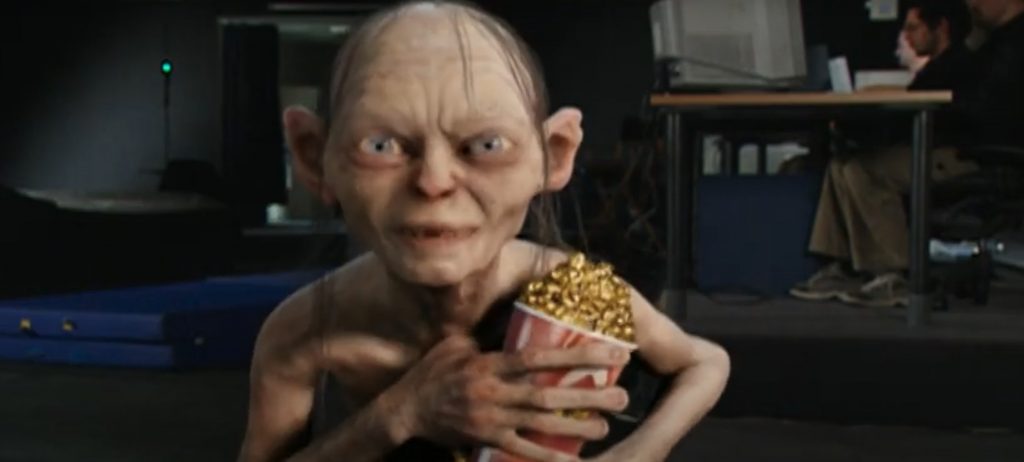
The intro was cute. Keanu Reeves was charming. And the winner is … The Lord of the Rings: The Two Towers. Elijah, Billy and Sean, looking MTV cool in untucked, unbuttoned shirts, bounded up on stage, where Sean apologized for Gollum’s previous tirade. “That dude is out of control!”
I admit it. I didn’t watch TORn’s clip of Gollum’s “acceptance speech.” I read a transcript and was horrified enough that I had no desire to watch it. Why? you ask. It was funny! you say. Perhaps. But the issue, in my mind, was not whether or not it was funny, but the fact that Tolkien is barrel-rolling in his grave at having one of his characters co-opted into speaking such filth. Puritan, you remark. Perhaps. “Purist” would be closer to the mark, I think. The hallmark of Tolkien’s work is the very purity of his language, and to find the most vile of modern insults coming out of the mouth of a digitally created Gollum disgusted me and, I think, would have appalled and disgusted Tolkien.
The boyishly handsome trio accepted the award on behalf of the production and left the stage. I came to my computer wondering. This new popularity: good or bad?
There is no need to speculate about what Tolkien himself would have thought. Though the popularity of his books, in his day, was smaller in scope and lesser in frantic, frenzied intensity than that we are observing now in response to the movies, he still had to fend off a wave of targeted questioning and obsession with minutiae, causing him to make remarks about his “deplorable cultus” and the dangers of becoming involved in the stories “in a way I’m not.” That tendency is more alive and well than ever today, thanks partly to the very wonderful establishment with which I am connected and others like it on the internet. “Fan fiction,” which I assume to have existed before the web but which certainly has suffered an unbelievable popularity explosion since, with access to an immediate and free forum, proves this in and of itself, as do the myriad questions we get at Green Books every day.
My colleague Quickbeam and many others have come down to the baseline opinion that if it encourages people to read Tolkien, then the indignities that come with the Hollywood marketing machine are well endured. But arepeople reading Tolkien as a result of all this hype? The evidence that I see is mixed.
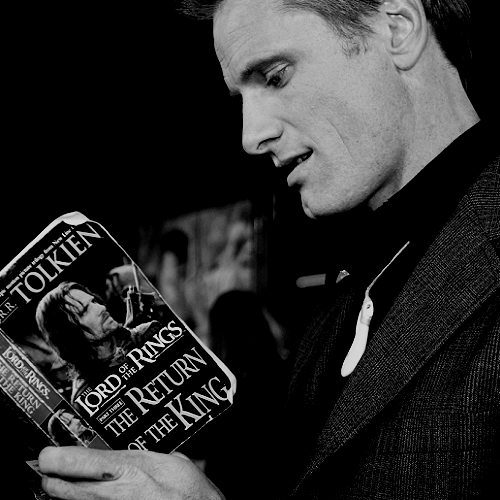
Viggo reads ‘The Return of the King’
We get many letters at GB that include notes like “I am now reading the books to my [sons, daughters, nephews, nieces, grandchildren], and they LOVE them. They would never have been interested in them before the movie.” That’s wonderful, and of course I couldn’t be anything but pleased. But we get a greater number of notes, questions for the Q&A, that clearly show that their authors have not read and have no desire to read—only to know more about the world that their current idols [insert Elijah, Orlando, Billy, Dominic, Sean, Sean, or Viggo here] inhabit in these films. “Who is Aragorn and where did he come from?” “Who are Legolas’s parents? Does he ever fall in love? Is it true that he dies in the third movie?” and my personal favorite, “Can you give me a complete history of Elrond? Who is he, where did he come from, who are his parents, what is his significance?” Don’t tell me that these folks have any intention of reading—this stuff could be readily found if they’d ever even cracked a book.
So if people are not reading, what’s the fuss about? Special effects, swordplay, hot guys, and hot chicks, apparently. Again I hear that scraping, swishing sound … Tolkien is rolling.
I am not intending any commentary here on Jackson’s films themselves. My opinions on that score are well documented elsewhere. My concern is with the ultramodern hype that has followed.
I admit it. There’s not much reason to care whether or not the marketing machine runs at full efficiency and creates these millions of screaming Orli drones. After all, what does it hurt Tolkien’s books or my enjoyment of them? From one perspective, it doesn’t hurt one iota. From another perspective, it hurts to see characters that I regarded as the highest of the high, the pinnacle of heroic epic, degenerated into pop-culture icons. And it is not so with some of my other favorites. Anne of Green Gables, Elinor and Marianne Dashwood of Sense and Sensibility, and others have all been brought with sensitivity and grace to the big screen. And sensitivity and grace are not lacking in the majority of Jackson’s characterizations, either. So the difference must lie in the public reaction to them and to the supposedly clever accolades, like Gollum’s fling at the MTV awards, that follow.
Forgive me, dear readers, if I am indulging in a ramble without a point. This musing is simply part of a bigger question—how healthy is all this fandom, anyway? “Frenzy and intensity,” I said above to describe the modern fanboy and fangirl machines, and it’s true. The nearness of people to one another through the media and internet allows them to mass-embrace one concept in a way they never could have done a century ago. Is this healthy for our individual and collective minds and spirits? The screaming, the shoving for a picture or an autograph … I digress. Those are issues connected with all popular Hollywooders, not with Lord of the Rings alone, of course. And I guess that’s the crux of the matter—something formerly so exalted in the realm of literature alone has been brought to a level equal to that of the Backstreet Boys or Britney Spears. I guess that’s where the real rub lies. Like the rub of a tweed jacket upon the inside of a coffin. Tolkien is rolling.
If you have a Tolkien/Middle-earth inspired poem you’d like to share, then send it to poetry@theonering.net. One poem per person may be submitted each month. Please make sure to proofread your work before sending it in. TheOneRing.net is not responsible for poems posting with spelling or grammatical errors.
Speaking of translating Tolkien’s world to TV and cinema, we dug into our archives to find a rather relevant masterpiece from Green Books staffer Ostadan – originally posted November 4th, 2004. Enjoy!
Golden copy of the “Universal Gateway”, Chapter 25 of the Lotus Sutra kept in Taiwan National Palace Museum. One of the many excellent works of Kumarajiva
“Translation is like chewing food that is to be fed to others who are unable to chew themselves. As a result, the masticated food is bound to be poorer in taste and flavor than the original.” [attributed to Kumarajiva, translator of Buddhist texts into Chinese. Translated.]
Unu Ringo ilin regas, Unu ilin prenas, Unu Ringo en mallumon ilin gvidas kaj katenas.
Let us look at this translation more carefully. If we were to take each word and translate it to English directly, it would read,
One Ring them rules, One them takes, One Ring into darkness them guides and chains.
Esperanto’s word order is more liberal than English, especially in verse; a more grammatically correct English translation would be “One Ring rules them, One takes them, One Ring guides them into darkness and chains them.” Those familiar with the English text will see many evident differences — the use of present tense; the reduction of “them all” to simply “them”; the change of “find” to “take”, and so on. Why should this be so? The main reason is that Bertil Wennergren, who translated the verse, was attempting to retain not only the sense of the text, but the rhyme scheme and general meter of the original. Esperanto, which uses suffixes as markers for such things as tense and part of speech, has few single-syllable words. In contrast, there is only one word of more than one syllable, “darkness”, in the entire English version of the Ring couplet (and few, indeed, in the entire Ring-verse). If any semblence of the poetry of the original is to be retained, then the meaning of the text must be altered somewhat to fit the restrictions imposed by the verse form and the language of translation.
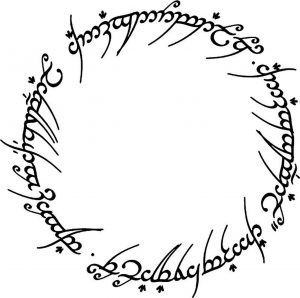
Of course, within the story, the famous couplet is itself only a translation, with a slight change in meter, of the Black Speech found on the Ring:
Gandalf says that his rendering in the Common Speech is “close enough” to what is said on the Ring. So the question arises: is the Esperanto translation similarly “close enough”? A “purist” might say, no: there are too many details lost or even changed by this translation, and Tolkien’s linguistic work has been undermined; someone reading the Esperanto text would come to very different conclusions about the vocabulary and grammar of Black Speech from those reached by English-speaking readers. But someone of a more “revisionist” bent sould say that the Esperanto Ring-inscription tells, probably as well as possible given the constraints of a verse translation in Esperanto, the same story as the original English. After all, it is certainly plausible that Celebrimbor, hearing these words spoken from afar as Sauron first took up the One Ring, would indeed know just how he had been betrayed and what Sauron’s true purpose behind the Rings of Power was.
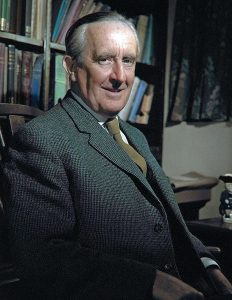
J.R.R. Tolkien
In a real sense, any translated work is a collaborative effort between the original author and the translator, much as a symphonic performance is a collaboration between the composer and the conductor. In a work as complex as The Lord of the Rings, the translator must be aware of the stylistic and linguistic techniques that Tolkien is using, and create them anew in the language of translation. For the result to have any artistry at all, the translator has to be as creative and capable in the language of translation as Tolkien was in his own. The result will not be pure Tolkien; it will be Tolkien as interpreted and re-told by the translator. Arden Smith’s irregular column in the journal Vinyar Tengwar, entitled “Transitions in Translations”, has documented a wide range of successful and unsuccessful translations. In some, little care is taken in style or nomenclature — one might be reminded of the infamous Japanese subtitles for the Fellowship of the Ring movie. In others, the translator may go as far as inventing Tengwar and Cirth modes for the language of translation and will re-draw the title page inscription in translation, as well as re-lettering the translation of the West-gate of Moria in the illustration. But in all cases, the result is not, and cannot be, identical to the experience of reading the original English text.
A “purist” might therefore conclude that because a translation necessarily loses some of the nuances and richness of the original, nobody should read Tolkien’s work in translation, and that the translators themselves are wasting their time in a futile exercise at best, or a fraudulent representation of their own works as being J.R.R. Tolkien’s at worst. To the purist, Tolkien’s original work is the only “true” account of events in a world that seems nearly as real as the ancient history of our own world, and deviation from that account seems to be somehow a distortion of a primary truth. But most people would agree that, given a certain minimum quality of translation, the defects inherent in reading a work in translation are outweighed by the availability of the book to people who cannot read it in English and would not be able to experience Middle-earth in any form without the translation, like the unfortunate soul in the quotation from Kumarajiva, who requires someone else to chew their food if they are to avoid starvation. Some of these people may even be motivated by a good translation to search out an English edition and laboriously work through it.
By now, the reader has probably anticipated the author’s conclusion from these musings about translation: the art of the filmmaker has much in common with the art of the translator. The requirements of film — or at least an artistically and commercially successful one — dictate particular rhythms and modes of expression in the storytelling that the original author contemplated no more than Tolkien considered how the Ring-verse would fit the rhythms of Esperanto or other languages. Even more than a translator, the filmmaker is a collaborator with the author, reinventing and recreating the author’s work so that it can be expressed as artistically as possible in the “language of film”. The result will not be purely Tolkien’s work, and will inevitably lose much of the delicious “flavor” of the original. It may even have serious defects in several particulars; but the real question is whether, like the Ring-verse translation, it tells the same essential story, “close enough”. If it does, then it does what any good translation does: it brings a great work to people who otherwise would not read it on their own.
“I cannot read the black and white letters,” he said in a quavering voice.
“No,” said Jackson, “but I can. The letters are English, of a narrative mode, but the language is that of the Epic Romance, which I will not utter here. But this in the Cinematic Tongue is what is said, close enough…”
If you have a Tolkien/Middle-earth inspired poem you’d like to share, then send it to poetry@theonering.net. One poem per person may be submitted each month. Please make sure to proofread your work before sending it in. TheOneRing.net is not responsible for poems posting with spelling or grammatical errors.