Andy Serkis who’s new to directing was honored to be asked to be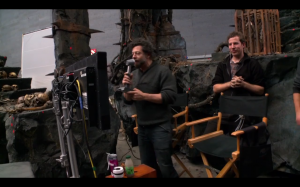 the second unit director on The Hobbit (and he does a good job as we have seen through out Peter Jacksons video blogs). Peter Jackson gave Andy Serkis filmmaking tips and acted as a mentor. contactmusic.com quoting from EMPIRE magazine:
Serkis explained: ‘‘He would watch form his set, call: ‘No, no, it’s not working. Just bail out of the shot.’ He was mentoring me. ”There were different ways we worked. We’d set up entire sequences, or he’d start a scene and I would finish it if there wasn’t time.”
[More ]
Posted in:
Share:

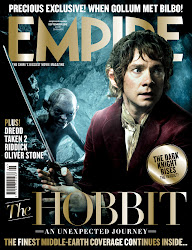 Earlier this week, Empire revealed two new stills from The Hobbit to coincide with their multi-page Hobbit feature for the September 2012 issue of their magazine that focuses on Riddles in the Dark.
Now we have a super-high resolution version of the cover, and of the still that shows Martin Freeman and Andy Serkis performing the Riddles scenes — with Serkis wearing his mo-cap suit. If you prefer your pictures BIG (a couple thousand pixels wide), you’ll want to run and grab these right now.
Thanks to everyone who gave us the heads-up on this.
[TORn super-res gallery] [TORn’s First Look]
Posted in:
Share:
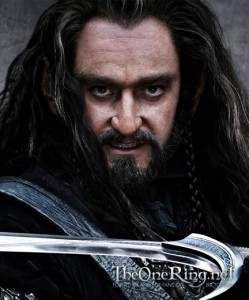 Meredith Woerner of io9.com posted a video interview with Richard Armitage talking at Comic-Con 2012 about his role as Thorin Oakenshield. Asked if he had to update his character for modern audiences he said:
“I never really thought of updating it. I actually did the opposite. I thought of it as more kind of Greek tragedy. I looked at Shakespeare, a lot of my preparation I was looking at Henry V and bits of Richard III, just to find roots in British literature that were deeper. But I think making it feel contemporary the big themes of the story — loyalty and trust and camaraderie — I think those things are contemporary.”
[Complete interview]
Posted in:
Share:
Benedict Cumbatch the voice of Smaug and staring as the Necromancer in The Hobbit films, helps kick-off the BBC‘s coverage off the 2012 Olympic Games in this short feature.
Posted in:
Share:
After a successful run in Washington DC last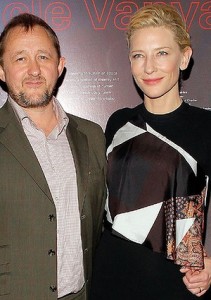 year Andrew Upton, Cate Blanchett and Richard Roxburgh have brought the Sydney Theater Company’s production of the famous Chekhov play Uncle Vanya to New York City. And it’s wowing audiences in the Big Apple.
Opening as a part of the Lincoln Centre Festival at the weekend, critics have praised the “uniformly brilliant cast” that includes Cate Blanchett and Hugo Weaving.
Cate Blanchett and Richard Roxburgh are still slightly terrified by the play ‘It’s excruciating,’ says Blanchett. ‘What I find the most difficult thing to exist within is what Tamas [Ascher, the Hungarian director] describes in Chekhov as the “stupid silences” where everyone just falls into a silence that is utterly stupid, and their stupidity is revealed to them, and they are staring into a void.’ The production continues at the New York City Centre until Saturday.
[More]
Posted in:
Share:
[Part 1 in a series from The Frodo Franchise Author Kristin Thompson]
Me and My Book
I’m a film historian by trade. I got my Ph.D. in film studies in 1977 and have written several textbooks and academic books on various topics in the field. In 2007, my book The Frodo Franchise: The Lord of the Rings and Modern Hollywood, by Kristin Thompson, came out from the University of California press. As we all wait for the release of the first part of The Hobbit, I thought some of you might be interested in some of my experiences while researching the book. I had a lot of access to the filmmakers for interviews and was given facilities tours during the last part of the post-production on The Return of the King.
I first conceived the book in 2002, when it became obvious to me that Peter Jackson’s film (I call the three parts one film, as he does) was going to be very, very important historically for a wide variety of reasons. The technology (the techniques developed to animate Gollum, the selective digital color grading) would be revolutionary. The internet campaign was pioneering, as was the filmmaking team’s approach to cooperating with the video-game designers. It was a big franchise film—and a fantasy at that—and yet it won the respect of critics and Academy-Award voters as no such film ever had. (The Fellowship of the Ring had won “only” four Oscars, but I knew even then that The Return of the King would be awarded lots.) Somebody should write a book about it, I thought. But probably nobody would, not the way it should be done, with interviews with the people involved. Not while the film was still in production. I concluded that it was up to me. Was it possible, though, to get the kind of access I would need? I set out to find out.
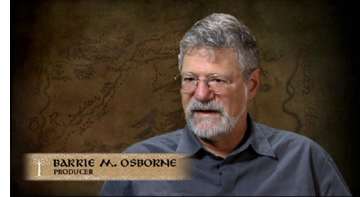
In January of 2003, through a mutual friend, I was put in touch with producer Barrie Osborne. Fortunately, he was interested in having such a book written. Without him, my project would have been dead in the water. Continue reading “Researching THE FRODO FRANCHISE: Part 1, Off to Wellington without a Handkerchief”
Posted in:
Share:


