Longtime Wētā Workshop designer Daniel Falconer presented a treasure trove of thoughts, images, and lore to a gathering of MegaCon Tolkien fans in Orlando this past weekend.

Falconer’s presentation was entitled, “WETA: Delving too Deep? A Tolkien Nerd’s Stories Designing for the Lord of the Rings films,” – but let me tell you, fellow nerds, Falconer delved the PERFECT amount.

The panel was the first time that Wētā Workshop had ever attended MegaCon Orlando, and provided a rare chance for fans of the Lord of the Rings books and movies alike to look at details from the artwork that touched upon all of the history embedded in the appendices of Return of the King.

The design work of these movies has always been some of the most fascinating parts of the production, not just because fans were provided a glimpse behind the scenes via the DVD Extras, but also because it has always been clear that the artists were bent on creating close to the same historic resonances that Tolkien infused into his works.

Falconer asked that we not share photos of any of his slides and I will abide with his request, but I’ll attempt to describe some of the fantastic details as best I can.

The Nine

For example, one of the opening slides that Falconer showed was an extremely important but not often dwelt upon detail: What did the Nine Rings for Mortal Men actually look like?

The Nine actually had two different designs, Falconer said. For the living kings, the rings had a red stone encircled by a spiked crown, and the likeness of each king engraved onto the side of their ring. But the rings changed when they became wraiths, with the design becoming both harsher and simpler. The kings’ engraved likenesses turned from faces to skulls. “But this change is never seen because the wraiths are too bright to show the detail of their rings,” Falconer concluded.

Details like this just kill me. Get ready for some more…

Sting

Falconer said that he was just thrilled when his design for Sting made it onto the screen. The inscription on the blade was done by David Salo, who wrote out the Elvish for “Sting is my name, and I am the spiders’ bane.”

Of course, this caused a bit of a continuity concern for The Hobbit, Falconer said, because Sting would not have the inscription on it BEFORE Bilbo named it Sting. So the design for Sting does not have the inscription when Bilbo finds it. Falconer’s head canon is that Bilbo had the inscription added to the blade during his stay in Rivendell, before Frodo joins him.

Glamdring

Glamdring also caused a few continuity issues, Falconer said, because Gandalf loses his sword and staff at Isengard, but of course he has to have his famous sword for the rest of the films. So the sword that Gandalf carries to Orthanc is a different sword, with a design based on a longsword that John Howe brought with him to New Zealand, with the idea that Gandalf had left Glamdring in the care of Elrond during his trip to visit Saruman.

“It was interesting seeing John talk his way through customs with that longsword,” Falconer said.

Gandalf’s Staffs

It never occurred to me that Gandalf’s staff changes so often during The Hobbit and Lord of the Rings. Of course it changes when he becomes Gandalf the White, but Falconer revealed just how many times Gandalf has to replace his staff: six!

First is the staff that Gandalf uses to inscribe his initials onto the door of Bilbo’s house. He loses it at some point in The Hobbit movies, and Radagast provides Gandalf with his own staff before the Battle of Five Armies. The staff from Battle of Five Armies gets a few rough pointy bits knocked off before Fellowship of the Ring, and that is what Gandalf uses until he visits Saruman in Orthanc.

He loses that staff in Orthanc along with his unnamed “first sword,” and another staff is made in Rivendell before they set out on their quest.

Finally, Gandalf becomes The White and has a staff that is designed around the shape of flame – because he bears Narya, the ring of fire. But he loses this when he confronts the Witch King, and has to make himself one more staff before the end of Return of the King. 

Other Wizard Staffs

Falconer showed us the design for the two blue wizards that were initially going to be in the prologue of Fellowship of the Ring, before they were cut. The designs were much more astrological and Eastern looking than the staffs of Gandalf, Radagast, or Saruman.

(Wētā, if you’re reading this, a 25th anniversary “Concept Art of The Fellowship of the Ring” book should definitely contain all of these unused bits of concept art. Please!)

A Look Around Rivendell

Falconer then took us through all of the wonderful historic frescos and objects that Elrond (“A pack rat,” Falconer said) kept around Rivendell.

Sauron’s Missing Ring

Falconer mentioned that Alan Lee painted the mural of Isildur battling Sauron at The Last Alliance for Fellowship of the Ring, but when the mural was brought back for The Hobbit, someone noticed that Sauron did not actually have the One Ring on his finger – Alan Lee painted it in just in time for filming it in The Hobbit, but if you look closely at this mural in Fellowship, it’s still missing.

(As an aside, Falconer said that Rivendell in general had a kind of “Elven magic,” very little set continuity, but somehow it all worked.)

Celebrimbor

Celebrimbor the ring-forger is presented in a that shows him forging one of the Three Rings. But another of the murals in Rivendell resembles the ruins of Celebrimbor’s great Second Age city, Ost-in-Edhel in Eregion, which the Fellowship walks through before encountering the Crebain.  

“I asked Alan Lee whether the painting was of Ost-in-Edhel, and he said, ‘Could be,’ so I never really had it verified,” Falconer said.

Gil-galad

Elrond also carefully kept and displayed the shield of Gil-galad after his death at the Last Alliance. Gil-galad’s crest, as drawn by Tolkien, shows a number of four-pointed white stars on a field of blue; the artists took inspiration from this and created livery and a shield that mirrored the crest. 

“Elrond also has Gil-galad’s crown on display, but he must not have been thinking too hard about it, because it’s upside down,” Falconer said, showing a picture of Mark Ferguson’s Gil-galad wearing the crown in the other direction.

Aeglos, “Snow-tip” in Sindarin Elvish, the spear of Gil-galad, was designed by Falconer’s colleague at WĒTĀ whose name I was unable to catch (“Incidentally the best man at my wedding,” Falconer said). The inscription on the blade is:

Gil-galad wields a well-made spear

The Orc will fear my point of ice

When he sees me, in fear of death

He will know my name:

Aeglos

Aragorn’s hunting knife is made to echo the design of Aeglos, and has a portion of this inscription on it too.

Arwen (and Idril’s) sword, Hadhafang

Also on display in Rivendell is the sword that was originally designed for Arwen. Here is where my own inner Tolkien geek felt a wash of joy: the sword was designed to be an heirloom from Gondolin, specifically from the princess of that realm, Idril.

Here’s the history: Turgon son of Fingolfin was king of Beleriand’s hidden city of Gondolin. His daughter was Idril Celebrindal. She is better known in Lord of the Rings as Elrond’s grandmother, however. She married the human Tuor and had one son, Ëarendil, who eventually bore the Silmaril on his airship Vingilot; but before that, Ëarendil married Elwing of Doriath and became the dad of Elrond and Elros. 

And somehow, Elrond preserved his grandmother’s sword through the third Kinslaying at Sirion, his kidnapping by the sons of Fëanor, the War of Wrath, the drowning of his entire birth country of Beleriand, and finally through a long journey East toward Middle-earth, where he eventually uses it in several battles including the Last Alliance — before he gives it to his daughter.

The inscription on the sword reads, “This blade is called Hadhafang, a noble defense against the enemy throng for a noble lady.” If this inscription was put there by Idril, she had more foresight than just building a secret tunnel out of Gondolin, because “noble lady” translates directly to the word “AR-WEN.” 

Amazing, learning this detail alone justified my entire con experience!

Two figures on a boat

Given that this Rivendell mural displayed TWO figures on a boat instead of ONE figure and a BIRD on a boat, I can assume that this is Idril and Tuor aboard the boat Eärramë, off to vanish into the West. I did not get to verify this with Falconer, however.

The Scepter of Annúminas

Why does Aragorn wear a wingéd helm during his coronation instead of a crown? It’s because there isn’t a crown.

Elrond keeps the actual indicator of Aragorn’s kingship, the Scepter of Annúminas, at Rivendell because he’s the keeper of all the important Dunedaín artifacts until there’s a king of unified Gondor and Arnor again. He brings it to Aragorn upon the midsummer wedding of Aragorn and Arwen.

Elrond’s Telescope

This detail slew me. “Elrond has a telescope because his father is a star,” Falconer said. The telescope was a gorgeous and graceful fall of art nouveau lines, decorated with a small paean to Varda, or Elbereth, the Valar who created the stars.

Gimli and the Caves of Aglarond

Falconer showed us concept art of the Caves of Aglarond beneath Helm’s Deep. He said that one of the original endings to Return of the King showed Gimli’s life post-quest, as the lord of Aglarond. The art department created a jeweler’s glass for him to use while at work on the gems of these caves.

“But we had plenty of endings already,” Falconer said.

Falconer also showed us details of the Book of Mazarbul from the Mines of Moria, based on Tolkien’s own drawing of the cover. Incidentally, Tolkien wanted his own illustration of it to be in Fellowship of the Ring, but it proved to be too costly for Unwin & Allen to publish.

Edoras

Falconer showed close-ups of the hangings from around Meduseld. The hangings are scenes from the history of the Horse-lords. (If you are at all interested, this history is nicely summarized in Unfinished Tales Part II: Chapter 3.)

I noticed Scatha the Worm fighting Fram, and Eorl the Young pledging his friendship to Cirion the Steward of Gondor, among other moments.

Knights of Dol Amroth

We got to see some of the original concept art for the Knights of Dol Amroth. These were not used in the movies, but the banner (a swan and a ship, argent, on a blue field) shows up at the Battle of Pelennor Field.

“These were some of the first pen-and-ink drawings we did in the days before Photoshop, and we’d all played Dungeons and Dragons, so the designs were straight out of the rulebook from the 80s,” Falconer said. 

“Elves are Art Nouveau, Dwarves are Art Deco”

You’ve probably seen the meme around the internet that proclaims that the way to tell the difference between the Art Nouveau and Art Deco styles are via their Tolkien race.

I asked Falconer if he was aware that Wētā actually set the agenda for this meme.

“I have seen that meme, but for a little while, Elves were going to be Art Deco with lots of angles and points. And even before that, we took inspiration from Moorish design,” Falconer said.

“So when did the trend toward Art Nouveau begin for the Elves?”

“Probably when Alan Lee designed those columns.”

So there you have it.

Please return

There was a lot more to Falconer’s panel — about the continuity of Gollum, different types of Ents, and the shape of the Fell Beasts — but I think I’d better just leave us all wanting to see it again.

We’ll get to see everyone from Wētā over here again soon, right?!

Our friend Jerry Vanderstelt has an amazing new print out – if you haven’t already added this to your collection!

This gorgeous print captures the beautiful Rivendell – but from a different viewpoint than his previous print of the same location. We see a quiet moment between Aragorn and Arwen, most likely before Aragorn sets out to help Frodo destroy the One Ring. Fans can purchase this print right now, ranging in sizes from 16×24 to 24×36, with prices between $85-170 USD depending on the size chosen. If you know Jerry’s work you already know this is another home run piece by him. Get it now, as the paper editions have an edition size of only 2000 pieces.

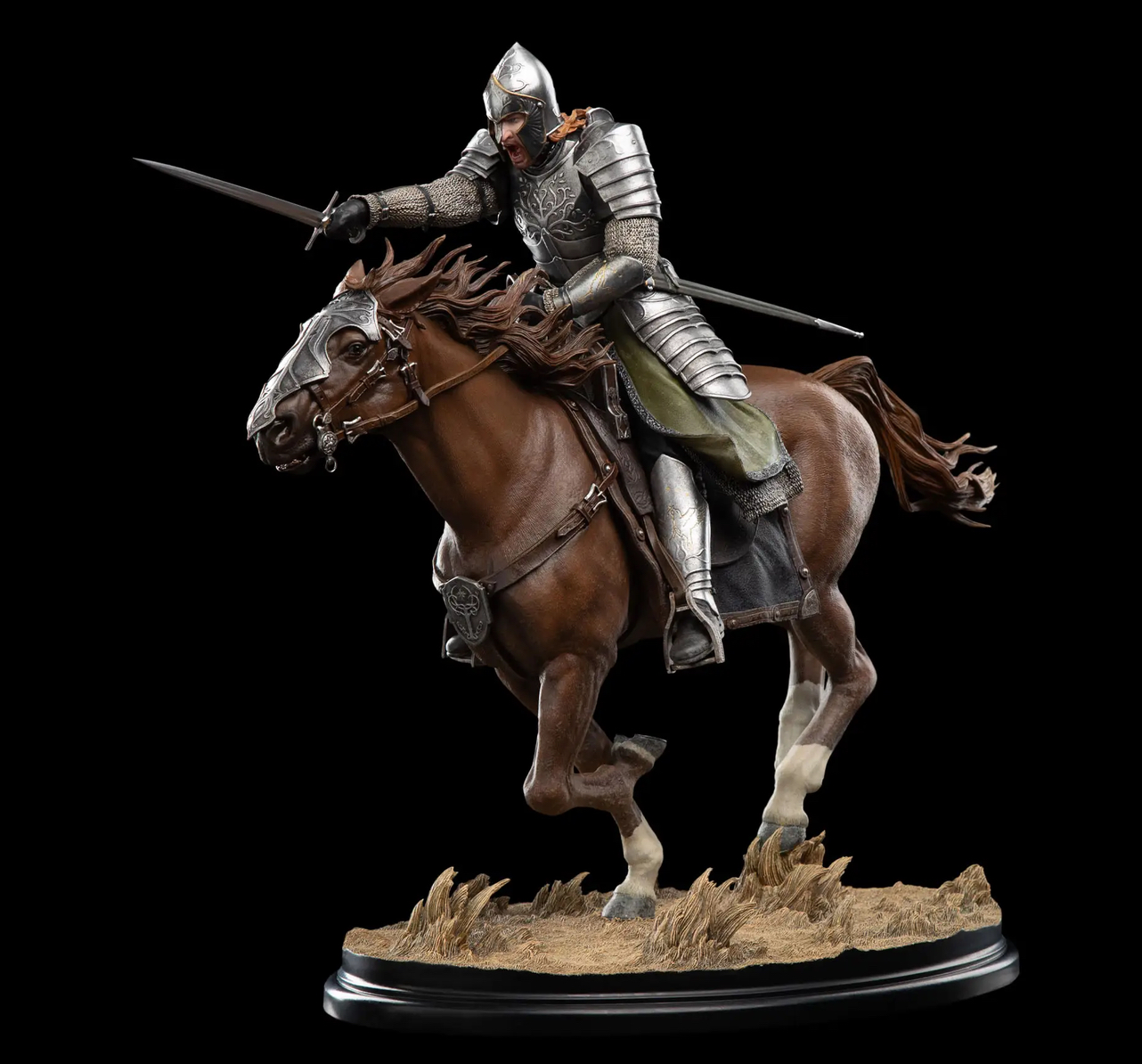
Our friends at Weta Workshop have unveiled their latest amazing statue fans can pre-order for their collections. If you’re like me and love The Battle of the Last Alliance sequence from The Lord of the Rings: The Fellowship of the Ring then you’re going to want to add this to your collection.

Elrond as we see him during the battle is now available for pre-order in 1:6 scale. He joins Elendil, Sauron, and Gil-Galad to create an amazing 4 statue setup of this sequence. Elrond comes in with a price tag of $699 USD, 1350 piece edition size, and will be shipping towards the end of this year. If you’re a fan of The Hobbit Trilogy then you have a chance to add the re-opened open edition of the Smaug Bust or the limited version of Smaug the Golden with an edition size of 900. The open edition of Smaug is $499 USD while the limited edition is coming in at $599 USD, with both due to ship in quarter 2 of this year.

One of the pieces I had been dying to get my order in for, since I saw it at SDCC 2024, was the classic series Boromir. The reason? Well, I fell in love with the choice of the pose and the look of the piece. This is a version I wasn’t sure we’d ever get but was blown away when it happened. When this statue went up for pre-order there were two versions like the recent Legolas statue. You could get the Boromir with 1:4 Horn of Gondor, which was limited to 400 pieces total or you could get the standard classic series. That version is still available for $399 and in-stock. I think this statue is just fantastic with great paint, details, and likeness. I could not be happier to have this in my collection and I hope you will do the same.

Continue reading “Collecting The Precious – Weta Workshop’s Boromir Classic Series Review”

Today our friends at Weta Workshop launched another fantastic looking 1:6 statue from The Lord of the Rings. If you’re a fan of Legolas Greenleaf then today is your day, as he joins the classic series.

Fans have a chance to pre-order him two ways as of this post. The first is the first 800 orders get a 1:4 metal replica of his knives. This effectively makes the first 800 made a limited edition version. If you decide you just want the statue iteself that will go up for pre-order once these first 800 have sold.

Both versions are available for pre-order for $399, and will ship in the first quarter of next year.

If you’re a fan if the mini statue line we’ve also got two great announcements for you. Our friend Jed Brophy, who as you know has played many a Middle-earth role, has finally had a statue of one of his characters from The Lord of the Rings made. You can now pre-order the mini Sharku on Warg for $179.

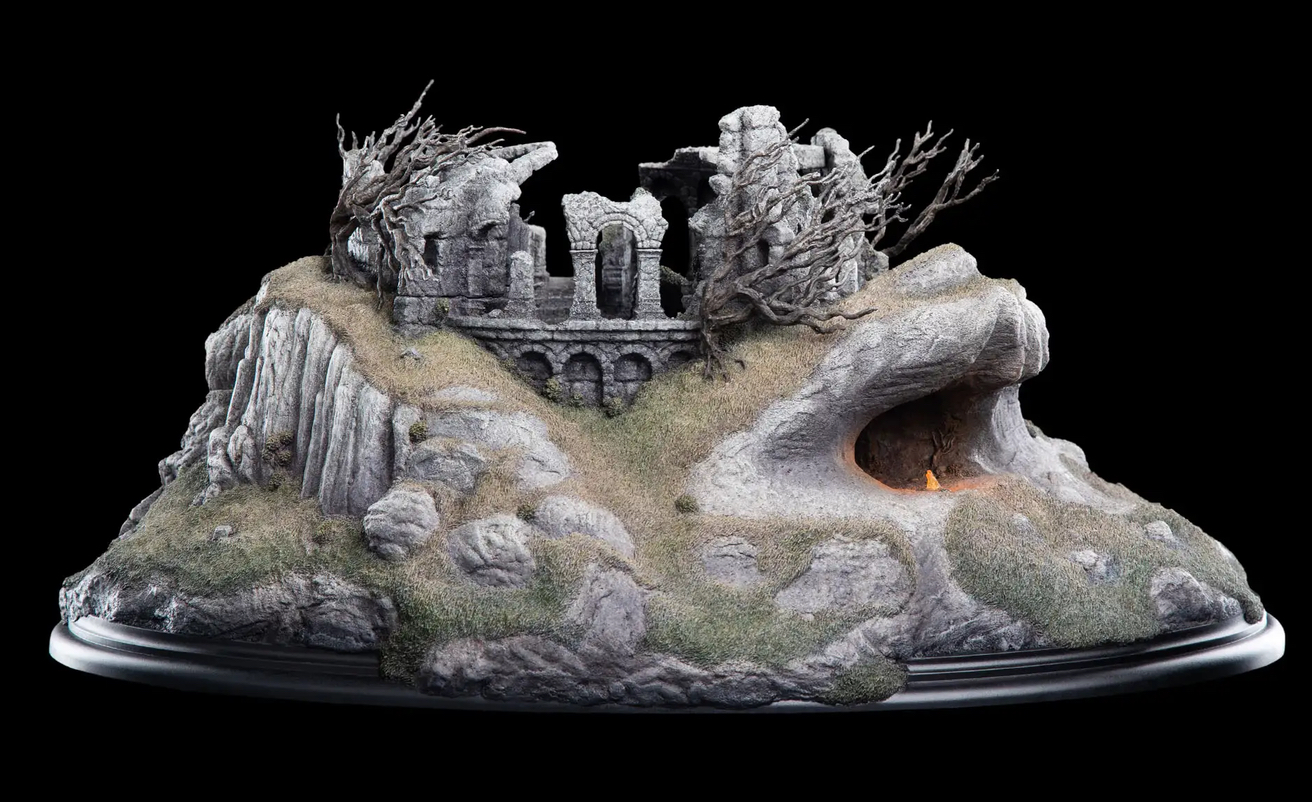
If mini environments are your thing, then you will want to add the mini Zirakzigil to your collection for $99. Both of these are due to ship in the first quarter of 2026.

Illustration from Letters From Father Christmas 2023 ed – Christmas 1934

It’s that most wonderful time of the year again! If you’re looking for the perfect holiday gift for your favourite Tolkien fan, you’ve come to the right place. The staff of TheOneRing.net have put together a list of our favourite items of the year, with price points for every budget.

From our Fellowship to yours, TheOneRing.net would like to wish you all a peaceful and happy holiday season.

Please note, unless otherwise indicated, all prices are in US Dollars.

Demosthenes recommends the Letters from Father Christmas.

Letters from Father Christmas is always a good choice, I think. The illustrations are cute and there’s a dry sense of humour to the letters and I really like how a story gradually evolves over the years.

2020 Centenary Edition

Published to celebrate the first ever ‘letter from Father Christmas’ in 1920, this beautiful oversized edition of Tolkien’s famous illustrated letters from ‘Father Christmas’, includes a wealth of charming letters, pictures and decorated envelopes, and promises to be a festive feast for Tolkien fans of all ages.

The centenary edition of Letters from Father Christmas is available from Harper Collins Australia for AUD$39.99.

Kelvarhin recommends the 2026 Tolkien Calendar: The Great Tales of Middle-earth.

This is the must have, yearly gift for every Tolkien fan, and lovers of Alan Lee’s beautiful artwork.

The official Tolkien calendar, this year containing 13 breathtaking paintings inspired by J.R.R. Tolkien’s three ‘Great Tales’ of Middle-earth: THE CHILDREN OF HÚRIN, BEREN AND LÚTHIEN and THE FALL OF GONDOLIN. Featuring beautiful artwork by Alan Lee, including a selection of stunning new paintings and drawings appearing here for the first time.

It’s available from Harper Collins for $13.59

Kristin Thompson recommends a copy of Tolkien’s Medievalism in Ruins: Relics and Ruins in Middle-earth for your academically inclined Tolkien fan.

I just received my copy of TOLKIEN’S MEDIEVALISM IN RUINS: RELICS AND RUINS IN MIDDLE-EARTH, eds. Nick Katsiadas and Carl Sell. I haven’t had a chance to read it but it looks excellent. A good gift for the academic-minded Tolkien fan, but the giver has to have deep pockets and considerable affection for the recipient.

The structural and symbolic purposes of ruins in literary texts have a long history, yet few scholars explore their importance within J. R. R. Tolkien’s legendarium. From the ruins of Erebor and the relics of Gondolin appearing in The Hobbit to the various images of Amon Sûl, Moria, and Osgiliath in The Lord of the Rings, Tolkien constructs a distinct mood—one that captures characters’ awareness of the glories of the past and a desire to emulate them. The scholars who do engage Tolkien’s relics and ruins tend to limit the scope to Tolkien’s debt to the Middle Ages. While such scholarship begins important conversations, the full story of Tolkien’s relics and ruins is left untold. Tolkien’s Medievalism in Ruins takes corrective action and expands this historical and critical literary scope. This collection seeks to promote a more comprehensive approach to Tolkien’s legendarium.

It’s $150.50 hardback on Amazon and $86.40 for the Kindle version.

Wee Tanya recommends The Bovadium Fragments.

A version of JRRT’s The Bovadium Fragments was released in America on November 18 that includes a forward and context from Christopher Tolkien. TORn’s article about the book is over here. The short story is a satire about Oxford and how congested it was getting from vehicle traffic, as seen from the future, a piece that directly speaks to Tolkien’s nostalgia for an agrarian past and his dislike of the polluting elements of modernity. Here is the blurb: “The first-ever publication of a previously unknown short satirical fantasy by J.R.R. Tolkien, edited by his son, Christopher Tolkien, and accompanied by illustrations from the author together with an essay, ‘The Origin of Bovadium,’ by Richard Ovenden OBE. In this new edition, Christopher Tolkien provides notes and commentary that will enable the reader to enjoy at last this tale of an imagined Oxford viewed through the lens of future (and not wholly reliable) academic study.”

You can find it on Amazon: Amazon.com: The Bovadium Fragments: Together with The Origins of Bovadium: 9780063479081: Tolkien, J. R. R.: Books for $23.99. Or directly from Harper Collins:  The Bovadium Fragments – HarperCollins for $21.60.

Elessar recommends the Aragorn miniature from Weta Workshop.

What disembarked the great ships of Umbar™ were not the expected reinforcements; descending upon the docks was a man, an elf, and a dwarf. The dead soon followed, bound by oaths unfulfilled, their presence like shadow and fear upon the wind. Urged on by the thought of comrades hard-pressed under the siege of death, Aragorn unsheathed his blade and gave the cry of war. Thus, once more, he led the charge into the jaws of darkness.

The Aragorn Miniature is available from Weta Workshop for $129.00.

Or if you want to get in early for next Christmas, or your favourite Tolkien fan’s birthday next year, this miniature of Sharku on Warg is available for pre-order for $179.00 and will ship in early 2026.

An Orc of withered years and many wounds, upon his seamed visage lay records of long strife and harsh labour. Sharkû was a master of the great Wild Wolves, those fell Wargs, whose cunning and savagery few could tame. Long had he dwelt among them, bearing upon his flesh their piercing bites and tearing claws. Yet he endured and, honed by skill and scar, savagely led his pack of unrelenting hunters.

garfeimao suggests Doomed to Die: An A-Z of Death in Tolkien.

greendragon chooses goodies from Oscha Slings.

As ever, Oscha have so many gorgeous items – I’d be thrilled to find any of their treasures under my tree! I asked their creators what their own choices would be; they suggested:

For her – Trees of Gondor Ithildin Scarf
Elegant and ethical, this organic cotton scarf features the iconic Trees of Gondor—perfect for Tolkien fans who love style with a story.

For him – Treebeard Pine Mug
Start the day in Middle-earth style. This bone china mug showcases Treebeard and his classic quote: “The world is changing: I feel it in the water, I feel it in the earth, and I smell it in the air.”

For little ones – Shire Westfarthing Baby Blanket
Wrap them in warmth and whimsy with this super-soft organic cotton blanket, inspired by the peaceful Shire. Lightweight yet cosy, it’s perfect for naps, pram adventures, and treasured keepsake moments.

Oscha also have items perfect for stocking stuffers or secret Santa, with tote bags and tea towels around the $20 mark.

greendragon’s next choice is Geek Orthodox’s stained glass masterpieces

Artist Ian at Geek Orthodox creates the most gorgeous pieces. The great news is, if one of his pieces of glass art work is beyond your budget, he has window cling replicas (of a very high standard) of the stained glass; and he has lovely pins. So there is something to suit every pocket book!

greendragon adds: “And finally, I can’t very well NOT remind folks that there is Green Dragon whiskey out there, from our good friends at Syzygy Forge. To toast the holiday season – cheers, Gaffer!”