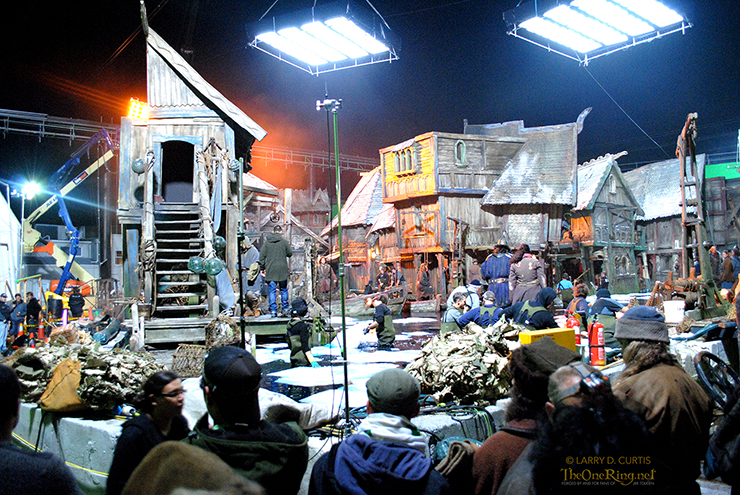
(The outdoor Lake-Town wet set with extras and crew assembled for a night shoot on “The Hobbit.”)
WELLINGTON — The great cities of history have risen up around rivers, lakes and on coasts. Water holds vast and replenishing stores of food, improves transportation of people and goods, encourages trade, and of course keeps a population hydrated. Paris. London. Hong Kong. New York. Tokyo. Moscow. Boston. On and on.
Lake-town benefitted from excellent transportation and presumably a wealth of fish and food and clean, fresh water but it was built on water for a different reason.
Dragons.
One dragon in particular: Smaug The Terrible.
Tolkien’s Lake-town, like real-world Venice, was built on wooden pillars sunk into water. The lake men — with the destruction of Dale seared forever into their memory — built on water for safety. We watched it in the prolog of “The Hobbit: An Unexpected Journey,” while they had to live with the fear of dragon every day. Water-based living provided at least a chance against the great and terrible worm if he ever attacked again.
Long-time friend of TheOneRing.net, Sohaib Awan, has kicked off a new Fictional Frontiers podcast and invited our own MrCere to talk all things Hobbit. Long a radio program, Fictional Frontiers, with Shotglass Digital, is reaching a new audience with a new format that allows for a longer, more in-depth discussion. Awan has championed “The Hobbit: An Unexpected Journey,” and loves both the realms of Tolkien and the work of Peter Jackson. He has used MrCere (Larry D. Curtis) as a frequent guest and in this episode they discuss both the upcoming second installment of the film and the success of the first and Curtis talks big picture about his time in New Zealand. The podcast can be found right here! Awan says MrCere will return in future episodes to talk more Hobbit.
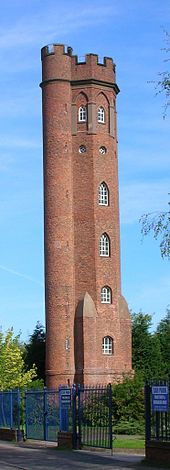
There are many places, stories and events which are said to have been influences on J R R Tolkien in his tales of Middle-earth. One which has long intrigued the Professor’s fans is Perrott’s Folly in the West Midlands, England. This extraordinary tower is located in the Edgbaston area of Birmingham, near where Tolkien lived as a boy. It is a 96 foot tall structure, built by John Perrott in 1758 for some reason which is unknown today – possibly it was simply a status symbol, though the more romantic belief is that he wanted a building from which he could see his wife’s grave 15 miles away (even though she was still alive when first Perrott built the tower; the sceptics say he was in fact using it to spy on her infidelities…)
You can read more about Perrott’s Folly and its supposed influence on Tolkien here. Normally this strange building is not open to the public; visitors on the Tolkien Trail in Birmingham are turned away, disappointed. However, next Saturday, 26th October, the Folly will be open for a ‘Drawing Event’, organized by Trident Reach the People Charity, which manages the building. The occasion will be a family friendly, experimental art event, where mirrors, odd objects and noise will be used to imagine how Perrott’s Folly might look, sound and function in the future.
The day will run from 11am to 5pm, and is free and open to all. You can read more about it here. If you’re in the area, don’t miss this great opportunity to see inside a landmark which would have been very familiar to J R R Tolkien, and which just might have been a seed for one of his ‘Two Towers’.
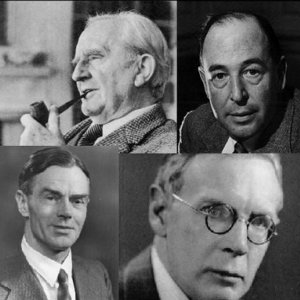
The CBC radio show Ideas ran this interesting two part series on C.S Lewis and the Inklings.
In the first podcast Frank Faulk explores the early life of C.S. Lewis, and the experiences that would shape him on his journey to becoming one of the 20th century’s greatest thinkers and writers on Christianity. In part two Faulk looks at C.S. Lewis’s conversion from atheism to Christianity, and his deep friendship with Tolkien, Barfield and Williams.
EDITOR’S NOTE:This is the first of many set visit reports that will publish weekly from now until the premiere of “The Hobbit: The Desolation of Smaug.” We will update this post with photos from the set visit as soon as possible.
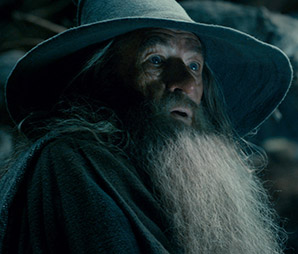
Ian McKellen as Gandalf.
WELLINGTON — Thousands of creative hands will have touched “The Hobbit: The Desolation of Smaug,” by the time it hits movie screens. For those making the film it means long hours, pushing the limits of creativity, people and technology. It is accurate to say every frame is filled with passion, lots of passion.
Despite all the love for the project from every quarter, there is a group that may be the least-heralded, most overlooked, and yet whose passion for the project is surpassed by no man — or woman. They will receive no awards, no fame, no recognition and yet, they loved their work on “The Hobbit,” and legions of fans would have willingly taken their place in a heartbeat.
They are called “extras,” and for these films that meant extra passion, extra time and extra fun.
How would I know? Well, I was one of them!
I am a staffer here at TheOneRing.net (TORn), contributing for over a decade to the all-volunteer, not-for profit website forged by and for fans of J.R.R. Tolkien. In that time I formed a bond of trust and friendship with people on all sides of the production.
Warners Bros. and the production team on “The Hobbit,” invited me, as a representative of TORn, to not only visit the set but to be embedded there as a journalist for five weeks. Every working day for a month and a week in 2012, I woke up and reported to set near Wellington, New Zealand where Peter Jackson and his team of filmmakers were putting together the film adaptation of J.R.R. Tolkien’s beloved children’s book, “The Hobbit.”
I can hardly believe this happened even though I remember it with incredible clarity. It seems surreal now — as it did every day when I arrived, showed my badge to security and walked into the grounds where Middle-earth would be created for audiences world wide. Each day was appreciated.
You might have seen this article when io9 debuted it last year, or you might not have. I missed it but it’s an interesting read. I spent a bit of time researching the Jeffrey Inaba artwork, which is called Skylight. The comparison to the Eye of Sauron (either book, or movie) seems inflated, but there are just a few parallels with the glow of the One Ring.
The author of The Hobbit and The Lord of the Rings casts a massive, sweeping shadow over fantasy literature and entertainment. But J.R.R. Tolkien’s influence spreads much further than that. Everywhere you look, you can see Tolkien’s legacy: in science, in art, in language.


 Dragons.

 The CBC radio show Ideas ran this interesting two part series on C.S Lewis and the Inklings.
 You might have seen this article when io9 debuted it last year, or you might not have. I missed it but it’s an interesting read. I spent a bit of time researching the Jeffrey Inaba artwork, which is called Skylight. The comparison to the Eye of Sauron (either book, or movie) seems inflated, but there are just a few parallels with the glow of the