We’re thrilled that Willie Jenkins, aka Knewbettadobetta, has joined the merry band here at TORn as one of our volunteer staffers. We’re always delighted when he’s able to join us on panels at events, and now from time to time we’ll also be sharing his thoughts here on our homepage. (Of course, you can always find all his reels on his own Tiktok any time you want to hear more from him!) Knewbetta joined us at Dragon Con this year – and he shares here his thoughts on the convention, and the fandom in general.
I’m Willie Jenkins, better known online as **Knewbettadobetta**, a *Lord of the Rings* content creator, lore enthusiast, and now a staffer for **TheOneRing.net**. This year, I came to Dragon Con 2026 with a particular mission: to do press for TheOneRing.net and to observe, experience, and better understand the connection—the symbiotic relationship, really—between the Tolkien fandom and Dragon Con.
What I found was something I already suspected, but seeing it firsthand made it impossible to ignore – and man was I hype.
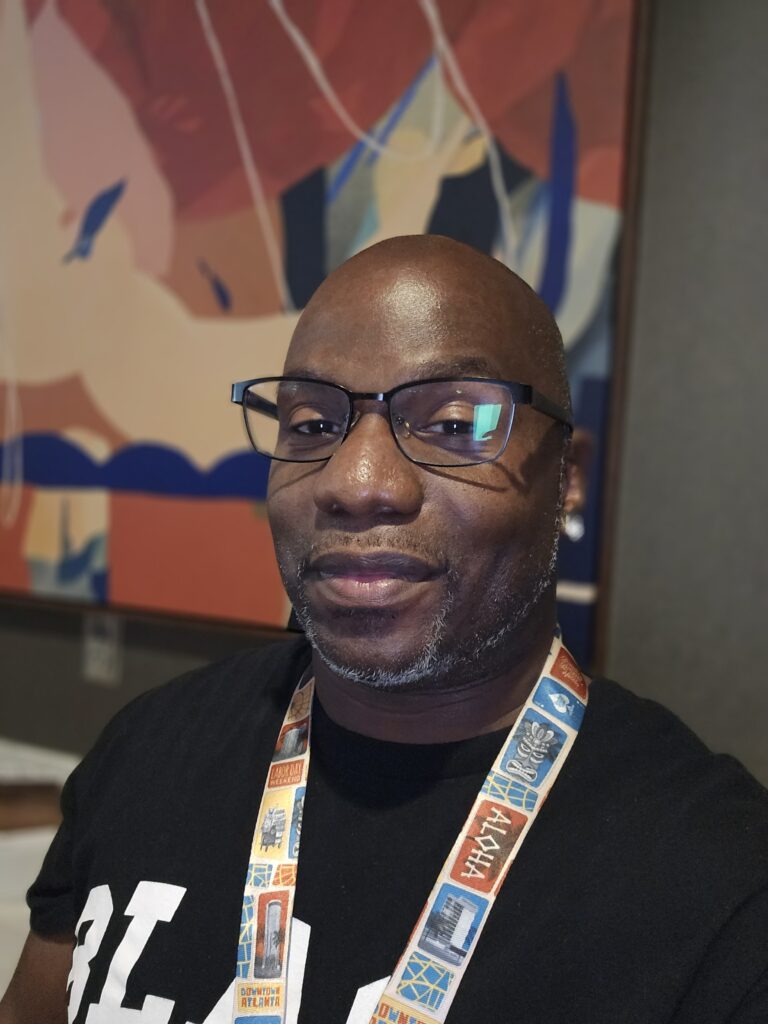
Knewbettadobetta at Dragon Con
The Lord of the Rings community is at the heart of the fantasy community, and Dragon Con has become one of the places where that heart beats loudest.
There is something uniquely special about Dragon Con. It is enormous, chaotic, colorful, weird, welcoming, exhausting, exhilarating, and deeply communal. It feels less like a convention that you attend, and more like a temporary world that you enter. And in that world, The Lord of the Rings has a place that feels almost foundational.
Dragon Con itself is, in many ways, the heart of the “con” experience. It is a fan-made convention built around the idea that fandom belongs to the fans. You can find almost anything you could possibly be interested in somewhere within its sprawling ecosystem. Every interest has a home. Every niche has a gathering. Every kind of nerd has a place to lock in and be unapologetically themselves – and this is evident from the number of POC attendees each year growing and growing, who sometimes are scared to show that side of themselves. But news reaching back each year that this is a safe and fun space has reached far and wide. Dragon Con is one big fellowship!
And that is exactly why Tolkien fits here so beautifully.
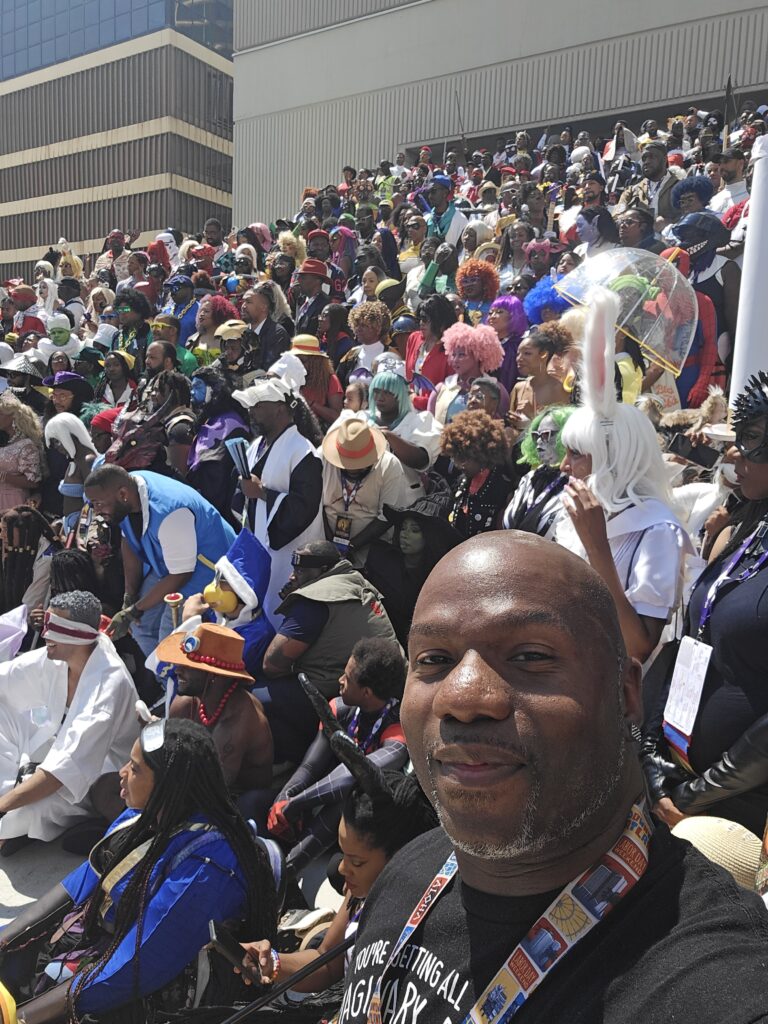
Knewbettadobetta joins a Fellowship of fans
The Heart of Fantasy
Fantasy has evolved tremendously since Tolkien introduced generations of readers to Middle-earth, but The Lord of the Rings remains one of its great foundational works. You feel that at Dragon Con.
You see it in the costumes. You hear it in conversations. You find it in panels where people can spend an hour dissecting lore, languages, adaptations, characters, mythology, and the smallest details of Tolkien’s world. You see people gathering for photographs, marches, meetups, games, and themed events.
And then, just when you think you have seen every possible version of Tolkien fandom, another Aragorn walks by.
Or a Gandalf.
Or a Nazgûl.
Or an elf.
Or an entire Fellowship.
That is part of what makes Dragon Con so much fun. It has its own culture layered over all of these individual fandoms. There are the ribbons that people collect and trade, the infamous **Cult of the Carpet**, enormous group photos, spontaneous gatherings, parties, elaborate cosplay, and the wonderfully strange moments that can only happen when thousands of passionate people are packed into the same convention ecosystem.
Yet the Tolkien fandom doesn’t simply exist alongside Dragon Con’s culture. It participates in it, it contributes to it, it becomes part of the fabric. And this year, I got to experience that from an entirely different perspective.
The High Fantasy Track and TheOneRing.net
One of the things that stood out most to me was Dragon Con’s dedication to the High Fantasy Track and, specifically, its willingness to give High Fantasy a dedicated space where TheOneRing.net could join our fellow fans as part of Tolkien-focused programming. That matters. The Tolkien fandom is enormous, but depending on the convention, it can sometimes feel like the presence of The Lord of the Rings doesn’t match the size or passion of the fandom itself.
Dragon Con feels different. Here, Tolkien has room. And when you give Tolkien fans a room, they fill it.
This year’s panels on all things Middle-earth were amazing and, for me personally, deeply fulfilling. As a POC content creator, being given a space to stand in front of a large, engaged audience and talk about something I genuinely love was meaningful on a personal level.
But what made it even more special was the audience itself.
I was surrounded by some of the smartest, most knowledgeable, and most dedicated people in the fandom. The panel I participated in on ‘Delving into the Dwarves’ really stood out for me, with how many people were interested in the lore of the dwarves – and the love they had for the dwarves over even the elves (who tend to get most of the shine!). Being able to answer questions about peoples’ loves and validate their thoughts on their favorite characters, and give new insight, knowledge and perspective on a lesser known race in the fandom, was exhilarating.
These weren’t people simply showing up because The Lord of the Rings happens to be popular (although of course there is room for those folks, too!). These were people who care. People who know the lore. People who have spent years thinking about Middle-earth, discussing Tolkien’s work, debating interpretations, studying adaptations, and keeping the fandom alive. Being able to contribute to that conversation was an honor.
And it reminded me of one of the most beautiful things about fandom: You can be the person standing on the stage, but you are still one of the people in the room. You’re still a fan.
A Place to Lock In
That is another thing I love about Dragon Con.
You can spend one night completely losing yourself in the experience, and then somehow wake up the next morning, find your coffee, put yourself together, and lock right back into your niche. That’s Dragon Con.
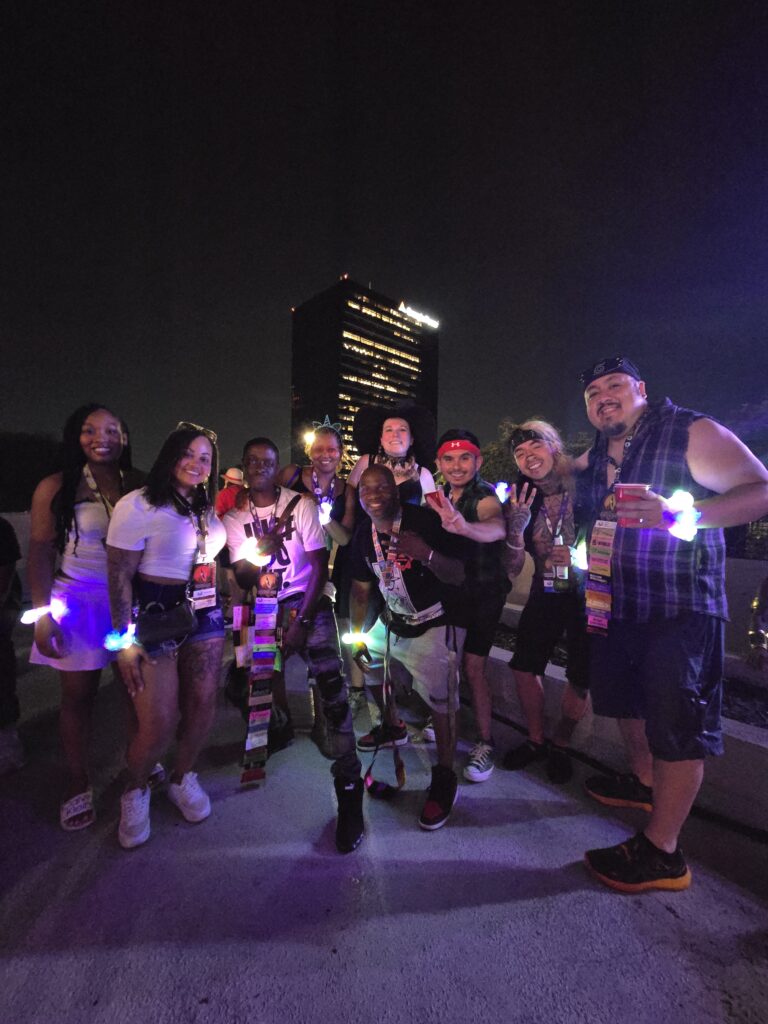
The nightlife is vibrant, energetic, and incredibly freeing. There is something about being surrounded by thousands of people who are also temporarily stepping outside the normal rules of everyday life. You can dance – and you better believe I danced lol, being from New York and the hip hop culture I loved the vibes at night, and the willingness of everyone to let loose and dance the night away.
You can dress up. (I’m still working on this – lmao my inner cosplay self has yet to come out!)
You can be ridiculous.
You can be dramatic.
You can be weird.
You can be your entire self.
And for a lot of us, that freedom is more important than we realize.
Life accumulates stress. Work accumulates stress. Responsibilities accumulate stress. The little frustrations and anxieties of an entire year can pile up until you don’t even realize how badly you need to exhale. Trust me, this has been one hell of a year for me – but while I was a Dragon Con I was totally free.
Dragon Con gives you a place to exhale.
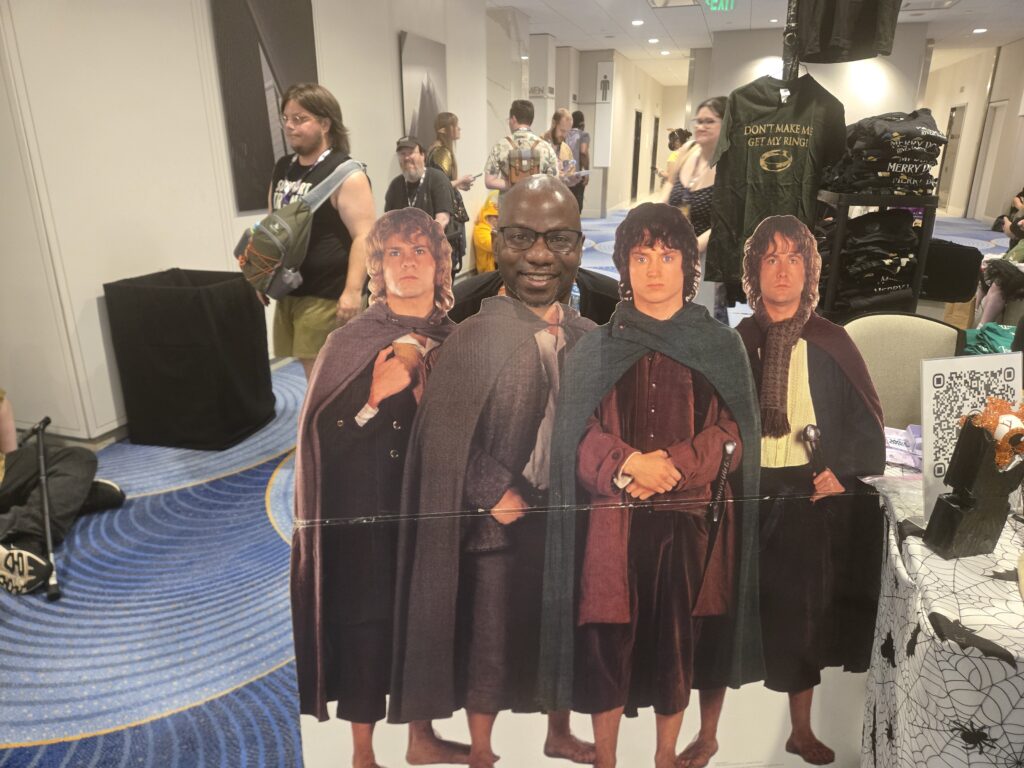
The closest we’ve got Knewbettadobetta to cosplay – so far…
Then, somehow, the next morning, you wake up and do it all again. Except now you’re sitting in a panel listening to someone explain an obscure piece of fantasy lore that you have been thinking about for months.
Or you’re raising your hand to ask a question.
Or you’re sitting in the audience completely enthralled by somebody else’s passion – which is one of the most refreshing things about the whole con.
If you’re lucky enough to be a panelist, you’re standing in front of a room trying to articulate why the thing you love matters so much.
That duality is one of Dragon Con’s greatest strengths – you can play hard, nerd harder.
And then there is An Evening at Bree
If you want to understand the love the Tolkien community has for this fandom, spend a night at Bree.
The annual High Fantasy Track party, hosted by TheOneRing.net, has become one of the highlights of Dragon Con’s Tolkien experience – for some, a highlight of the whole convention – and this year’s event was no exception.
Dragon Con provides a phenomenal ballroom, security, crowd management, and line organization that allows an event like this to operate smoothly despite the sheer number of people who want to attend. The result is a party that feels both massive and intimate at the same time.
And the attendees bring it.
People show up in full Lord of the Rings attire. Costumes range from recognizable characters to wildly inventive interpretations of Middle-earth. You see the creativity and craftsmanship of the fandom everywhere you look. The ‘sexy’ versions of these characters are quite the sight! Then you can turn around and see a cosplay that took the wearer months to make, and might be some of the most complex and beautiful and thoughtful cosplays you ever seen in your life; and the beauty of it is that they both are just as valid as the other.
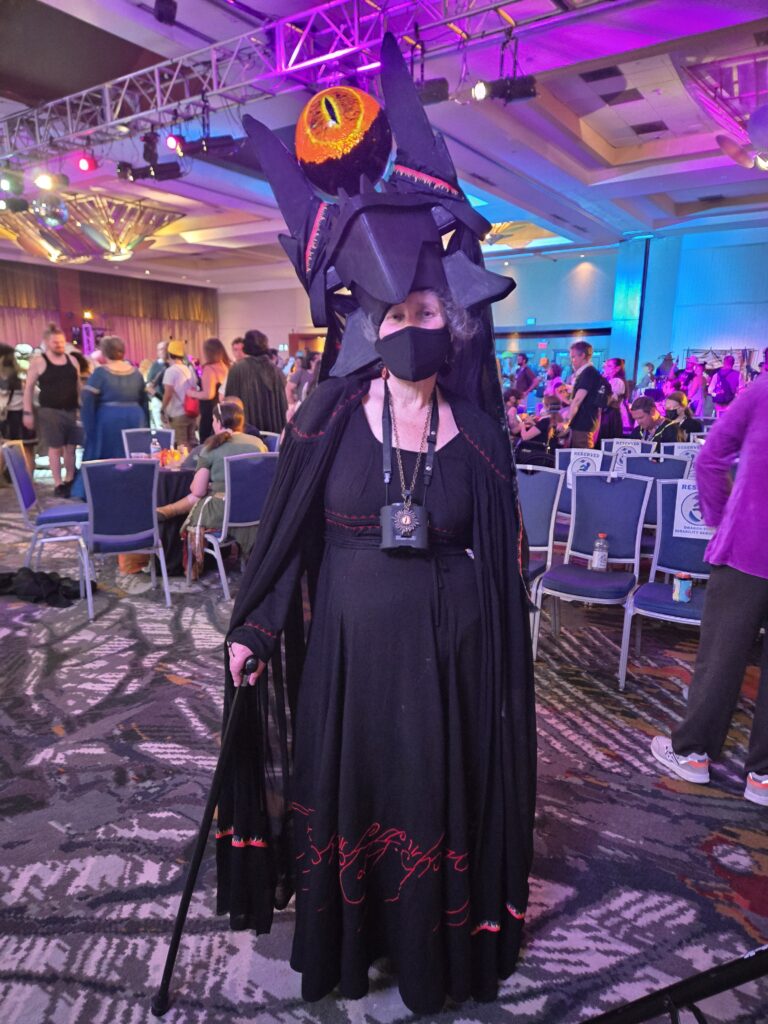
A fabulous Barad-dûr cosplay at the Evening at Bree
Then the music starts. People dance, sing, laugh. For a few hours, everyone gets to forget about whatever is waiting for them outside the convention.
You don’t just feel like you’re attending a party with a Tolkien theme. You feel like you’ve stepped into The Prancing Pony.
The bands who played throughout the evening (The Brobdingnagian Bards, Landloch’d, and Beth Patterson) delivered infectious songs, sometimes directly inspired by the world and themes of Lord of the Rings, reinforcing that strange and wonderful feeling that the ballroom had somehow transformed into Bree.
This year’s cosplay contest was particularly fun, refreshing, and beautifully hosted by TORn’s own greendragon! And then, an Elf Choir performed.
It was mesmerizing.
For a moment, the party became something else entirely. The noise and excitement gave way to voices coming together, and the result felt almost reverent.
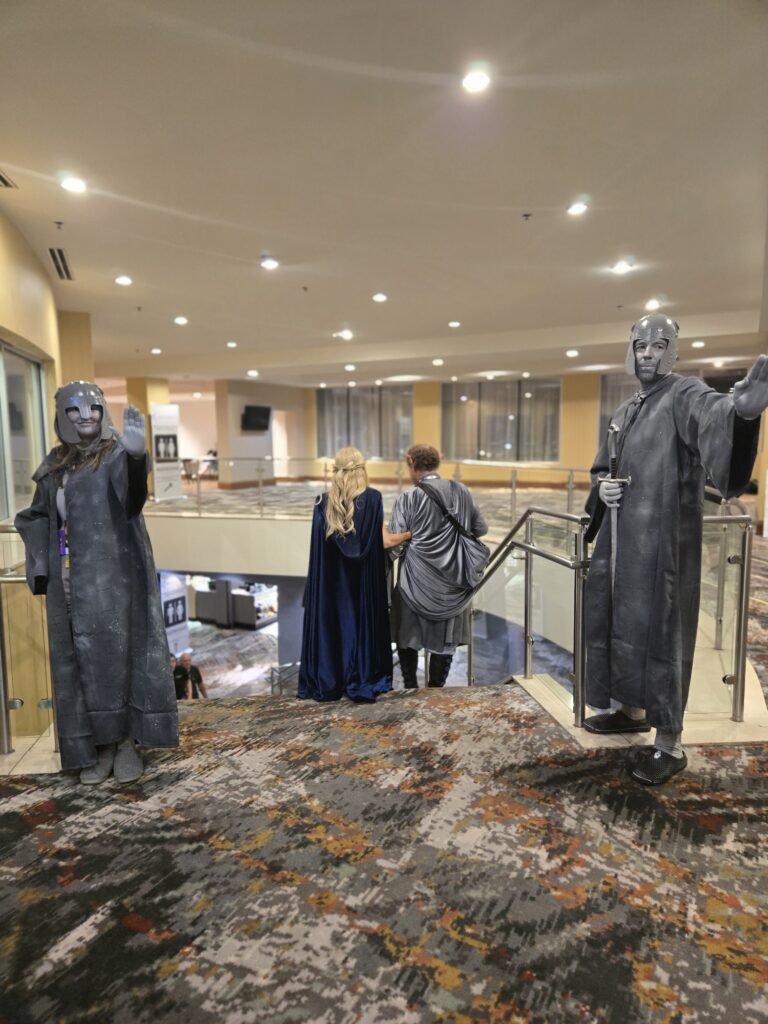
It was a beautiful reminder that fandom isn’t only about consuming stories. Sometimes it’s about creating something together – and I felt right at home. Leaving the event, a couple of fans cosplayed as the Argonath – and stood by the steps leading away from the ballroom, on either side, arms outstretched. The sight left me in awe – and brought so much weight and magic to the night. These are the special little things that make Dragon Con different.
Cosplayed Argonath
Tolkien Belongs Here
One of the most encouraging things about Dragon Con is seeing how naturally Tolkien fandom fits into the larger convention culture.
The same people collecting Dragon Con ribbons are wearing Hobbit costumes. The same people participating in giant convention photo shoots are organizing Tolkien group photos. The same people attending parties until the early hours of the morning are showing up the next day for lore-heavy panels.
There are Tolkien meetups. There are marches. There are games. There are cosplay gatherings.
There are discussions that go deep into the mythology and history of Middle-earth.
There are people who have spent years studying Tolkien’s writings, sitting alongside people who just discovered the world through an adaptation.
And somehow, it works. That’s fandom at its best.
Dragon Con understands that a convention doesn’t have to choose between being broad, and giving individual fandoms meaningful space. You can have thousands of different interests under one roof, while still allowing communities to develop their own identities. You don’t feel tied down or forced into a time slot, or forced to pick a fandom. Any and everything goes here and all are welcome – no matter your level of knowledge of a thing. If you like it, they love it for you, and let you into the fold.
That is particularly important for Tolkien fandom – because The Lord of the Rings isn’t simply another fantasy property. It is one of the pillars upon which modern fantasy fandom was built. So when Dragon Con gives Tolkien fans a home, it isn’t merely acknowledging a popular franchise. It is nurturing one of the traditions that helped make the fantasy community what it is.
The Symbiotic Relationship
That was ultimately what I came to Dragon Con to examine: What is the relationship between Tolkien fandom and Dragon Con?
After experiencing this year’s convention as a TheOneRing.net staffer and content creator, I would describe it as symbiotic.
The Tolkien community – like many other fandoms represented there – brings knowledge, creativity, cosplay, scholarship, humor, passion, and history to Dragon Con.
Dragon Con provides the infrastructure, audience, space, and community for that passion to thrive.
Each benefits from the other. Dragon Con gives Tolkien fandom a platform; Tolkien fandom gives Dragon Con another deeply passionate community that contributes to the larger culture of the convention.
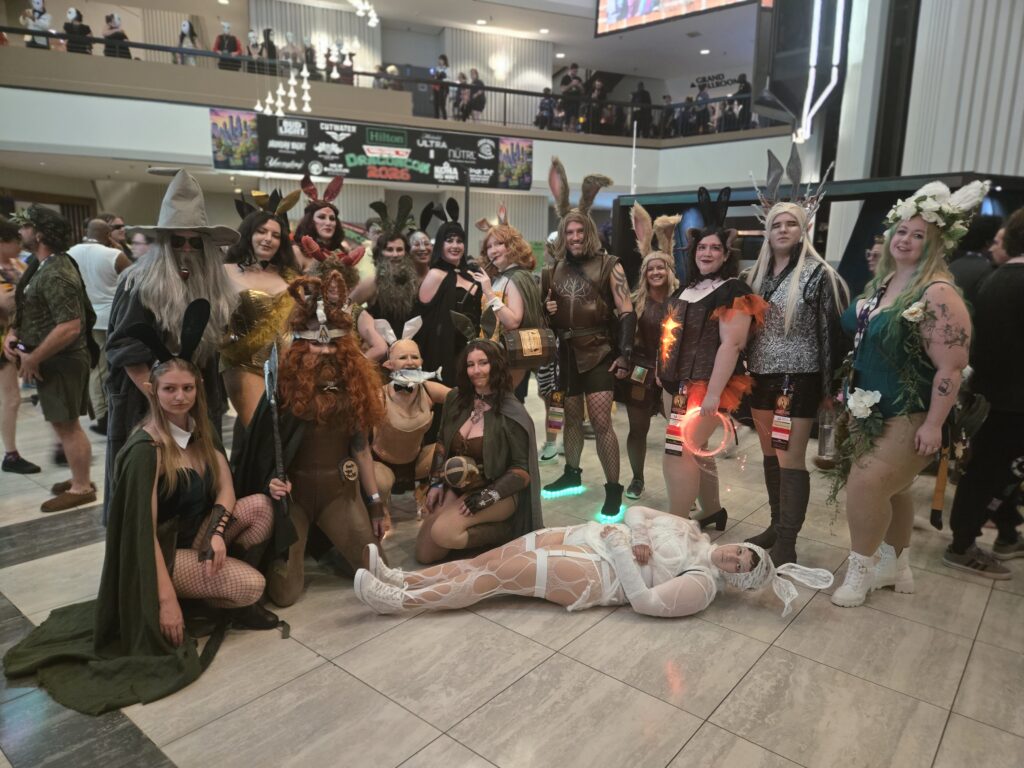
Middle-earth cosplayers for Dragon Con’s annual ‘Bunny Hutch’ party
That relationship becomes especially important as new Tolkien media – and new generations of fans – continue to emerge. Fandom doesn’t stay alive simply because a story was popular decades ago. It stays alive because people keep talking about it.
They keep creating.
They keep dressing up.
They keep writing.
They keep making videos.
They keep hosting panels.
They keep asking questions.
They keep arguing about lore.
They keep singing.
They keep dancing.
They keep showing up.
Dragon Con creates a place where all of that can happen, in one long weekend.
The Heart Still Beats
My time at Dragon Con 2026 left me with a pretty simple conclusion:
The Lord of the Rings community is the heart of the fantasy community, and Dragon Con is one of the places where that heart can beat loudly, proudly, and freely.
There is something incredibly powerful about seeing Tolkien fandom represented alongside the countless other communities that make Dragon Con what it is: the Klingons, the Whovians, the robot builders, the horror lovers…
The ribbons, the giant photoshoots, the meetups, the panels.
The late nights and the early mornings!
The bizarre conversations with strangers that somehow become friendships. (We literally found another group from asking about their Dungeon Crawler Carl attire and boom! – we were inseparable the entire con!)
Friends old and new
The moments where you realize you have been standing in a hotel hallway for forty-five minutes talking about a fictional language.
That’s Dragon Con. And that’s Tolkien fandom.
Both are built around the same fundamental idea: people who love something coming together and turning that love into a community.
Dragon Con is a fan-made convention where you can find a place for almost anything you love. It is wonderfully expansive without losing the intimate feeling of fandom. I was proud to be there this year representing TheOneRing.net, not just as a content creator, but as a fan. And it is good to see Dragon Con continue to show focus and dedication to one of fantasy’s great mainstays.
Because Middle-earth isn’t going anywhere.
The fans aren’t going anywhere.
And as long as there are places willing to give that fandom room to gather, create, celebrate, debate, dance, sing, dress up, and tell stories of its own, the heart of fantasy will keep beating.


 5:
5: