Two years ago I wrote a story asking the question, “To be Hot or Not? That is the Dwarf Question.”
While essentially a joke — one which spread like wildfire – a real concern for some fans prior to casting “The Hobbit” was whether or not a film featuring a supporting cast of 13 short hairy men would be interesting to studios and audiences unless those short hairy men were transformed into attractive short-statured hunks, the likes of which would send diehards into fits of horror.
The question was, would the filmmakers be forced to go that route, and also – did we want them to? Should there be Hot Dwarves?
(From here on this will contain minor spoilers, so those of you who wish to remain “pure,” turn back now.)
++++++++++
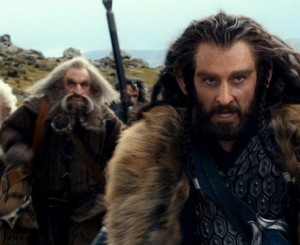
With the casting of Richard Armitage as Thorin, the leader of the dwarves, we couldn’t help but admit that we were conflicted. Supremely talented actor. But could he look dwarflike? Did he have to? Wait, yes, he has to. But should he? Head said yes, hormones said no. Shut up hormones.
As the other actors were added, fans’ questions grew. And as stills of costumed dwarves began rolling out, the discussions raged on in fandom – Were the dwarves too cute? Too bad-assed? Too dwarvish? Not dwarvish enough? Too KLINGON? Second guessing gave way to infinity-guessing.
The movie a year or more off, poring over images and studying production diaries provided much fodder for speculators. Beyond Thorin, beyond Aidan Turner’s Kili and Dean O’Gorman’s Fili, the whole company was under intense scrutiny.
With the exception of Thorin, dwarves aren’t the leading characters in “The Hobbit” and yet the film would live or die on them. Too comical and audiences wouldn’t buy into the story. Too Hollywood-handsome and audiences wouldn’t buy into the story. Should they fade into the background entirely then it simply wouldn’t be “The Hobbit.” Nor if they became Robo-Dwarves-of-Doom, chewing on the scenery.
So, with the “Unexpected Journey” finally here, how did it all turn out?
Fabulous.
No, Thorin does not harken back to the droopy-eyed Rankin Bass incarnation, nor does he resemble Tolkien’s description of a blue-hooded, silver-tasseled grump. But neither is he a Chippen-dwarf. He embodies the essence of the character – the haughty nobility, the impatience and simmering anger. The sadness. This is not the hot dwarf you were looking for, but so much more.
Voice, body language, costume, prosthetics – all combine to transform Armitage into the strong, surly Thorin Oakenshield. One dimensional images fade from mind and the focus shifts to the character in action, as it should.
It will be interesting to see where the second and third films take Thorin. At the conclusion of “Unexpected Journey” he has an emotional encounter with Bilbo – much, much earlier in the action than what occurs in the text. And that exchange adds another layer to a complexity that outweighs looks.
And what about the rest of the company?
While “The Hobbit” on page is essentially a child’s tale, Peter Jackson hasn’t filmed a child’s tale. There is a vein of darkness running through the movie, brought by material added from the appendices and the established “Lord of the Rings” visual style.
For the action scenes to be believable – particularly in the higher frame-rate and in 3D – the dwarves must be warrior-like, to appear capable of fighting with the agility and intensity required. In the company of these dwarves, Gimli would appear soft.
And yet, the dwarves retain a whimsicality that makes them distinct. Like Thorin, their appearance is an expression of personality. With less time at the forefront, how they look is a large part of how we get to “know” them.
Balin with his luxurious white beard, the elder of the company. Bofur’s quirky cap and quick wit. The soft-spoken Ori in his cowled hood. But the things that seemed over the top in stills – Bifur with the axe-impaled forehead – aren’t in your face. Remarkably, at least in “Unexpected Journey,” we’re spared Bombur sight-gags.
Which brings us to Kili and Fili.
No, they do not look like dwarves. Kili even less so than Fili. Even in the company of dwarves, they do not look like dwarves. And yet, they look as if they belong with the dwarves. And while I’m pretty sure that might not make sense, I think once people see the film, you’ll understand what I mean. In the context of their behavior and actions – they work as dwarves. They fight like dwarves. It helps that Peter has not indulged in long, lingering, soft-focused glamor shots of Aidan Turner or Dean O’Gorman. Thank you, Peter.
While looks are possibly one of the more trivial aspects of the film – seriously, I do recognize the ridiculousness in all of this – a noticeable amount of effort has been put into crafting each dwarf’s appearance and then stepping back from focusing on it. It’s a measure of subtlety we didn’t expect.
++++++++++
In the meantime, the phrase “Hot Dwarves” has spread across the globe since my story was first published.
At San Diego Comic-Con this summer, Carrie Fisher fell for our “I <3 Hot Dwarves” t-shirt. In Wellington, Aidan Turner, who wanted a shirt for his own, was gifted with a “Hot Dwarves” button.
The phrase crops up in most stories I’ve read, is at alluded to in many interviews, raises its head in pop-culture memes and … well, last week showed up on the red carpet of the world premiere itself. [Watch]
“How do you feel about being one of the pin-ups in the The Hobbit,” said an interviewer to Richard Armitage.
”I thought you were going to say ‘hot dwarf.’” he graciously responded with some humor.
As I said at TheOneRing.net’s Comic-Con panel: Thank you, Richard, for being such a good sport. Bravo!
At the first public showing of a movie picture depicting a train coming toward the viewers, people scattered in alarm trying to get out of the way. Or so the story goes. Some will do the same with director Peter Jackson’s new film The Hobbit: An Unexpected Journey.
The irony is that The Hobbit’s titular character, Bilbo Baggins, doesn’t like to take risks in a film that revels in them.
It’s visionary stuff, and Jackson is alone on the frontier with only James Cameron visible on the horizon. The first installment of The Hobbit trilogy is new cinema.
Instead of playing safe and comfortable in lower-risk financial zones, Jackson has pushed the boundaries with 3D, with 48 frames of film per second -– or the digital equivalent — flashing past viewers’ eyes instead of the traditional 24fps. It is definitely different.
The filter of the traditional look of cinema, what we are used to seeing in the dark, is gone. Forever? Consumers will ultimately decide but studios continue to churn out films in 3D despite anything but universal acclaim.
Here, Jackson has gone to such lengths to make the fantastic look real that for many the film will look unreal -– but only if viewers choose to see it in the director’s preferred way. Of the approximately 24,000 theaters that will display The Hobbit: AUJ, around 1,000 will have the technology to display it as it was shot — HFR 3D. But, for those 1,000, hang onto your arm rests, cinema has just leapt forward.
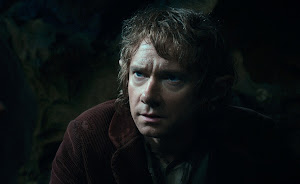
Bilbo Baggins (masterfully portrayed by Martin Freeman in a performance that will be lost amidst the eye-popping action sequences), as many readers will know, relishes his comfortable life in the cinematically familiar Bag End. He is interrupted by a gaggle of dwarves and a meddlesome wizard who for reasons he cannot himself explain, thinks Bilbo needs to travel with the dwarves.
All of this is familiar ground for readers of Tolkien’s original tale. And, as expected, the screenwriters (Fran Walsh, Phillipa Boyens, Guillermo del Toro and Peter Jackson) make great effort to up the stakes and ramp-up the tension.
People who haven’t been paying attention to the promotional lead-in campaign may be surprised to find that joining Freeman and Ian McKellen’s Gandalf as lead characters in the film is Richard Armitage as Thorin Oakenshield. It’s a role likely to launch Armitage, blessed with an already-fervent fanbase, masculine good looks, and ample ability, into the stratosphere. The character is deeply scarred and tragic. Thorin gives the children’s tale a Shakespearean disaster angle and the film makes the most of it in in ways that may not surprise viewers but will nevertheless delight them.
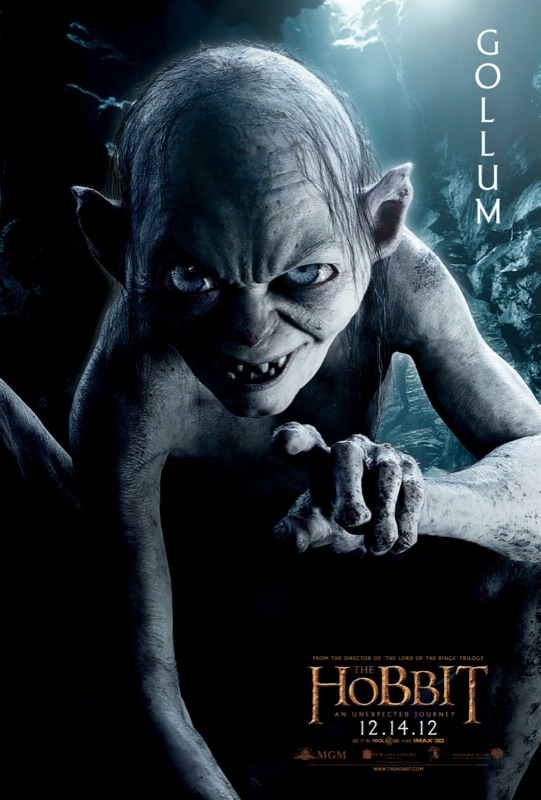
Andy Serkis returns to work his performance-capture magic as Gollum, and Jackson and his actors reach the peak of performance and technical … well … wizardry in a scene that is the film’s best. Despite being dialog-heavy, it is cinematic magic.
So Bilbo, content to play it safe in a movie that most definitely isn’t, is joined by all these dwarves who despite excellent design and characterization, just don’t have enough room in the movie. Considering Jackson’s Middle-earth legacy, many viewers will immediately begin pondering extended editions and hope for more from these characters.
Then -– especially if they see it in 48 fps -– they’ll want to schedule another viewing. This writer’s initial reaction to the film was wanting to see it again immediately. As of this writing, that has been impossible. Fans, and those who care about film as an art form (and perhaps as a science) will want to view The Hobbit: An Unexpected Journey in both its incredibly clear new format and as a traditional film.
Others, the Bilbo Baggins of the world, are perhaps better advised to simply see the film as they saw The Lord of the Rings. They will be thrilled with adventure and the interplay of now-familiar movie characters playing again inside the incredible landscapes of Middle-earth. Peering deeper into dwarven culture will come with a (pun-intended) deep satisfaction and they will be thrilled, despite some dark days for fans, back in a delightful rendition of Jackson’s Middle-earth..
It goes without saying that not everybody will like everything. Setting aside technology for a moment, sections of the film that delight some will frustrate others.
In one place Gandalf reuses a familiar story-telling device. For some that will hearken back to the familiar. For others it will seem like a rehash. There are a handful of such moments. The 100% CGI orc Azog may feel cartoon despite (or because of) his technical perfection; he is no Gollum. But putting aside the quibbles, Jackson has delivered a tightly paced action flick that is rollicking fun. He has captured again the magic of Tolkien’s world with his own stylistic, cinematic stamp.
Radagast the Brown is a delight and injects some of the fringe legends of Tolkien’s own hand and some of the lighter tone of the source material into the sometimes dangerously heavy Middle-earth. There is the expanded Goblin Town with its madcap action – more jolly than peilous – which takes license with underground kingdoms. But amidst all this fun we are tossed a dozen decapitations as well creating a puzzle for some parents and sensitive younger viewers. Cate Blanchett casts her graceful spell along with the most welcome Christopher Lee and appropriate the slightly less stressed Elrond from Hugo Weaving, iconic in his own right.
The dead-on casting with exemplary performances from the leads as well as those in small roles make the fantasy feel real more than any technician can -– and the technicians on this film are world-class here. And yes, fantasy films can have exemplary performances and actors selling the fantastic as the everyday, have achieved high-craft in their art. Technically masterful, this adaptation of a classic children’s tale is grand and glorious cinema that is indeed lighter than its Rings cousin but also with nasty battle elements.
What’s more, any discussion about the need for three films or the making the decision to do so based on anything but storytelling merits couldn’t be more incinerated if Smaug himself engulfed the conversation in dragon’s fire. The case for three films is settled.
But being first is difficult. Like Ebay selling its first item in 1995 (a laser pointer if you must know) new things can take a while to catch on. The lion’s share of reviews are going to address the step forward in display technology (including this one!) but the story will sink or swim because of the characters, their situations and the craft with which they are brought to life.
Viewers need to evaluate: Are they Bilbos? Do they want safe, familiar cinema or do they want to go on an adventure at the theater? The comparison isn’t mine originally but I like best the thought that somebody has taken the window out and now we are not looking through the filter of film but looking at the real world. It will take some adjusting.
Will you like it? Well, do you embrace change? Can your entertainment tastes evolve? This is like nothing you have ever seen and it will jar not just your eyes but your brain. The dragon slayers will revel in the new and the adventure. Not every note will ring true for every viewer but whatever else, this movie is about fun and adventure.
And (something that will obviously delight the studio) the real answer to this riddle is that this is a film that cries out to be seen in both formats and compared by the viewer. It is entertaining entertainment but it is also a landmark of technology and a test of crowd behavior. I agree with Jackson and Cameron; this is the future.
Whatever the public and critics conclude, Jackson and his team must be admired for operating on wires high above the crowd with no net or safety line with fearlessness and passion. As for me, I will take that at my cinema experience every time over another action film content to play it safe.
NOTE:Larry D. Curtis spent five weeks on the set during film of The Hobbit and freely acknowledges his opinion of this film is compromised. Further, he is dying to see the film again to have a more informed opinion.
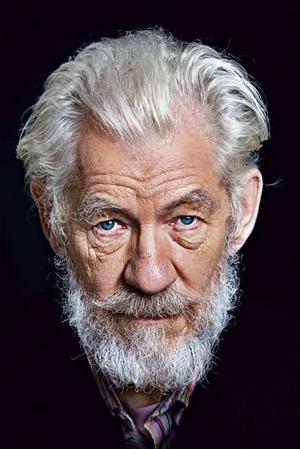
Ian McKellen chats with TODAY’s Matt Lauer about reprising his role as Gandalf the Wizard in the new film The Hobbit: An Unexpected Journey, and working with the special effects required to create Middle Earth. He says in it “he has five more weeks (of shooting) to do next year” and that working on the green screen can be “a bit unnerving”. Continue reading “Ian McKellen interviewed on MSNBC”
Will Gollum appear at the end of the third film?Although the wait is nearly over for the familiar goblins and mystical forests of The Hobbit: An Unexpected Journey, senior visual-effects supervisor Joe Letteri says the only thing that remains the same for this iteration of Peter Jackson’s fantasy films is on the surface. The digital tools that brought countless Orcs to life and gave Gollum his distinctive distorted face are virtually unrecognizable from those used a decade ago for the The Lord of the Rings trilogy.
“It’s changed almost completely,” Letteri says. “On the outside, you want Gollum to look like the same character, but he’s completely different” underneath.
The biggest change from the first set of films is the way that actor Andy Serkis’ performance is captured and analyzed in order to create the digital character, according to visual-effects supervisor Eric Saindon. “Our facial capture has progressed leaps and bounds,” he says. “Now we actually capture all of Andy’s performance, when he’s acting with Martin (Freeman) in Gollum’s cage on set. We have a small camera attached in front of his face that captures his exact facial performance. Rather than an animator going in and doing it frame-by-frame, the computer analyzes Andy’s performance and then fires Gollum’s muscles to do the exact same thing. So the first half of the animation, which is the raw mo-cap data, is really Andy.”
“We know so much more about how the face works,” Letteri adds. “When people communicate face to face there are so many things that are going on that you really have to study now and put into the characters. We hope that people recognize that there’s this extra layer of depth.”
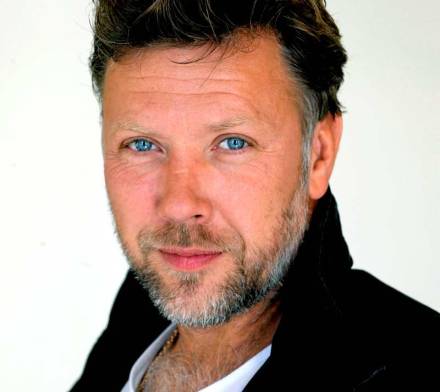
Thanks to Ringer Lissuin on the TORn message boards we have the following translation of the article in Swedish paper Nöjesbladet talking about Mikael Persbrandt and his role as Beorn in The Hobbit. Warning: some film and book spoilers! Continue reading “Jackson: Persbrandt to gain larger role in The Hobbit”


 While essentially a joke — one which spread like wildfire – a real concern for some fans prior to casting “The Hobbit” was whether or not a film featuring a supporting cast of 13 short hairy men would be interesting to studios and audiences unless those short hairy men were transformed into attractive short-statured hunks, the likes of which would send diehards into fits of horror.
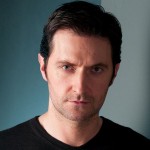 With the casting of Richard Armitage as Thorin, the leader of the dwarves, we couldn’t help but admit that we were conflicted. Supremely talented actor. But could he look dwarflike? Did he have to? Wait, yes, he has to. But should he? Head said yes, hormones said no. Shut up hormones.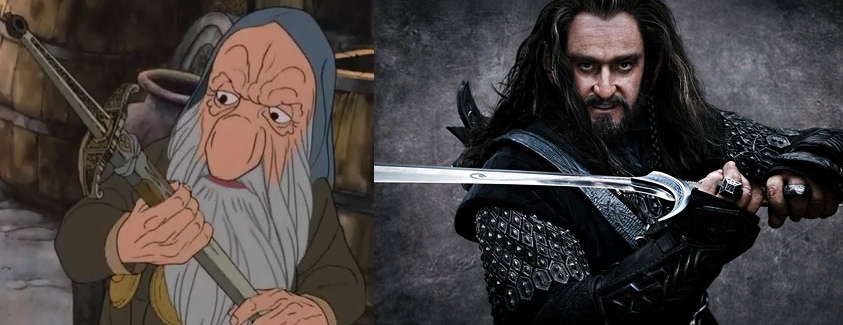
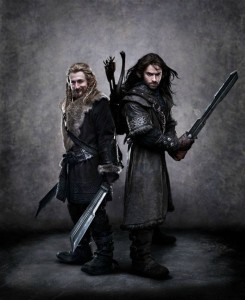 Which brings us to Kili and Fili.
 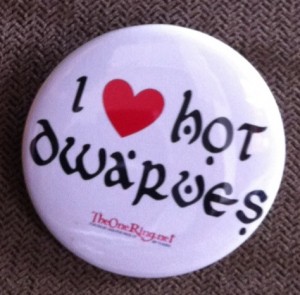 In the meantime, the phrase “Hot Dwarves” has spread across the globe since my story was first published.

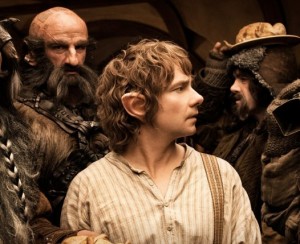 Bilbo Baggins (masterfully portrayed by Martin Freeman in a performance that will be lost amidst the eye-popping action sequences), as many readers will know, relishes his comfortable life in the cinematically familiar Bag End. He is interrupted by a gaggle of dwarves and a meddlesome wizard who for reasons he cannot himself explain, thinks Bilbo needs to travel with the dwarves.
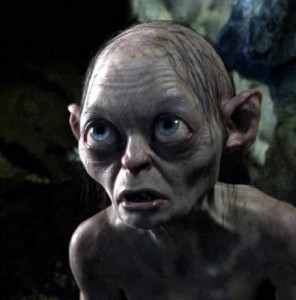 Andy Serkis returns to work his performance-capture magic as Gollum, and Jackson and his actors reach the peak of performance and technical … well … wizardry in a scene that is the film’s best. Despite being dialog-heavy, it is cinematic magic.
 What’s more, any discussion about the need for three films or the making the decision to do so based on anything but storytelling merits couldn’t be more incinerated if Smaug himself engulfed the conversation in dragon’s fire. The case for three films is settled.
 TheOneRing.net staffer Garfeimao and long-time TORn friend Nancy Steinman were able to secure tickets to the World Premiere of The Hobbit: An Unexpected Journey. Here are Garfeimao’s largely spoiler-free thoughts on what she saw.