Brian Sibley and Pauline Baynes are names which will be instantly familiar to many Tolkien fans. Author, broadcaster and screenwriter Sibley scripted a radio version of The Lord of the Rings for the BBC, and his wonderful book The Maps of Middle-earth was illustrated by John Howe. Sibley also wrote The Making of the Movie Trilogy for Peter Jackson’s The Lord of the Rings movies, and the three ‘Official Guides’ for his Hobbit trilogy.
Artist Pauline Baynes, who died in 2008, worked with Tolkien himself, creating maps and illustrations for his works. Many fans will have had her art work on their walls, as she illustrated Middle-earth posters in the early seventies. Her work adorned covers of various editions of the Professor’s works, and she first collaborated with Tolkien when she illustrated Farmer Giles of Ham back in 1949. She also illustrated all of C S Lewis’ Narnia books.
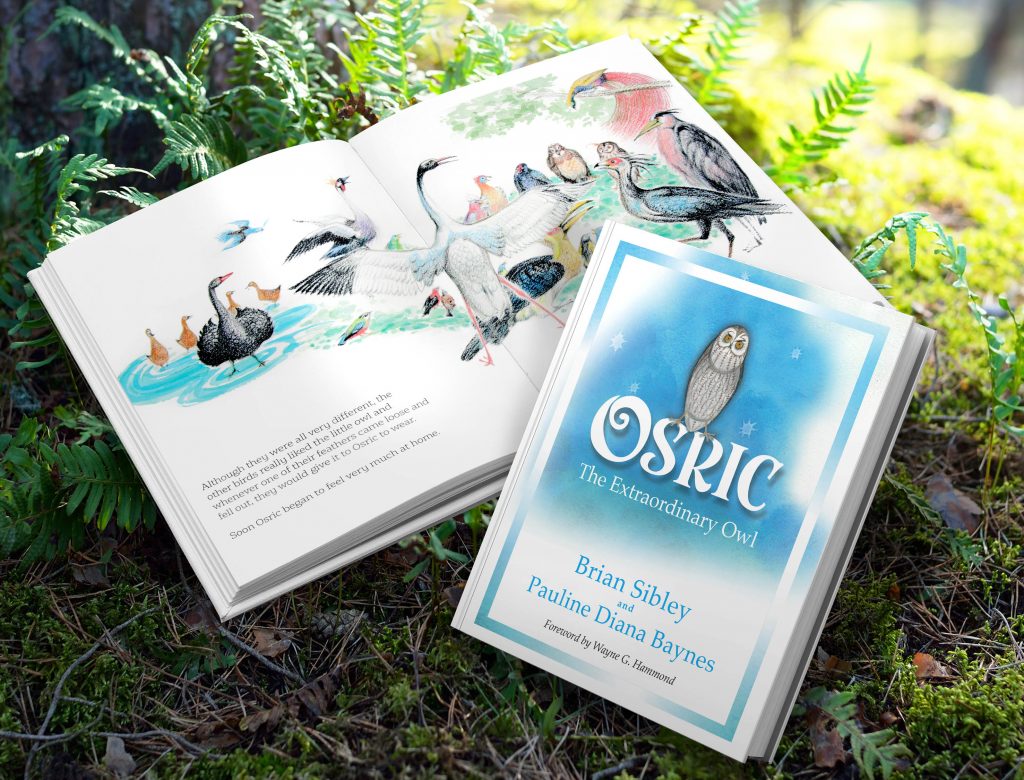
Baynes and Sibley were friends for many years, and together they created a tale of Osric the Extraordinary Owl. TORn’s good friend Jay Johnstone has finally been able to publish this wonderful work, in a limited edition of just 250 – with a foreword by none other than Tolkien scholar Wayne G. Hammond! Here’s what the official press release tell us:
Osric the Extraordinary Owl resulted from the collaboration of two friends: artist and illustrator Pauline Baynes and writer, dramatist and broadcaster Brian Sibley. It was a friendship spanning more than two-and-a-half decades, with many shared interests, among them the work of J. R. R. Tolkien and C. S. Lewis famously illustrated by Pauline and the subject of acclaimed dramatisations by Brian.
Sibley’s tale of a small grey owl in search of the courage to establish his individuality and ‘be himself’ (but which can be also be read as a ‘coming-out story’) was written in 1970 but had to wait until 2007 to find an artist at a time when Baynes was without any commissions and was wanting opportunities to keep drawing and painting. As a result she produced 22 delightful, double-page illustrations featuring not just Osric and his owl family but also an entire aviary of the most spectacular, colourful birds from black swans and peacocks to flamingos and toucans.
Baynes completed her pictures for Osric the year before her death in 2008 but ‘the extraordinary owl’ had to wait another decade to find a publisher. At the Tolkien Society’s 50th anniversary conference in 2019 noted Tolkien artist Jay Johnstone met Brian Sibley and another of Pauline’s friends, Wayne G. Hammond who, with his wife Christina Scull, is responsible for many key works of Tolkien scholarship and who, as Librarian of the Chapin Library of Rare Books at Williams College, Williamstown, Massachusetts, has curatorship of the Pauline Baynes bequest of paintings, drawings. Out of that Tolkien encounter came the decision to finally get Osric’s saga into print.
After a delay, caused by the Covid pandemic, Jay Johnstone is now pleased to announce the publication of Osric the Extraordinary Owl. This collector’s edition hardback book is written by Brian Sibley and illustrated by Pauline Baynes, with a foreword by Wayne G. Hammond. It is designed and produced by Jay Johnstone and comes in a gilded presentation box. Each book is individually numbered and comes with signed book plates by Brian, Wayne and Jay.
Fans of Bayne’s art and Sibley’s writing will not want to miss out on this very limited release. You can find out more by clicking here.
Amazon will get an additional 5% from more New Zealand’s Screen Production Grant, Reuters reports today.
(Reuters) New Zealand said on Friday it has agreed to give Amazon (AMZN.O) extra rebates on its expenses for the filming of “The Lord of the Rings” TV series in the country, hoping to reap multi-year economic and tourism benefits.
Amazon will get an extra 5% from New Zealand’s Screen Production Grant in addition to the 20% grant the production already qualifies for, the government said in a statement.
Amazon is estimated to be spending about NZ$650 million ($465 million) filming the first season of the show, for broadcast on its Amazon Prime streaming platform, meaning it would be eligible for a rebate of about NZ$162 million ($116 million), the government said.
“The agreement with Amazon … generates local jobs and creates work for local businesses,” Economic and Regional Development Minister Stuart Nash said in a statement. “It will enable a new wave of international tourism branding and promotion for this country.”
The first season entered production in Auckland last year with more than 1,200 people employed. Approximately 700 workers are indirectly employed by providing services to the production, the government said.
U.S.-based Amazon media officials weren’t immediately available for comment outside regular U.S. business hours.
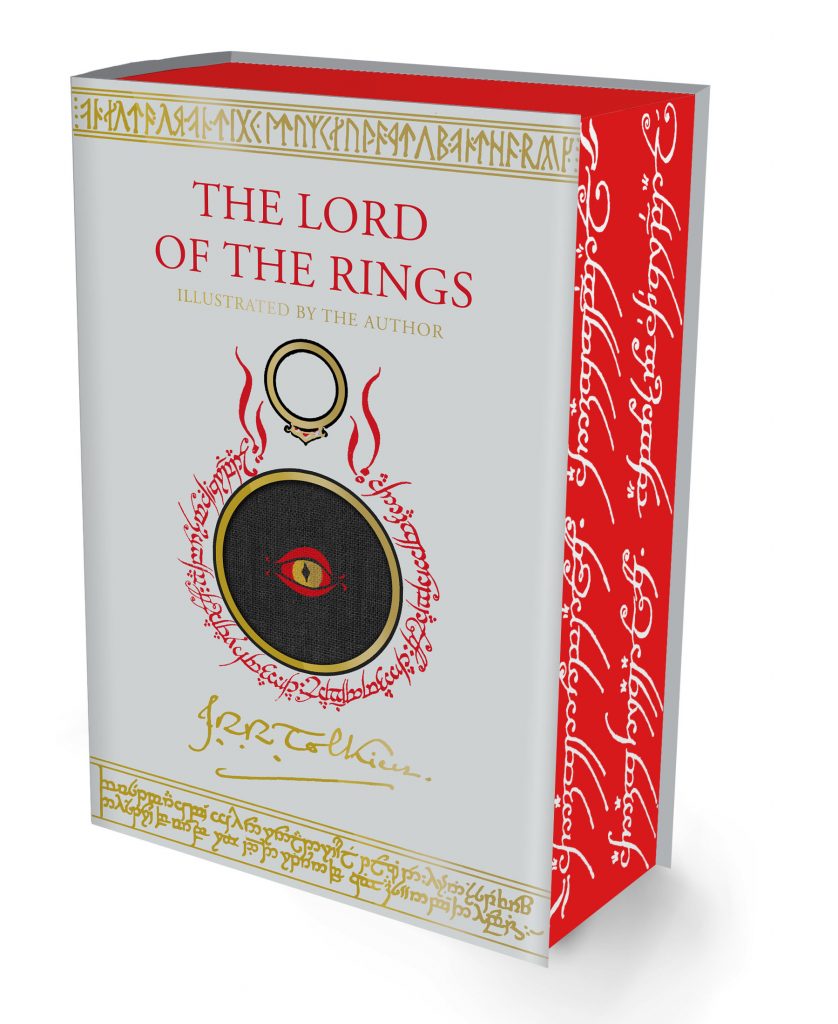
Just in time for Tolkien Reading Day: our friends at Houghton Mifflin Harcourt have sent us exciting news! Later this year, a new edition of The Lord of the Rings will be published, featuring – for the first time since the original 1954 publication – artwork by the Professor himself.
Here’s their full press release:
Houghton Mifflin Harcourt Books & Media will publish a brand-new edition of The Lord of the Rings by J.R.R. Tolkien that, for the the first time since its publication in 1954, will feature paintings, drawings and sketches by the author, in the U.S. on October 19, 2021.
Deb Brody, HMH’s VP and Publisher, says: ‘Professor Tolkien is known the world over for his literary and academic achievements, most especially as author of The Hobbit, The Silmarillion, and the critically acclaimed and worldwide bestselling The Lord of the Rings.
‘His charming and evocative illustrations that accompanied The Hobbit, particularly the now-iconic image that appears on its cover, have become as beloved as the story they accompany.”
‘Yet the author himself was characteristically modest, dismissive of the obvious and rare artistic talent he possessed despite having had no formal training. This modesty meant that relatively little else of his artwork was known of or seen during his lifetime, and generally only in scholarly books afterwards.
‘This all changed in 2018, with the first of three record-breaking Tolkien exhibitions in Oxford, New York and Paris, at which hundreds of thousands of people were able to appreciate at first hand the extraordinary artistic achievement of a man known primarily for the written word. Among the exhibits was a selection of the paintings, drawings and sketches that Tolkien produced when writing The Lord of the Rings. Originally intended by him purely for his personal pleasure and reference, after such an overwhelmingly positive response by people to Tolkien the Artist it seemed fitting to finally reunite this art with the words it enhances, and we are delighted that in so doing it will allow people to enjoy this masterpiece anew.’
The Hobbit was first published in 1937 and The Lord of the Rings in 1954–5. Each has since gone on to become a beloved classic of literature and an international bestseller translated into more than 70 languages, collectively selling more than 150,000,000 copies worldwide.
The Lord of the Rings, illustrated by the author, will be published subsequently in translation around the world.
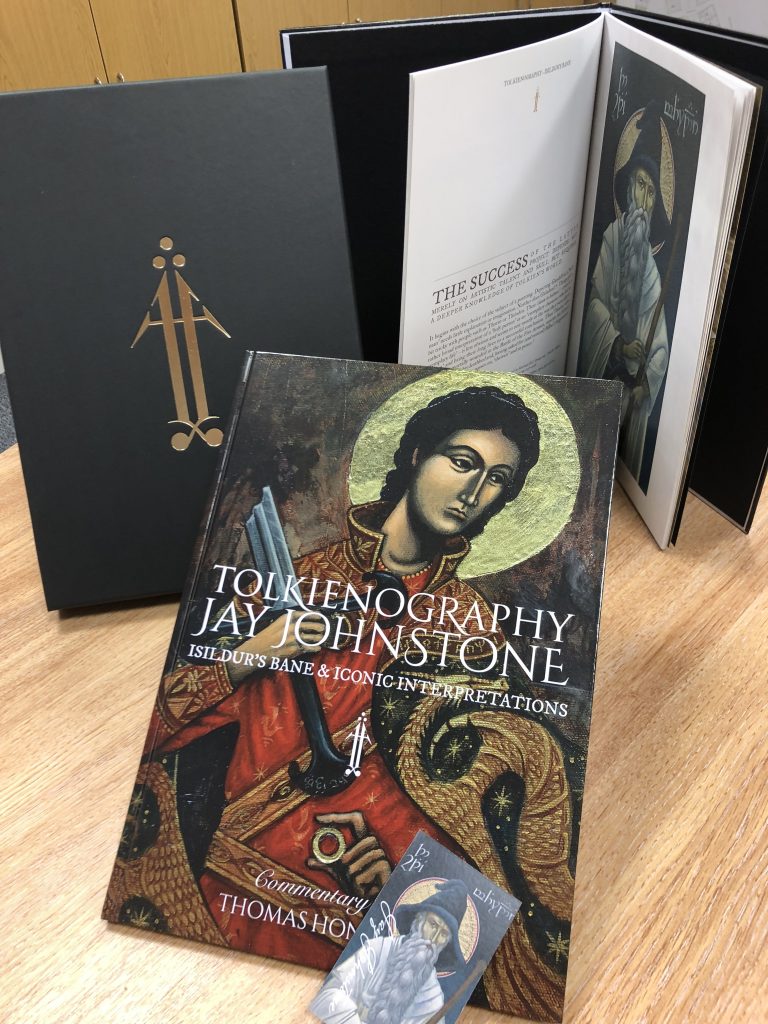
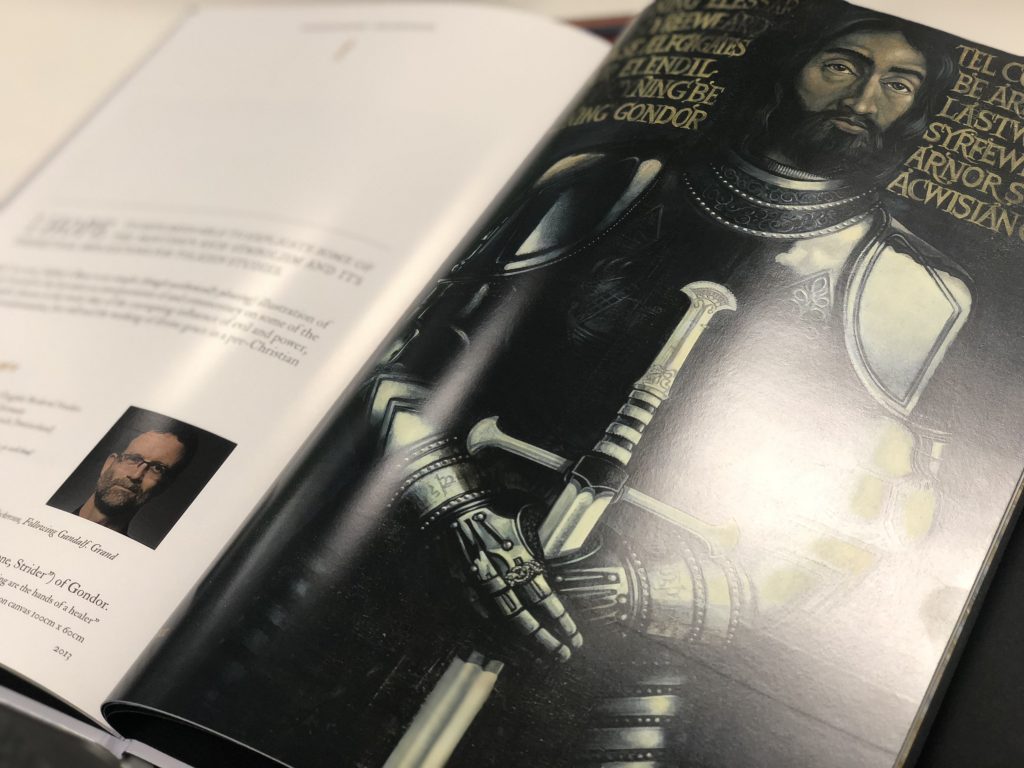
Middle-earth fans will not want to miss this amazing book from artist Jay Johnstone – Tolkienography: Isildur’s Bane & Iconic Interpretations (with commentary by Thomas Honegger).
It’s an amazing volume, filled with rich, luminous artwork. It was reviewed in the latest edition of theJournal of Inkling Studies (Volume 10, issue 2); here’s a little of what writer Lance A. Green had to say:
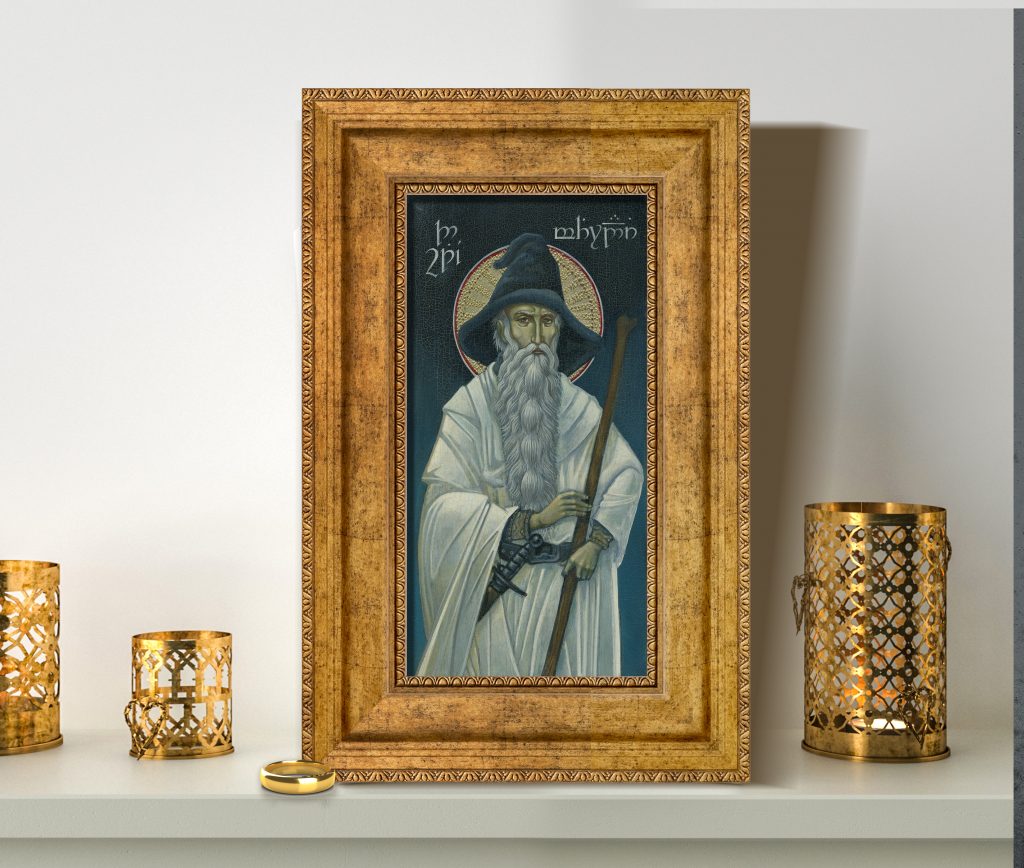
Tolkienography invites a deep immersion in Tolkien’s myth through the artwork of Jay Johnstone, who has been painting Tolkien-themed illustrations for about thirty years. Together with Thomas Honegger’s commentary, Tolkienography offers a novel artistic rendering of Tolkien’s sub-creation, provoking new interpretations of its characters and essential themes. Printed with colourful clarity, the styles and techniques of Johnstone’s pieces are different enough to avoid any redundancy for the viewer. Colours, spacing, and characters are varied with each turn of the page, as are the painting techniques, which range from more contemporary styles to those mirroring medieval forms, including frescos and Byzantine iconography. Johnstone’s oils and charcoal works certainly capture the imagination: the charcoal and chalk of the Council of Elrond (25), the oil on canvas of Isildur’s death in the river Anduin (35, 39), and the binding of Melkor (41) all wonderfully convey character and scene. An immense oil and gold-leaf rendering of Gandalf atop Shadowfax riding into Helm’s Deep (49–50) is one of the most striking paintings in the book, afforded two full pages in order to capture its immensity. Yet the artwork that crowns and guides Tolkienography is the Byzantine-styled iconographic paintings of Tolkien’s characters.
Lance A. Green, Journal of Inkling Studies Vol 10 Issue 2
The Journal is published by Edinburgh University Press; you can find more of the article here. If you’d like your own copy of Johnstone’s beautiful book, don’t delay – it’s a limited print of 500 copies! At only £45 – and signed by the artist! – it really is a steal for such a spectacular book. You can order it – and see more art from Johnstone – at his website, here.
SO … you heard Amazon’s working on a Lord of the Rings TV series or a Middle-earth TV Series, or something, and now you want to be ‘read and ready’ when the show premiers (sometime later this year, we hope!). But you don’t know Tolkien from Tookish? Get your pens, pencils, or pixels handy! This is your Reading List to help you prepare! With the understanding that this list will go way beyond the scope of what Amazon has purchased the rights to work with, here’s what you Need to Read:
The Basics
The Lord of the Rings: Especially allll that stuff after the story ends, known as the Appendices. VERY IMPORTANT! The Appendices are the source from which Amazon is generating, or on which they are basing, their storytelling; but reading them on their own will be of little worth if you have no context or passion for Middle-earth.
[Ed’s note – if you have a REALLY short amount of time, your ‘Cheat’s guide’/last minute revision is Appendix A I (i) ‘Numenor’ and Appendix B ‘The Tale of Years – The Second Age’.] [Amazon.com]
As we prepare to hang up our stockings on Christmas Eve, hoping for a visit from a certain gentleman dressed in red, let’s take a closer look at a wonderful, festive book for Tolkien fans of all ages.
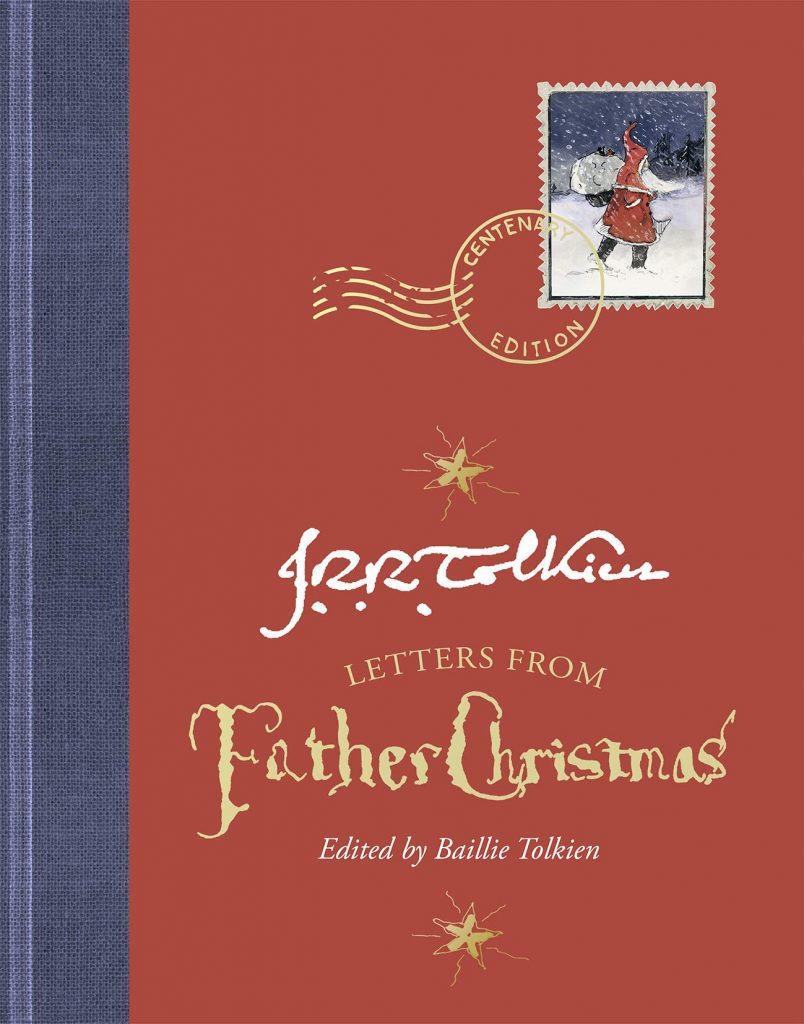
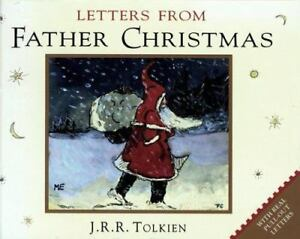
The October 2020 edition from Houghton Mifflin Harcourt
Released in time for the 2020 holiday season, Houghton Mifflin Harcourt has followed the path of its British cousin Harper Collins in publishing a striking new edition of the Letters from Father Christmas. Hitting the American market in late October, this oversized hardback beauty boasts 208 pages of colorful Christmas chronicles first designed to enchant Tolkien’s growing family with seasonal tales from the North Pole. This is the first three-digit milestone for the Tolkien corpus: as a “Centenary Edition”, the publication date marks the 100th anniversary of the first letter from Father Christmas reaching three-year old John Frances Reuel Tolkien in December 1920. These letters would continue over the next 23 years, welcoming Michael, Christopher, and Priscilla into the society of Father Christmas, the Great (Polar) Bear and his two sidekick nephews, Paksu and Valkotukka, and an elvish secretary, as they cope with everything from goblins to general clumsiness.
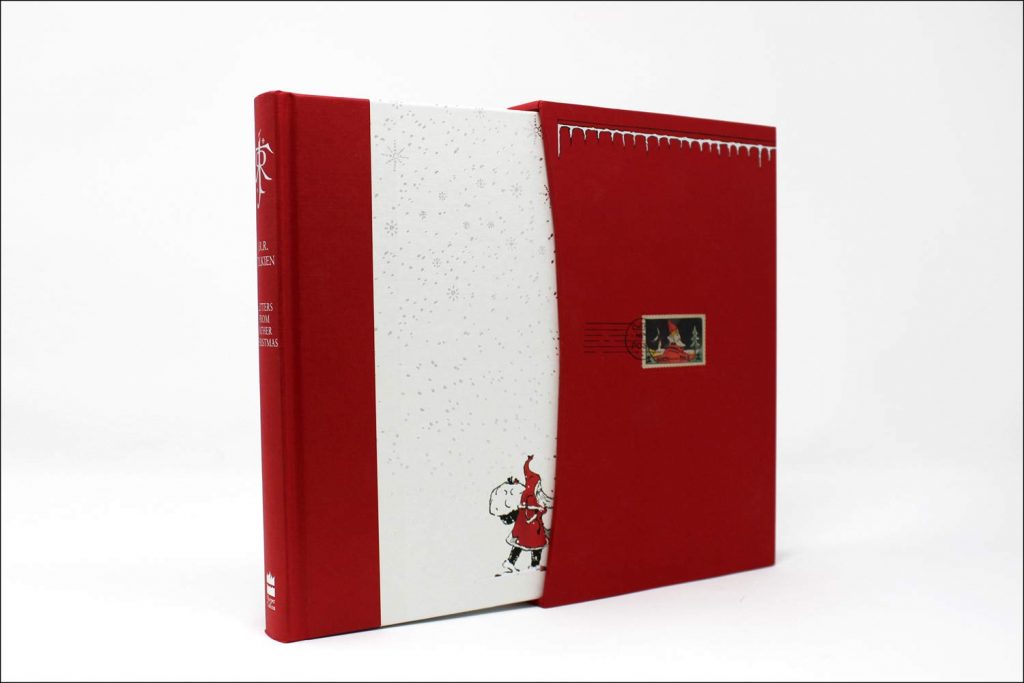
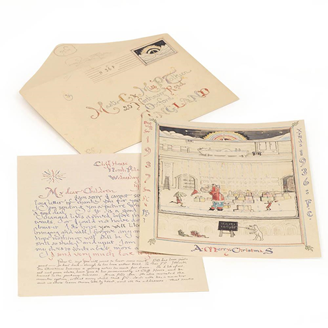
This latest (and more affordable) edition, like the slipcase “Deluxe Edition” published in 2019 by Harper Collins, contains transcriptions and facsimile pictures of the entire collection of “F.C.” letters, along with their assorted envelopes and stamps so characteristic of Tolkien’s meticulous attention to detail. It also includes an introduction from the book’s editor and Tolkien’s daughter-in-law, Baillie Tolkien, who married Christopher in 1967. Also included is a personal note from the Professor himself, reproduced for the first time.
Letters from Father Christmas, Deluxe Slipcase Edition, published by Harper Collins in October 2019 at an appropriately deluxe price point.
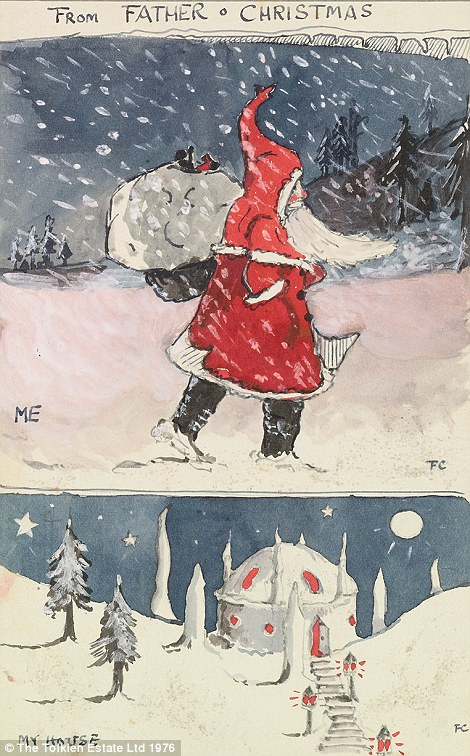
Tolkien likely began these letters as a whimsical family flourish, designed to make Christmastime a bit more magical for his children. But as with most of his projects, the tale grew in the telling. The letters began with a simple note of less than 100 words to his firstborn, accompanied by an iconic Father Christmas “self-portrait” and picture of his house.
Father Christmas assures young John Tolkien that all is well at the North Pole
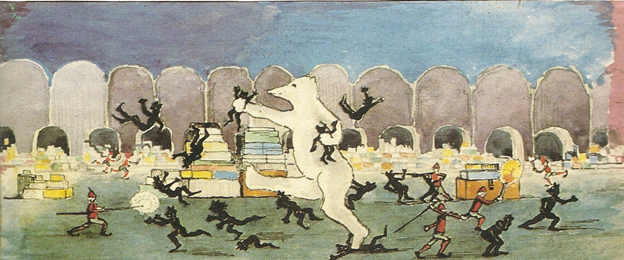
Over the years, these evolved into occasional notes to each of his children, much lengthier epistles, occasional poetry, a more extensive cast of recurring characters, and assorted annual calamities to be overcome: from a plumbing disaster, to a broken North Pole, to reindeer on the loose, to an unexpected visit from the Man in the Moon. Occasionally, there is even a faint early echo from Middle-earth, with the appearance of elven aid “Ilbereth”, a single vowel away from his more famous star-kindling forebear; extensive new languages and calligraphy for multiple races, and a great (polar) bear fighting off goblin hordes in ways that would make Beorn proud.
The Great Polar Bear defends the realm Beorn style
The art of The Father Christmas Letters proves to be the most engaging element of the books, including meticulous hand drawn stamps and envelope decorations, spidery handwriting in Tolkien’s favorite black and red mix (nearly illegible in some cases), and above all the host of water color illustrations that surely captivated the imagination and speculation of Ronald and Edith’s young family, even as they continue to do for us (especially for any who have had a chance to see some of the originals under glass at recent exhibitions in Oxford, New York, or Paris).
This combination of text and illustration is a likely contributor to the Letters’ complicated publishing history. They first appeared three years after Tolkien’s death with a greatly abridged 1976 edition that focuses on pictures (not always reproduced in their complete form), partial texts, and only token reproductions of the original and elaborate written and decorated letters.
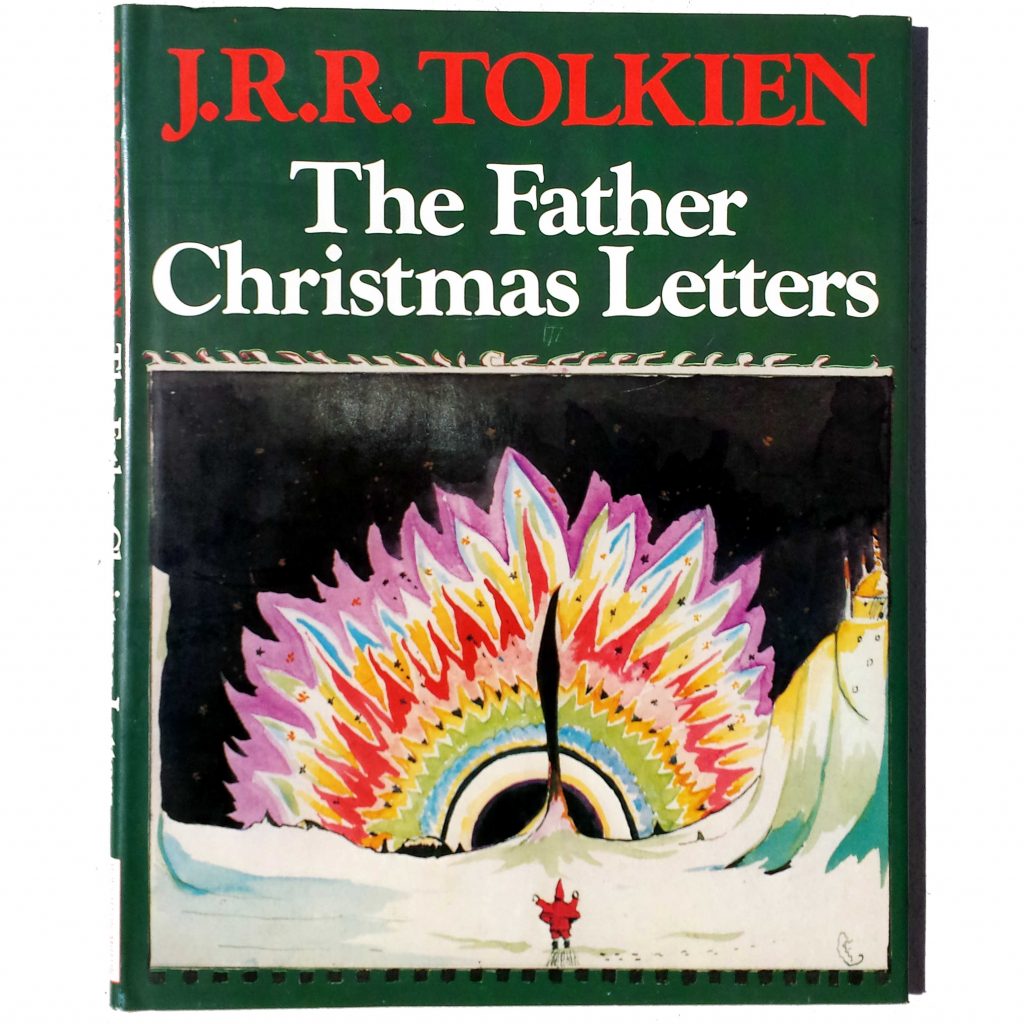
The first edition, and third posthumously published Tolkien work, clocks in at only 44 pages, 1976
Even in this premier edition, there are hints from Baillee Tolkien that we were only getting a sampling of a richer treasure. Further editions followed, largely keeping to a similarly abridged approach.
It was not until 1993 that Tolkien scholars began to appreciate the full extent and complexity of what was still missing from the Father Christmas saga; and inquiring minds wanted to know more.
The first response was a delightful new edition published by Houghton Mifflin in 1995, introducing a novel approach: ten letters enclosed in actual envelopes, sprinkled with recaps and illustration highlights. While still not exhaustive, this latest installment began to recreate some of the delight of actually receiving and opening these annual updates. The book also included three previously unpublished pictures.
Father Christmas starts mailing it in, 1995; a new title approach, too!
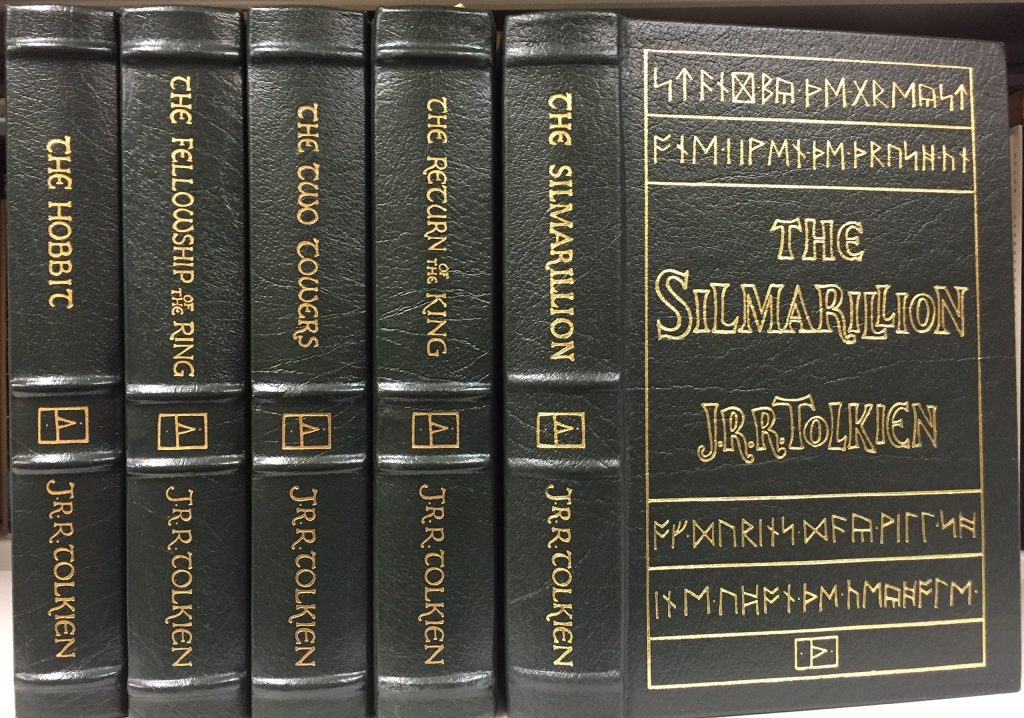
Finally, in 1999, we received a new “revised and enlarged” version, with the complete set of more than 30 letters and all of Tolkien’s pictures, some with a lesser quality color reproduction. For the truly deep-pocketed, there was also an opportunity to add to their Easton Press library of well-bound leather books. These were particularly fine editions for those who love distractingly enlarged details as page decorations.
Now that the complete set of letters was finally available to the public, we could enter the era of anniversary editions. The first on the scene came after five more years, in 2004, with fewer pages and illustrations, but at least fewer marginal distractions. The 2009 edition – or 10th anniversary of the complete set – proved that the 1999 version was only mostly complete, adding several omitted pages from letters in 1937 and 1941. An updated version of the same edition in 2012 provided 39 new images covering all but a few pages of the actual letters, and much improved reproductions.
For the truly dedicated enthusiast, the upgraded Collector’s Edition of the Bodleian’s exhibit catalogue, Tolkien, Maker of Middle-earth, includes a facsimile version of the Christmas 1936 letter and its accompanying explanatory picture.
For the truly dedicated enthusiast, the upgraded Collector’s Edition of the Bodleian’s exhibit catalogue, Tolkien: Maker of Middle-earth includes a facsimile version of the Christmas 1936 letter and its accompanying explanatory picture.
Tolkien’s family tradition ended on a bittersweet note in a 1943 letter (“a grim year”) to a 14-year-old Priscilla. Father Christmas muses, “After this I shall have to say ‘goodbye’, more or less: I mean, I shall not forget you. We always keep the old numbers of our old friends, and their letters; and later we hope to come back when they are grown up and have houses of their own and children.” The 2020 Centenary Edition ofThe Father Christmas Letters offers just that kind of opportunity: to reminisce, to return, to find great hope and cheer in small things, and to consider how we might pass this joy to future generations. Merry Christmas!
(Looking for further gift ideas, as you rush to complete your shopping? Check out TORn’s holiday gift guide!)
Editor Note: Throughout the month, and as part of our Tolkien Advent Calendar celebration, we are featuring news and resources for fans of J.R.R. Tolkien, his worlds and works. Today’s official advent calendar is below!
Day 21 of TheOneRing.net’s Advent Celebration 2020