There’s a particular letter in The Letters of J.R.R. Tolkien where Tolkien writes about his experience of dealing with a proposal from Forrest J. Ackerman to make an animated film of The Lord of the Rings.
Within that letter, there’s one revealing sentence.
Stanley U. &: I have agreed on our policy : Art or Cash. Either very profitable terms indeed ; or absolute author’s veto on objectionable[my emphasis] features or alterations.
Letter #202, The Letters of J.R.R. Tolkien.
The deal never happened, though Tolkien did subsequently sell film rights in 1969 to United Artists under the looming pressure of inheritance taxes.
These days, I suspect there’s no such pressure. More, the “Middle-earth universe” is seen as a proven starter for the world’s media companies. I think that has given Tolkien Estate leverage: the power to demand not just Cash, but Art as well.
In the context of the recent Vanity Fair feature, this explains not just the starting price for the Tolkien Estate’s rights auction a “gobsmacking” $200 million, but the documented demand for input into the direction of the series. In an early, seemingly unauthorised, interview, Tom Shippey described this “input” as a “veto power”.
It also says something about the power of Middle-earth that even with that eye-watering starting price and the attachment of certain pre-conditions, Netflix, HBO and Amazon all put their hand up and bid.
Still, even if Tolkien Estate was willing to put its foot down to get that capital-A Art, it was always going to take an equally ambitious (and well-resourced) studio to come through with the goods.
Despite Vanity Fair’s assurances (it’s pretty stunning that they’ve seen the first three episodes already), it’s too early for us ordinary punters to declare The Rings of Power a sure bet — in either the commercial sense, or the Art sense.
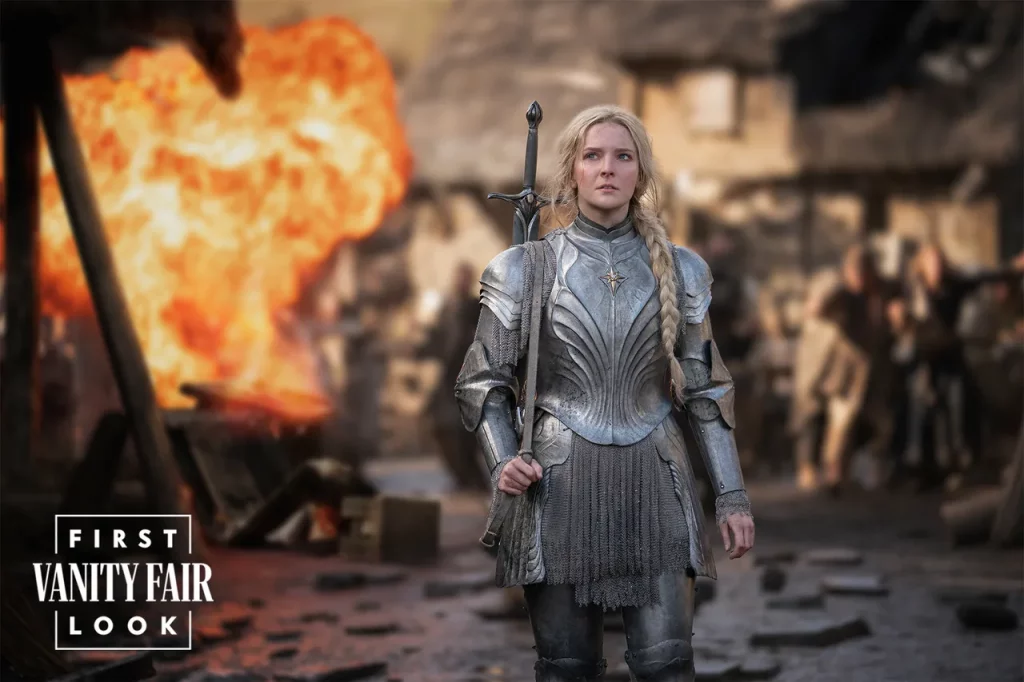
However, Vanity Fair’s first look under the bonnet shows there’s no lack of promise: the images are intriguing and suggestive, sets and costumes look suitably spectacular, and the production staff are making the right sort of noises about respecting the integrity of the source material.
But a show with the resources of The Rings of Power should (by default) have stunning production values and a real, lived-in feel. That’s just a given.
And it’s politic for showrunners to make the right noises (I would, too). The question is, can we identify instances of real substance to back those noises? Has the objectionable — as Tolkien might have seen it — been excised?
An Atlantis-like Númenor, the full glory of Khazad-dûm —- that vast dwarven metropolis carved out of the bones of the Misty Mountains, the puissance of the elven smith Celebrimbor, whose skills with metals and magic are crucial to the forging of the rings are all lore-friendly inclusions.
They’re also easy wins.
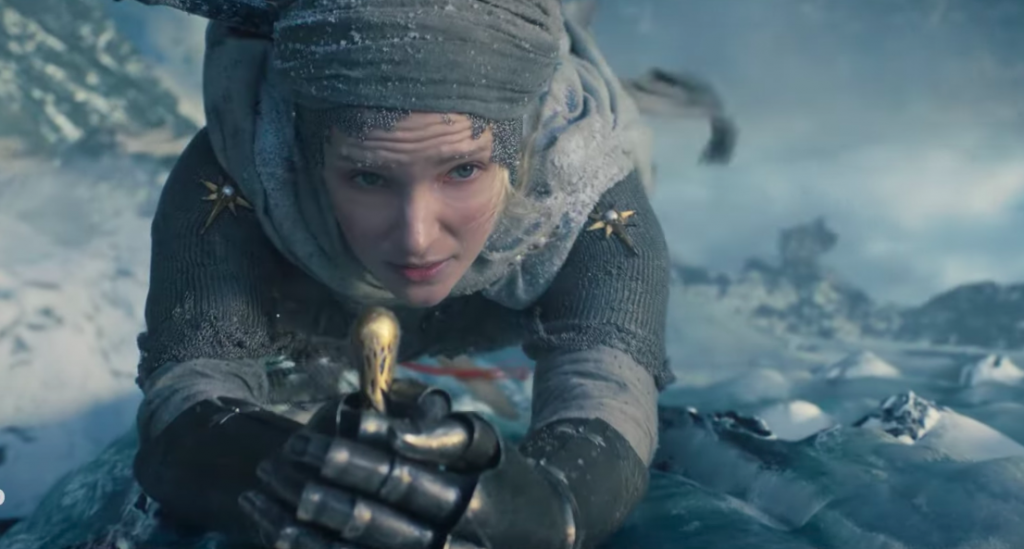
In a way, so too is the centrality of Galadriel.
Galadriel is a key player in the Second Age (fighting the long defeat, as she expresses in The Lord of the Rings). After the publication of that book, Tolkien increasingly came to view her as one of the most remarkable elves to play a role in Middle-earth’s history, and his later essays and notes paint her as an increasingly exceptional individual. She’s also incredibly peripatetic throughout the Second Age — wandering from Lindon, into Eriador and eventually south to Eregion, under the Misty Mountains to Lórien, back across to Imladris (Rivendell) and finally the south coasts of what would later become Gondor.
During all that, she’s a key participant in events. She joins Gil-galad to reject the approaches of Annatar, alternately collaborating and at loggerheads with Celebrimbor (and later advising him to hide Nenya, Vilya and Narya), before strengthening then-Lórinand (later Lórien). Unfinished Tales states that she views the dwarves of Khazad-dûm “with the eye of a commander”.
That bespeaks a driven individual — and this is something that the teasers from Vanity Fair support. I want to see lots of ambition from Galadriel — someone with just as much inner-belief and determination to make things happen as Fëanor, but with (even at the start of the Second Age) a touch more wisdom. I think you should too.
As showrunner McKay Patrick tells Vanity Fair: “This young hot-headed Galadriel… how did she ever become that elder stateswoman [who we meet in Lórien in The Lord of the Rings]?” The awareness of that difference is present; if the show is able to intelligently show this change, it will have taken a large step toward something that accords with J.R.R. Tolkien’s own musings.
Reassuring also is the gradual emergence of the Second Age threat — one that’s recognised by some, but not by others. After all, up until the forging of the One, Sauron (as Annatar) uses the velvet glove, not the iron fist. Very late writings recently published in The Nature of Middle-earth even suggest that his minions mocked him behind his back for this.
Again, direct statements from the McKay seem to back this: “We didn’t want to do a villain-centric thing. We wanted it [the first season] to be about introducing these worlds and the peoples who dwell in them and the major heroes and characters.”
And what is potentially one of the most contentious decisions — to include Hobbits as “Harfoots” — accords somewhat with both Gandalf’s description of Gollum’s folk (yes, I know those are, more correctly, Stoors): “a clever-handed and quiet-footed little people.”
And a note in the prologue chapter of The Lord of the Rings, “Concerning Hobbits” details that “even in ancient days [Hobbits] were, as a rule, shy of ‘the Big Folk’, as they call us, and now they avoid us with dismay and are becoming hard to find … [and] they possessed from the first the art of disappearing swiftly and silently, when large folk whom they do not wish to meet come blundering by…”
Is this one decision Tolkien Estate has weighed in on? Regardless, much will hinge on the execution of the concept.
Set against the above is the compression of the timeline that the showrunners discuss. First, kudos to the production staff for being clear on this. In fact, it recalls Peter Jackson’s bald statements that his films would include no Scouring of the Shire — a very real cause of fan angst at the time. (I still think that writing decision undersold some of the character development of the four key hobbits, but, weighing in at 201 minutes, PJ’s The Return of the King is already very long.)
I get the fact that it’s probably really difficult for any television series to traverse a 2,500-year history in a way that is not choppy and disjointed, and remains compelling viewing. Being able to see characters such as, say, Isildur and Ar-Pharazôn across a span of 5 seasons allows a great deal more screentime (and thus development and insight) than would be possible in a couple of seasons. A strictly linear structure would introduce them only at near the very conclusion of the entire series.
Still, I would have liked (as many speculated before the Vanity Fair article came out) to have seen Amazon be really daring and attempt to run two split, simultaneous timelines — one leading up to the forging of the One (and Sauron’s defeat by the elves and Númenor’s fleet), and another focused on Akallabêth and, perhaps, the War of the Last Alliance (also culminating in Sauron’s defeat, this time by the elves and the Dúnedain of Arnor and Gondor).
Doubtless, it would be demanding on the audience. But if it worked, it would have been amazing.
It’s worth noting, though, that J.R.R. Tolkien in his appraisal of the Morton Grady Zimmerrnan’s 1958 script made specific reference to his displeasure with time contraction of events.
There he states that:
I fail to see why the time-scheme should be deliberately contracted. It is already rather packed in the original, the main action occurring between Sept. 22 and March 25 of the following year. The many impossibilities and absurdities which further hurrying produces might, I suppose, be unobserved by an uncritical viewer; but I do not see why they should be unnecessarily introduced.
Letter #210, The Letters of J.R.R. Tolkien
Does that make this particular contraction objectionable?
In Letter #210, Tolkien points out that he doesn’t want to see “his work treated as it would seem carelessly in general, in places recklessly, and with no evident signs of any appreciation of what it is all about.” He does not want the tone lowered “towards that of a more childish fairy-tale.” Lastly, he does not wish for deliberate alteration of the story, in fact and significance, without any practical or artistic object [my emphasis].”
At least, those are my key takeaways.
Now, one observes that if the time scheme of The Lord of the Rings is packed, the precis account of the Second Age in The Tale of Years is most certainly not.
Tolkien also notes in Letter #210 that he closely observed the passing of seasons in The Lord of the Rings. He suggests that such pictorial representations could be used to non-explicitly indicate the passage of time. Similar effects might be employed for The Rings of Power series. Maybe not the thousands we are familiar with from “The Tale of Years”, but certainly dozens — or even the 100 to 200 that might encompass the lifespan of a Dúnedain of Númenor, or a dwarf of Durin’s line.
How much time is being contracted? Vanity Fair is not precise: the writers say that events are compressed “into a single point in time.” That might mean a span of a generation.
Here is where it would have been fascinating to be a fly on the wall in the discussions between Amazon Studios and Tolkien Estate.
Finally, keep in mind J.R.R. Tolkien’s letter to Milton Waldman outlining his artistic vision:
I would draw some of the great tales in fullness, and leave many only placed in the scheme, and sketched. The cycles should be linked to a majestic whole, and yet leave scope for other minds and hands, wielding paint and music and drama. Absurd.
Letter #131. The Letters of J.R.R. Tolkien
Absurd. Yet, here we are.
With this in mind, I think there are promising signs that Tolkien Estate (and indeed, Amazon Studios) is seeking Art, not just Cash. Early shoots with the promise of beautiful spring, you might say.
But there’s still an awfully long way to go.
As Galadriel says in The Lord of the Rings: “hope remains while all the Company is true.” We’ll see in September how true this particular company has been.
About the author: Staffer Demosthenes has been involved with TheOneRing.net since 2001, serving first as an Associate News Editor, then as Chief News Editor during the making of the Hobbit films. Now he focuses on features and analysis.The opinions in this article are his own and do not necessarily represent those of TheOnering.net and other staff.
If you have a Tolkien/Middle-earth inspired poem you’d like to share, then send it to poetry@theonering.net. One poem per person may be submitted each month. Please make sure to proofread your work before sending it in. TheOneRing.net is not responsible for poems posting with spelling or grammatical errors.
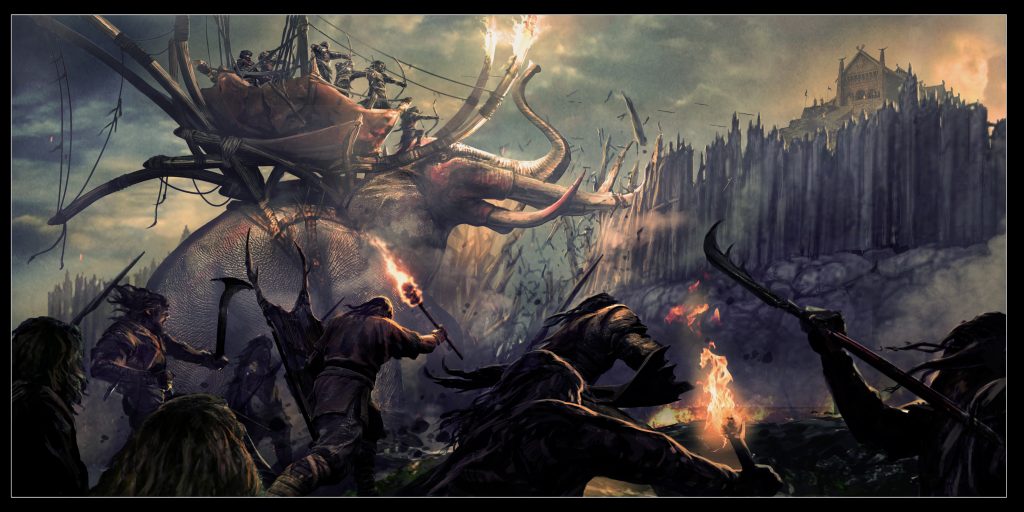
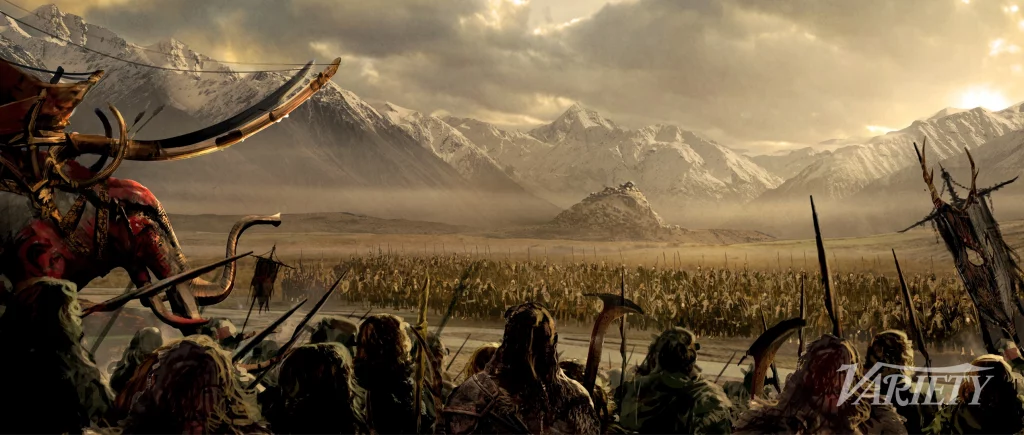
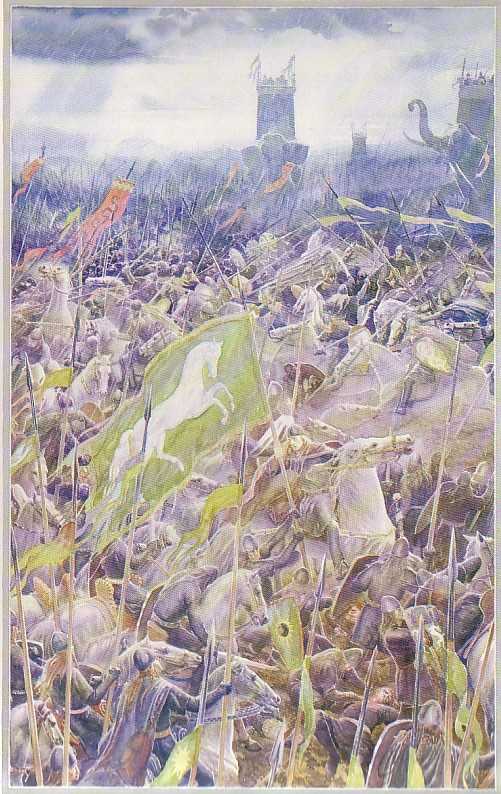
It appears that the appearance of Mûmakil in the recent Warner Bros. concept art has sparked dire thoughts that the production is already going off-track and that the apocalypse is nigh.
Fear not: I think people are misremembering the contents of Appendix A of The Lord of the Rings. That’s okay — I forget things all the time only to be reminded of something really obvious like “Oh, Finrod is a blonde, duh”.
The good news is that we don’t have to dig far here to get at the substance of the argument. First, Appendix A: II: The House of Eorl. Second, we want to look at the corresponding entries for the Stewards of Gondor. That is, anything mentioned during the stewardship of Beren.
This comprises the core of our knowledge about this period of the history of Gondor and Rohan.
Looking more closely at the histories, two passages stand out.
First, turning to the House of Eorl, we find this passage describing events in the years after Helm Hammerhand killed the Dunlending, Freca, with a blow from his fist at Edoras:
Four years later (2758) great troubles came to Rohan, and no help could be sent from Gondor, for three fleets of the Corsairs attacked it and there was war on all its coasts. At the same time Rohan was again invaded from the East [my emphasis], and the Dunlendings seeing their chance came over the Isen and down from Isengard. It was soon known that Wulf was their leader. The were in great force, for they were joined by enemies of Gondor that landed in the mouths of Lefnui and Isen.
Appendix A, The Lord of the Rings
Now, I’ll agree from the east is vague. Do the Balcoth, who assaulted Gondor during Cirion’s stewardship, still exist as a threat? Could that be referring to them? Or folk out of Rhûn? Not impossible. That the folk of Harad would circle all the way around Mordor in order to cross the Brown Lands and cross the Anduin at The Undeeps seems … less than likely.
But I don’t think it actually matters.
Because more details emerge from the Appendix A section that discusses events during the lifetime of the Steward of Gondor, Beren.
In the days of Beren, the nineteenth Steward, an even greater peril came upon Gondor. Three great fleets, long prepared, came up from Umbar and the Harad [my emphasis], and assailed the coasts of Gondor in great force; and the enemy made many landings, even as far north as the mouth of the Isen.
Appendix A, The Lord of the Rings
Joining these two together, I believe, solidifies an argument for the presence of Haradrim (and thus, potentially Mûmakil at Edoras when it’s taken by Freca’s son Wulf).
Because as Appendix A also states:
The Rohirrim were defeated and their land was overrun; and those who were not slain or enslaved fled to the dales of the mountains. Helm was driven back with great loss from the Crossings of Isen and took refuge in the Hornburg and the ravine behind (which was after known as Helm’s Deep). There he was besieged. Wulf took Edoras and sat in Meduseld and called himself king. There Haleth Helm’s son fell, last of all, defending the doors.
Appendix A, The Lord of the Rings
Thus, what the concept art shows is Wulf’s final assault on Edoras with the assistance of Haradrim allies. Haradrim allies who were part of those three fleets (along with the Corsairs of Umbar). Haradrim allies who landed at the mouths of the Lenfui and the Isen. And Haradrim allies who travelled all the way up from the south coasts to support Wulf in his invasion. His invasion of, first, Westfold, and subsequently the rest of Rohan.
If they happen to bring Mûmakil in tow, well is not that lore-accurate, too?
The Haradrim need not have invaded from the east at all. In fact, the invasion from the east is probably another, different folk. Rather, the Haradrim were with Wulf all along. And the Mûmakil? Well, what better weapon to overthrow the horselords? As we see in the Battle of the Pelennor Fields…
But wherever the mûmakil came there the horses would not go, but blenched and swerved away; and the great monsters were unfought, and stood like towers of defence, and the Haradrim rallied about them.
The Battle of the Pelennor Fields, The Lord of the Rings
The Battle of the Pelennor Fields by Alan Lee.
About the author: Staffer Demosthenes has been involved with TheOneRing.net since 2001, serving first as an Associate News Editor, then as Chief News Editor during the making of the Hobbit films. Now he focuses on features and analysis.The opinions in this article are his own and do not necessarily represent those of TheOnering.net and other staff.
If you have a Tolkien/Middle-earth inspired poem you’d like to share, then send it to poetry@theonering.net. One poem per person may be submitted each month. Please make sure to proofread your work before sending it in. TheOneRing.net is not responsible for poems posting with spelling or grammatical errors.
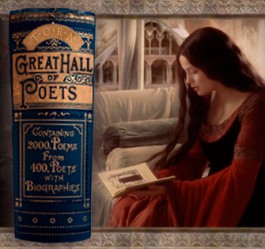
Welcome to The Great Hall of Poets, our regular monthly feature showcasing the talent of Middle-earth fans. Each month we will feature a small selection of the poems submitted, but we hope you will read all of the poems that we have received here in our Great Hall of Poets.
So come and join us by the hearth, and enjoy!
If you have a Tolkien/Middle-earth inspired poem you’d like to share, then send it to poetry@theonering.net One poem per person may be submitted each month. Please make sure to proofread your work before sending it in. TheOneRing.net is not responsible for poems posting with spelling or grammatical errors.
Art of Fate
by: Milan
How can so much darkness exist, while there is light?
How can the Black Eye of Mordor stare, while hobbit children skip through the grass?
Do all the troubles wash away down the River Anduin, great and wide, mysteriously,
Or do they pop up like hobbit children in a game of hide and seek, ready to come out for Elevenses?
How does life move on, to the beauty of the Lorien,

To come into the songs of old,
To relinquish the art of fate,
To come back stronger than you came,
What will the minstrels sing?
What will they say in their songs when you’re gone,

When you look into Galadriel’s Mirror, what will you see?
A sad reflection of yourself, of everything you are,
The destruction of your home, a black eye of fowl menace,
Who are you? Can you face yourself for me?
Weren’t we all just hobbits, letting our days unwind, in a safe haven for a time,

When the Carrion fowl take your body,
What will you think?
Will you watch from your ship at sea,
Or paddle forward, to find what awaits you in lands of bliss,
What will be your regrets, your wishes, your lies to yourself?

-Milan
~~ * ~~
Middle Earth haiku
by: H Herz
Strider's valiant, but...
Not all who wander can cook.
Where's second breakfast?

www.henryherz.com
~~ * ~~
If you have a Tolkien/Middle-earth inspired poem you’d like to share, then send it to poetry@theonering.net. One poem per person may be submitted each month. Please make sure to proofread your work before sending it in. TheOneRing.net is not responsible for poems posting with spelling or grammatical errors.
Welcome to The Great Hall of Poets, our regular monthly feature showcasing the talent of Middle-earth fans. Each month we will feature a small selection of the poems submitted, but we hope you will read all of the poems that we have received here in our Great Hall of Poets.
So come and join us by the hearth, and enjoy!
If you have a Tolkien/Middle-earth inspired poem you’d like to share, then send it to poetry@theonering.net One poem per person may be submitted each month. Please make sure to proofread your work before sending it in. TheOneRing.net is not responsible for poems posting with spelling or grammatical errors.
If you have a Tolkien/Middle-earth inspired poem you’d like to share, then send it to poetry@theonering.net. One poem per person may be submitted each month. Please make sure to proofread your work before sending it in. TheOneRing.net is not responsible for poems posting with spelling or grammatical errors.
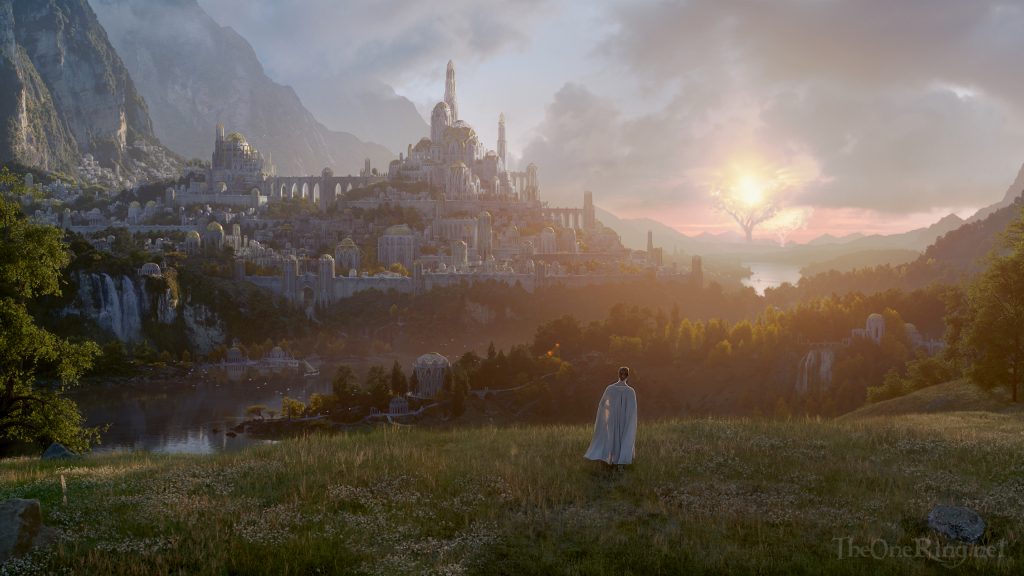
Here’s a question. If you’re LOTR on Prime, and if your main series material is centered on the Second Age, why tease/lead with an image that show something from a vastly earlier period in the history of Tolkien’s world?
I’ve been pondering this a lot.
Unless LOTR on Prime has gone collectively mad, then there has to be a purpose — some link between that panorama, and the Second Age story that we know is coming.
So, let’s analyse that.
The location itself may offer a link.
Why? Because Númenor — much, much later — tries to invade Valinor. Problem is, that period of Númenor’s history has little to do with the dwarf-elf interactions we seem to be promised if spy reports are correct. So, it’s probably not Valinor itself that’s important, nor the Two Trees in themselves (sorry TREES! fans, I empathise).
That leaves the events that happen in Valinor, and the key protagonists in those events.
Events are — by and large — resolved by The War of Wrath. However, some of those protagonists remain and become involved in the new dramas of the Second Age in Middle-earth (and Númenor).
And I feel this could offer a clue to what’s going on.
Of the chief actors through the events of the Second Age, I can think of four (five, technically) who are also players in during the final Years of the Trees.
Sauron
The first is Sauron. But the link between Sauron and Valinor/The Two Trees is tenuous to non-existent. According to The Silmarillion, he rebelled much earlier and then spent much of Melkor’s imprisonment lurking in and around Angband. He doesn’t really feature strongly in First Age events until Beren and Lúthien’s quest.
Neither the trees — nor any of the events that occur around them — are useful to solidify the background of Sauron for the audience. If you wanted to use Sauron as a link, you’d need to begin somewhere else. For this reason I eliminate Sauron.
Galadriel and Celeborn
The next two come as a pair: Galadriel and Celeborn.
Here, it’s a twofold opportunity.
One, it’s a way to establish Galadriel’s prominence among the Noldor, and the strength of her ambition. Recall Galadriel’s role in the rebellion of the Noldor and their exile. Fëanor is instigator, but in the Silmarillion version she is also involved:
Galadriel, the only woman of the Noldor to stand that day tall and valiant among the contending princes, was eager to be gone. No oaths she swore, but the words of Fëanor concerning Middle-earth had kindled in her heart, for she yearned to see the wide unguarded lands and to rule there a realm at her own will.
Of the Flight of the Noldor, The Silmarillion.
My thinking is that portraying some of Galadriel’s early life in Valinor could be used as a way to support her desire and capacity to (at least to according one tradition outlined in Unfinished Tales) establish Eregion much later in the Second Age with the assistance of Celeborn.
It would also serve to underpin — whether through continued pride, or Ban (or both) — why she did not return to Valinor for so long. There’s vast amounts of drama to be wrung here should LOTR on Prime do it right. A sort of “How I became a massive troublemaker and learnt to love the Ban” sort of thing.
Galadriel is also LOTR on Prime’s most natural and relatable link to Peter Jackson’s movies: well-liked and well-remembered even among those who aren’t Lord of the Rings aficionados.
Celebrimbor
Next is Celebrimbor. To my surprise (for I wasn’t aware of it until very recently), Tolkien outlined that Celebrimbor was born in Valinor during the Years of the Trees, not in Beleriand during the First Age. That he subsequently followed his father, Curufin, into exile, while his mother remained behind, suggests to me that he was well into adulthood by the time of the Noldor’s rebellion against the Valar.
His identity as the grandson of Fëanor makes him a close witness to events in Valinor while his (presumably) growing talents as a smith and craftsmen can be contrasted against the immense skill of Fëanor (and Galadriel). In particular, Fëanor’s achievements with the Silmarils could be used as a dramatic spur for his own creations.
For Celebrimbor, Eregion is not so much a place to rule but a place where he can be free to create with the ultimate aim of someday surpassing the works of his grandfather. Celebrimbor is also a more natural tie for recent spy reports of dwarves and elves meeting. Unless it’s a very frosty meeting, that’s not very likely to be one involving Galadriel and Celeborn (even if Galadriel is not entirely unreceptive to dwarves).
Glorfindel
Glorfindel is the final option. Also an exile, also born in the Years of the Trees. Coincidentally, also blonde. As The Fellowship of the Ring describes it, “his hair was of shining gold”.
Moreover, Glorfindel returns to Middle-earth sometime during the Second Age to play a role in helping keep Sauron at bay after he forges the One Ring. Tolkien writes that this was probably sometime between SA1200 and SA1600 though, and I wonder whether even the first full season would get that far.
Any other elf is a poor fit.
Cirdan did not make the journey to Valinor. Gil-galad is too young — born near the end of the First Age in Beleriand. Elrond is in the same boat. And the rest of the chief Noldorin exiles either died in the long wars against Melkor, or returned to Valinor at the conclusion of the War of Wrath.
If you have a Tolkien/Middle-earth inspired poem you’d like to share, then send it to poetry@theonering.net. One poem per person may be submitted each month. Please make sure to proofread your work before sending it in. TheOneRing.net is not responsible for poems posting with spelling or grammatical errors.
Welcome to The Great Hall of Poets, our regular monthly feature showcasing the talent of Middle-earth fans. Each month we will feature a small selection of the poems submitted, but we hope you will read all of the poems that we have received here in our Great Hall of Poets.
So come and join us by the hearth, and enjoy!
If you have a Tolkien/Middle-earth inspired poem you’d like to share, then send it to poetry@theonering.net One poem per person may be submitted each month. Please make sure to proofread your work before sending it in. TheOneRing.net is not responsible for poems posting with spelling or grammatical errors.
The Mirror
by: Cassie Hughes
i)

Oh dearest love how can I bear
the mirror’s tale to me this night,
a family torn and ripped apart
as darkness claims and covers light.
Celebrian! Celebrian!
I called but could not keep her safe
for claws and fangs bore her away
to torment she could not escape.

The mirror fogged then cleared again
as vengeance showed to me their face,
twin perils twisted, hearts enslaved
by lustful wrath they could not sate.
Come back to us! Come back to us!
I shouted but they did not hear
above the clash of heavy blades,
the screams and sobs of death and fear.

Another scene unfolded then,
a ranger, tall and dark he stood
beside our precious Evenstar,
and oh! their faces shone with love.
Undomiel! Undomiel!
I wept then as she turned away
to follow where I could not go,
that mortal path of slow decay.

Is this my doing and my doom?
In reparation for past deeds
when thirst for knowledge ruled my head
and power cancelled other needs.
Oh Celeborn, my Celeborn
Have I brought darkness on us all?
Our daughter held beyond despair.
Her children lost beyond recall.

ii)

Your mirror tells what yet may be
but set in stone those tales are not.
Beloved, things are still in flux
our family safe, so ease your heart.
Galadriel! Galadriel!
Read nothing yet in what you saw.
They may be passing shadows just
like pipeweed smoke and not endure.

Yet if in truth they come to pass,
our strength combined will see us through.
As over ages proud and strong
together we have learned to do.
Do not despair! Do not despair!
Though tragedy may take our kin
live for today, let go these fears,
and do not let the darkness win.

iii)

The silvered surface briefly holds
An unseen fleeting image then
a halfling holding out his palm
upon which lies a glowing ring.
Ash nazg begiles! Ash nazg deceives!
What comes to pass will surely be
as told within those crystal depths,
and writ in legend endlessly.
If you have a Tolkien/Middle-earth inspired poem you’d like to share, then send it to poetry@theonering.net. One poem per person may be submitted each month. Please make sure to proofread your work before sending it in. TheOneRing.net is not responsible for poems posting with spelling or grammatical errors.