TheOneRing.net will be at WonderCon this year, and we will be hosting two panels over the course of the weekend, April 1-3 in the Anaheim Convention Center. If you plan to attend the convention, please read through the WonderCon COVID protocols.

Our first panel, Middle-earth! Coming to your TV this Fall will be at 4:30 pm on Friday, April 1 (no joke) in room North 200A. This will be our big overview panel, with all the news, rumors, and anecdotes about Amazon’s Lord of the Rings: The Rings of Power, as well as the WB’s upcoming animated War of the Rohirrim. There will be an update on any and all Middle-earth news, activities, and events coming up this year. And we can wait to see if anyone has had enough time to create a costume from the recent Amazon Teaser Trailer.

Our Second panel, I am no Man: The Women of Middle-earth will be a deep dive into Tolkien’s legendarium to discuss all the unique and wonderful women that Tolkien created. For those who have just read The Hobbit, Middle-earth feels like an ‘all males club’, but in The Lord of the Rings and some of the books of deeper lore, there are queens and warriors and creators, all women, who had a hand in shaping the Middle-earth we all know and love. The presentation is still being crafted, if there is a specific woman of Middle-earth you wish to see discussed, send an email to Garfeimao@TheOnering.net. Include the character name and a brief note about what makes her so special for you, we will include as many as we can fit into our allotted panel time.

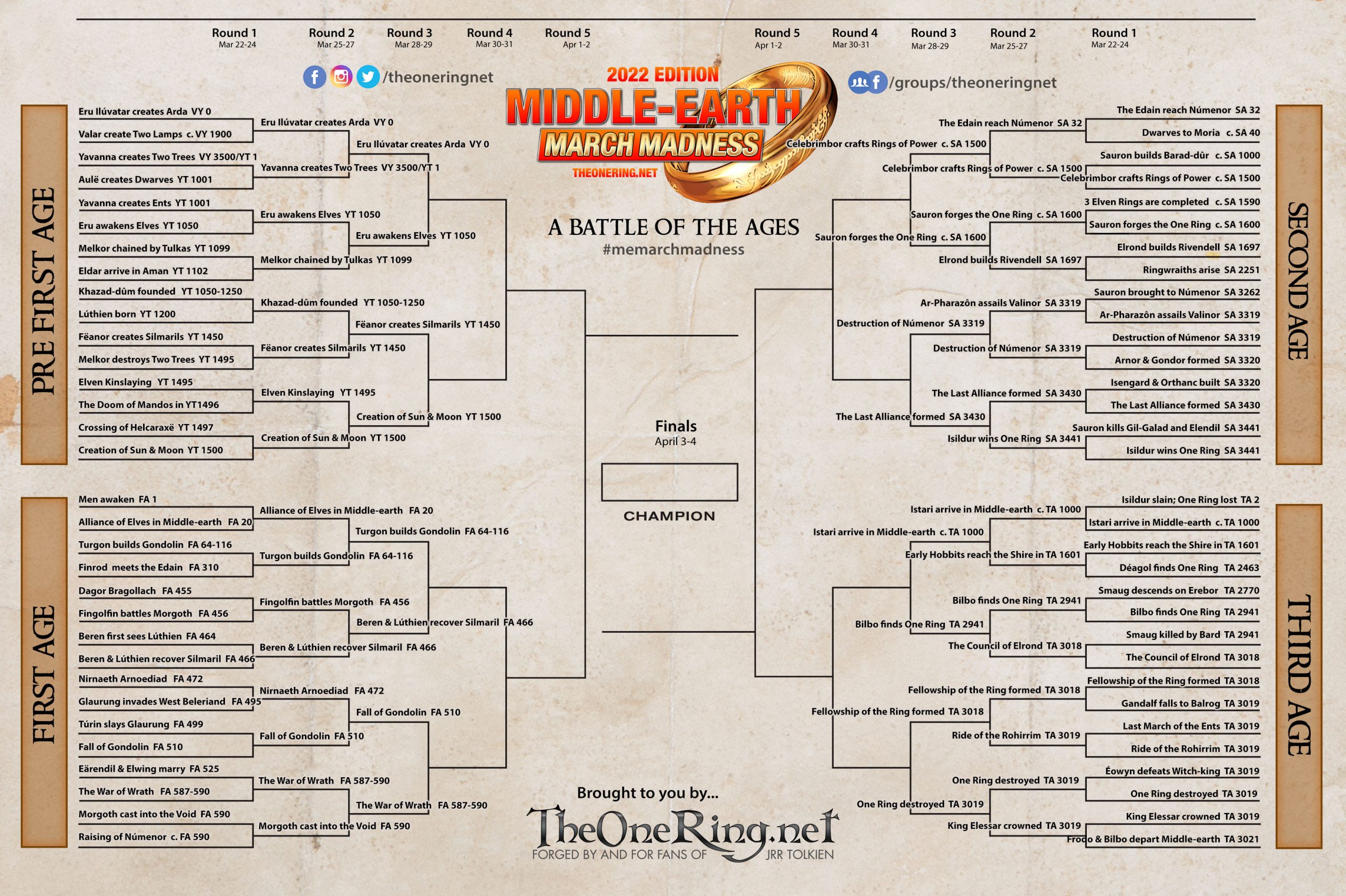
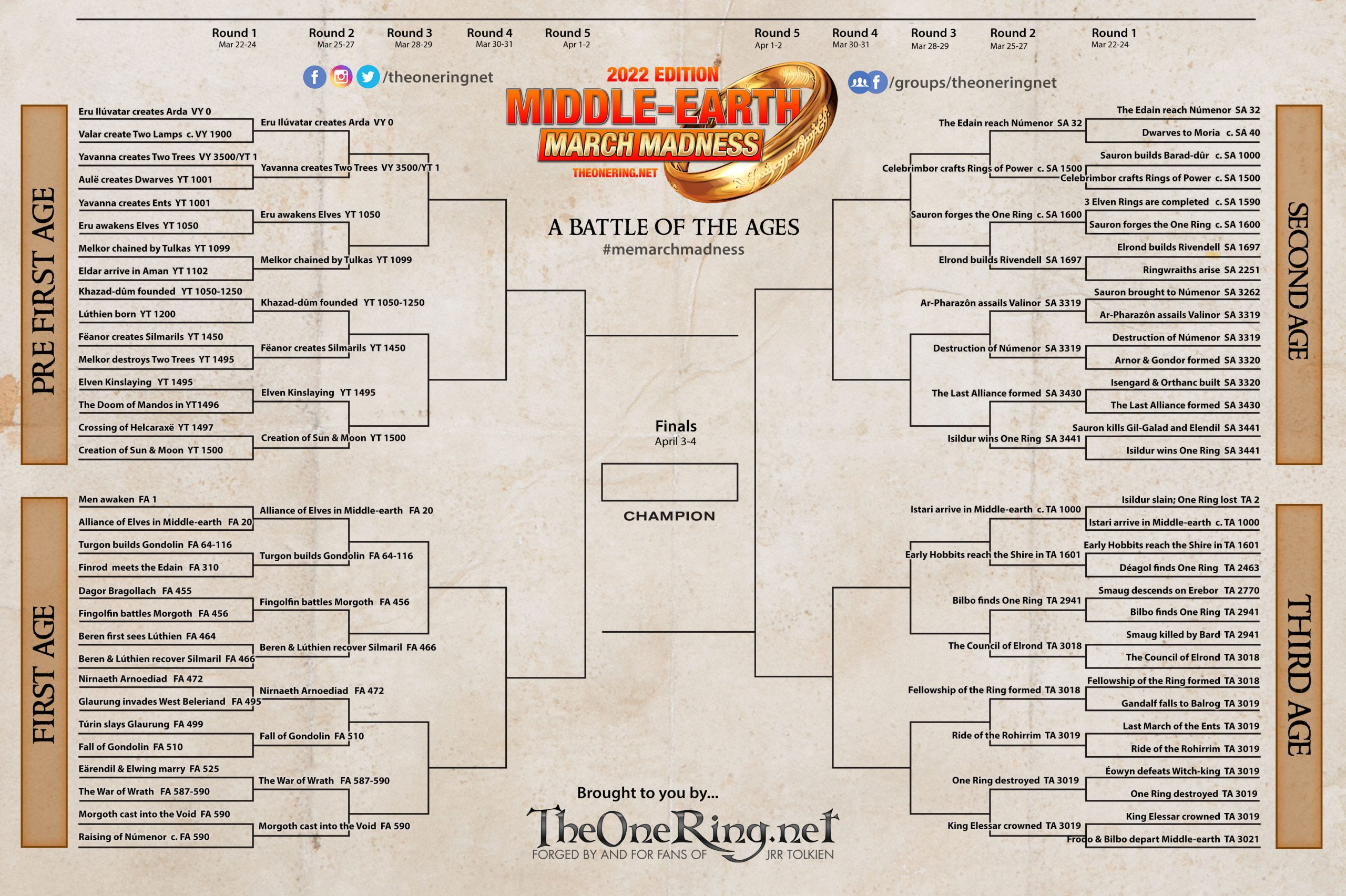
‘We come to it at last – the great battle of our time.’ Or – in this case – the great battle of the Ages! On Tuesday 22nd March we’ll kick off this year’s Middle-earth March Madness; and the theme is A Battle of the Ages.

Each of the four brackets this year represents an Age in Tolkien’s Middle-earth. This is the perfect opportunity to brush up on your history, as we get ready for Amazon’s Rings of Power – and the events of the Second Age – in September.

Over the coming weeks, we’ll have some posts to explore these brackets in more depth. What happened in the time of the Two Trees? Who conquered Glaurung in the First Age? And just when were those rings forged in the Second Age? Get ready to explore some History of Middle-earth together, as we vote to decide fandom’s favourite event from thousands of years.

How does it work, you ask? Simple! Staffers at TORn already voted to narrow down the many, many happenings to their top 64, and instead of seeding this year, the events appear in chronological order in each bracket. For each round, we will have a poll, where you vote for your choice in each match-up. Is Gandalf falling to the Balrog more significant than the Last March of the Ents? Are you more interested in when Beren first sees Luthien, or when they recover a Silmaril together? Which is more terrible – the destruction of the Two Trees, or the Elven Kinslaying? You decide!

Join us on Tuesday to kick off the Middle-earth March Madness tournament for 2022. 64 events will start out – but only one will be crowned Champion!


You’ve probably noted that in the various promo imagery we’ve seen, Galadriel bears a star-shaped emblem. It’s most prominent on her breastplate, but in the teaser trailer we also see the device used as shoulder pins.

The device that Galadriel bears upon her plate armour (left), and on either shoulders in the teaser trailer.

Is it some sort of heraldic device? If so, is it meant to be a personal device? Is it one for elves in general? Specifically for Noldorin elves? Or a particular branch of Noldor?

Let’s examine.

As I noted in my analysis of the Rings of Power Sun Sword poster, Tolkien developed a codified system of heraldic devices — examples of which can be found on the covers of the first UK edition of the Silmarillion. Many key characters involved in events of the First Age have their own associated device that they — and those of their house — employed.

Galadriel is not among those, though. We have no Galadriel device for direct comparison. Instead we must look at those of her near — and far — relatives.

Tolkien’s elven heraldry. Redrawn by Elenyanar and arranged by FromMidworld.

Finarfin’s eight-rayed lozenge-shaped device (see above middle-left) offers a lot of similarity. However, the rays do not taper in the same way as the devices Galadriel bears in The Rings of Power material. That being said, there is an intriguing note that “this device was also used by Finarfin’s heirs, and apparently especially Finrod (though he was also given another device).”

This becomes more curious since in The Rings of Power teaser trailer we see Finrod wearing the exact same device as Galadriel in a scene where he and other elves battle desperately against a host of orcs. Could this device be a House of Finarfin thing?

Well, we also see in the same scene that some of Finrod’s equally embattled retinue sport the self-same device. Now, one might observe that folk of Finrod’s own house might bear the same device. Absolutely, they might.

Both Finrod and his embattled retinue bear the same sigil on their armour in the flash scene we see near the end of the first teaser trailer. I’ve brightened this screenshot to make the sigils more visible.

The same device is also present on the shoulder of the as-yet-unidentified fellow caught up in an unfortunate encounter with some kind of troll in the Amazon teaser trailer. Is that another member of Finarfin’s house? Could it be Angrod, or Aegnor? As yet, we don’t know for sure.

This unknown person — clad in a similar maille outfit as Galadriel in the teaser trailer — bears the same symbol pinned on the shoulder in the exact same position. Again, this image is slightly brightened for better visibility although it’s tricky to get a crisp focus.

One also observes the exact same device on the waist of the attire of an individual dressed in gold on one of the The Rings of Power teaser posters and in the teaser trailer. We believe this individual to be Gil-galad.

Now, Gil-galad is not of Finarfin’s house; he wouldn’t wear Finarfin’s device. In fact, Tolkien gives Gil-galad his very own device — one of white stars set on a blue field (or sky). This seems to be a strong argument against any conclusion that it’s Finarfin’s device. It seems we must search elsewhere for better answers.

UPDATE: please check the bootnote at the end for an addendum on Gil-galad’s parentage.

Gil-galad bears the exact same symbol at the waist of his attire in both teaser poster, and teaser trailer.

Arguably, Eärendil’s sign might be something they could all unite under — if it matched. The Silmarillion recounts how he become a symbol of hope for all:

Now when first Vingilot was set to sail in the seas of heaven, it rose unlocked for, glittering and bright; and the people of Middle-earth beheld it from afar and wondered, and they took it for a sign, and called it Gil-Estel, the Star of High Hope. And when this new star was seen at evening, Maedhros spoke to Maglor his brother, and he said: ‘Surely that is a Silmaril that shines now in the West?’

Of the Voyage of Eärendil and the War of Wrath, The Silmarillion

Some support for this perspective can be gleaned from one of the Vanity Fair “First Look” images. In the one that seems to show Galadriel and Elrond re-uniting in Lindon, there is a large tapestry in the background. This tapestry shows a stylised rayed star very similar to those worn by Galadriel, Gil-galad, Finrod and others.

Elrond and Galadriel are reunited in the majestic elven kingdom of Lindon. Courtesy of Amazon
Studios. Note the the ship on the background behind them and the eight-rayed star at the very top of image.

This tapestry also depicts a ship or a boat, seemingly travelling toward, or guided by, the rayed star. Although probably a representation of a ship of the elves taking the journey to Valinor (it’s not yet the Straight Road because this is still the Second Age), the effect of the tapestry still feels evocative of the Star of High Hope mentioned above.

However, the heraldry of Eärendil is a six-pointed star, not one with eight points. I guess elven representations of Gil-Estel could be different — but the fact remains that what we see is just not Eärendil’s emblem.

There is one star that does seem a better visual fit: the Star of Fëanor that we encounter in the Lord of the Rings on The Doors of Durin at the west-entrance to Khazad-dûm.

‘There are the emblems of Durin!’ cried Gimli.
‘And there is the Tree of the High Elves!’ said Legolas.
‘And the Star of the House of Fëanor,’ said Gandalf.

A Journey in the Dark, The Lord of the Rings
The Doors of Durin from The Lord of the Rings as sketched by J.R.R. Tolkien. The Star of Fëanor can be seen at the centre of the image.

Like the emblem of Finarfin, there is a resemblance: eight rays and a distinct tapering. Perhaps more resemblance because of the tapering. Yet, it is also not exact: the four ordinal points are noticeably shorter than those we see on the device Tolkien created for The Doors of Durin.

There are additional (non-visual) contradictions.

Galadriel wouldn’t wear a symbol of the House of Fëanor. First, she’s of Finarfin’s house and would use his badge first. Second, Tolkien observes in Unfinished Tales that Galadriel had an abiding dislike of Fëanor. It’s that simple.

Just as importantly, Gil-galad wouldn’t either — not even as some symbol of solidarity. That’s because, throughout the Second Age, Gil-galad is the (undisputed) high-king of the Noldor in Middle-earth. The House of Fëanor is subsidiary to him in the Noldorin hierarchy.

Maedhros begged forgiveness for the desertion in Araman; and he waived his claim to kingship over all the Noldor, saying to Fingolfin: ‘If there lay no grievance between us, lord, still the kingship would rightly come to you, the eldest here of the house of Finwë, and not the least wise.’ [and] even as Mandos foretold the House of Fëanor were called the Dispossessed, because the over-lordship passed from it, the elder, to the house of Fingolfin, both in Elendë and in Beleriand.

Of the Return of the Noldor, The Silmarillion

Unfortunately, none of the options above fits neatly — every option creates unsatisfactory questions.

If this is the case, this prompts the question: why the lack of a good match?

Likely, the answer simply boils down to the intellectual property rights that Amazon holds for its TV series. (You might note that PJ’s Gil-Galad actually bears his Tolkienian heraldic symbol. The reason is probably down to a difference in the rights available.)

The showrunners have clearly stated (via Vanity Fair) that Amazon bought rights “solely to The Fellowship of the Ring, The Two Towers, The Return of the King, the appendices, and The Hobbit.” Nothing else.

That would place all the heraldic devices that Tolkien crafted out of reach — except the Star of Fëanor. But the showrunners are likely well-aware of the lore-clash of directly applying the Fëanorian star unilaterally.

Instead, it appears they’ve opted for something similar, but not exact — a generic derivation that they hope is symbolically evocative of elven heraldry and the elven reverence for Varda as the Lady of the Stars without directly contradicting one of the more obscure parts of the Legendarium (I love this stuff, but let’s face it — it is super-obscure).

That’s what I suggest is most likely occurring here.

Have they succeeded with that? On this point, I’m not convinced. Yes, it’s evocative — without a doubt. Yet the design still seems a little too similar to Fëanor’s star. I think it also leaves their hands tied when it comes to Celebrimbor. Because Celebrimbor should be the one using the Fëanorian star. Now, if they do try to replicate that, precisely as shown in The Lord of the Rings, will it even look different enough for us to notice?

BOOTNOTE: AlexP reminded me of something that I’d forgotten: Gil-galad’s parentage is complicated. The Silmarillion and Unfinished Tales as edited by Christopher Tolkien state that Gil-galad is the son of Fingon. Later, in preparing The History of Middle-earth, CJRT decided this was an editorial error and that his father’s final decision was that Gil-galad was a son of Orodreth. At the same time, Tolkien switched Orodreth to being a son of Angrod.

What does that mean?

Well, if Amazon were to leave the parentage of Gil-galad implied rather than stated (CJRT himself felt he should have, in retrospect left it obscure in The Silmarillion), then maybe Tolkien Estate would allow it. All three wearers of the badge — Galadriel, Gil-galad and, we presume, our unknown troll fighter — become Finarfin’s heirs. As such it could be argued that it’s fitting for them to use his symbol for the reasons discussed above. It could be a gesture of family solidarity. Even the star we see in the tapestry in the Gala-Elrond image is a fit, because Lindon is the heart of Gil-galad’s kingdom.

About the author: Staffer Demosthenes has been involved with TheOneRing.net since 2001, serving first as an Associate News Editor, then as Chief News Editor during the making of the Hobbit films. Now he focuses on features and analysis. The opinions in this article are his own and do not necessarily represent those of TheOneRing.net and other staff.

Acknowledgements: I got a lot of assistance from keen-eyed folks on our Discord in pulling this together. So in no particular order (and apologies to anyone else who contributed that I’ve missed), many thanks to DurinDeathless, LadyNico, Lasswen, AlexP, SirSquatch, Sid and Sir Skrilldor.

If you have a Tolkien/Middle-earth inspired poem you’d like to share, then send it to poetry@theonering.net. One poem per person may be submitted each month. Please make sure to proofread your work before sending it in. TheOneRing.net is not responsible for poems posting with spelling or grammatical errors.

The original music heard in the record-breaking The Lord of the Rings: The Rings of Power teaser trailer was composed by Felix Erskine.

Music continues to be top of mind for fans as Amazon Prime Video’s show kicks into gear. Thanks to a new Spy Report from Jim J Ware we can confirm that Cavalry Music is responsible for the epic score in the teaser.

Erskine is a London-born composer and the founder of Cavalry Music. A music prodigy, he studied Classical Guitar and Composition at the prestigious Royal College of Music at the age of 11 and spent his early music career working alongside composers like Brian Eno and Michael Kamen.

Erskine also arranged music for the recent KENOBI trailer from Disney+, which included an epic Duel of the Fates drop that some consider John Williams best-ever work. This guy knows how to blend celebrated old themes with the new, so why wasn’t he allowed to do the same with any of Shore’s iconic LOTR themes?

The question remains: Where is Howard Shore & Bear McCreary in all this? There have been rumors and suggestive posts everywhere from Deadline to Instagram comments (suspiciously deleted).

Watch Prime Video’s The Lord of the Rings: The Rings of Power superbowl teaser again:

There’s a particular letter in The Letters of J.R.R. Tolkien where Tolkien writes about his experience of dealing with a proposal from Forrest J. Ackerman to make an animated film of The Lord of the Rings.

Within that letter, there’s one revealing sentence.

Stanley U. &: I have agreed on our policy : Art or Cash. Either very profitable terms indeed ; or absolute author’s veto on objectionable [my emphasis] features or alterations.

Letter #202, The Letters of J.R.R. Tolkien.

The deal never happened, though Tolkien did subsequently sell film rights in 1969 to United Artists under the looming pressure of inheritance taxes.

These days, I suspect there’s no such pressure. More, the “Middle-earth universe” is seen as a proven starter for the world’s media companies. I think that has given Tolkien Estate leverage: the power to demand not just Cash, but Art as well.

In the context of the recent Vanity Fair feature, this explains not just the starting price for the Tolkien Estate’s rights auction a “gobsmacking” $200 million, but the documented demand for input into the direction of the series. In an early, seemingly unauthorised, interview, Tom Shippey described this “input” as a “veto power”.

It also says something about the power of Middle-earth that even with that eye-watering starting price and the attachment of certain pre-conditions, Netflix, HBO and Amazon all put their hand up and bid.

Still, even if Tolkien Estate was willing to put its foot down to get that capital-A Art, it was always going to take an equally ambitious (and well-resourced) studio to come through with the goods.

Despite Vanity Fair’s assurances (it’s pretty stunning that they’ve seen the first three episodes already), it’s too early for us ordinary punters to declare The Rings of Power a sure bet — in either the commercial sense, or the Art sense.

However, Vanity Fair’s first look under the bonnet shows there’s no lack of promise: the images are intriguing and suggestive, sets and costumes look suitably spectacular, and the production staff are making the right sort of noises about respecting the integrity of the source material.

But a show with the resources of The Rings of Power should (by default) have stunning production values and a real, lived-in feel. That’s just a given.

And it’s politic for showrunners to make the right noises (I would, too). The question is, can we identify instances of real substance to back those noises? Has the objectionable — as Tolkien might have seen it — been excised?

An Atlantis-like Númenor, the full glory of Khazad-dûm —- that vast dwarven metropolis carved out of the bones of the Misty Mountains, the puissance of the elven smith Celebrimbor, whose skills with metals and magic are crucial to the forging of the rings are all lore-friendly inclusions.

They’re also easy wins.

In a way, so too is the centrality of Galadriel.

Galadriel is a key player in the Second Age (fighting the long defeat, as she expresses in The Lord of the Rings). After the publication of that book, Tolkien increasingly came to view her as one of the most remarkable elves to play a role in Middle-earth’s history, and his later essays and notes paint her as an increasingly exceptional individual. She’s also incredibly peripatetic throughout the Second Age — wandering from Lindon, into Eriador and eventually south to Eregion, under the Misty Mountains to Lórien, back across to Imladris (Rivendell) and finally the south coasts of what would later become Gondor.

During all that, she’s a key participant in events. She joins Gil-galad to reject the approaches of Annatar, alternately collaborating and at loggerheads with Celebrimbor (and later advising him to hide Nenya, Vilya and Narya), before strengthening then-Lórinand (later Lórien). Unfinished Tales states that she views the dwarves of Khazad-dûm “with the eye of a commander”.

That bespeaks a driven individual — and this is something that the teasers from Vanity Fair support. I want to see lots of ambition from Galadriel — someone with just as much inner-belief and determination to make things happen as Fëanor, but with (even at the start of the Second Age) a touch more wisdom. I think you should too.

As showrunner McKay Patrick tells Vanity Fair: “This young hot-headed Galadriel… how did she ever become that elder stateswoman [who we meet in Lórien in The Lord of the Rings]?” The awareness of that difference is present; if the show is able to intelligently show this change, it will have taken a large step toward something that accords with J.R.R. Tolkien’s own musings.

Galadriel, commander of the Northern Armies. Matt Grace/Amazon Studios.

Reassuring also is the gradual emergence of the Second Age threat — one that’s recognised by some, but not by others. After all, up until the forging of the One, Sauron (as Annatar) uses the velvet glove, not the iron fist. Very late writings recently published in The Nature of Middle-earth even suggest that his minions mocked him behind his back for this.

Again, direct statements from the McKay seem to back this: “We didn’t want to do a villain-centric thing. We wanted it [the first season] to be about introducing these worlds and the peoples who dwell in them and the major heroes and characters.”

And what is potentially one of the most contentious decisions — to include Hobbits as “Harfoots” — accords somewhat with both Gandalf’s description of Gollum’s folk (yes, I know those are, more correctly, Stoors): “a clever-handed and quiet-footed little people.”

And a note in the prologue chapter of The Lord of the Rings, “Concerning Hobbits” details that “even in ancient days [Hobbits] were, as a rule, shy of ‘the Big Folk’, as they call us, and now they avoid us with dismay and are becoming hard to find … [and] they possessed from the first the art of disappearing swiftly and silently, when large folk whom they do not wish to meet come blundering by…”

Is this one decision Tolkien Estate has weighed in on? Regardless, much will hinge on the execution of the concept.

Set against the above is the compression of the timeline that the showrunners discuss. First, kudos to the production staff for being clear on this. In fact, it recalls Peter Jackson’s bald statements that his films would include no Scouring of the Shire — a very real cause of fan angst at the time. (I still think that writing decision undersold some of the character development of the four key hobbits, but, weighing in at 201 minutes, PJ’s The Return of the King is already very long.)

I get the fact that it’s probably really difficult for any television series to traverse a 2,500-year history in a way that is not choppy and disjointed, and remains compelling viewing. Being able to see characters such as, say, Isildur and Ar-Pharazôn across a span of 5 seasons allows a great deal more screentime (and thus development and insight) than would be possible in a couple of seasons. A strictly linear structure would introduce them only at near the very conclusion of the entire series.

Still, I would have liked (as many speculated before the Vanity Fair article came out) to have seen Amazon be really daring and attempt to run two split, simultaneous timelines — one leading up to the forging of the One (and Sauron’s defeat by the elves and Númenor’s fleet), and another focused on Akallabêth and, perhaps, the War of the Last Alliance (also culminating in Sauron’s defeat, this time by the elves and the Dúnedain of Arnor and Gondor).

Doubtless, it would be demanding on the audience. But if it worked, it would have been amazing.

It’s worth noting, though, that J.R.R. Tolkien in his appraisal of the Morton Grady Zimmerrnan’s 1958 script made specific reference to his displeasure with time contraction of events.

There he states that:

I fail to see why the time-scheme should be deliberately contracted. It is already rather packed in the original, the main action occurring between Sept. 22 and March 25 of the following year. The many impossibilities and absurdities which further hurrying produces might, I suppose, be unobserved by an uncritical viewer; but I do not see why they should be unnecessarily introduced.

Letter #210, The Letters of J.R.R. Tolkien

Does that make this particular contraction objectionable?

In Letter #210, Tolkien points out that he doesn’t want to see “his work treated as it would seem carelessly in general, in places recklessly, and with no evident signs of any appreciation of what it is all about.” He does not want the tone lowered “towards that of a more childish fairy-tale.” Lastly, he does not wish for deliberate alteration of the story, in fact and significance, without any practical or artistic object [my emphasis].”

At least, those are my key takeaways.

Now, one observes that if the time scheme of The Lord of the Rings is packed, the precis account of the Second Age in The Tale of Years is most certainly not.

Tolkien also notes in Letter #210 that he closely observed the passing of seasons in The Lord of the Rings. He suggests that such pictorial representations could be used to non-explicitly indicate the passage of time. Similar effects might be employed for The Rings of Power series. Maybe not the thousands we are familiar with from “The Tale of Years”, but certainly dozens — or even the 100 to 200 that might encompass the lifespan of a Dúnedain of Númenor, or a dwarf of Durin’s line.

How much time is being contracted? Vanity Fair is not precise: the writers say that events are compressed “into a single point in time.” That might mean a span of a generation.

Here is where it would have been fascinating to be a fly on the wall in the discussions between Amazon Studios and Tolkien Estate.

Finally, keep in mind J.R.R. Tolkien’s letter to Milton Waldman outlining his artistic vision:

I would draw some of the great tales in fullness, and leave many only placed in the scheme, and sketched. The cycles should be linked to a majestic whole, and yet leave scope for other minds and hands, wielding paint and music and drama. Absurd.

Letter #131. The Letters of J.R.R. Tolkien

Absurd. Yet, here we are.

With this in mind, I think there are promising signs that Tolkien Estate (and indeed, Amazon Studios) is seeking Art, not just Cash. Early shoots with the promise of beautiful spring, you might say.

But there’s still an awfully long way to go.

As Galadriel says in The Lord of the Rings: “hope remains while all the Company is true.” We’ll see in September how true this particular company has been.

About the author: Staffer Demosthenes has been involved with TheOneRing.net since 2001, serving first as an Associate News Editor, then as Chief News Editor during the making of the Hobbit films. Now he focuses on features and analysis. The opinions in this article are his own and do not necessarily represent those of TheOnering.net and other staff.

If you have a Tolkien/Middle-earth inspired poem you’d like to share, then send it to poetry@theonering.net. One poem per person may be submitted each month. Please make sure to proofread your work before sending it in. TheOneRing.net is not responsible for poems posting with spelling or grammatical errors.

The first-ever reveal of Amazon’s TV series The Lord of the Rings – The Rings of Power via Vanity Fair last week ignited anew the flame of passion for discussing Tolkien’s works, now being adapted for a new medium and in a new format; more so because the showrunners have set out to “come up with the novel Tolkien never wrote“.

For the Second Age of Middle-earth covers a vast period of time spanning over a thousand years, yet Tolkien himself, one might say, for all his numerous writings, both published and unpublished, almost neglected this period of Arda’s history in comparison to the detailed stories he wrote concerning the events and characters from the First and Third Ages of Arda, and indeed even those ages that preceded the First Age, reaching far back in time to the very creation of the World before Time itself began.

Bold yet befitting of this sprawling legendarium is the title of the show, concerning which showrunners J.D. Payne and Patrick McKay say, “This a title that we imagine could live on the spine of a book next to J.R.R. Tolkien’s other classics.

Amazon’s ambition to embark upon crafting such an original story – one that compliments Tolkien’s writings, stays true to the essence of his works, and will be judged critically by millions of hardcore fans, scholars, artists, and the industry itself – must certainly be applauded.

Behind the corporate logo that we are all familiar with are a group of passionate artists – showrunners, writers, production crew, and of course, the cast – many themselves Tolkien fans, who have been working for the past few years, and will continue to do so for the better part of this decade, to bring to life beloved characters and stories that so far have existed only in word.

The weight of responsibility to both honour Tolkien and please his legions of fans must be tremendous… and the initial wave of reactions to Vanity Fair’s first reveal is telling of the enormity of this responsibility.

We finally saw many of the leading cast as the characters they were chosen to portray.  While most of the cast, such as Morfydd Clark’s Galadriel, Owain Arthur’s Prince Durin IV, and Robert Aramayo’s Elrond were generally enthusiastically well-received, the reactions to the rest of the diverse cast was rather dismaying, shocking even, and even those might be understatements.

Image may contain Human Person Hair Clothing and Apparel

We got to see Sofia Nomvete as the Dwarven Princess Disa standing in her regal garb at the entrance of Khazad-dûm (possessing, in my personal opinion, a rather awe-inspiring bearing), but rather than geek out over the fact we will get to see this fabled Dwarven realm when it was still full of light, food, and music, what many chose to focus on was the colour of her skin.

Image may contain Human Person Ismaël Cruz Córdova and Fire

Ismael Cruz Córdova’s Arondir was likewise ill-received for his ethnicity, skin colour, and hair; rather than through an open-mind for his portrayal of a Silvan Elf, a group of Elves who Tolkien describes in the chapter “Flies and Spiders” in The Hobbit as “not wicked folk. If they have a fault it is distrust of strangers. Though their magic was strong, even in those days they were wary. They differed from the High Elves of the West, and were more dangerous and less wise. For most of them (together with their scattered relations in the hills and mountains) were descended from the ancient tribes that never went to Faerie in the West.”

The character Bronwyn played by Nazanin Boniadi (shown below) and the Harfoot-elder, a Hobbit, played by Sir Lenny Henry (whom we haven’t fully seen yet) have similarly received criticism for no other reason than simply being people of colour.

Image may contain Restaurant Human Person Cafe Food Court Food Cafeteria Church Altar Architecture and Building

Having been part of the Tolkien community and TheOneRing.net for more than 20 years, helping moderate discussion forums and social media platforms, I have witnessed the attacks of racists, bigots, and trolls on TORn’s many social platforms, and being a person of colour and finding myself at the receiving end occasionally, I have grown accustomed to ignore, and accept, and move on.

Yet the avalanche of unveiled, blatant, shameless racism that hit our social platforms like a massive wave last week shook me.

According to the Vanity Fair article, Tolkien scholar Mariana Rios Maldonado says, “Obviously there was going to be push and backlash, but the question is from whom? Who are these people that feel so threatened or disgusted by the idea that an elf is Black or Latino or Asian?

I wondered about this myself… who really are these self-appointed gatekeepers of Tolkien’s works, and what conceit leads them to believe they possess this automatic authority?

For Tolkien’s writings have been translated in numerous languages and read by people of vastly different cultures and backgrounds; and surely their imaginations of the characters and stories are informed and influenced by their background, upbringing, culture, and surroundings?

Here at TORn, I can attest with complete honesty, and without bias, that we have supported a diverse membership for over 20 years. Across our platforms – from the old IRC Chatrooms and our enduring Discussion Forums, to Facebook, Twitter, YouTube and most recently on Discord, our volunteer staff have striven to consistently maintain respectful spaces where people of all backgrounds and affiliations can gather together to share our love of Tolkien.

It must also be said that we have never refrained from objectively debating the adaptations of Tolkien’s works, and despite having great relationships with many of the people who worked on Peter Jackson’s Lord of the Rings and Hobbit trilogies, we have never shied away from being critical in our reviews of these films.

Debate, discussion, and interpretation has always been welcomed at TORn – it is what has kept us going for two decades – but racism, bigotry, and intolerance simply have NO place in our discourse.

So to all those Tolkien fans out there who may be feeling sidelined, belittled, marginalized, or discriminated against for various reasons (not just your race), please know that TORn is your haven. Our staffers are committed to working round the clock, covering most time zones, on all our platforms, to ensure you can feel not just safe but also empowered to join us and others on this new journey back to Arda.

And to the folks at Amazon – we will of course be objectively critical of the show – but we fully support your casting choices, and we can’t wait to see how this ensemble cast you’ve assembled will bring our beloved characters (and then some!) to life.

Bring on Disa, Arondir, Bronwyn, and the Harfoots (or is it Harfeet?)