 Welcome to our collection of TORn’s hottest topics for the past year. We’ve collected some of 2013’s most popular posts on our 10 Message Boards. You’ll be surprised at what captured the attention and imagination of our 10,500+ members. Come and have a look back at what has kept us busy as we impatiently awaited the release of The Hobbit: The Desolation Of Smaug. We actually did manage to talk about many fascinating things, besides The Hobbit. So just follow the links to some of our most popular discussions for 2013. Continue to watch this space as every weekend we spotlight the most popular buzz on TORn’s Message Boards. Everyone is welcome, so come on in and join the fun!
Continue reading “TORn Message Boards Weekly Roundup – Special New Year’s Edition!!”
Posted in:
Share:

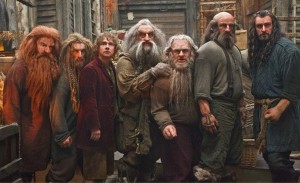 In this piece, Matt Lebovic of The Times of Israel explores the eternally fascinating question of the parallels between Tolkien’s dwarves and the Jewish people. Allegory is almost certainly too strong a word for the relationship, the quotes that Lebovic draws from Letters of J.R.R. Tolkien and various interviews make clear Tolkien’s dislike of the allegorical style (although Leaf by Niggle makes one wonder and Letters #241 and #153 provide conflicting evidence there), and his sincere admiration of the Jewish people.
Edit to quote from Letter #153:
…I might say in my myth I have used ‘subcreation’ in a special way (not the same as ‘subcreation’ as a term in criticism in art, though I tried allegorically [emphasis mine] how that might come to be taken up into Creation in some plane in my ‘purgatorial’ story Leaf by Niggle (Dublin Review 1945))…
Couple of quick points of nit-picking: the Company has 13 dwarves, not 12, it’s Middle-earth not Middle Earth, and arguably Khazad-dûm (Moria) is more accurately the spiritual home of the Dwarves (especially of the Longbeards of Durin’s line) rather than Erebor. As a point of trivia, the Dwarves eventually reclaim Khazad-dum under Durin VII sometime in the Fourth Age. As for the Arkenstone, some people hold that, within the Legendarium, it might have been a Silmaril, but that seems unlikely to this writer. Continue reading “Are Tolkien’s dwarves an allegory for the Jewish people?”
If you have a Tolkien/Middle-earth inspired poem you’d like to share, then send it to poetry@theonering.net. One poem per person may be submitted each month. Please make sure to proofread your work before sending it in. TheOneRing.net is not responsible for poems posting with spelling or grammatical errors.
Posted in:
Share:
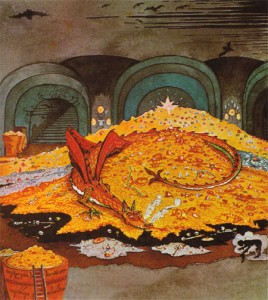 Lauren Davis from SF webzine io9 explores why, “in a media landscape overstuffed with dragons, do we still care so much about Smaug?”.
This was first published last month, and I missed it at the time, but it’s a very worthwhile read that delves into (among other things) the literary origins of Tolkien’s dragons — the story of Fafnir, and, of course, Beowulf. Follow the link at the bottom to read the complete article.
Why Smaug still matters
“A dragon is no idle fancy,” J.R.R. Tolkien wrote in his lecture “Beowulf: The Monsters and the Critics.” Whatever may be his origins, in fact or invention, the dragon in legend is a potent creation of men’s imagination, richer in significance than his barrow is in gold.”
Continue reading “Why Smaug still matters”
If you have a Tolkien/Middle-earth inspired poem you’d like to share, then send it to poetry@theonering.net. One poem per person may be submitted each month. Please make sure to proofread your work before sending it in. TheOneRing.net is not responsible for poems posting with spelling or grammatical errors.
Posted in:
Share:
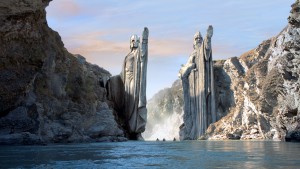 This is a very cool, very interesting Middle-earth history lesson wrapped into a list of its seven greatest architectural wonders. I find myself hard-pressed to disagree with any of the author’s choices. The ancient Dwarven cities of Nogrod and Belegost — and even Erebor — paled in comparison to Khazad-dûm’s lost glory.
Perhaps, at its peak, Osgiliath’s grandeur might have outstripped that of Minas Anor, but it lacked Minas Anor’s mountainous, physics-defying scale. The strange Pukel Men of Dunharrow might offer another option. And what of Thangorodrim and Angband, Morgoth’s fortresses from the First age and earlier? Would they have been mightier than Barad-dûr?
Anyway, have a read and add your thoughts in the comments. I’d encourage you to follow the links and read the full (and very extensive) entries on each wonder!
Continue reading “Discover the seven greatest architectural wonders of Middle-earth”
If you have a Tolkien/Middle-earth inspired poem you’d like to share, then send it to poetry@theonering.net. One poem per person may be submitted each month. Please make sure to proofread your work before sending it in. TheOneRing.net is not responsible for poems posting with spelling or grammatical errors.
Posted in:
Share:
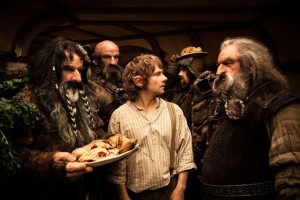 It’s safe to say that following the release of any film adaptation, conversation naturally veers to discussing divergences from the original work and creative license taken by the filmmakers. But what of those moments in which the film follows the lead of the novel more closely? A couple of
days ago, over on our forums, Ringer Barrow-Wight started a topic, including a LIST of many moments throughout The Hobbit: An Unexpected Journey, in which events and/or dialogue were very faithfully transferred from book to film. We’ve got it below for you to read.
After you take a look at Barrow-Wight’s list, be sure to check out this link, posted further down in the thread, which examines the differences between the films and the book: “The Hobbit: A List of Differences between the movies and the book” Continue reading “From The Hobbit to An Unexpected Journey: A look at the similarities and differences of a film adaptation”
Posted in:
Share:
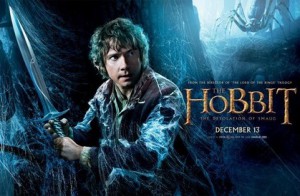 You’ve almost certainly visited Emil Johannson’s LOTRProject website at some point or another, whether to pore over his Middle-earth genealogy page, view the historical timeline of Middle-earth or try out his recent “Which Hobbit character are you?” quiz.
We asked Emil if he’d like to write a few words collecting his own thoughts on Peter Jackson’s The Hobbit: The Desolation of Smaug. Here is his review of the film.
If you’re still to see the film and are avoiding spoilers, please be aware that there are spoilers throughout.
The Hobbit: the Desolation of Smaug review: It is no longer Tolkien’s Middle-earth
The screen went black. The Desolation of Smaug had ended and I was left in the darkness of the cinema with a mix of emotions and thoughts in my head. It had been an entertaining and breathtaking two and half hours. They had essentially consisted of one single long action scene set in some truly spectacular locations. Martin Freeman had once again proved his worth as Bilbo Baggins, his subtle humor and incredible timing perfect for the role. Continue reading “LOTRProject’s Emil Johansson: it is no longer Tolkien’s Middle-earth”
If you have a Tolkien/Middle-earth inspired poem you’d like to share, then send it to poetry@theonering.net. One poem per person may be submitted each month. Please make sure to proofread your work before sending it in. TheOneRing.net is not responsible for poems posting with spelling or grammatical errors.
Posted in:
Share: