

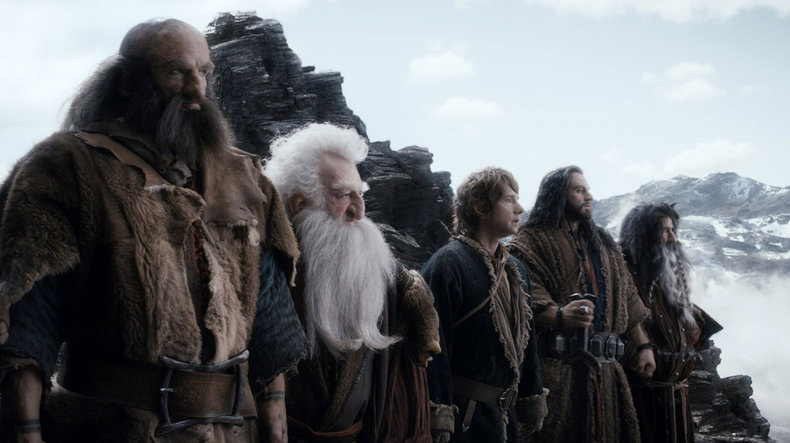
 The latest writing from TORn’s friend and regular Tolkien blogger Michael Martinez’s considers the content of Peter Jackson’s not one, not two but three Hobbit movies. The criticism often made is that Jackson has ‘padded’ Tolkien’s brief story, to create enough content for three films; but what of the content from the book which has in fact been lost? And how many of Jackson’s additions could be seen as necessary exposition, required to clarify and render cohesive several somewhat ‘glossed over’ plot points from The Hobbit (upon which Tolkien himself expanded, in the Appendices to The Lord of the Rings, for example)? Is any of Jackson’s content actually gratuitous padding, simply there to spin out a short tale? You can read Martinez’s take on all this in his interesting blog, here.
Category: Tolkien

 Film Producer Saul Zaentz has passed away at the age of 92. Many Tolkien fans will know him as the man who held the film rights to The Hobbit and The Lord of the Rings – but he was so much more: a true Hollywood legend, with countless film projects to his name. He won many Oscars, including Best Picture wins for One Flew Over the Cuckoo’s Nest, The English Patient, and my very favorite film of all time (perhaps with the exception of The Lord of the Rings trilogy) – Amadeus. Continue reading “Academy Award winning Producer Saul Zaentz dies at age 92”
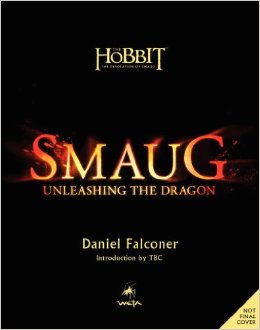 Due to be released
on April 1 (no, not an April fools joke), the new book Smaug: Unleashing the Dragon comes from the same wonderful team behind the three The Hobbit: Chronicles books. This release will be 96 pages, exploring the creation of the title character of the second Hobbit film from concept art to digital realization. Final cover art is not yet available, but you can order the book on Weta’s website as well as Amazon.com and other online book stores. Continue reading “‘Smaug: Unleashing the Dragon’ now available for pre-order on Amazon.com”
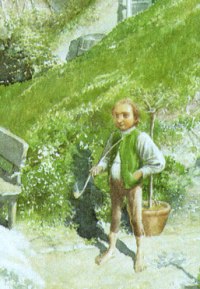
Here’s a thought-provoking article from Slate.com. We couldn’t help but notice the correction at the bottom of the story: “The caption for this story originally stated that Arwen and Aragorn are half-elf and half-human. Their lineage is apparently much more complicated than that.” Knowing fellow Tolkien fans, we imagine they received a comment or two (or twenty) to set them straight!
Are hobbits human and just really short? Or are they some entirely other species, like a gold-hoarding dragon? In high-school biology class they teach you to define species in terms of interbreeding. A horse is something that can make nonsterile babies with other horses; it may mate with a donkey, but since their offspring are sterile mules, horses and donkeys count as separate species. By that standard, the most relevant J.R.R. Tolkien passage comes from Appendix A of the Return of the King:
There were three unions of the Eldar and the Edain: Lúthien and Beren; Idril and Tuor; Arwen and Aragorn. By the last the long-sundered branches of the Half-elven were reunited and their line was restored.
It helps to recall here that Eldar is another word for elf and Edain is another word for human. Tolkien is saying here that there were two human-elf pairings in the backstory to the Lord of the Rings. One between Lúthien and Beren and another between Idril and Tuor. Both Arwen and Aragorn are descendants of one of these pairings. So when they get together in the course of the series, they reunite the half-elven lines. [Read More]
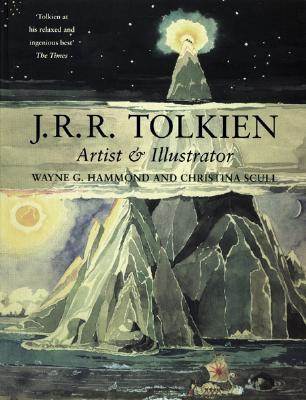 J.R.R. Tolkien was born on this day, January 3rd, 1892. During his lifetime, he created a world that came to life in our imaginations, and that we’ve come to love and cherish. While many of us can recite some of his prose an poetry by heart, and are familiar with his illustrations that appear in his books, there’s a whole treasure trove of lesser know drawings and paintings by the mulit-talented man. The folks over at brainpickings.org have a nice little tribute on their site celebrating the amazing artwork of The Professor as presented in the beautifully illustrated “J.R.R. Tolkien: Artist and Illustrator” by Wayne G. Hammond and Christian Scull. Have a look and join TheOneRing.net in a resounding: ‘Happy Birthday Professor Tolkien!’
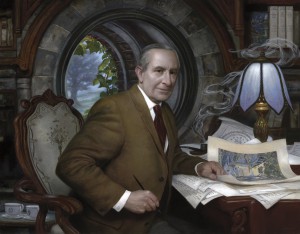 John Ronald Reuel Tolkien was born on January 3, 1892 in Bloemfontein, South Africa. To celebrate the birth and life of this much loved author Tolkien fans from around the world are invited to raise a glass and make a toast. In simple terms, you just gather with some friends at a pub, restaurant, cocktail party or bar and at 9pm local time you stand and raise your glass and say the words ‘To the Professor”. And with that, you will be joining together with fans around the world in remembrance of Tolkien and all that he has brought into your life. And if you are unable to join with friends, no worries, pull out your favorite Tolkien book on January 3 and sit and read it and at 9pm you can still perform the Toast on your own. BTW, you don’t have to be drinking alcohol, you could have a glass of water, soda, tea or hot chocolate, whatever feels right to you. What matters is the Toast and acknowledging your love of Tolkien and his words.
In Los Angeles, Tolkien Forever, the local Smial of the Tolkien Society will host their annual Tolkien Toast at the Cat & Fiddle pub in Hollywood. If you wish to get more info and to attend, you can find details at Tolkien Toast and if you are a So Cal local, feel free to RSVP and join in the fun. Everyone else, leave comments here and let’s see if we can make this the biggest Tolkien Toast of all.