And then there were eight… Middle-earth March Madness 2025: The Art of Middle-earth Round Four voting is open now! And we have a GIVEAWAY for you to enter! And if that were not enough, we have livestreams today and Tuesday with very special guests! Read on to find out more…
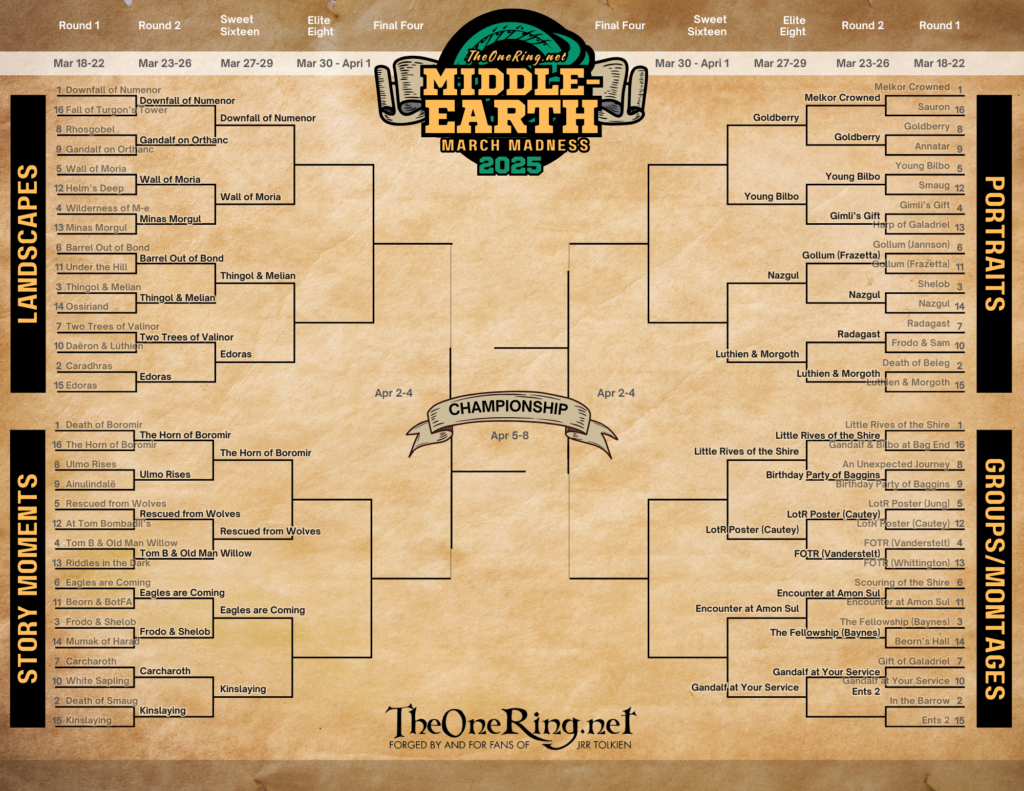
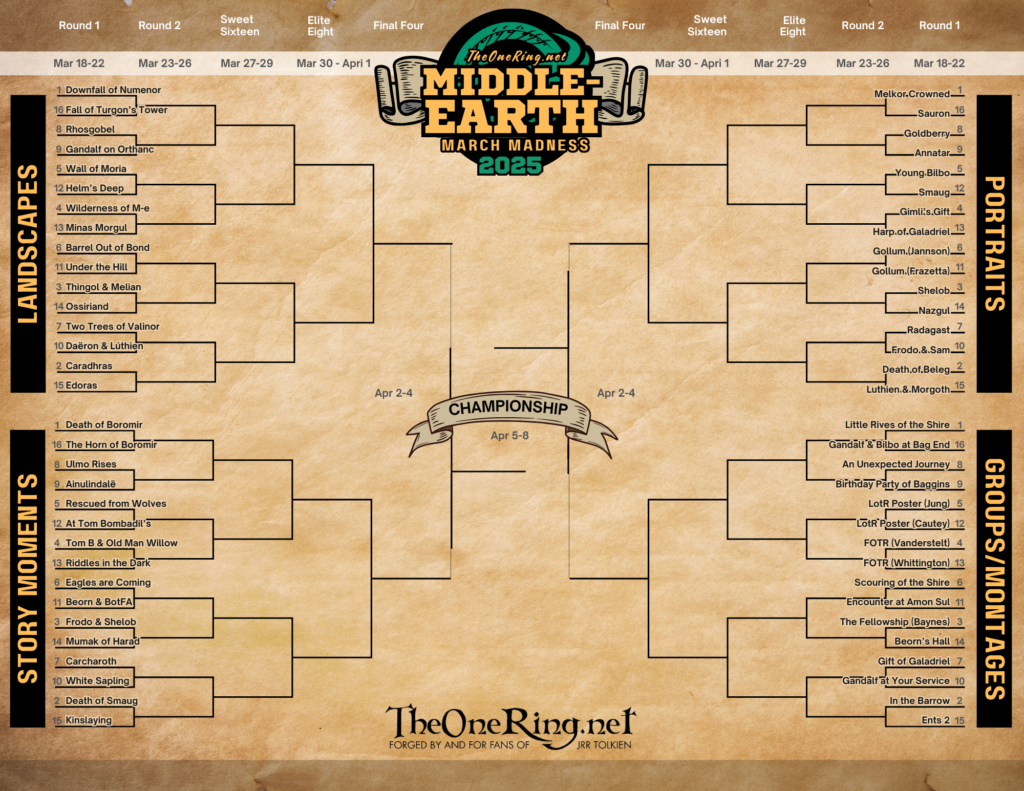
How the art works lined up in the Sweet Sixteen
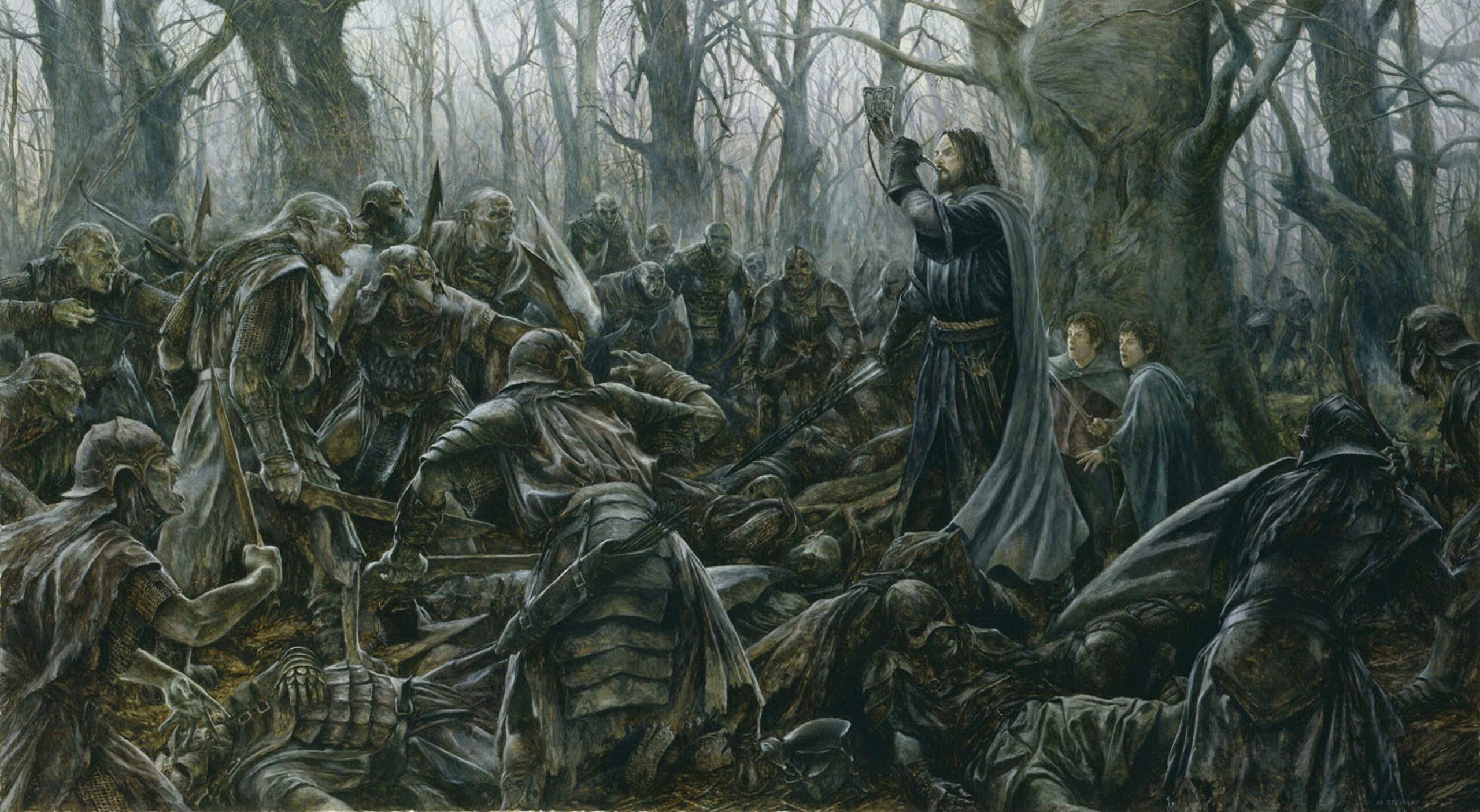
The battles are getting closer; in Round Three, most victories were by a margin of less than 60%. The biggest conqueror was Matthew Stewart’s The Horn of Boromir, which took over 70% of the votes to defeat Michael Hague’s Rescued from Wolves. It seems people have a soft spot for art which echoes Peter Jackson’s movies.
The Horn of Boromir, by Matthew Stewart
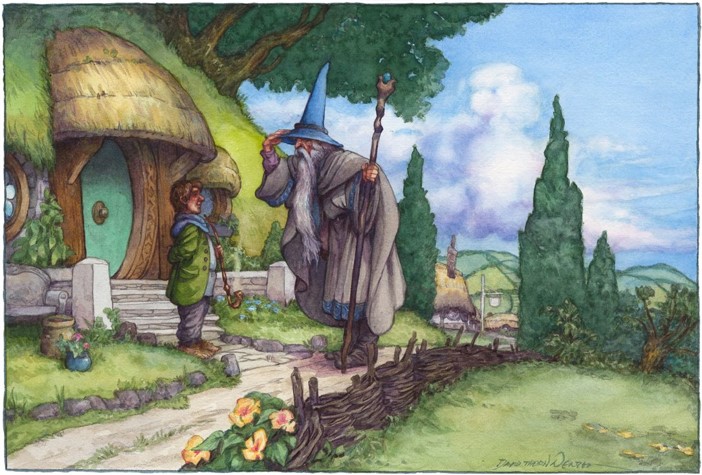
In the Groups/Montages region, there was one match up which went right down to the wire. In the end, David Wenzel’s Gandalf at Your Service (from his The Hobbit graphic novel) beat Eric Velhagen’s Encounter at Amon Sûl. The charms of the Shire overcame the dynamic but violent battle with Ringwraiths – but by a margin of only 4% of the votes.
Gandalf at Your Service, by David Wenzel
So now we are down to the final pairing in each of our four regions. This Elite Eight features some big names in the world of Tolkien art; and some with which you may not be so familiar. Which will go all the way, to become the Grand Champion of 2025? If you can predict that, you might be one of our lucky winners!
Thanks to our good friends at Warner Bros. we have copies of The Lord of the Rings: The War of the Rohirrim to giveaway. (What better way to celebrate the Art of Middle-earth than with this epic anime film?) During the Elite Eight round, you can enter to be in with a chance of winning, by guessing which of the remaining masterpieces you think will be the ultimate victor. Simply complete this form with your prediction; once Middle-earth March Madness is over, we’ll pick winners at random from those who successfully predicted the Grand Champion. (Sorry, this giveaway is only open to residents of the USA or Canada.)
Then make sure to give your chosen winner the best chance, by VOTING!
How does it work, you ask? Simple! Click on the button below. This will take you to the voting site, where you can view the entire bracket, and also view individual works in all their glory (and details of the artist). Place your votes for Round Four: Elite Eight!
Staffer Madeye Gamgee shares his thoughts on the pieces in the Elite (or ‘Elegant’ or ‘Engaging’) Eight:
In Landscapes, iconic Lord of the Rings scenes by incredible and well-know masters of their craft, Donato Giancola and Alan Lee. These two have emerged from possibly the strongest region, stacked with well-known artists and strong lesser know ones
In Story Moments, a focus on tragedy and death, curiously, whether it’s Boromir’s last tragic stand and redemption, or one of the darkest days (literally) in the story of the Silmarils, a mixture of beauty and Elven genocide.
-In Portraits, it’s light against dark in a battle of divine strength, with the fair (and powerful) River Daughter facing the specter of Morgoth, perhaps drawing inspiration from Luthien’s triumph in a similar artistic match
In Groups, perhaps a surprising and much more peaceful pairing, and all Shire-centric, with David Wenzel’s familiar meeting between Gandalf and Bilbo up against, well, who are those hobbits fishing by the little Shire river? It seems like a wonderful spot to look for a more peaceful adventure!
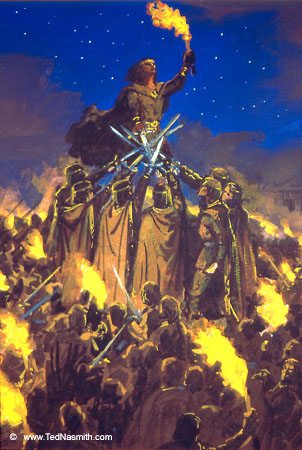
You have until the end of the day Tuesday April 1st to vote in Round Four; on Wednesday 2nd the Final Four will begin! But first – please join us TODAY, Sunday 30th, for a very special livestream. 3pm PST/6pm EST Ted Nasmith will join us, to discuss his incredible The Kinslaying of Alqualondë, which features in the ‘Story Moments’ bracket. Then join us again on Tuesday 1st April, when artist Donato Giancola will be with us during TORn Tuesday to discuss his masterpiece The Walls of Moria. We hope you’ll be there to hear from both these fantastic artists, as you make decisions on the Elite Eight round. And don’t forget to VOTE!
And just like that, we’re on to Round Three of Middle-earth March Madness 2025: The Art of Middle-earth. From 64 works of art which started in the four brackets, now we’re down to the Sweet Sixteen; and in this round, you only have three days to vote. Round Three voting is open now!
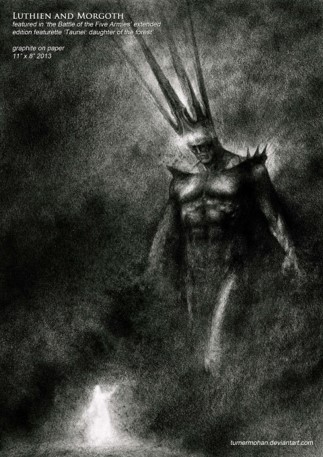
Round Two for the most part had pretty clear winners in the match ups. The one VERY close battle was between Angelo Montanini’s Radagast the Magician and Turner Mohan’s Lúthien and Morgoth. These two very different works were in a stalemate for most of the round. A brief flurry of votes in the final hour saw them continue to swap places for the lead, until finally, when voting closed, Mohan’s extraordinary work come out the victor – but by just ONE VOTE!
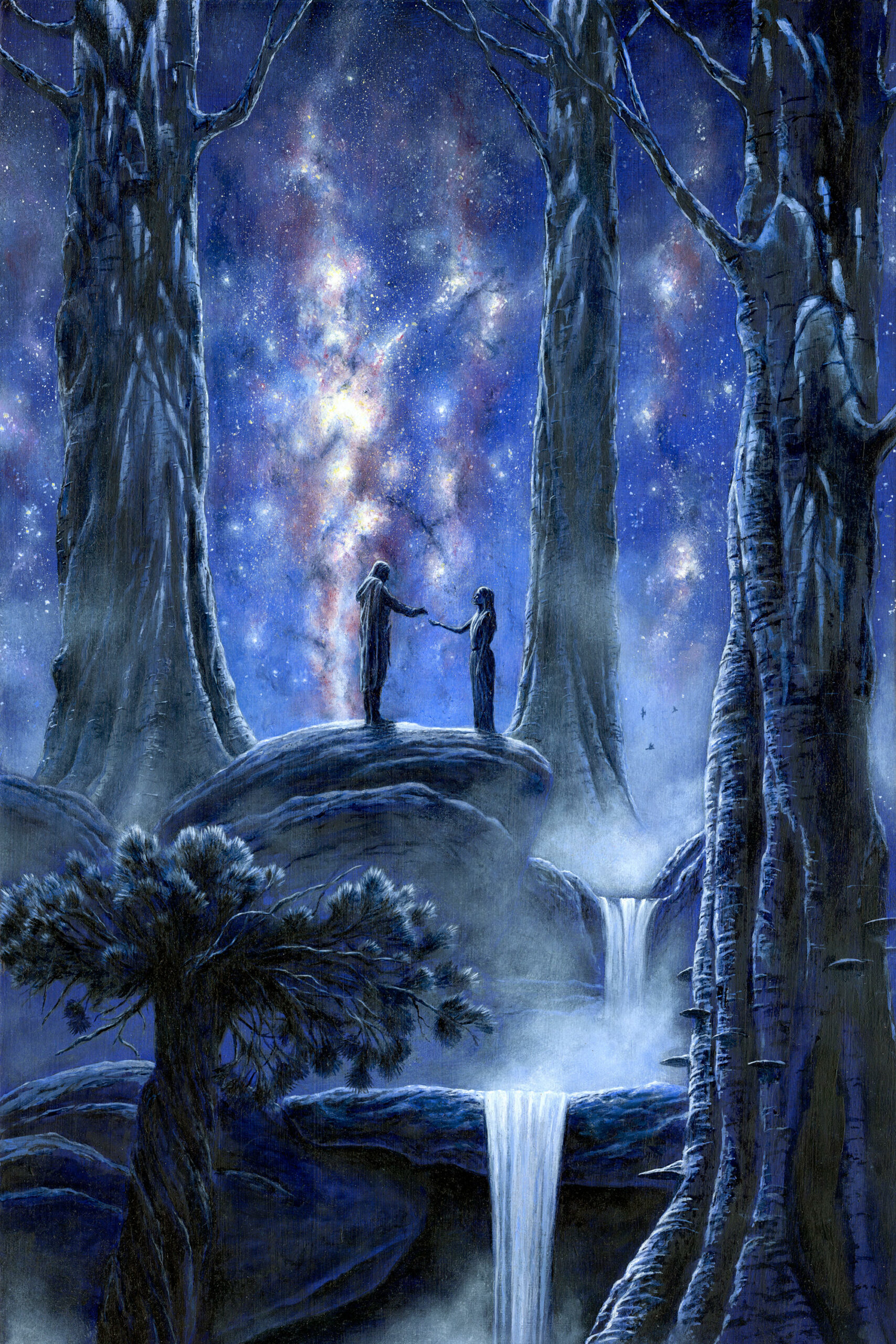
Lúthien and Morgoth by Turner Mohan
One perhaps surprising departure in Round Two was John Howe! His Barrels out of Bond was narrowly defeated by Kip Rasmussen’s Thingol and Melian, which claimed 56% of the vote. Both are gorgeous pieces; it just shows how difficult it is to choose when all these artists are so talented, and their visions are so different. It now looks like Alan Lee and Donato Giancola may meet in the Elite Eight, to decide the overall winner in the ‘Landscapes’ bracket; but first, they have to make it through this next round!
Thingol and Melian, by Kip Rasmussen
Some thoughts from staffer Madeye Gamgee on the contest so far:
In the Sweet 16, as far as book “Conferences” go, we have representation from:
The Silmarillion — 4
The Hobbit — 3
The Lord of the Rings – 9
We had some very familiar artists get knocked out of the tournament this round, including John Howe, Justin Gerard, Jerry VanderStelt, and Colleen Doran. Surviving are newer artists like Anna Lee, Edvige Faini, Soni Alcorn-Fender, and Eric Velhagen. Art from titans Donato Giancola and Alan Lee may be heading to a face-off in the Landscape finals. Can Ted Nasmith’s work prevail over less well-known but formidable competing artwork? Will the comfort of David Wenzel’s classic Hobbit graphic novel be enough to overcome what may be the most diverse group of competing artwork in the Groups/Montages region? It’s not getting any easier!
Take a look at the fours brackets as they now stand; which masterpiece do you think is en route to becoming to champion for 2025? As always, we encourage you to take some time enjoying the art, and perhaps follows some links to check out other works by the artists, before you place your next votes. (You can also always access the earlier rounds at the voting link; so all these incredible pieces are still there for your viewing pleasure!)
Decisions are getting harder, as the field narrows. How you make your choice is up to you!
How does it work, you ask? Simple! Click on the button below. This will take you to the voting site, where you can view the entire bracket, and also view individual works in all their glory (and details of the artist). Place your votes for Round Three: Sweet Sixteen!
You have until the end of the day Saturday March 29th to vote in Round Two; on Sunday 30th we’ll open voting for Round Four! That Sunday, we’ll also have a very special livestream at 3pm PST, when none other than Ted Nasmith will join us, to discuss his ‘The Kinslaying of Alqualonde’, which features in the ‘Story Moments’ bracket – and he may even share some preliminary sketches with us! We hope you’ll join us for that, as you make decisions on the Elite Eight round; but first, go and examine the Sweet Sixteen! Vote well!
With thousands of votes over all the pairings, Round One of Middle-earth March Madness 2025: The Art of Middle-earth is done; and half the wondrous works of art have been eliminated. If you joined us for any of our livestreams, you’ll know how tricky those choices were; and from here on, it only gets tougher! Voting is open now for Round Two!
Round One saw some VERY close battles – and indeed, few works won by really wide margins. In the ‘Landscapes’ bracket, Mary Fairburn’s Gandalf on the Tower of Orthanc beat Federico Cimini’s Rhosgobel by less than 1% of votes cast! That same bracket, however, saw one of the biggest victories: Alan Lee’s Edoras took 86% of votes, to defeat Paul Gregory’s Caradhras – a beautiful work which might well have made it through to Round Two, had we not set it up with such a challenging opening round battle!
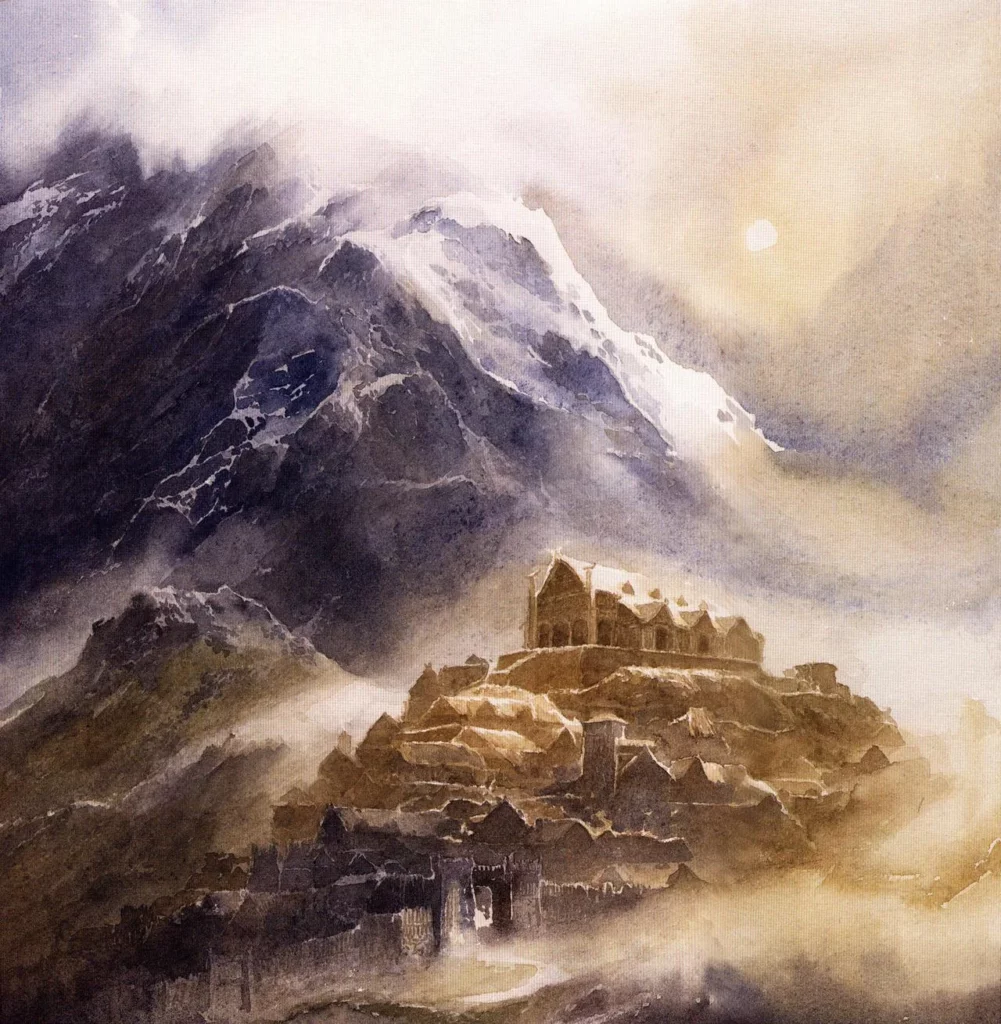
Edoras by Alan Lee
Check out the bracket now, to see which pieces made it through. Then we hope you may linger a while, spending some time with the 32 remaining pieces, before you place your next votes.
How you choose is up to you! How you vote is explained below:
How does it work, you ask? Simple! Click on the button below. This will take you to the voting site, where you can view the entire bracket, and also view individual works in all their glory (and details of the artist). Place your votes for Round Two!
You have until the end of the day Wednesday March 26th to vote in Round Two; on Thursday 27th we’ll open voting for Round Three! We’ll have more livestream discussions of the featured art – and look out for some very special guests coming up, as well as some giveaways! Join us on Tuesday 25th for TORn Tuesday where Jerry VanderStelt will be our guest, to discuss his piece in the ‘Montages’ bracket, The Fellowship of the Ring. We hope to see you then – perhaps you may want to wait to vote until after that stream, in case it changes your mind…?
Our first panel, ‘Celebrating Tolkien Reading Day’ will be on Friday, March 28 at 6:00 pm in Room 207. We will be reading some selections from various Tolkien books, and there may be a few little surprises along the way. This panel, in particular, will be very family-friendly, we may even call a few children to the front to join us in storytelling. Follow the link below to see details.
Our second panel, ‘Lord of the Rings: Previewing Upcoming Projects’ will take place on Saturday, March 29 at 2:00 pm in room 211. This panel will be where we discuss all the recent and soon-to-come Middle-earth-themed shows, films, books, games, and more. The link below shows more details.
Spring is springing in the Northern Hemisphere, and that means it is time for March Madness! We here at TheOneRing.net always like to join in the fun; and this year, we bring you Middle-earth March Madness 2025: The Art of Middle-earth.
As those who joined us for the livestream launch yesterday know, this year we’ve chosen 64 works of art – artists’ imaginings of the realms and characters created by The Professor. These are then divided into four ‘Regions’: Landscapes, Portraits, Story Moments, and Groups/Montages.
As you can imagine, it was very difficult to narrow the field to 64 artists and then to choose just ONE work from each artist! (But we certainly had fun, exploring and perusing and immersing ourselves in Middle-earth art!) Now we hand the difficult decision making over to YOU! As ever, our March Madness plays out in six rounds, with half the entries getting knocked out each round. So right now you have the challenging task of voting to reduce 64 wonderful art works down to just 32!
How will you choose? That is entirely up to you! But first, a word about OUR choices:
You will notice the absence of Tolkien himself in this ‘contest’. We decided it would be unfair to include The Professor’s own art work – for surely he would be the clear winner! So the pool is made up of artists INSPIRED by Middle-earth, not the creator of Middle-earth himself. We also have not included art from film. There is of course art inspired by film – you can see a clear influence of Peter Jackson’s movies on some of these works – but we have not included, for example, stills from the recent, beautiful anime movie The Lord of the Rings: The War of the Rohirrim, nor from Ralph Bakshi’s 1978 The Lord of the Rings (though you will find the poster from that film in one of the brackets!)
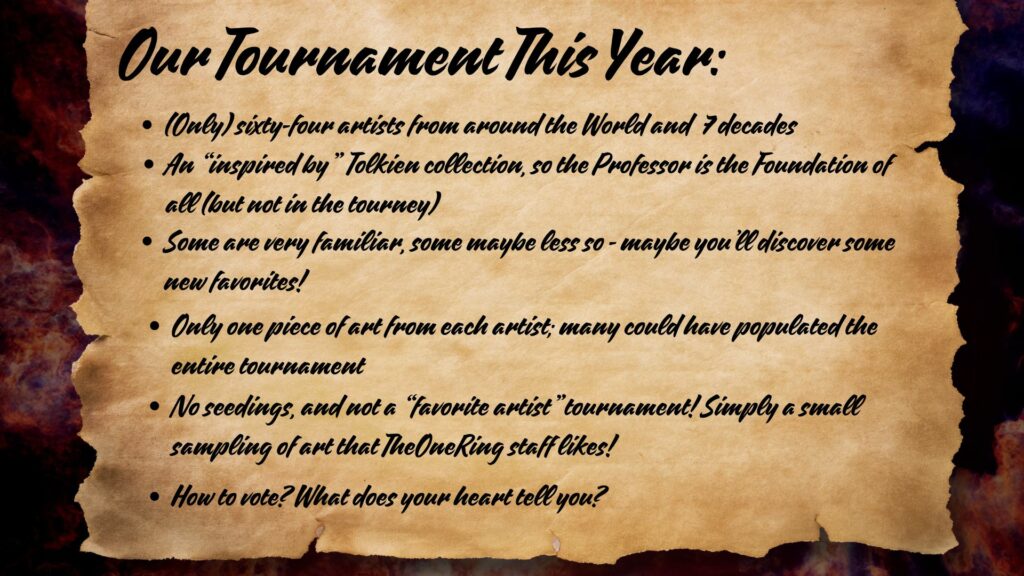
This year’s March Madness, more than ever, is very much ‘for fun’. We didn’t seed our choices this year; we felt it was impossible to create any kind of ‘rank’ for these stunning visuals. Likewise, your vote will be entirely about your own personal taste. There is no ‘best’ piece amongst these 64 – only the ones YOU like best. So, vote however you would like. Toss a coin, if it comes down to it! But DO take some time enjoying all of the art. Our hope is that fans will take pleasure in revisiting familiar works, and also that many people will be introduced to artists whose work they do not already know. We’ve made sure to include links where available, so perhaps you’ll head off down a rabbit hole to explore more pieces by a painter you’ve just discovered. Maybe you’ll even buy some works from that artist, for your own wall! (And that’s actually quite a good ‘yard stick’ for decision making – ‘Would I like to hang this on my living room wall?’)
In short, treat the voting brackets like an art gallery. Stay a while! (You have until midnight EST at the end of March 22nd to vote in Round One.) Gaze, reflect, ponder, enjoy. And then VOTE.
How does it work, you ask? Simple! Click on the button below. This will take you to the voting site, where you can view the entire bracket, and also view individual works in all their glory (and details of the artist). So let’s get voting!
You have until the end of the day Saturday March 22nd to vote in Round One; on Sunday 23rd voting will open for Round Two! Look out for more livestream discussions of the featured art, coming from our TORn Tuesday team, where we’ll also have some very special guests – and some giveaways! Keep an eye on our socials for all details. We hope you enjoy exploring this Art of Middle-earth; let the games begin!
Oaths hold an astonishing power in Tolkien’s Middle-earth. Here, TORn Discord member Narrative Epicure explores how Sauron and Elrond’s understanding of this fact drives each to behave very differently toward others.
~ Staffer Demosthenes
Concerning Oaths in Middle-earth
by TORn Discord member Narrative Epicure
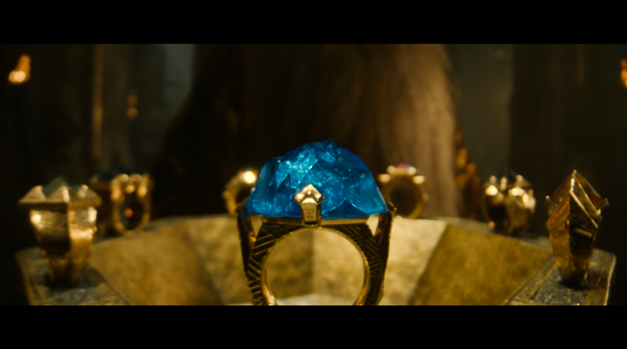
In December 3018 of the Third Age, everybody’s lucky number was nine. After an involuntary white-water rafting trip down the Bruinen, Sauron’s Nazgûl returned to Mordor. These servants, so long bound to him by works he wrought in ages past, gathered once more in the dark shadow of Barad-dûr. In the Elven realm of Rivendell, Lord Elrond prepared a Fellowship whose journey would determine the fate of Middle-earth.
“The Company of the Ring shall be Nine;”1 he declared, “and the Nine Walkers shall be set against the Nine Riders that are evil.”2
Contrasts between the Ringwraiths and the Fellowship are legion, but in their preparations, one particular distinction reveals the nature of the hands that send them: while Sauron insists on sending servants bound to him by rings of power, Elrond demands nothing of anyone but Frodo (to not cast away the ring or deliver it to an Enemy). To the fellowship, he says, “no oath or bond is laid upon you.”3
As they depart on their journey south, he demands no promise from the nine he sent.
This difference between Elrond and Sauron is illustrative of each lord’s perspective on oaths and—to a larger degree—of the way each lord interacts with and treats the people of Middle-earth.
Concerning Oaths
Oaths and promises are fascinating subjects that could fill volumes on their own. On a surface level, an oath is a set of words promising some conduct or restraint. Yet, the way we treat an oath transforms it from a set of words to a power. In our own world, this power is usually subtle, intangible, and typically confined to the effects on psyche, trust, or the occasional legal ramification. In large part, oaths have over us what power we give them. In Middle-earth, this intangible power becomes tangible. Tolkien writes of oaths not only as if they have power, but as if they behave.
Oaths are living things that bless those who honor them, and occasionally impose consequences on oathbreakers. Tolkien describes the Oath of Fëanor (an oath that drives much of the action and conflict of the First Age) as “ever at work,”4 and on other occasions he says it has “slept now for a time.”5
In The Lord of the Rings, we see the terrible result of going back on your word when the Men of Dunharrow break oaths to fight Sauron and Isildur curses them to “rest never until [their] oath is fulfilled.”6
Tolkien’s writing ascribes another unique trait to oaths: they bind people to each other. Tolkien’s Legendarium offers many examples of this: the Oath of Eorl bound Rohan and Gondor together, the Oath of Finrod bound him to aid the kin of Barahir (at the cost of his life), and the sons of Fëanor were “bound by the oath”7 they swore.
But the people of Middle-earth can be bound even without oaths. When Melkor darkened the two Trees of Valinor, the Valar determined that the light of the Silmarils could restore the trees if Fëanor allowed their use. Fëanor refused. The Silmarillion describes him as “fast bound” to the Silmarils. Long before his oath, the love of his crafts bound him.
It was this binding power that Sauron would seek to replicate. In the Second Age, he bent the power of oaths back on itself, twisting it into the shape of rings, “for his desire was to set a bond upon the Elves.”8
Bound by Oaths
In Season 1 of the Rings of Power, young Elrond describes his outlook on oaths. “To some, [oaths] may now hold little weight, but in my esteem, it is by such things our very souls are bound.”9
He sees oaths as Tolkien wrote of them, and he uses them to build a web of collective strength. Elrond gives oaths. He enters them freely as a show of loyalty to those he cares about. Some may argue he enters them too freely.
Yet, despite the impetuous manner in which he binds himself to others, he’s hesitant to let others make oaths to him. When the Fellowship departs, and he asks no oath or bond, he explains some of his reasoning (paraphrased to just dialogue):
Gimli: “Faithless is he that says farewell when the road darkens.” Elrond: “Maybe, but let him not vow to walk in the dark who has not seen the nightfall.” Gimli: “Yet sworn word may strengthen quaking heart.” Elrond: “Or break it.”10
He’s cautious to hold others to promises made without all facts. We see this again in the mines when he stops Durin from sharing his true name—an act that, while not an overt oath, would have bound the two together. And while he freely binds himself, he’s cautious with whom he makes such promises. Note that in Season 2, when Galadriel asks, he immediately refuses to swear any promise “whose asking is born of that ring.”11
But seconds later, he swears exactly what she wishes, only this time to her. He will not suffer himself to be bound to or by her ring, but holds no qualms for his friend. And despite his fears that she is bound to Sauron through that ring, he demands no similar oath from her lips.
At his core, Elrond believes oaths are about people. He cares much more about binding himself to others than binding them to him. He cares deeply about them. When he stumbled into Durin’s Mithril mine in Season 1, he wasn’t looking for mithril itself like Durin suspected. He was looking for his friend. He worried about Durin’s secrets and went there to maintain trust between them.
After swearing an oath to Durin, he’s given a nugget of mithril, which he immediately offers to return. His king sought that ore, but to Elrond, this was always about his friend. Incidentally, this outlook works to his favor. Durin never would have given him the mithril if it were why he came lurking.
Bound in Darkness
If Elrond is the give, Sauron is the take. Elrond builds strength, Sauron builds power. To the dark lord, the purpose of oaths is to ensure those beneath him remain subservient. We see this in the very terminology he uses. He almost always eschews the word “oaths” in favor of “binding.” He doesn’t want to forge webs like Elrond; he wants to forge chains.
Sauron is cautious about oaths he swears. When faced with no alternative, he tries to manipulate them in his favor. “I swear to serve the lord of Mordor”12 is the juicy example that springs to mind. He’s there to bind others to him, not the other way around. Oaths don’t show loyalty or closeness, they keep others in line.
In the finale of Season 1, he asks Galadriel to bind herself to him. What he wants from Galadriel is a promise—an oath—so he can make her a queen, fair as the sea and the sun, stronger than the foundations of the earth. But notice again his subtlety. He offers her effectively nothing. “You bind me to light, and I bind you to power.”13
In exchange for her legitimizing his “healing” of Middle-earth, he binds her to power. But in Sauron’s estimation, he is that power. He binds her to him, and in exchange, she validates his rule. But as Gandalf famously warned Saruman, “he does not share power.”14
He’s promised her only chains.
Since he cannot elicit true loyalty, Sauron must demand it. He can deceive and win hearts, but he cannot keep them. It is this inability to earn true loyalty that—in part—drives Sauron’s need for the rings. Elrond cares for people while Sauron seeks only what he can use from them.
Each ring of power is a literal manifestation of that search for utility. If the people of Middle-earth will not swear to him, he will find some other way to bind them to him.
Frodo observed that “the Shadow . . . can only mock, it cannot make: not real new things of its own.”15
Unable to make bonds and elicit oaths, Sauron mocks, imitating the power of an oath’s bond with his rings. That involuntary bond shreds trust, but he doesn’t need trust when he has control. Dominate some creatures, bind others, make empty promises, and—when your army is threatening enough—maybe some people will swear with less coercion and deception.
And so, nine walkers set out from Rivendell, each a hero, while nine riders set out from Mordor, each a thrall. Sauron told us his plan from a prison cell in Númenor: “identify what it is that [a person] most fears . . . [and] give them a means of mastering it so you can master them.”16
Elrond’s line of thinking would likely be more along the lines of “identify what it is that a person most fears, and swear to protect them from it.”
With that contrast laid out, it’s clear in which fellowship you’d find better company.
About the author:Narrative Epicure is an aspiring loremaster and practicing attorney longing to read or write things that aren’t legal. When he’s not buried in Tolkien’s Legendarium, he enjoys books, board games, and other activities with his Fellowship, which includes his wife and three daughters.
If you have a Tolkien/Middle-earth inspired poem you’d like to share, then send it to poetry@theonering.net. One poem per person may be submitted each month. Please make sure to proofread your work before sending it in. TheOneRing.net is not responsible for poems posting with spelling or grammatical errors.