From stuff.co.nz: Brett Hodge, owner of Matamata Post and Rails, which has supplied the timber for The Hobbit duology since construction began in February, told the Waikato Times that Sir Peter Jackson’s company Three Foot Six was building the home of the Hobbits to last.
What they did last time was build a temporary set, but now it’s a permanent set.
It will begin a perpetual celebration around the party tree, on the set, where The Fellowship of the Ring began with Bilbo’s disappearance.
The Green Dragon, where the dwarf Thorin Oakenshield awaits Bilbo Baggins ahead of their quest, will include a real thatched roof and the nearby Bywater bridge, made from polystyrene blocks resembling stone for The Lord of the Rings, is being rebuilt in permanent stone.
Read more of the article over at stuff.co.nz that ends with quotes from none other than members from our very own message boards.
Doug Adams, author of the recently released book “The Music of the Lord of the Rings Films”, has written up an article over at his site on why New Zealand matters for The Hobbit. Doug has worked closely with Howard Shore for the better part of a decade and he has had great insight into the production for the music of the Lord of the Rings movies. So besides enumerating the enormous difficulties the production would have faced were it to move off-shore, Doug writes this article through a “music-specific lens” and details the impact the move would have had on the music for The Hobbit movies.
Here’s a snippet from the article:
That impact would have been felt most painfully during the post-production. Post, as you all know, is where the lion’s share of the music is created. Yes, Shore has already begun his creative process, but nothing other that pre-recorded songs an diagetic music can be recorded and mixed until the film is shot, edited, and locked. Performers and rooms need to be booked for specific schedules … as do technicians, editors, producers, and so on and so forth. It’s a small army, and it needs time and care.
My greatest fear — viewed through a music-specific lens, that is — was that the production would be rearranged in such a manner that there would be very little time for the music to be created appropriately.
Happily, with New Zealand now set and a February kick-off locked, it looks like none of these concerns will materialize. With a December 2012 release for part one, Shore and company should, presumably, be able to earnestly start into the post-production in late summer of 2012 … essentially the same schedule that was in place for the LOTR pictures. And those came out pretty well, I think! 🙂
Read the entire article over at Doug’s site. Many thanks to message board member Magpie for pointing us to this article.
Bruce Hopkins writes: I am just letting you know I have posted to my radio web page the chat I had with photographer Ian Brodie. We talk for 13 minutes, he is such an amazing guy, really enjoy any time I get to talk with or spend in his company. You can check it out here, if that doesn’t work then try this.
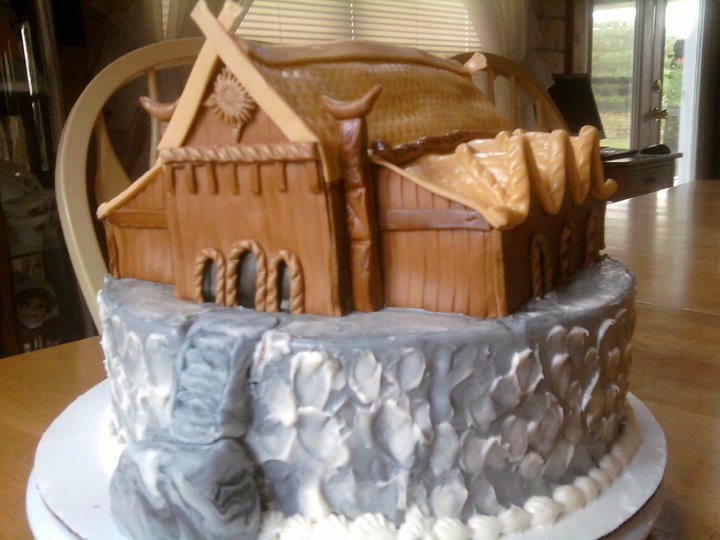
Hi! My friend Melissa, whose family introduced me to all things Tolkien, made a birthday cake for her 14 year old brother Jonathan. He requested that it be the Rohan Longhouse on top of Edoras. Melissa is not formally trained as a cake artist & I think she did an awesome job! Thanks! ~Rachel
Rachel, we agree! We’ve seen some impressive creations in our 10 years online, and this one definitely takes the…err…cake? Jonathan has a great Mom! Click on the image to see a larger version.
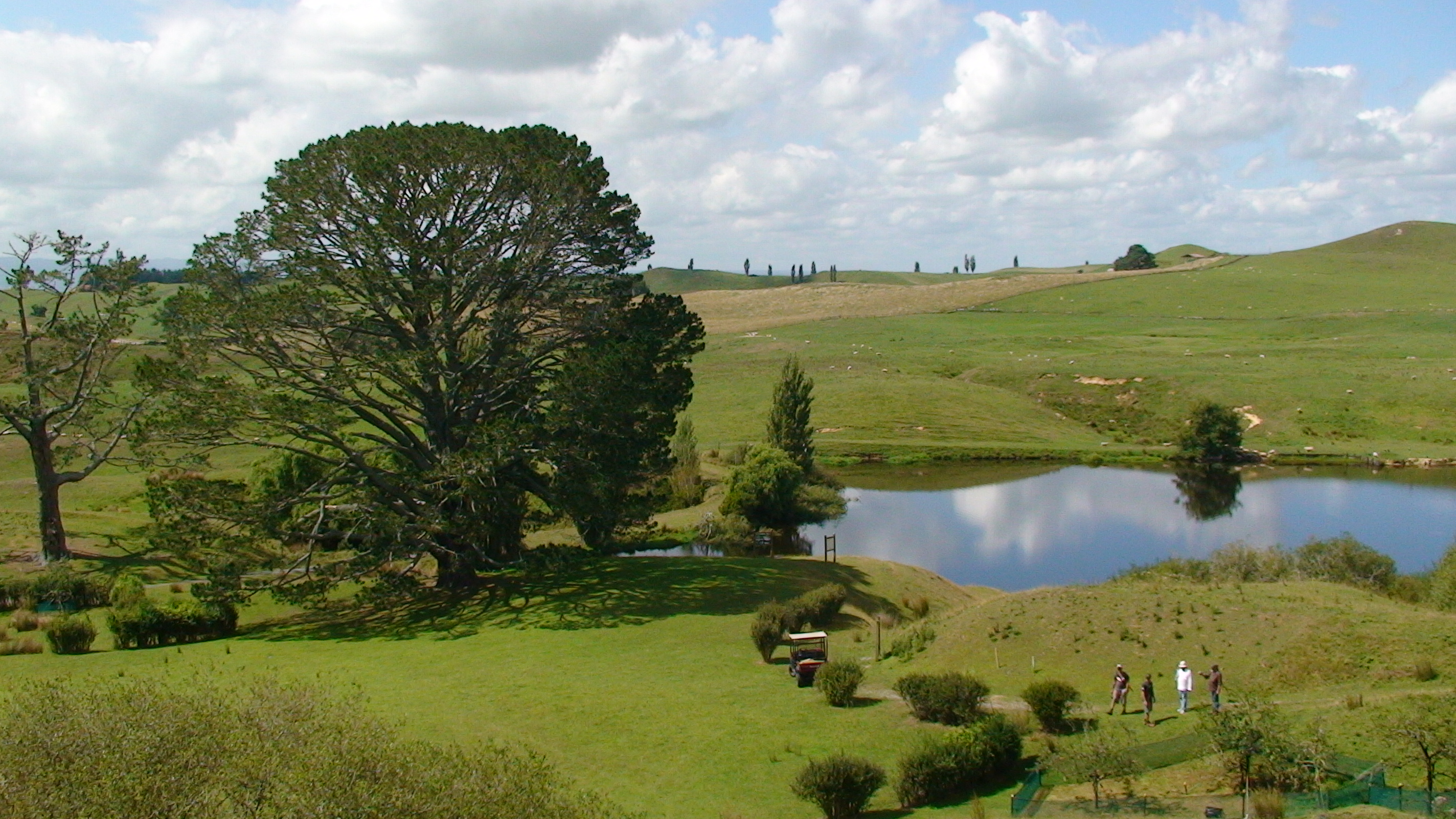
The New Zealand farmland that was transformed into Middle Earth for the Lord of the Rings film series has been recolonised by sheep, some of whom have set up home in the deserted hobbit holes. The rolling green pastures that provided the backdrop for director Peter Jackson’s trilogy were originally going to be converted into hobbit theme park, to attract tourists to the town of Matamata on the country’s North Island. But the plans were shelved, and the land is now home to 12,000 sheep and 250 cattle. They are allowed to roam around the 17 hobbit holes left behind after the production team departed. More..


 From stuff.co.nz: Brett Hodge, owner of Matamata Post and Rails, which has supplied the timber for The Hobbit duology since construction began in February, told the Waikato Times that Sir Peter Jackson’s company Three Foot Six was building the home of the Hobbits to last.