Radio NZ National program The Arts on Sunday has interviewed Peter King who is the brains behind the make up design for the Lord of the Rings and The Hobbit.
King has previously won an Oscar and a BAFTA for his work on The Lord of the Rings, while his other film credits include Nine, the Nanny McPhee movies, King Kong, Thunderbirds and An Ideal Husband.
I don’t know how long the link will remain up so you should have a listen soon. Press play below to hear the interview.
If the above link doesn’t work for you listen [here]
Posted in:
Share:

Tom Cardy from stuff.co.nz writes:
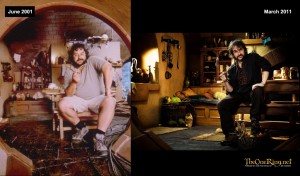
Today at age of 50,Peter Jackson has just wrapped up principal shooting on the two-part The Hobbit in Wellington, he has done what was considered the impossible.
How things have changed for Wellington, after the release of The Lord Of The Rings, the subsequent release of King Kong and The Lovely Bones has not only made him the best known New Zealander in the world – it had a direct impact on the city he lives in.
[Read More]
Posted in:
Share:
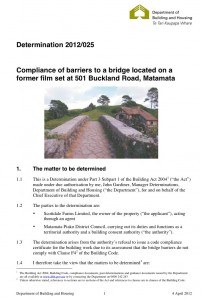 Thanks to Ringer David H from Auckland NZ, we have this link to a wonderfully revealing and in-depth PDF from The Department of Welfare and Housing Te Tari Kaupapa Whare. The document is titled: Compliance of barriers to a bridge located on a former film set at 501 Buckland Road, Matamata. You see, the bridge made famous in The Lord of the Rings and The Hobbit was considered to be not complying with Clause F4 Safety from falling of the Building Code, and and as a result seemed to ultimately be required to make some adjustments to allow public use. However, after a lot of discussion, notes and analysis, you’ll see that Manager Determinations John Gardiner has reversed a previous decision and decided the bridge, in its current form, qualifies for code compliance! Hobbits of Hobbiton rejoice! The bridge will remain open! [PDF]
Posted in:
Share:
In this One News report Richard Taylor, Pietro Marson and Rod Sheeny (Weta Workshop Animatronics) talk about how Weta Workshop is using 3D printers to make weapons and props for The Hobbit and the Lord of The Rings trilogy.
Animatronics engineer, Rod Sheehy, says that the printing technology is an advantage because it keeps costs down with the items made in-house, saving a lot of time and Taylor says that they’ve used the tech to make helmets, sword hilts and axes. Thanks to Ringer Marc for the heads-up!
Posted in:
Share:
 Jared Connon is the supervising location manager for The Hobbit, and worked on The Lord Of The Rings.
The eagle-eyed film locations expert has worked in the film industry since he was 19, knows New Zealand like the back of his hand and is considered one of the best in the business. Connon has seen more remote parts of New Zealand than most fellow kiwis. He’s also very dedicated to the Māori ethos of kaitiakitanga — treading lightly on the land, treating it with respect and leaving it unspoiled for future generations.
In this feature, Connon speaks about location scouting, the logistical challenge of organising filming permissions and what makes a good location scout.
[More]
Posted in:
Share:
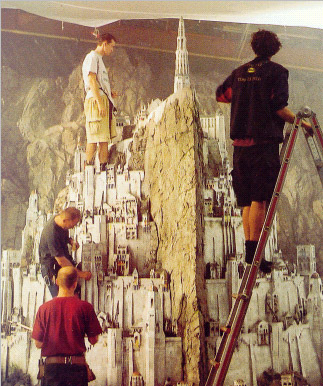
Given the awe-inspiring miniatures and “bigatures” used for The Lord of the Rings, many of TORn’s members have been questioning (some with a pang of longing!) the decision to do away with miniature photography for The Hobbit, speculating the use of 3D may have had something to do with it.
Whilst poring over the numerous press interviews and Q&As conducted with Peter Jackson over the course of this weekend, we found the answer via Collider.com in PJ’s response to the question of what the biggest advances in technology have been since The Lord of the Rings. He says:
The technology that advanced the most, in the last 10 or 12 years, is really the fact that we did a lot of miniature shooting on The Lord of the Rings. All the big architectural structures of Middle Earth were really miniatures, some of them quite large. But, you’re limited to what you can do with a miniature because you literally have to have a big camera that has to sweep past it, so you can’t get too close to it and the detail doesn’t hold up too well, if you do.
This time around, there are no miniatures. It’s all done with CGI. Everything that we need to build, from a miniature point of view, we build as a CG miniature. I can now swoop in, over rooftops and through doorways. I can do things that I never could have dreamt of doing with the miniatures. For me, that’s actually one of the most profound differences.
Posted in:
Share:


