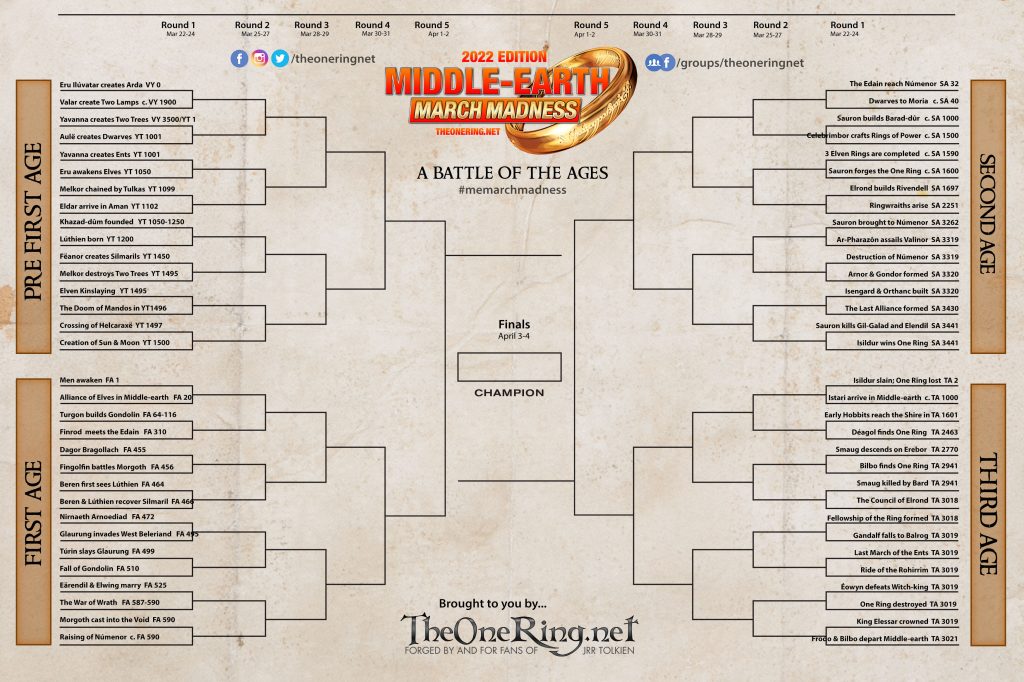
Round One is underway! This year’s Middle-earth March Madness tournament focuses not on characters, costumes, or movie moments, as with previous years. Instead, milestone events are stepping into the competitive arena: major creations, critical turning points, the founding and breaking of kingdoms, births, deaths, victories and defeats. These events appear in four competing divisions, each representing one of the epic ages that comprise the history of Arda and Middle-earth: Ages One through Three, along with the foundations – the ‘Pre-First Age’ that unfolded before the rising of the Sun and Moon.
Even casual fans are likely to be familiar with many of the landmark events of the Third Age, especially those covered by The Hobbit and The Lord of the Rings. With Amazon’s entry into the Tolkienverse, we will soon be drawn into a more extensive familiarity with Second Age affairs, like the rise and fall of Númenor and the forging of the Rings of Power. Thanks to the enduring body of work curated by Tolkien’s son, Christopher, we have a rich pool of resources covering First Age affairs, like the romance of Beren and Lúthien, the tragedies of the Children of Húrin, and the fall of the elven kingdom of Gondolin.
Now’s your chance to brush up on your History of Middle-earth, as we explore events which happened throughout the four ages leading up to the final departure of the Rings of Power. Stay tuned for posts taking a look at the events in the Pre-First, First and Second Ages; if you need reminding of the events of the Third Age, may we suggest it’s a perfect excuse to rewatch Peter Jackson’s Lord of the Rings trilogy?
For more discussion of the 64 events starting out in March Madness this year, join us TONIGHT on the TORn Tuesday live stream. And then – place your votes!
How does it work, you ask? Simple! Click on one of the orange division buttons below. Then click the ‘Vote Now’ option that appears above the divisional bracket. This year you get to vote in each divisional match-up in one convenient and visual interface. Note – you need to click each division to vote in their respective brackets. So let’s get voting!
You have until the end of the day Thursday March 24th to vote in Round One; on Friday 25th we’ll announce winners and open voting for Round Two! Let the games begin!
‘We come to it at last – the great battle of our time.’ Or – in this case – the great battle of the Ages! On Tuesday 22nd March we’ll kick off this year’s Middle-earth March Madness; and the theme is A Battle of the Ages.
Each of the four brackets this year represents an Age in Tolkien’s Middle-earth. This is the perfect opportunity to brush up on your history, as we get ready for Amazon’s Rings of Power – and the events of the Second Age – in September.
Over the coming weeks, we’ll have some posts to explore these brackets in more depth. What happened in the time of the Two Trees? Who conquered Glaurung in the First Age? And just when were those rings forged in the Second Age? Get ready to explore some History of Middle-earth together, as we vote to decide fandom’s favourite event from thousands of years.
How does it work, you ask? Simple! Staffers at TORn already voted to narrow down the many, many happenings to their top 64, and instead of seeding this year, the events appear in chronological order in each bracket. For each round, we will have a poll, where you vote for your choice in each match-up. Is Gandalf falling to the Balrog more significant than the Last March of the Ents? Are you more interested in when Beren first sees Luthien, or when they recover a Silmaril together? Which is more terrible – the destruction of the Two Trees, or the Elven Kinslaying? You decide!
Join us on Tuesday to kick off the Middle-earth March Madness tournament for 2022. 64 events will start out – but only one will be crowned Champion!
As we wait – eagerly or anxiously – for new Middle-earth content in the form of Amazon’s upcoming Rings of Power tv show, we can pass some of the time with new content direct from the Professor himself. On February 26th the Tolkien Estate relaunched their website, releasing previously unseen material from their archives.
The exciting new reveals include draft manuscripts, letters, and even audio and video clips of Tolkien and his son, Christopher. You can read more about this release here; and you can find the Tolkien Estate website here.
The Second Age of Middle-earth was filled with adventure, deception, courage, and battle. It broke the continent and the world of Arda. Find out what took place and which characters and events might feature in Amazon’s Lord of the Rings on Prime.
Project Northmoor will be hosting its first livestream/webinar on September 22nd from the Oxford Centre for Fantasy and has chosen the upcoming Amazon series as the theme. Julia Golding, founder of the centre and author, will be joined by Paula Kalamaras, a fantasy writer and editor, and Tai Truesdell, a film maker and producer. They are all huge Tolkien fans as well and know far too much than is good for them about the Second Age. They will be discussing what happens in the Second Age and what, from the perspective of creatives, might be done with series.
In the first part of this interview we met Julia Golding, founder of Project Northmoor and the Oxford Centre for Fantasy. Here we find out more about the Centre and the teachings of J.R.R. Tolkien. Don’t miss a first look at Julia’s video tour of the barrow of Wayland’s Smithy, which may have been one of the inspirations for the Barrow Downs east of the Shire in The Lord of the Rings. She also takes us to the famous White Horse Hill. (Link at end of article.)
Mithril: I recently completed the first class offered by the Oxford Centre for Fantasy. Along with truly fun and productive lectures and assignments, the course had some fantastic tutors and guest speakers, and I am now part of a community of writers inspired by Tolkien. We even have an online Inklings group the Centre created for us. Was it always your intent to grow the experience into a community? How do you see it evolving?
Julia: I wish I could claim I had a master plan, but actually it has been more an organic growing experience. Our headline thought was this project is about encouraging the next generation of fantasy creatives, using Oxford and the Inklings as examples to inspire us. The idea to create a space for a community of writers came from reading Diana Pavlac Glyer’s book on the Inklings, Bandersnatch. Diana was one of our guest speakers. Her book unpacks how the Inklings supported each other as writers, and also why it eventually folded as a group. I thought after reading this that it would be natural to see if our first students wanted to stay together to continue their journey, using the Inklings example. They clearly can’t meet every week at Magdalen in C.S. Lewis’s rooms as Tolkien and friends did, but they can meet together in their online group. Once the space was set up, I stepped back to let the students become their own thing.