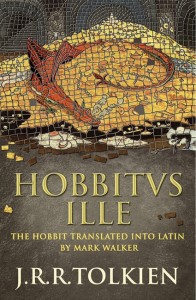
 The review copy of Hobbitus Ille by Mark Walker is a beautifully presented hardcover edition with art and interior maps in the style of early English copies and is provided by Harper Collins.
Walker has taken up a very brave challenge in providing us with the first Latin translation of Tolkien’s The Hobbit. His intent was to provide as direct a translation of Tolkien’s own words as possible and the end result is a complete and unabridged volume where even the poetry is in Latin. This direct translation is not the hallmark of the best translations, nor is it the Classical Latin of Caesar and Cicero. Continue reading “Reviewed: Hobbitus Ille”
If you have a Tolkien/Middle-earth inspired poem you’d like to share, then send it to poetry@theonering.net. One poem per person may be submitted each month. Please make sure to proofread your work before sending it in. TheOneRing.net is not responsible for poems posting with spelling or grammatical errors.
Posted in:
Share:

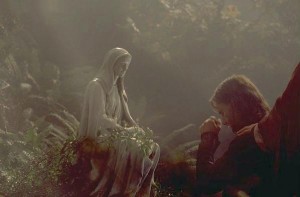 I quite enjoyed this short piece explaining the sacrifice that Gilraen, the mother of Aragorn, makes for her people. There’s also a bit of linguistic geekery for the word nerds. Enjoy. Continue reading “The tragedy of Gilraen, Aragorn’s mother”
If you have a Tolkien/Middle-earth inspired poem you’d like to share, then send it to poetry@theonering.net. One poem per person may be submitted each month. Please make sure to proofread your work before sending it in. TheOneRing.net is not responsible for poems posting with spelling or grammatical errors.
Posted in:
Share:
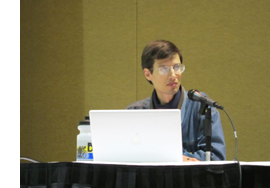 David Salo who you may know from his work as a linguist, language constructor and translator for Peter Jackson’s The Lord of the Rings and The Hobbit movies has recently started his own language blog called Midgardsmal. Salo intends to blog about his thoughts about his work on the films, as well as the new languages he created for The Hobbit. Continue reading “Linguist David Salo now blogging at Midgardsmal”
Posted in:
Share:
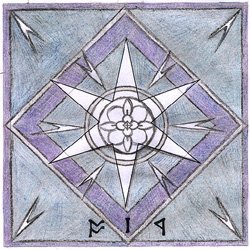 The Gwaith-i-Phethdain, or the Fellowship of the Word-smiths, is a part of the Polish website Elendilion.pl, run by our friend and Tolkien geek Richard “Galadhorn” Derdzinski. Since the early days of the internet when information was hard to come by and to share, he has led the effort in analyzing the languages in the Lord of the Rings films from 2001 through 2004, and beginning last year, he’s once again embarked on analyzing the languages in The Hobbit films.
To quote Richard:
The way to find the texts in the languages of Middle-earth was difficult. First of course was the careful and watchful hearing in the cinemas. Richard traveled far from Poland to Ireland to watch the movie 2 weeks before the Polish premiere. The first results were published thanks to the work of Miriam “Niranare” Simon of the German forum Mellyn Lammath and Cerebrum of the Hungarian website Parf-en-Ereglas. Then the international community of the Tolkien linguists with Helge K. Fauskanger (of Norse Ardalambion) and Andrew Higgins (of Elfling list) helped to find the detailed explanation of David Salo’s conlang forms.
The dialogues, together with lyrics and inscriptions, in the languages of Tolkien were created for the movies by David Salo, an American linguist. Richard’s analysis is a work in progress, continually updated based on suggestions from fans contributed via comments to his blog-style posts, and the results of his work on The Hobbit thus far can be found as follows:
The analyses of the dialogues, lyrics and inscriptions in the Lord of the Rings films can be found at Elvish.org.
Elendilion.pl is also famous for the investigation of the oldest ancestry of the Tolkien family. This family name emerges for the first time in the mediaeval sources of the German Order in Prussia, in small village in today’s Poland, Tołkiny, cf. http://www.elendilion.pl/2010/02/02/tokiny-in-warmia-a-nest-of-the-tolkien-family-ii/
Posted in:
Share:
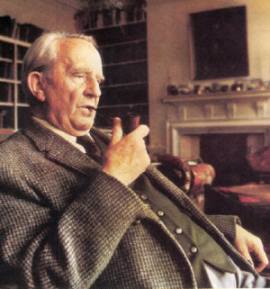 Readers who are skeptical after seeing the title of this piece have a right to be. English professors have been known to find all sorts of things in books which the authors never put there. In addition, at first glance Middle-earth seems a particularly non-religious place. We find no mention of God in The Hobbit, no prayers, Bibles, churches, priests, or ministers — none of the things typically associated with the Christian faith.
Fans also know Tolkien was a Professor of Anglo-Saxon and that his writings were influenced by the myths of Northern Europe which he and his friend, C. S. Lewis, loved to read aloud with the circle of friends that later grew into their famous writing group, the Inklings.
So how might it be claimed that The Hobbit is a Christian story? Continue reading “The Hobbit: an essentially Christian story?”
If you have a Tolkien/Middle-earth inspired poem you’d like to share, then send it to poetry@theonering.net. One poem per person may be submitted each month. Please make sure to proofread your work before sending it in. TheOneRing.net is not responsible for poems posting with spelling or grammatical errors.
Posted in:
Share:
Cardiff Metropolitan University is offering another great online course: J.R.R. Tolkien: Myth and Middle-earth in Context. Online registration is available now for the course that begins September 19 and runs for twelve weeks. The course is available to anyone who can access the internet – you don’t need to live in the U.K. However, only a limited number of students may enroll, so all enrollments will be treated on a first-come, first-served basis. While this is an accredited course at Masters level, students can take it for credit or just for pleasure. Students will have access to Cardiff Metropolitan University’s Electronic Library (which includes a wealth of e-books, databases such as JSTOR and Literature Online), as well as relevant journals such as Tolkien Studies and Mythlore in electronic format. According to our friends at Cardiff, this unique course will not be offered again for at least a year or two, so be sure to register soon!
For more information, follow these links: course description / unit-by-unit video introduction / enrollment / FAQ, or visit Cardiff’s Tolkien and Fantasy Online Courses facebook page.
Posted in:
Share:


