When exactly is Durin’s Day? For various reasons, including the non-exact correlation of the Shire Calendar and our modern Gregorian calendar, it’s quite hard to know for certain.
In this extensively researched piece, DarkJackal uses Tolkien’s notes as published in John D. Rateliff’s The History of the Hobbit to explains why there are conflicting theories… and, in a very Tolkienian fashion, no definitive or easily settled upon answer.
If you have a Tolkien/Middle-earth inspired poem you’d like to share, then send it to poetry@theonering.net. One poem per person may be submitted each month. Please make sure to proofread your work before sending it in. TheOneRing.net is not responsible for poems posting with spelling or grammatical errors.
With the human face of Beorn finally revealed (Warning: visual spoilers on that link!), I thought readers might be interested in a little bit of book character history and background.
The most common questions that people ask concern his ability to change shape. Is it magical? Is he cursed? Does he have control over it? Did Tolkien mean Beorn to be some kind of beserker?
If you have a Tolkien/Middle-earth inspired poem you’d like to share, then send it to poetry@theonering.net. One poem per person may be submitted each month. Please make sure to proofread your work before sending it in. TheOneRing.net is not responsible for poems posting with spelling or grammatical errors.
Yesterday saw not only the launch of the new The Hobbit: The Desolation of Smaug trailer, but also another exciting release for Tolkien fans – the publication of the latest edition of the book which started it all! You may remember TORn’s post about Jemima Catlin, the young illustrator behind the first new illustrated edition of The Hobbit since Alan Lee’s iconic version in 1997. (Catlin is also the featured illustrator for the 2014 Tolkien Calendar.)
This book is now available for purchase in the US! (It was released by HarperCollins in the UK in September.) It’s a beautiful edition. The hardcover, with cloth binding, is charmingly old fashioned, and the cover illustrations have gold accents, which shimmer with the promise of the magic contained within. Catlin’s images are a combination of pencil, ink and watercolour; there are many little pictures decorating the text, as well as more than ten full page, full colour pieces. The story is interpretated in lively, delightful drawings which show a new interpretation of old friends.
This is an edition to treasure, and would particularly be a wonderful introduction to The Hobbit for children. It’s a great reminder that, as spectacular as the movies are, the enchantment began in the pages of a fabulous book. If you’re thinking about holiday shopping already, add this to the list! I for one feel I can never have too many editions of The Hobbit; this beautiful new edition is certainly worth adding to your collection.
Earendil and Elwing by Jenny Dolfen. In this new TORn Library piece, Gibbelins writes about the deep, yet extraordinarily subtle faith underlying Tolkien’s legendarium, and why it works for readers of all faiths — even those who profess to no faith at all. Continue reading “Why Tolkien works for readers of all faiths”
If you have a Tolkien/Middle-earth inspired poem you’d like to share, then send it to poetry@theonering.net. One poem per person may be submitted each month. Please make sure to proofread your work before sending it in. TheOneRing.net is not responsible for poems posting with spelling or grammatical errors.
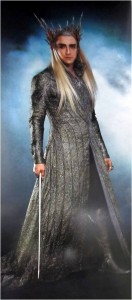
Anyone who’s read both The Silmarillion and The Hobbit will have noted the strong similarities between the Elvenking of Mirkwood and Thingol Greycloak. In this article, Tolkien scholar Michael Martinez examines whether, at the time Tolkien was writing The Hobbit, the Elvenking was intended to be Thingol himself.
John Rateliff addressed this question in The History of The Hobbit without really closing the issue, although he favors the view (based on the available evidence) that the Elvenking of The Hobbit (whom we learn is named Thranduil in The Lord of the Rings) is NOT to be equated with King Thingol in The Silmarillion. Continue reading “Was the Elvenking of The Hobbit supposed to be Thingol?”
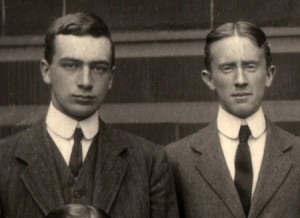
Robert Quilter Gilson (left) and Tolkien in 1910 or 1911. Photo courtesy of Julia Margretts. John Garth, writer, researcher and author of Tolkien and the Great War recently published online for the first time — with previously unseen photographs — a paper first published in Tolkien Studies 7 in 2010 (Tolkien Studies: An Annual Scholarly Review is an annual journal of scholarship on J.R.R. Tolkien and his works).
If you have a Tolkien/Middle-earth inspired poem you’d like to share, then send it to poetry@theonering.net. One poem per person may be submitted each month. Please make sure to proofread your work before sending it in. TheOneRing.net is not responsible for poems posting with spelling or grammatical errors.


 When exactly is Durin’s Day? For various reasons, including the non-exact correlation of the Shire Calendar and our modern Gregorian calendar, it’s quite hard to know for certain.
 With
With 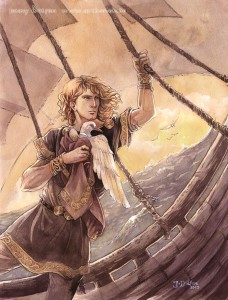
 Anyone who’s read both The Silmarillion and The Hobbit will have noted the strong similarities between the Elvenking of Mirkwood and Thingol Greycloak. In this article, Tolkien scholar Michael Martinez examines whether, at the time Tolkien was writing The Hobbit, the Elvenking was intended to be Thingol himself.