

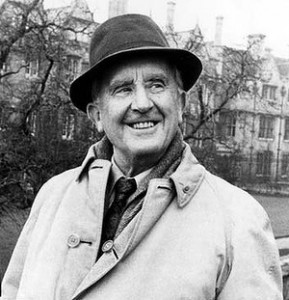
 It’s a question many of us have asked, but none of us can answer: What would J.R.R. Tolkien have thought of Peter Jackson’s version of The Lord of the Rings?
Because I’ve read a lot and thought a lot about Tolkien and his invented world, and I’ve engaged in a lot of debates about the quality and accuracy of the movies, I feel entitled to say things like, “Well, there are parts he would have loved and parts he would have hated.” But that’s not Tolkien talking. That’s me. The author died long before The Fellowship of the Ring was released in 2001, so I’ll never know how he might have reacted to the Jackson films, and neither will anyone else.
The nearest we can come to Tolkien’s assessment might be that of his son, Christopher Tolkien, who did not give the Jackson movies a positive review. “They eviscerated the book by making it an action movie for young people aged 15 to 25,” Christopher told the French newspaper Le Monde in July 2012.
There’s a good chance Christopher’s father would have agreed with his son’s (rather unfair, in my opinion) assessment. It’s well known that, of Tolkien’s four children, Christopher was the one most drawn to his father’s creation. “As strange as it may seem, I grew up in the world he created,” Christopher (who is 88) told Le Monde. “For me, the cities of The Silmarillion are more real than Babylon.”
As a boy, Christopher, “huddled for warmth by the study stove, would listen motionless while his father told him” tales from his imaginary world, Humphrey Carpenter wrote in his biography of Tolkien. In his teens and twenties, Christopher was “deeply involved with the writing of ‘The Lord of the Rings’. He had read the first chapters in manuscript, and had drawn maps and made fair copies of the text for his father,” Carpenter wrote in The Inklings. When Christopher eventually joined the Inklings (the informal literary group that included Tolkien and C.S. Lewis), “it grew to be the custom that he, rather than his father, should read aloud any new chapters of The Lord of the Rings to the company, for it was generally agreed that he made a better job of it than did Tolkien himself,” Carpenter wrote.

So Christopher, clearly, knows The Lord of the Rings and his father’s thoughts about it more intimately than anyone else alive. With that in mind, it may be safe to assume Tolkien’s view would have aligned with Christopher’s, and he would therefore have hated the Jackson movies.
Then again, father and son don’t seem to have shared the same opinion about whether or not the book should be turned into a movie – any movie – at all. Christopher seems to think that The Lord of the Rings is so layered and complex that no film version could do it justice. “My own position is that The Lord Of The Rings is peculiarly unsuitable to transformation into visual dramatic form,” Christopher stated in December 2001, just before the first Jackson movie hit theaters.
Tolkien himself, however, was quite willing to see his book turned into film – under the right circumstances. In fact, he sold the movie rights for The Lord of the Rings (along with The Hobbit) to United Artists in 1969, according to Le Monde.
Tolkien was first approached about a Lord of the Rings movie in 1957, when three American businessmen proposed an animated version, according to Carpenter’s biography. “I should welcome the idea of an animated motion picture, with all the risk of vulgarization; and that quite apart from the glint of money, though on the brink of retirement that is not an unpleasant possibility,” Tolkien wrote one of his publishers that year. (The Letters of J.R.R. Tolkien, Letter No. 198)
In regards to selling the film rights, Tolkien and his publishers came up with a “cash or kudos” policy, according to Carpenter. Tolkien put it this way: “Either very profitable terms indeed; or absolute author’s veto on objectionable features or alterations.” (Letter No. 202)
 The 1957 proposal included some “really astonishingly good pictures (Rackham rather than Disney) and some remarkable colour photographs. They have apparently toured America shooting mountain and desert scenes that seem to fit the story,” Tolkien wrote (202). But the synopsis of the proposed film they gave him was “on a lower level. In fact bad,” Tolkien wrote (202). Carpenter summarized the problems: “A number of names were consistently mis-spelt (Boromir was rendered ‘Borimor’), virtually all walking was dispensed with in the story and the Company of the Ring were transported everywhere on the backs of eagles, and the elvish waybread lembas was described as a ‘food concentrate’.”
Tolkien’s overall problem with the script was that it was “a compression with resultant over-crowding and confusion, blurring of climaxes, and general degradation: a pull-back towards more conventional ‘fairy-stories’. People gallop about on Eagles at the least provocation; Lorien becomes a fairy-castle with ‘delicate minarets’, and all that sort of thing.” (Letter No. 201) But as bad as it was, he was still willing to “play ball, if they are open to advice.” (201)
In these letters, published in The Letters of J.R.R. Tolkien, we get a rare glimpse of Tolkien the (surprisingly shrewd) businessman. The book also gives extracts from Tolkien’s comments on the 1957 film synopsis (Letter No. 210). The synopsis itself isn’t included, but Tolkien’s “review” sheds some light on its contents – and is probably the closest we’ll come to his vision of how The Lord of the Rings should be filmed.
The author’s comments also give an indirect glimpse of what he might have thought of Peter Jackson’s films. Tolkien’s “review” of the 1957 synopsis dwelled on one scene, from The Fellowship of the Ring, in particular: the Weathertop confrontation of Aragorn and the four hobbits with the Black Riders. “I have spent some time on this passage,” he wrote, “as an example of what I find too frequent to give me ‘pleasure or satisfaction’: deliberate alteration of the story, in fact and significance, without any practical or artistic object.”
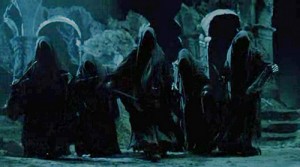 He gave examples of what displeased him:
“Strider does not ‘Whip out a sword’ in the book. Naturally not: his sword was broken … Why then make him do so here, in a contest that was explicitly not fought with weapons?”
“The Black Riders do not scream, but keep a more terrifying silence. Aragorn does not blanch. The riders draw slowly in on foot in darkness, and do not ‘spur’. There is no fight. Sam does not ‘sink his blade into the Ringwraith’s thigh’, nor does his thrust save Frodo’s life.”
“A scene of gloom lit by a small red fire, with the Wraiths slowly approaching as darker shadows – until the moment when Frodo puts on the Ring, and the King steps forward revealed – would seem to me far more impressive than yet one more scene of screams and rather meaningless slashings …”
I could spend a lot of time laying out the similarities and differences of the 1957 and 2001 versions of the Weathertop scene, but you’re probably replaying the Jackson version in your head right now, and you don’t need my help. I will say this: Aragorn is too much the beefcake in Jackson’s version of this scene, swinging his big sword and throwing his flaming torches at the Black Riders, who run away like screaming babies. But I’ll side with Jackson on one point: It was kind of strange for Aragorn to be carrying a broken sword, which he did at that point in the book. Besides being a priceless heirloom, the Sword that was Broken was rather useless in a fight (which Aragorn acknowledged). Why not leave it in Rivendell until it’s ready to be re-forged, and carry a workable sword in the meantime?
Tolkien also addressed the overuse of the Eagles in the 1957 version: “I feel this to be a wholly unacceptable tampering with the tale,” he wrote. “‘Nine Walkers’ and they immediately go up in the air! The intrusion achieves nothing but incredibility, and the staling of the device of the Eagles when at last they are really needed.” At least Jackson didn’t commit that unpardonable sin.
The 1957 synopsis leaves out a scene that Tolkien considered extremely important, a scene that Jackson left in: “The disappearance of the temptation of Galadriel is significant. Practically everything having moral import has vanished from the synopsis.”
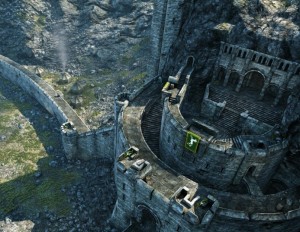 Tolkien was, however, OK with cutting out some parts of the book, if necessary. He even suggested cutting out the battle of the Hornburg (Helm’s Deep), “which is incidental to the main story; and there would be this additional gain that we are going to have a big battle (of which as much should be made as possible), but battles tend to be too similar; the big one would gain by having no competitor.” (By the “big one”, the author must have been referring to the Battle of the Pelennor Fields in The Return of the King.)
Jackson didn’t cut the battle of Helm’s Deep. Oh no. It’s the big set piece of his second movie. Whether or not that diminished the big battle in his third movie is debatable.
Then there’s the handling of Saruman’s end. The 1957 synopsis cut out the “end of the book, including Saruman’s proper death. In that case I can see no good reason for making him die,” Tolkien wrote. “Saruman would never have committed suicide: to cling to life to its basest dregs is the way of the sort of person he had become.” If Saruman needed to be tidied up, Tolkien wrote, “Gandalf should say something to this effect: as Saruman collapses under the excommunication: ‘Since you will not come out and aid us, here in Orthanc you shall stay till you rot, Saruman. Let the Ents look to it!’”
Seems like Jackson’s shorter version of “The Return of the King”, the version that ran in theaters (as opposed to the extended edition), handled “Sharkey’s End” in a manner Tolkien would have preferred.
Despite his distaste for the 1957 synopsis, Tolkien was still willing to “play ball”, as he wrote. So why was that version never made into a movie?
In his biography, Carpenter gave an explanation: “There did not seem to be much prospect of kudos in this, and as there was not much cash either, negotiations were not continued.”
Like I said at the beginning, we’ll never know what Tolkien would have thought of the Jackson movies; but based on what we’ve just read, it’s safe to say he would have preferred them over the 1957 proposal. And not to sound too vulgar, but there probably would have been more cash involved as well…
===================
Maedhros is a guest writer and his views do not necessarily reflect those of TheOneRing.net. Maedhros lives in Grand Rapids, MI. He’s been hooked on Tolkien since he was 11, when he opened the first page of “The Two Towers” and read about Aragorn tracking a hobbit; and Boromir’s death scene, of course.

 Welcome to our collection of TORn’s hottest topics for the past week. If you’ve fallen behind on what’s happening on the Message Boards, here’s a great way to catch the highlights. Or if you’re new to TORn and want to enjoy some great conversations, just follow the links to some of our most popular discussions. Watch this space as every weekend we will spotlight the most popular buzz on TORn’s Message Boards. Everyone is welcome, so come on in and join in the fun!
 Last weekend, the Hall of Fire crew discussed the story of Earendil and Elwing, and their momentous voyage that obtained the help of the Valar against Morgoth. Belatedly, for those who couldn’t attend, here’s a log.