What was the real reason that Galadriel and Celeborn wanted no visitors in Lothlorien?


What was the real reason that Galadriel and Celeborn wanted no visitors in Lothlorien? [Join the Discussion!]
Continue Reading
What was the real reason that Galadriel and Celeborn wanted no visitors in Lothlorien?
 As the ‘Black Friday’ weekend continues, ending with ‘Cyber Monday’ tomorrow, there are deals to be had all over the web. We thought we would highlight one that caught our eye from regular site supporter Sideshow Collectibles. They are offering the Galadriel Premium Format Figure for 30% OFF Sunday Only with coupon code BWSN3010. If you are not familiar with the Premium Format line, these items are mixed media statues that stand approximately 20″ tall and are well known for their intricately detailed representations of the characters. According to their website only 10 pieces of Galadriel remain! You can also save 10% on the ‘Clash of Kings‘ Diorama, featuring Aragorn vs. The King of the Dead. [Galadriel] [Clash of Kings Diorama] [Sideshow’s Black Friday Deals] [Instock LOTR Items]
 Many of us Ringers know the comparisons of The Lord of the Rings to Harry Potter are many. Well, Film.com has compiled a few for your reading pleasure. Enjoy!
Fantasy stories generally lift from the same mythological source bank. Actually, if you want to get super scholarly and esoteric about it, every story (especially the more sword-and-sorcery themed variety) is the same basic “hero’s journey” archetype detailed by Joseph Campbell. But fantasy stories — King Arthur, Lord of the Rings, The Chronicles of Narnia, Willow, Peter Pan, Conan the Barbarian — build their world out of the same objects. You have magicians, dragons, unicorns, gnomes, and elves popping up to do battle, and they’ve made their way from medieval tapestries and texts to our modern movie screens.
[Read on]
In celebration of the Two Towers concert at Radio City Music Hall next month, I will be tweeting the entire text of ‘The Two Towers’ on the official Twitter page. Join in on the fun and see if I can make it in 3 weeks time!
Visit the Radio City Music Hall page for updates, pictures and more!
The following is a short essay from Ringer Squire. Do you agree? Disagree? Share your responses with our discuss or comment areas.
Headlined here yesterday, and discussed on the Main board just now is a link to an entertaining new interactive map of Middle-earth. It’s modeled on Google Earth, in that one can zoom out and see the whole subcontinent, or zoom in and see individual towns and towers close up. Of course it follows Tolkien’s own map, more or less exactly, but it has in fact been redrawn via computer by a new artist, Mr. Kris Kowal. And when you zoom in you see little bits that Tolkien could not or would not include in his original map, like icons representing the Argonath, the road to Isengard (see illustration below), and the ruined tower on Weathertop. Several place names have been added based on texts in Unfinished Tales, like the “Undeeps” of the middle Anduin, so the creators are clearly knowledgeable about their Tolkien geography.
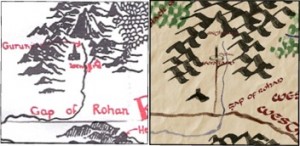
I understand that it is a work in progress, so perhaps we may expect to see more of the details of the Shire in the future, based on the separate map that appears in Fellowship. But really, the power of zooming in, which is so much fun in Google Earth, is disappointing in this “Google Middle-earth”. There’s nothing to zoom in to for 99% of the world—and there never will be. Tolkien only drew on his map the specific places that were mentioned in his story; and for anyone to add anything else is, of course, just another form of fan-fiction.
This new map thus surprisingly reminds us just how poorly Tolkien detailed his physical world. The map, and several recent discussions we have had in the Reading Room about the distribution of hobbit-folk and the political organization of the Rangers, bring me back to an old question. Tolkien expressed his belief that one of the aesthetic virtues of The Lord of the Rings is that it contained hints of the earlier history of the world, but only hints. Continue reading “Why are there no ‘towers of a distant city’ on the map of Middle-earth?”
 If you happened to be trolling around Flickr recently, you may have run across this image of a ship named ‘Loth Lorien’ from photographer Henry Oude Egberink. According to to the description:
With 42 m length LOTH LORIEN belongs more to the smaller ships. As J.R. TOLKIEN she was restored by Jaap van der Rest; the ship now can take up to 34 trainees. LOTH LORIEN is sailing usually in the North and Baltic Sea. She offers trips for single bookers and is available for complete charter and events.
Check out the full image in Henry’s Flickr Gallery. [Click here]
