

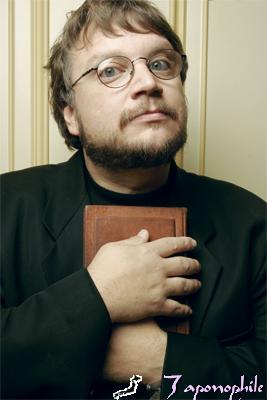
 Our friends at Popcorn Taxi have come through with the audio of their August 18 Q&A with Guillermo del Toro regarding Hellboy II to transcribe. The biggest bombshell of the night came near the end of the 42 minute session: The first official news that the scripting team of Peter Jackson, Fran Walsh, Philippa Boyens and Guillermo del Toro had begun writing The Hobbit. Here’s how Guillermo described the breaking news:
Guillermo:
“Well the only thing I can say is that we are now finally and officially and merrily in progression on the scripting process. We are all actively working on it and having a grand time at it. It keeps transforming and changing and it is ‘the most beautiful’ writing experience of my life, I’m enjoying it tremendously – and there’s bound to be news soon enough.”
Without further adieu, here is the transcript in full of the Q&A session. The Hobbit news can be found at (41:21) on the last page. I would encourage everyone to read the full transcript as Guillermo talks in depth about his early interests in automatons and clocks, his characters, cast, monsters fairies and vampires, children’s books, CGI and effects, his childhood, The Golden Compass, spirituality, his inspirations and his perspective of the world he perceives.
Hellboy II & Guillermo del Toro Q&A Live from Berlin – Transcript
Hosted by: Popcorn Taxi (Sydney Australia)
Popcorn Taxi: http://www.popcorntaxi.com.au/about.php
Host: Oscar Hillerstrom (sci-fi channel)
Date: 18th August 2008 @ 11:00pm (AEST)
Theatre Event Location: Greater Union Cinema, Bondi Junction, Sydney, Australia.
Associated Theatre event: Cinema Nova, Melbourne Australia.
Transcription by: Deleece Cook
Introduction by Host, Oscar Hillerstrom:
… now if you’re wondering where all this comes from, some of you may know that he had a Grandmother who brought him up (you know) in a very strict Catholic background. She tried to exorcise him twice because he kept on coming up with these strange drawings of demons and monsters till, I guess at one point she decided that he needed to atone for his sins. So he had to walk to school with bottle caps in his shoes the wrong way up, so that he would bleed for his sins.
So she was a pretty special character, and I think you can often see in his films the kind of rebellion that that kind of punishment breeds. Obviously the film here (referring to the Hellboy II The Golden Army) was all about whether you take disobedience on a personal level, or many different levels, and also that beautiful clash between what we know about the natural world and what we’ve decided to construct in our own world. And I think perhaps now when he has started with Pan’s Labyrinth and also hopefully will take us when he gets to the Hobbit, is this wonderful idea that good and the bad, being not only two sides of the same coin, but merely the same thing looked at in a different way. And I think perhaps not only just as film-goers but also as people we can take of those things …
(00:)
Guillermo del Toro:
Hello?
Oscar:
… a little bit more …
Ah! Here he is. Hello! Guillermo!
Guillermo:
Hey!
Oscar:
Hello Guillermo, this is Oscar in Sydney and in Melbourne.
Guillermo:
Perfect!
Oscar:
Thank-you very much for a great film!
[The audience generously applauses]
Guillermo:
Ah, Thank-you, thank-you. I just landed in Berlin [laughs], so I maybe a little jetlagged for your questions but [laughs] great! Happy to be there.
Oscar:
Well it’s fantastic to have you coming at us through the ceiling.
[the interview is conducted by satellite phone – Guillermo’s voice fills the cinema]
Guillermo: (laughing)
I do that only at dinner.
Oscar: [Laughing]
Well I think the first … I’m going to ask you some questions and then we’re going to have some questions from Sydney and some questions from Melbourne.
Obviously, you’re travelling the world telling the people about this film, [Guillermo answers: ‘yes’.] and I think the first question we have for you is: Why? Why do you feel the need to tell these stories? You tell them in such a specific way and they are an explosion of your mind, why do you have to share your mind with the world?
(02:20)
Guillermo:
Well, you know, I think that the images and the characters, and ultimately the stories seem to be something that I love to share. And the creation of those things is so elaborate, is so difficult, and ultimately rewarding when they come out the way you want them to – ah, you know – I know for example in Hellboy II there is the scene with the Troll Market, which of the beginning, I threw out, I found a lot of opposition, a lot of people didn’t see it the way I saw it in my mind, and when I finally was able to realize the world and the creatures that populate the Troll Market, (ah, you know) there is a great satisfaction – it’s almost like – I wouldn’t say it’s as important but it’s almost like discovering – not so much as a new continent, because it’s not that important (laughs), but it’s almost like showing people a little street of a very strange village that you knew existed and that is not in any map. So you are a very tiny discoverer of Orel (?)
(03:37)
Oscar:
Now film making isn’t just a personal journey, although obviously you have a very specific stamp on your films – you share the load with many different people. Obviously your stars – in this case Ron Perlman, who’s worked with you quite a bit. And of course also Luke Goss, who as Prince Nuada has shown people that he really has taken his first introduction into the big leads that you gave him in Blade II – They’ve really made their roles their own, but they’ve given these roles a life of their own. But there’s one other person that I think nobody notices – but he’s been with you for a while as well – and that’s Brian Steele – who’s the man inside Wink, and whose also the Scottish Fragglewump [Guillermo answers: ‘Yes’.] … Can you tell us a little bit about how do you create a character with a man in a monster suit like that?
(04:31)
Guillermo:
Well there’s very few performers that can actually become actors and you can colour the monster suit world, and certainly under make-up. You know some of the great actors – you put prosthetic make-up on them and they kind of freeze (or) but some of the great one’s can also enjoy it.
Case in point historically, Laurence Olivier or Peter Sellers were people that thrived on their make-up. Ron Perlman is one of them certainly, and a dear friend of mine. But, Doug Jones and Brian Steele both – they are immaculate making suits and prosthetic effects and so forth come to life like nobody else I know frankly, so in that sense they are kind of (a) ruined with me because I obligate them to perform two or three sometimes four parts in the same movie because I am spoilt. They are too good and I won’t settle for a performer that is less than that.
In this movie I was happy to also work with one of the greatest performers, that is one of the three performers that gives the light to Johann, and that is John Alexander who has been in many mythical creations including Men In Black, and Greystoke, and most of the famous Gorilla suits done by Rick Baker have been worn by John Alexander.
It’s a particular art, and Brian Steele is a guy that is really great at portraying of physical brute force, but also is capable of a lot of nuance, he plays Cathedral Head, he plays Fragglewump, he plays Wink, he appears as Himself at one point. He’s the guy that yells at Hellboy “Hey, your Hellboy!” – You know – and Hellboy says “Yeah, I’m ugly” – you know. So Brian is also a very loyal guy and one of the few guys that can put on a suit as brutal and as massive as Wink – which is one of the best but also most difficult creature suits I’ve ever seen. He was losing I think – I may be exaggerating – but I believe he was losing ten, fifteen pounds of sweat every day in that suit. To the point where I think my wife suggested very strongly, I get one. [Oscar laughs heartily]
… or made.
(07:04)
Oscar: (laughs)
Um, now these films are, they’re wonderful fun, and there’s a lot of comedy, and I think particularly tonight’s performances that we saw with the interaction with for example between Johann and… Hellboy, [Guillermo answers: ‘Hellboy, yes.’] Was that something that you’ve been wanting to do for a while – and ‘Cutting Loose’, or has this been something that people have said “Hey, we’re got to have a bit more comedy, a bit more of this, a bit more of ..”
(07:29)
Guillermo:
No, No. I’ve been wanting to do it. I think that you can see a little bit of comedy for example even as early as Cronos. If you watch Cronos again and you re-watch it, there is a Morgue Attendant that is purely a comedic beat. And here and there on Mimic, I was able to do it a little bit with Charles Dalton and with the kids, but you know, only until I did the first Hellboy was I able to bring a little bit of that comedic touch.
On the first Hellboy much less than this one – much, much less. But I always love the Ron Perlman’s sense of comedy, his sense of timing for comedy. And I always write – the roles I write for him – or for Luke Goss, or for Doug Jones or Selma Blair, I write them with their particular rhythms and particular delivery in mind. And I thought it would be a great interaction to contrast Hellboy and Yohan, and in other ways contrast even Hellboy more than in the first – I very much wanted to have more character oriented moment.
(8:43)
Oscar:
Is there, now that your films are in a sense becoming a brogue map, there’s almost a pathway where you seem to be taking the elements of things in jars, mechanical objects and of course the other – all the monsters or nature. Is there somewhere where you’re taking us?
(09:04)
Guillermo:
Well, you know, I think that (um) in a strange way I don’t have a (I don’ have) a goal in mind. It’s more like a wandering spirit that I really transverse those roads – you know, if I did my career the way I wanted it to happen, there wouldn’t be four years, a four year gap between Cronos and Mimic, and another four years gap between Mimic and Devil’s Backbone. And they wouldn’t have happened in that order necessarily.
And you know, some of the best movies I’ve written I’ve never shot. You know, they remain unproduced. So you know, I do know that there is an almost unlimited amount of stories and creatures and places that I would love to continue to create. And I know now that I’m 43, I have a certain sense of (a) realization that I will never be able to do them all. You know I don’t have this optimism of youth that time will be unlimited and I will be able to make all the movie and create all the creatures. So you know, just (err) expect more weirdness if you want to share it.
(10:32)
Oscar: [laughs]
Well (um) As a student and an author of Alfred Hitchcock I believe you’ve written a book about Hitchcock. [Guillermo answers “yes”] I’m just wondering that (?) he went on making quite a few films as he went on it life and also produced a very singular flavour which people again and again returned to. Do you think you’re movies, that you haven’t made, say for example’ The Left Hand of Darkness’ which is the western based on the Count of Monte Cristo, or of course ‘At The Mountains of Madness’ which is based on H. P. Lovecraft – Do you think these films will give you that outlet that you so desire?
(11:07)
Guillermo:
I do. I do. And even if I get to do all those and I continue, if you look at the career of Hitchcock is model-ic. In around 50 years he did over 50 – over 50 films. He generated a very successful TV series of which he directed and quite a (bit) number of episodes – and essentially, that is an ideal career.
It’s a career which is part of an industry. And I really don’t feel completely at home quite anywhere. I am ill-fit somewhat in the European or Independent Film scene, you know, I don’t quite fit the model of the Art House Movie completely, except now and then, and I don’t feel completely at home in the Hollywood system either. So it is hard for me to promise myself continuity of that sort.
I cannot promise myself to become Woody Allen and have a steady flow of one movie per year. Also because the Universes I create normally take at the very least eight months, nine months just of designing and conceptual pre-production. I cannot be that fast. But I would love to. I would love to if I could have had chosen a model – both – the two film makers I admire the most were very prolific film makers – both Louis Verneuil and Alfred Hitchcock were very prolific.
(12:50)
Oscar:
Well, I think we’re going to open up the floor now Guillermo. We’re going to send our microphones around to our friends here in Sydney. And we’ve also had some questions already asked down in Melbourne. So I’m going to try with some audience questions, and [laughs] we’ve got some interesting ones. Umm, OK, we’ll start off with this one – some we may know, but some we may not.
What children’s books or novels have inspired you?
(13:26)
Guillermo:
Well there’s many. And there is a very important seminal period in any guy’s life, in any person’s life where you read those magical books. I always say there’s a moment where you discover Tom Sawyer, or you discovered Treasure Island, or you discover – and in my case – strangely enough, I read all that, but the really important discoveries were all fantastic works. Mostly in the category of horror, I discovered H. P. Lovecraft at a very young age. So I know it doesn’t qualify as a normal children’s book [laughs] those were very youthful reads – Mark Twain, most of Mark Twain, Lovecraft – um, Oscar Wilde, certainly all the Faery books, all the children’s Faery Books I have at home available, I read them all. And I continue to collect Faery Tales and Folklore and Myths from around the world.
I have a good hefty library of these themes. And (you know) one of them is coincidentally is The Hobbit, which is the project coming up of two movies. I’ll be very close to Australia; I’ll be closer than now [laughs –as he is currently in Berlin] shooting those movies. I hope to drop by and visit you.
(15:00)
Oscar:
Well we’re all looking forward to that!
Now we’re going to have your first ever question form a Sydney audience live – and they are ready, now.
(15:08)
Audience Member:
Hello Guillermo.
(15:12)
Guillermo:
Hey!
(15:14)
Audience Member:
I saw in the Credits you turned up as ‘Creature Vocals’. What does that mean. Is that miscellaneous grunts in the Troll Market?
(15:19)
Guillermo:
Yeah, well, it actually – I have done the voice s of most of the monsters in most of my movies. I was the insect in Cronos, I was in Devil’s Backbone I was the wheezing breathing of the ghost, in Mimic I was a lot of the creature sounds of the insects – the reaper – (?) two, sometimes a fourth. I take the credits sometimes I don’t.
But in Hellboy II we made it a point to do it because I am the voice of over 90% of the creatures that appear in the movie. I am the voice of Mr Wink, I am the voice of the Tooth Faery, I am the voice of every miscellaneous creature in the Troll Market grunting, growling. So I have a lot of fun. It’s easier for me to do it than to explain to another performer how to do it. And I’m pretty good at lip-synch. [Audience member laughs] So you know, when I do that I feel that the creatures become, when I conceive them, when I design them with the team of designers, I already know how they’re going to sound. So it’s very easy for me to do it really quick – it’s a very economical way also, because we do it in my lunch breaks – in post production, I go and do creature sounds for an hour or two.
(16:50)
Oscar:
Now, I guess the climax with Hellboy II was almost the climax of your love of clockwork, and we have a question from Melbourne, which is: Could you please elaborate on your fascination with watches and clockwork?
(17:03)
Guillermo:
Well first of all I’m fascinated about by them as a fetish, as an object. I just love the absolute beauty of a handmade mechanism. I don’t like gadgets as much as I like clockwork mechanisms. This all stems from the fact that when I was a kid my parents had a library that I read, and in the library there was a book that had one little chapter about automatons.
And I really loved the classic automaton makers like Jacquet Droz, Jacques de Vaucanson, they created automatons for the Courts of Europe, and reading about them, reading about for example, they created a duck that was able to swim and quack and eat and then eventually poop – you know it was just beautiful. And there is a fantastic legend in a later book I found (I don’t know) about automatons, a fantastic legend that actually Vaucanson was assigned by the court, by the Imperial Court, he was assigned to create a perfect mechanical model of the human body. And (for all) by all accounts he succeeded – up to a point except with the soft parts of the body, and that was the end of his experiment. The bureaucracy put an end to his experiment because they would not finance his trip to the Southern Islands to fabricate the parts from latex.
So I was fascinated by this, by these accounts, and by many other accounts I read. I started collecting watches as a kid – not an expensive collection, by any means, but I love what is called ‘skeleton’ watches – the watches where you can see all the workings. And I disassembled a few watches in my life.
Now, aside from that, aside from the fetish-istic point of view, I love the symbolic power of these images and others I go back to. I love the idea that the Universe, in my mind, the Universe is a very complex, very eccentric in the most strict physical sense of the word. And eccentric mechanical devise that keeps changing and evolving almost like a mechanical nanotechnology. I love that as a model of the universe, I love Clockwork. And I just think that in the story it became impertinent, not only for the fight to turn the gears, which has this sense of destiny and progression and inexcerability (?) but what I love is the idea that The Golden Army, it’s a purely mechanical thing that doesn’t care which side wins – one way or another. They will serve who ever wears the crown. And I also found it fascinating to create this reassembling, reconstructing nanotechnology made out of gears. So you know, I don’t try to put it when it’s not pertinent. There are no gear mechanisms I believe in Mimic or – no, I’m lying (chuckles) I think there’s one or two – but I bring it in whenever I can, but I don’t try to force it into the story.
(20:36)
Oscar:
Thank-you.
Now we have another question from Sydney …
Guillermo:
Hey!
Oscar:
… Up here (microphone is being given to audience member)
(20:41)
Audience Member:
Hello Guillermo – George here. Oscar was telling us before that your Grandmother tried to exorcise you twice – obviously it didn’t work judging from what we saw on screen, and we’re thankful for that!
I’m just wondering a couple of things – Ah, firstly Alfred Hitchcock obviously appeared in all his films and now we know that you appear in an audio form, which is also nice to know too – but I was wondering about the metaphorical implications of the movie – umm – cause we know there’s deep layers in your films – you come from Mexico, which in a way is almost like the subjecated elf world, troll world, just below America (you know in some ways) You also come from a Catholic background I imagine where you also have a strong sense of the mystical and the metaphorical – the bread and the blood and the wine all represent things (Guillermo: ‘a-hah’) and part of the body.
So I’m just wondering, are those conscious influences you think in your movies? The political and the religious, or are they kind of more subconscious percolating up and you’re only aware of it afterwards or when somebody points it out to you?
(21:42)
Guillermo:
I think it’s a little bit of both. I mean, no matter what – there is two schools of painting that I admire that are – that go about using symbols in very different ways. One is the art school of the surrealists – which go at creating symbols just by juxtaposition but it’s completely visceral – it’s not systematic and it doesn’t have a particular value. You know the idea of surrealism is the act of juxtaposing images and things – is completely an act of creation.
There’s another school of painting that I also adore which is the symbolists. Which, calibrate their use of symbols very, very, very carefully. And they do it in almost a renaissance or medieval way, where things represent thematic, spiritual or even some cases, social commentary. You know, you can find the Flemish, Dutch, Belgian – many, many, many schools of painters that reflect these tendency. And in my case I think its a little bit of both. You can – I try to systematize the colours and the shapes and the textures and the movies and certainly the images to symbolize something particular. I will elaborate in the case of Hellboy – what it is I think. But at the end of the day, it’s also a visceral creation and there is third fourth or no meaning. Eventually when you play it for an audience, they can signify something for me, and when they play for an audience, (they) (I) it either becomes just a popcorn movie, which I’m perfectly happy with, or they become something else and they point it out to me.
But I do try to at least come in with them forming a little system or a sub about certain something’s, and the case of Hellboy II for example we were talking about the Golden Army (you know) and I tried to create things where form and function, or form and theme content are one.
The Golden Army looks like a clockwork because they are essentially living slightly humanized living weapons. You know, they have to have the heftiness, the weight, the appearance of a mechanical tank – because that’s what they are – they are sentient, semi sentient tanks. They lack one key thing, which is will. And Will and Choice are things that I recur doing. I think that choice is what makes us human. Choices that make us become something more than just another mammal species on the plant.
You know, – I am a very lapsed Catholic, I lapsed perhaps earlier than when my Grandmother exorcised me (chuckles). She did try to exorcise me twice – she was a very peculiar woman, but I loved her deeply. But I’m completely lapsed – never to learn the mythology – the cosmology of Catholic dogma, and Catholic mythology – and the pandeum (sp?) weighs very heavily on me.
In Hellboy II, I think that beyond Mexico , what I tried to say is that we’ve come to a point in our culture which it makes me disparaged because we’ve come to a point as a world, as a planet, where we can’t apparently not agree on anything which is not truth in one whole historic or another. One needs to destroy another one in order to assert its self socially. And you can go to war over oil and you can still pretend that it’s a Holy War, or a war of principles.
And I wanted very much to show a culture, and entire culture and an entire way of life being destroyed and to have a super hero movie where it actually would make people realize that the only character in the movie with any immoral ideas, right or wrong, I’m not sanctioning it, but the only character that thinks that beyond himself is the bad guy quote/unquote in the movie.
The only guy that enunciates total principles and concerns in the movie is the Prince – is Prince Nuada. Hellboy is thinking about himself when he outs himself and he’s thinking about himself only mostly throughout the movie – and so does Liz, and Abe Sapien, who very humanly gave up the world – these are very fallible heroes. And I think that the beauty of it is; for a character as much as adorable knuckle-head as Hellboy is, for him to have a moment of (in his scale) of ‘to be or not to be’ would be elemental – ‘should I shoot it, or should I not?’ Where normally all you get in a summer movie is bad guys straightly drawn and not with much moral ambiguity, and good guys with not much moral ambiguity, I think the theme is Hellboy II is very simple. It’s extremely simple because I do think and I do hope the moral trajectory is not – at least that was my hope.
I’m very happy that other movies have this moral ambiguity – (umm) certainly Dark Knight has a moral ambiguity – umm you know, I’m not saying that everybody has to stand politically where I stand, but at least I want to do, I wanted to do Hellboy II and question the infallibility of heroes – you know.
(27:53)
Oscar:
… Thank-you very much Guillermo.
It seems strange that with your political ideas and your religious ideas and your love of clockwork, that you haven’t taken the Golden Compass franchise and run with it.
I’m wondering in this world of studios which are a bit afraid of the world outside, and the Bible Belt and the things like that – Where there any changes – this is from Barbara in Melbourne – she’s asking ‘What studio changes were made to Hellboy II if any?
(28:27)
Guillermo:
You know, about the Golden Compass, they were some of my favourite books – the Philip Pullman books, and I did at some point (err) I was approached and I read one of the early drafts and there were already changes in at work in that draft that I didn’t feel comfortable with because the essence of the book is to be very confrontational – you know, and I do think that fairytales need to be confrontational. They don’t need to lie.
You know there are two types of fairytale. Essentially one is the one that conforms with the system – and that’s the fairytale which essentially where kids are taught to behave well. And then there is another fabulous form of fairytale where kids are taught to behave not necessarily bad, but certainly think for themselves – and that’s the fairytale I much favour.
And Golden Compass was a very intriguing spiritual book – no so much so in the screenplay I read, and you know in Hellboy II, I must admit that thematically and artistically other than budgetary concerns, I was very much left alone.
There was no meddling, there was at some point questions about a line or two and I fought for them – but it was never a proteic battle. At one point somebody said they felt the audience would react aversely to a line like “I’m not a baby, I’ a tumour”. But I very much love that line so I (you know) fought for little things like that.
But it was never an epic battle of morality. These things are an advantage, because one of the great lessons of Alfred Hitchcock – Alfred Hitchcock kept saying that he was essentially an anarchic film maker because he kept creating what he called Bomb Bombs poisoned with cyanide – he said if it looks like an amusing movie, if it looks like a commercial movie, if it looks like a popular piece of entertainment, but you put these seedlings of contrary ideology in it, then you are essentially poisoning more people than if you give them medicine straight. This was one of the great edicts that Hitchcock gave, and I very much think that the studios were, the studio was very happy with Hellboy, ‘cause we delivered a lot of value for the budget we were given, and they were very happy with the spectacular nature of the action and the sets and so forth, and there was not much pause about whatever heathen content I’m pretending it has. I mean, this is more my own agenda, it was never made too public.
(31:50)
Oscar:
Now, we also have more questions from our Sydney audience who are chomping at the bit – and we have someone up there – there we are …
Audience member:
Hi there.
Guillermo:
Hi!
(32:01)
Audience Member:
As a 3D student, I’m just wondering what you’re feeling on using animatronics compared to 3D or CGI?
(32:13)
Guillermo:
I think that it’s very easy to fall either way on an argument like this, and it would be very false to fall either way. I can say the following: I think that 3D, CGI can be a very lazy tool for very lazy directors. It’s something that can be easily be abused by film makers that just don’t feel like shooting things, and they want to have somebody else do the heavy lifting.
I think that it’s very important for example, even in a CG effect to come in with elements of reality, to be plate, or an interacting actor, an interacting element, I think that when you go completely CG – exclusively CG on a frame – it has to be because there is no other resource.
By the same token I think it’s a wonderful tool. I think it’s a tool that is with us for good – definitely for good – and it’s with us forever, as long as film making exists. So everybody might as well embrace it and love it – ‘cause it’s here to stay.
But I do see the animatronics part of the process, as a dying art. And I think that it should not be. It should be defended at all costs. And that’s why, although we do expensive CGI in the movie very extensive – we have over a thousand shots – I can also proudly say that about 90% of the creatures that appear in the movie were achieved physically by animatronics and make-up effects – not so with the Golden Army – not so with the Elemental – and not so with the Tooth Fairies to name a couple, because their size made it impossible to do physically. But whenever its physically possible – even creatures as physically complicated at Wink, or many creatures in the Troll Market – we went the physical route because I think there is a beauty and a flavour to animatronics that is unique to it, and it should not be a lost art.
(34:28)
Oscar:
Now Guillermo, you’ve said in the past that you have an empathy with monsters – that you have a compassion towards them because for being ultimately being inhuman and disenfranchised creatures, that they illuminate our humanity (Guillermo answers: ‘yes’) and there’s a question I guess which also brings this up, from Melbourne, which is about the fantasy world and fantasy films. And I have a twist on that one – and obviously the question is “How do these fantasy films show us more about ourselves than the reality of a normal film – but also, What is it about monsters that you think perhaps shows us about you?
(35:18)
Guillermo:
Well, I think that when you see Hellboy II, it’s pretty clear which side I’m on. I’m definitely on the side of the Prince (laughs). I’m not making many arguments for his methods, but the ideas he expounds are my own ideas.
The ideas that we have (you know) there is some value in the iconoclastic nature of mankind and I love that we have destroyed all structures, but (you know) what we have erected in their place is pretty boring – pretty biennial. You know we, we destroy the belief in a pantheon of ancient Gods and this and that, enthrone science and logic, only to become a society that becomes concerned only by the most vulgar boring things – like Reality Shows, parking lots, shopping malls – so I do share my (the) idea that the Prince has. In that, I guess I’m pretty misanthropic.
But I do also think that it has been always the highest humanly endeavour to create things that do not exist in real life. (You know) for example; the medieval function of a Bestiary – you know people – when modern people look at a Bestiary, many times you’ll get the reaction of a chuckle or a raised eyebrow because they say “Look how inaccurately they drew a Camel … or a Whale … or a Rhino”. But what was beautiful about Bestiary is in many of the (many times) is that they explained not only the biology and the morphology of the animal, but they explained the symbolic and the spiritual and magical function of that animal.
And I do believe that Monsters are part of the Bestiary, the essential Bestiary of the humanity. Because much like the Angels and other creation we use them as tools to explain not only the Universe outside, but the Universe within us. As man becomes more focused or should I say ‘F*ck You’sed’ (Guillermo and Oscar laughs) on the Inner World, Monsters take a really interesting turn.
You know, the early mythology of Man is a mythology of creatures that create and destroy the cosmos. Creatures that explain the night and the thunderstorm and the break of dawn. But as man becomes sanitary, and it that actually becomes more perverse, Monsters start to reveal things about our nature. You know, Demons and Angels, and things that illuminate our behaviour. I think for example often much more modern mythology like that Dr Jekyll and Mr Hyde, Dracula, they represent particular Victorian concerns. But by the same token I think that the myth of the Vampire – I would be willing to have a nice chat with an anthropologist, I believe that the Vampires I think where also invented to justify and elaborate and accept ultimately some cannibalistic past of mankind.
So, there is a theory of also that Dragons for example were forged in mans imagination by amalgamating all the predators that we fear most as a mammalian species. You know, the Tiger, the Reptile, the Bird, all in one.
So I do think that Monsters are one of the most intimate creations to the human Soul and that it is absolute nonsense to reject them. I think we should value more emotion and imagination and a little less logic and hard facts – because no matter what the logical party says, and the party that says that only adult concern is a the concern that has to do with logic and the real world quote/unquote, I think that mankind is (as mankind) we are physical and spiritual beings and there is nothing in logic or in the real world that explains our spiritual side. And the only way we can concede it is through imagination and creation. So I always advocate the idea of a moral holistic much more permissive view of humanity, and that includes Monsters.
(40:30)
Oscar:
Wow! I think that was one of the best answers to any question to whatever the question was – we can’t remember what it was – but that was tremendous.
Now unfortunately we are coming to the end of our chat with you – which is terrible, ‘cause I know there’s lots and lots of people wanting to ask more and more questions.
(40:54)
Guillermo:
I think I might come back, I promise to go there in the next couple of years and we’ll do a screening of either Devils Backbone or Pans Labyrinth or something and we’ll have an hour.
(41:02)
Oscar:
Fantastic!
(Rousing applause from the audience)
(41:06)
Guillermo:
That’s a promise.
(41:08)
Oscar:
Now Guillermo, before you go – just in case there is a scoop for our audience in Sydney and Melbourne – I’m just wondering – obviously Andy Serkis, Sir Ian McKellen have been chatting with you – Is there any confirmed casting or perhaps ideas or collections you can give us from the Hobbit?
(41:21)
Guillermo:
Well the only thing I can say is that we are now finally and officially and merrily in progression on the scripting process. We are all actively working on it and having a grand time at it. It keeps transforming and changing and it is ‘the most beautiful’ writing experience of my life, I’m enjoying it tremendously – and there’s bound to be news soon enough.
There is no big revelations at this stage, except to confirm that I myself will not be playing Bilbo Baggins.
(the theatre audience and compare laughing)
Guillermo:
That is also a promise. (Guillermo laughs)
(42:10)
Oscar:
Well I think we can all be happy for that.
Although I think when we hear Smaug finally say something we might listen a little bit carefully and see if there’s a slight Mexican accent .
(42:21)
Guillermo: (laughing heartily)
No, no. I wouldn’t count on that.
(42:27)
Oscar: (laughing)
Well, strangely enough, we’re all looking forward to the whispers in the dark as we’ve enjoyed our conversation with you in the dark, from both Sydney and Melbourne.
Guillermo del Toro, it’s been a pleasure and a real thrill I think for myself but also everybody in Australia, and we look very much forward to seeing you not only in New Zealand, but also popping over and having a chat with us live at Popcorn Taxi. And please – listen to this applause – (Guillermo says: ‘Thankyou’) this is not only for you, but for your wonderful, wonderful imagination.
(Cheering, clapping, whistling and stamping).
(43:05)
Guillermo:
Thank you very much.
(The host thanks the audience for attending, and the evening event ends)
Transcription by Elven for Popcorn Taxi & tORN
