

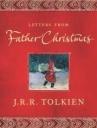
 On behalf of the staff of TheOneRing.net, we’d like to wish you all peace, health and love this holiday season. You may notice that our site has ‘re-skinned’ in time for the holiday with a ‘Letters from Father Christmas’ theme – inspired by the artwork of J.R.R. Tolkien. If you weren’t aware, starting in the early 1920s Tolkien responded to his children’s letters to Father Christmas with notes and drawings. He introduced the chores of packing the many packages, the mishaps of weather and the mischief of his faithful helper, North Polar Bear, to his sons and daughter. These letters are lovely reproduced in ‘Letters from Father Christmas,’ a wonderful little book published by Houghton Mifflin. Consider picking it up sometime if you have not already! [Purchase at Amazon]
Category: J.R.R. Tolkien

From The Tolkien Society: At 9pm (local times) on January 3rd fans around the world are invited to raise a glass and toast J.R.R. Tolkien’s Birthday. The Tolkien Society has some webpages where fans across the globe can let other fans know where they’ll be celebrating if they’re hosting a party, or just what particular tipple they’ll be raising. Fans will be able to check the webpage and see who is celebrating where and if they wish to get in touch and join in. Continue reading “Tolkien Birthday Toast Press Release”
 Ataahua writes: I just checked out the latest issue of Locus magazine, and ‘The Children of Hurin’ has now been in the top-ten list of hardback sales for the fifth month in a row, take a look at the list here.
 There is magic in the last line of The Lord of the Rings. To recap: the stolidly courageous Sam Gamgee, having watched his best friend, Frodo Baggins, sail towards the Grey Havens and into a kind of death, is left to walk back to the Shire where he finds his wife and children waiting with the promise of a quiet life far from the slaughter of the War of the Ring. J. R. R. Tolkien finishes with the sentence: “‘Well, I’m back,’ he said”. It is a touchingly understated conclusion which returns the prose to the homely simplicity of the inaugural chapters after the archaic epic mode of The Return of the King. However, as Diana Pavlac Glyer tells us in her scholarly and perceptive study The Company They Keep, this is not how Tolkien originally intended to finish his trilogy. He had in mind a further epilogue, set sixteen years after the events of the rest of the book, which would have provided another, superfluous glimpse into Gamgee’s domesticity. In this ultimately excised version, a grey-haired Sam reads stories of his adventures to his children, spinning them tales of wizards and orcs and walking trees. There is even the faint suggestion that Sam has been narrating the story of The Lord of the Rings itself, before, at last, we depart the Shire for good, leaving Sam and Rose in a state of connubial bliss, tale-telling by the fireside.
A Poole bungalow once the home of JRR Tolkien is to be demolished. The bungalow in Lakeside Road was where Tolkien retired with his wife Edith in 1968 after his two best-known works, The Hobbit and the Lord of the Rings trilogy, had already made him famous. An application by Cranbrook Homes (Southern) Ltd for outline planning permission for two four-bed family homes on the site breezed through planning at Poole council on Monday. James Dean, director of Cranbrook Homes said he was not aware of the building’s history. He said: “It’s going to be replaced with two superb contemporary houses. In the light of what you’ve just told me, perhaps one of them should be called Tolkien.” [More]
GJOGV, Faeroe Islands (AP) — It’s just after 9 p.m. when the magic begins. The late-setting sun breaks through purple rain clouds to drape the rugged island of Eysturoy in a golden shimmer. A perfect rainbow arches over the Slaettaratindur mountain. Offshore, a wild ocean launches ferocious swells against the Giant and the Witch, two spectacular rock pillars that protrude from the surf like craggy teeth. All that’s missing from the storybook setting is a band of orchs or goblins crawling out from behind a rock, or a pipe-smoking hobbit emerging from one of the turf-roofed houses. The Lord of the Rings analogy is never far away in the Faeroe Islands, a barren and wind-swept archipelago whose volcanic peaks shoot out of the Atlantic Ocean halfway between Iceland and Norway. Local legend even claims the ring of power is hidden here. [More]